⏱ 6 min read
Recommended Reading
Executive summary
Governance traceability connects “what we believe” (principles) to “what we run” (platform configuration and contracts). TOGAF provides architecture governance constructs; Kafka and Schema Registry provide enforcement points for event contracts; ADRs provide decision narratives; and lineage standards provide operational proof and impact analysis. EA governance checklist
- Traceability chain design
- Enforcement points: schema compatibility and topic policies
- Evidence: baselines/audit logs and lineage metadata

- TOGAF compliance review concept.
- ADR practice.
The five-link governance chain

Architecture governance for Kafka is only effective when there is an unbroken traceability chain from abstract principles to concrete runtime configuration. Each link in the chain must be explicit, documented, and verifiable. ArchiMate for architecture governance
Link 1: Architecture Principle. "All inter-service communication must be asynchronous and event-driven for domains with eventual consistency tolerance." This is a strategic decision modeled as an ArchiMate Principle element, approved by the architecture board.
Link 2: Design Standard. The principle generates specific standards: "Domain events must use Avro serialization with backward-compatible schema evolution. Topic names must follow domain.entity.action convention. Partition count must be justified based on throughput requirements. Retention must meet regulatory minimums per data classification."
Link 3: Kafka Configuration. Standards translate to concrete configuration: value.serializer=io.confluent.kafka.serializers.KafkaAvroSerializer, schema.registry.url=https://registry.internal:8081, topic naming validated by a pre-creation hook, partition count documented in the topic request form.
Link 4: Runtime Enforcement. Configuration is enforced at runtime: the Schema Registry rejects non-backward-compatible changes, a Kafka AdminClient hook validates topic names before creation, partition count is reviewed in the architecture review board for topics expecting >10K messages/sec.
Link 5: Compliance Evidence. Evidence is generated automatically: Schema Registry logs show all schema changes and compatibility checks. Topic creation audit logs show who created what and when. Consumer group monitoring shows active consumption. This evidence feeds back into the architecture repository as compliance status on each Kafka-related element.
Governance layers: from abstract to concrete
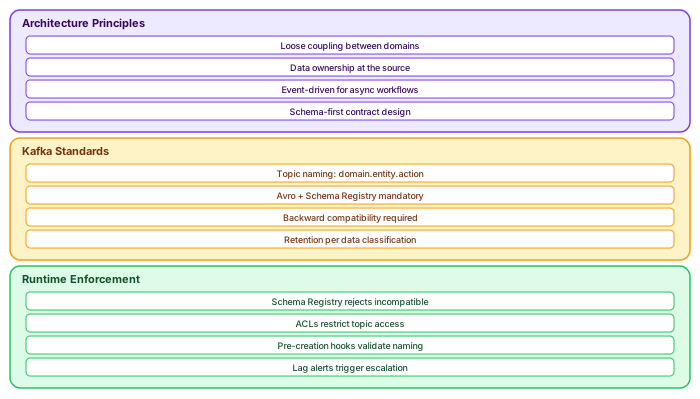
The gap between architecture principles and running Kafka clusters is where governance breaks down. Principles say "loose coupling" — but what does that mean for topic partition keys? Standards say "backward compatible" — but who enforces it at 2 AM when a developer pushes a schema change? Closing this gap requires three explicit layers with clear ownership. ArchiMate modeling standards
Architecture principles (owned by EA team): These are strategic choices modeled as ArchiMate Principle elements in the repository. "Loose coupling between domains" means each domain publishes events without knowing who consumes them. "Data ownership at the source" means the producing team owns the schema, documentation, and quality. "Event-driven for asynchronous workflows" means Kafka is the default for fire-and-forget communication — REST is reserved for synchronous request-reply. "Schema-first contract design" means the schema is designed, reviewed, and registered before the first line of producer code is written.
Kafka standards (owned by platform team + EA): Principles translate to specific, testable standards. Topic naming follows domain.entity.action (e.g., payments.transaction.authorized). Avro serialization with Schema Registry is mandatory — no JSON without schema. Backward compatibility is the default compatibility mode; teams that need forward or full compatibility must justify it in the architecture review. Retention periods are set per data classification: 7 days for operational events, 1 year for audit events, 6 years for regulated financial events.
Runtime enforcement (owned by platform team): Standards are enforced at deployment time: the Schema Registry is configured to reject non-backward-compatible changes (no human in the loop needed). Kafka AdminClient hooks validate topic names before creation — topics that do not match the naming pattern are rejected. ACLs restrict which service accounts can produce to or consume from which topics. Consumer lag monitoring triggers alerts when a consumer falls behind, escalating to the owning team.
Auditing the governance chain
The governance chain produces auditable evidence at every layer. Architecture principles are versioned in the EA repository with approval records. Standards are documented as architecture contracts. Runtime enforcement generates logs: every schema registration, every topic creation, every ACL change. This evidence feeds compliance reporting — when a regulator asks "how do you ensure data contracts are maintained?", the answer traces from the principle through the standard to the runtime enforcement log, with no gaps. Sparx EA guide
# Verify governance chain for a specific topic
# Step 1: Check topic naming compliance
kafka-topics --describe --topic payments.transaction.authorized   --bootstrap-server kafka:9092

# Step 2: Check schema registration
curl -s https://registry:8081/subjects/payments.transaction.authorized-value/versions

# Step 3: Check ACLs
kafka-acls --list --topic payments.transaction.authorized   --bootstrap-server kafka:9092
When governance breaks: common failure patterns
Even well-designed governance chains break in predictable ways. Knowing these patterns enables proactive prevention. Sparx EA governance best practices
Principle-standard gap: Architecture principles exist but are never translated into testable standards. "Loose coupling" remains an aspiration rather than a measurable configuration. Fix: every principle must produce at least one testable standard within 30 days of adoption, or it is removed from the principles catalog.
Standard-enforcement gap: Standards exist but are not enforced at runtime. Developers know the naming convention but create non-compliant topics because nothing stops them. Fix: every standard must have an automated enforcement mechanism (pre-creation hooks, Schema Registry rules, CI/CD checks). Standards enforced only by human review are standards enforced inconsistently.
Enforcement-evidence gap: Runtime enforcement works but produces no evidence. When the auditor asks "how do you ensure schema compatibility?", the team says "the Schema Registry handles it" but cannot produce logs showing what was validated and when. Fix: every enforcement mechanism must log its decisions in a format that feeds compliance reporting.
Evidence-principle gap: Compliance evidence exists but is never reviewed against the original principles. Nobody checks whether the enforcement mechanisms actually satisfy the principles they implement. Fix: quarterly governance reviews compare enforcement outcomes against principle intent, identifying gaps where the automated checks miss the spirit of the principle.
If you’d like hands-on training tailored to your team — Sparx Enterprise Architect, BPMN, SysML, Apache Kafka or the Archi tool — or modelling coaching in ArchiMate and TOGAF-aligned governance, you can reach us via our contact page.
Frequently Asked Questions
What is architecture governance in enterprise architecture?
Architecture governance is the set of practices, processes, and standards that ensure architecture decisions are consistent, traceable, and aligned to organisational strategy. It typically includes an Architecture Review Board (ARB), architecture principles, modeling standards, and compliance checking.
How does ArchiMate support architecture governance?
ArchiMate supports governance by providing a standard language that makes architecture proposals comparable and reviewable. Governance decisions, architecture principles, and compliance requirements can be modeled as Motivation layer elements and traced to the architectural elements they constrain.
What are architecture principles and how are they modeled?
Architecture principles are fundamental rules that guide architecture decisions. In ArchiMate, they are modeled in the Motivation layer as Principle elements, often linked to Goals and Drivers that justify them, and connected via Influence relationships to the constraints they impose on design decisions.