⏱ 22 min read
Most enterprise systems lie.
Not maliciously. Not even carelessly. They lie because they flatten time into a single row, a current status, a latest balance, a final answer. They take a rich sequence of business facts—what happened, when it happened, when we learned about it, whether we later corrected it—and squeeze it into “the state.” Then, months later, someone asks a perfectly reasonable question: What did we believe on March 3rd? Or: Why did this customer receive that letter? Or the most expensive one of all: Can you reconstruct the chain of decisions that led to this loss?
At that point, the system shrugs. The database knows what is true now. The business needed to know what was true then.
Temporal modeling is the discipline of refusing to throw time away. In event-driven systems, especially those built around Kafka, streams, and microservices, that discipline becomes both possible and dangerous. Possible, because events naturally preserve change over time. Dangerous, because too many teams stop at “we have events” and assume they have a temporal model. They do not. An append-only log is not automatically a business timeline. A Kafka topic is not a domain model. And a projection is not the truth; it is an interpretation. event-driven architecture patterns
This article is about building systems that treat time as a first-class concern. Not as an afterthought for audit. Not as a compliance tax. As architecture.
The central idea is straightforward: model domain events as time-stamped business facts, preserve them on a timeline, and derive projections for operational use. But the hard part is not the mechanics. It is choosing the right notion of time, preserving domain semantics, handling corrections, migrating from CRUD-centric systems without breaking the business, and accepting that projections will sometimes be wrong until they are reconciled.
That is where architecture earns its keep.
Context
Event-driven systems are usually sold on decoupling, scalability, and responsiveness. Those are fine benefits. But in large enterprises, the real attraction is often simpler: events let us preserve causality. They let us answer not just what is the state? but how did it become the state?
Consider a large insurer. A claim is filed on Monday, enriched on Tuesday, partially denied on Wednesday, reopened on Friday after additional evidence, and corrected the following week because one service processed a stale message. A traditional service with a mutable claim_status field can tell you that the claim is “Under Review.” It cannot naturally explain the path. A temporal model can.
This matters because enterprise domains are soaked in time:
- orders are placed, authorized, shipped, returned, and refunded;
- loans are originated, repriced, delinquent, restructured, and charged off;
- employee records are effective from one date, recorded on another, and corrected on a third;
- inventory exists physically, is reserved contractually, and becomes visible operationally at different moments.
Most of these domains do not have one timeline. They have several. There is event time, processing time, effective time, settlement time, posting time, and sometimes legal time. If the architecture ignores that, the software will eventually encode temporal semantics in ad hoc flags, hidden batch jobs, and “special logic” that nobody wants to touch.
You can always tell when a system has lost the plot. Teams start adding columns like is_current, version, corrected_flag, backdated, and reprocess_indicator. These are the archaeological layers of time being denied.
Domain-driven design gives us a better stance. The point is not to collect every timestamp available. The point is to model the domain’s notion of change and make its language explicit. A payment “authorized” is not the same as a payment “captured.” A policy “effective from” is not the same as “entered into the system.” A shipment “delivered” according to a carrier scan may not be “accepted” in the customer service domain. Temporal architecture begins in semantics, not in infrastructure.
Problem
The problem sounds technical but is really conceptual: how do you preserve a trustworthy business timeline while still delivering fast, useful, current-state views?
If you only store current state, you lose history, causality, and explainability.
If you only store raw events, you burden every downstream consumer with rebuilding state, understanding corrections, and interpreting half-finished business meaning.
If you let every service invent its own event vocabulary and time semantics, your “event-driven architecture” becomes a distributed misunderstanding engine.
And if you attempt to retrofit temporal thinking after the fact, you discover the enterprise’s least favorite truth: yesterday’s shortcuts become tomorrow’s controls issue.
Three questions expose the problem quickly:
- Can you reproduce a decision exactly as the system saw the world at that moment?
- Can you distinguish between when something happened and when your system learned about it?
- Can you correct history without pretending the original event never existed?
Most organizations answer “sort of,” which usually means “no.”
The difficulty is amplified in Kafka-based microservice landscapes. Kafka gives you durable ordered logs per partition, consumer groups, replay, compaction options, and excellent tooling for stream processing. But Kafka does not define your business invariants. It does not decide whether a correction should be modeled as a compensating event or as a superseding event. It does not tell you whether “OrderCancelled” is legal after “OrderShipped.” It will faithfully preserve nonsense if you publish nonsense.
That is why temporal modeling must sit above the broker. The broker is plumbing. Important plumbing, certainly. But no architect should confuse the pipe with the water.
Forces
Temporal modeling in event-driven systems is a balancing act among forces that pull in different directions.
Business traceability vs operational simplicity
The business wants lineage, auditability, replay, and investigation support. Operations teams want compact data models, clear APIs, and low-latency queries. These goals are not enemies, but they do create tension. A complete timeline is usually not the best format for serving a customer dashboard.
Domain truth vs integration convenience
Domain events should express meaningful business facts. Integration teams often prefer generic “entity changed” events because they are quick to publish from CRUD systems. That shortcut is seductive and corrosive. CustomerUpdated tells you almost nothing. AddressChanged, CreditLimitApproved, or CustomerSuspended carry semantics. Those semantics determine valid projections and reconciliation rules.
Event time vs processing time
In distributed systems, messages arrive late, out of order, duplicated, or after correction. The business often cares about event time—when the thing happened. Infrastructure naturally observes processing time—when we saw it. Sometimes both matter. Often they must both be modeled explicitly.
Immutable facts vs corrective business reality
Architects love immutable logs because they are clean. Businesses love corrections because reality is messy. The result is a subtle discipline: preserve original events immutably, but represent corrections as new facts in the timeline. Never erase; interpret.
Local autonomy vs enterprise consistency
Microservices encourage bounded contexts and local ownership. Good. But temporal semantics that cross contexts still need governance. If one service uses effective dates, another uses processing timestamps, and a third emits only snapshots, enterprise reporting becomes a game of forensic reconstruction. EA governance checklist
Replay power vs replay danger
Replay is one of the superpowers of event-driven systems. It is also a loaded weapon. Rebuilding projections can recover from bugs and create entirely new read models. It can also trigger duplicate side effects, saturate downstream stores, and produce states that differ subtly from the original run because the external world has changed.
These are not reasons to avoid temporal modeling. They are reasons to treat it seriously.
Solution
The pragmatic solution is to separate three concerns:
- The event timeline as the durable record of domain facts.
- Temporal semantics that define what each timestamp means and how corrections work.
- Projections that materialize views for operational, analytical, and decisioning use.
This is not just event sourcing, though it overlaps with it. Full event sourcing says the event stream is the source of truth for an aggregate and current state is reconstructed from events. Temporal modeling is broader. You can use event-sourced aggregates in some bounded contexts and still maintain event timelines plus projections elsewhere. The key architectural commitment is that time and business change are explicit, not incidental.
A good temporal event model usually includes:
- aggregate or entity identity;
- event type with business meaning;
- event time: when the business fact occurred;
- recorded time: when the event was captured by the system;
- effective time, where relevant: when the fact should be considered applicable in the domain;
- causation/correlation identifiers for tracing process chains;
- version or sequence metadata to maintain local ordering;
- correction or supersession semantics, if the domain permits revisions.
The subtle but crucial move is this: projections are disposable, timelines are not.
A projection is a deliberately biased view built for a purpose: current balance, shipment status, fraud score input, claims dashboard, regulatory extract. It can be rebuilt. It can be wrong temporarily. It can evolve independently. But the timeline must remain stable enough to replay and reinterpret.
That leads to an architecture pattern that works well in enterprises:
- publish semantically rich domain events;
- retain them durably in Kafka or an event store;
- build one or more projections from the timeline;
- use reconciliation to compare projections against source timelines and external systems;
- apply progressive migration so legacy CRUD systems can coexist while the temporal core grows.
Here is the simplest conceptual picture.
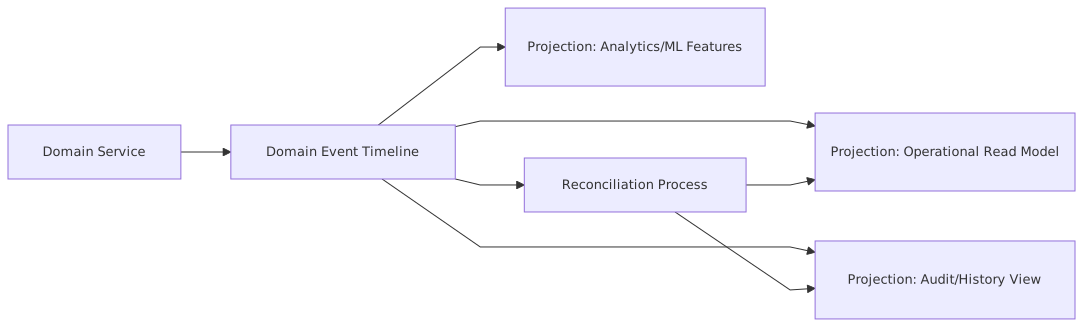
This pattern sounds obvious. It is not common enough. Too many implementations either over-index on the log and under-design the domain, or build projections with no recovery strategy.
The better approach is opinionated:
- Events must be named in the ubiquitous language of the bounded context.
- Every event must carry explicit time semantics.
- Corrections are new events, not silent updates.
- Projections are optimized for use, not worshipped as canonical truth.
- Reconciliation is built in from the start, not added after the first audit finding.
That last point deserves emphasis. In real enterprises, sooner or later some projection drifts. A consumer lags. A transformation bug sneaks in. A partner sends a duplicate. A service deploy changes interpretation. If your architecture has no reconciliation loop, your confidence in “eventual consistency” is merely a form of optimism.
Architecture
A robust temporal architecture in an event-driven estate usually spans several layers.
1. Bounded contexts and domain timelines
Start with domain-driven design. Each bounded context defines its own facts and invariants. Orders, billing, fulfillment, and customer support are not different tables of the same truth. They are different models of reality. The events emitted by each context should reflect that.
For example:
- Ordering emits
OrderPlaced,OrderLineAdded,OrderCancelled. - Payments emits
PaymentAuthorized,PaymentCaptured,RefundIssued. - Fulfillment emits
PickStarted,ShipmentDispatched,DeliveryConfirmed.
Do not publish generic row mutations from a shared schema and call it a domain model. That is database-driven integration wearing a fashionable hat.
2. Event timeline storage
Kafka is often the practical choice for the enterprise timeline backbone. It provides durable append-only logs, partitioning, replay, consumer isolation, retention policies, and integration with stream processing. For many teams, Kafka plus a schema registry and disciplined event versioning is sufficient. In some domains, a dedicated event store may complement Kafka, especially when aggregate-specific retrieval or strict event stream semantics are needed.
The architectural point is not whether the timeline lives in Kafka alone or Kafka plus another store. The point is that the timeline is durable, replayable, and semantically governed.
3. Projection pipelines
Projections transform timelines into useful models:
- current-state tables for APIs;
- temporal history tables for case investigation;
- feature stores for machine learning;
- search indexes;
- data warehouse facts.
Some projections are streaming and near-real-time. Others are batch-derived. Both are acceptable. The mistake is pretending they have the same consistency characteristics.
A current customer account view, for instance, may combine:
- the latest posted ledger events,
- pending authorization events,
- effective-dated fee corrections,
- a cached KYC status from another context.
That view is not “the source of truth.” It is a working surface assembled from several truths.
4. Temporal query patterns
A strong architecture supports more than “latest state.”
Common temporal query modes include:
- as-is now: current projection;
- as-of event time: reconstruct what had happened by a point in business time;
- as-known-at processing time: reconstruct what the system knew at that moment;
- effective-period queries: retrieve facts valid over a date range;
- delta queries: what changed between two points.
The distinction between “as-of” and “as-known-at” matters deeply in regulated and operationally sensitive domains. If a late-arriving event happened last week but was only processed today, those two answers differ.
5. Reconciliation and repair
A mature temporal architecture assumes divergence and equips itself to find and fix it. Reconciliation compares:
- projection state against replayed timeline-derived state;
- internal views against external sources of record;
- aggregate invariants across bounded contexts where contractual consistency exists.
Repair may involve:
- replaying a projection from an offset;
- publishing compensating or corrective events;
- quarantining malformed events;
- manually adjudicating business exceptions.
This architecture is easier to understand in motion.
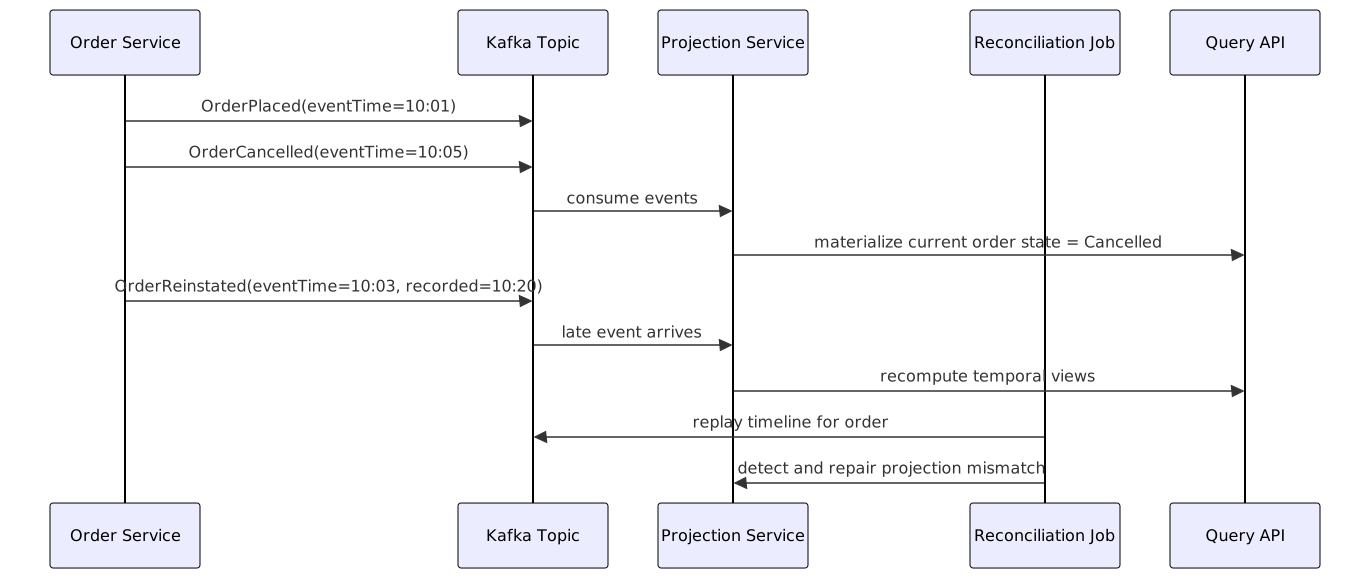
This is where teams discover whether they really modeled time or merely timestamped messages.
6. Event schema evolution
Enterprise systems live long enough to regret their first event contracts. Schema evolution is unavoidable. Additive changes are easiest. Semantic changes are harder. Renaming fields is trivial compared with changing the meaning of an event.
An event called OrderUpdated is evolution poison because every downstream consumer infers its own meaning. By contrast, ShippingAddressChanged can evolve with much less ambiguity. Domain specificity is not verbosity. It is future-proofing.
Migration Strategy
Most enterprises do not begin with a clean event timeline. They begin with line-of-business systems, relational databases, integration middleware, nightly batches, and APIs that expose whatever the tables happened to contain in 2014.
So migration matters more than greenfield elegance.
The right strategy is usually progressive strangler migration. Not a heroic rewrite. Not “big bang event sourcing.” A sequence of deliberate steps that preserves business continuity while increasing temporal fidelity over time.
Step 1: Identify high-value temporal domains
Do not start everywhere. Start where time matters enough to justify the investment:
- claims and payments;
- orders and fulfillment;
- pricing and entitlements;
- customer commitments and compliance decisions.
A good selection criterion is this: choose a domain where “why did this happen?” is both common and expensive.
Step 2: Capture change events from legacy systems
Initially, you may publish events from change data capture, outbox patterns, or application hooks. This is acceptable as an on-ramp. But be clear-eyed: raw database changes are not the destination. They are scaffolding.
If the legacy policy admin system updates policy_status = ACTIVE, your first emitted event may be a coarse PolicyStatusChanged. Fine. But over time, enrich and refactor toward domain events like PolicyBound, PolicyReinstated, or PolicyLapsed.
Step 3: Build projections before replacing systems of record
A common migration mistake is trying to replace the write model too early. Instead, first build projections that serve reporting, inquiry, and selected operational workflows. This proves the timeline is useful and exposes semantic gaps before the core transaction path depends on it.
Step 4: Introduce reconciliation loops
Once projections matter operationally, reconciliation becomes non-negotiable. Compare legacy state against event-derived state. Expect differences. Some will be defects in your pipeline. Some will reveal hidden legacy behavior. These discoveries are not migration failures; they are the work.
Step 5: Shift source-of-truth boundaries gradually
As confidence grows, move selected decisions or writes into services built around temporal models. Keep boundaries crisp. Maybe order history and customer notifications move first, while billing remains legacy-backed. Later, authorization rules or inventory reservation may move.
Step 6: Retire legacy state dependencies carefully
Only when downstream consumers rely on projections and replay paths are proven should you retire direct dependence on legacy tables. Even then, keep historical access paths long enough to support dispute resolution and migration auditability.
The migration path often looks like this.
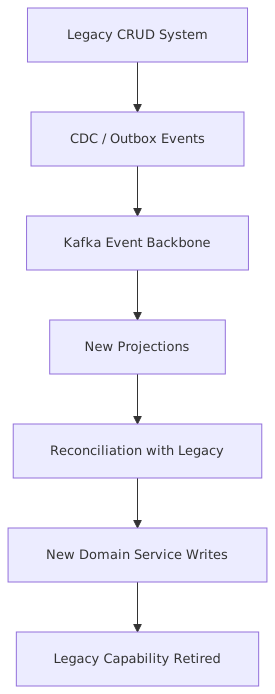
Progressive strangler migration works because it acknowledges a hard truth: temporal architecture is as much about learning domain semantics as it is about technology. You will not get those semantics right by decree. You get them by exposing them to real workflows, mismatches, and edge cases.
Enterprise Example
Take a multinational retail bank modernizing its card disputes platform.
The legacy estate had a case management application, a payment authorization platform, a settlement system, and several regional customer service tools. Each had a partial view of the dispute lifecycle. The inquiry screen showed the latest status, but when regulators asked why a provisional credit was issued and later reversed, analysts had to inspect five systems and two spreadsheets.
The bank introduced a dispute bounded context with a temporal event model. Key domain events included:
DisputeOpenedMerchantEvidenceReceivedProvisionalCreditIssuedChargebackSubmittedDisputeResolvedInCardholderFavorProvisionalCreditReversedDisputeReopened
Each event carried:
- dispute ID,
- card account reference,
- event time,
- recorded time,
- initiating actor,
- causation ID,
- region and scheme metadata,
- effective date when relevant.
Kafka topics became the event backbone. A stream processing layer built several projections:
- Current dispute state projection for customer service.
- Regulatory timeline projection showing what was known and when.
- Financial exposure projection for risk and reserve calculations.
- SLA breach projection to identify aging disputes.
At first, the legacy case management system still owned writes. Events were emitted through an outbox pattern. The new projections were read-only and used by analysts. Within three months, the bank discovered dozens of silent state transitions that had never been visible before—especially reversals and reopenings caused by external network messages arriving after regional cutoffs.
Then reconciliation began. Every night, the bank compared the event-derived current state with the legacy dispute tables and the settlement ledger. Mismatches were categorized:
- pipeline defects,
- duplicate upstream messages,
- missing mappings from one region,
- genuine business anomalies.
This mattered. One region was issuing provisional credit before all required evidence checks because a batch feed arrived after local midnight and the old system interpreted dates incorrectly. The current-state database had masked that behavior for years. The timeline made it obvious.
Over time, new write paths moved into the dispute service itself. Customer service remained on a projection, while financial postings still integrated with the old ledger. Eventually, the bank retired large parts of the legacy inquiry stack, but not before proving replay, reconciliation, and correction handling at production scale.
That is the value of temporal modeling in the enterprise. Not elegance for its own sake. Better memory. Better explanations. Fewer expensive surprises.
Operational Considerations
Temporal architecture is unforgiving of operational sloppiness.
Ordering and partition strategy
Kafka preserves order only within a partition. If your projection logic depends on per-aggregate sequencing, partition by aggregate key and make that explicit. Cross-aggregate ordering is generally unattainable and often unnecessary. Design around local timelines, not fantasies of a globally ordered enterprise history.
Idempotency
Consumers must tolerate duplicates. Projection updates should be idempotent or sequence-aware. Side effects triggered by replay need special handling; the safest rule is simple: projections may be replayed, external side effects may not.
Retention and archival
Not every event needs infinite retention in Kafka, but the business timeline needs durable preservation somewhere. Hot retention in Kafka plus archival to object storage or an event repository is a common pattern. Decide based on replay needs, regulatory obligations, and cost.
Monitoring lag and drift
Monitor more than consumer lag. Lag tells you timeliness. It does not tell you correctness. Add drift indicators:
- count mismatches between projection and recomputed state,
- rate of late-arriving events,
- frequency of correction events,
- schema validation failures,
- dead-letter queue growth.
Backfills and replay governance
Rebuilds should be routine, scripted, and isolated. Use versioned projection logic. Tag rebuilds clearly. Avoid replaying into the same sink without a plan for coexistence or cutover.
Security and privacy
Temporal stores are dangerous if they preserve data that should not remain exposed forever. PII handling, field encryption, tokenization, and right-to-erasure obligations must be designed in. Immutable events do not exempt you from legal requirements. Often the answer is to keep sensitive payloads outside the event or encrypt them with erasable keys.
Tradeoffs
Temporal modeling gives you power, but it is not free.
The biggest tradeoff is complexity in exchange for fidelity. You gain traceability, replay, and richer semantics. You also gain multiple time dimensions, projection maintenance, schema discipline, and new failure modes.
Another tradeoff is eventual consistency in exchange for decoupling. Projections are not instantly synchronized. Some business workflows can tolerate that. Some cannot. If a warehouse picker needs a single source of current reservation truth with strict consistency, a temporally derived projection may not be enough on its own.
There is also a tradeoff between semantic richness and publishing cost. Rich domain events require thoughtful modeling and usually changes in source applications. Generic events are cheap now and expensive later. As usual in architecture, you are choosing where to pay.
And then there is replayability versus operational risk. Replay is a superb recovery and migration tool. It also creates blast radius if misused. A projection bug can be fixed with replay; a downstream billing side effect cannot be casually replayed without consequence.
My bias is clear: in domains where history matters, the tradeoffs are worth it. But only if you are disciplined enough to build the operational guardrails.
Failure Modes
Here is how temporal architectures fail in the real world.
1. Event streams without domain meaning
The team emits EntityUpdated from every service and congratulates itself on becoming event-driven. Six months later, every consumer contains custom diff logic and temporal reasoning collapses into application code. This is not temporal modeling. It is distributed CRUD.
2. Projections treated as canonical truth
A search index or read table becomes “the source” because it is convenient. Then drift occurs, replay becomes politically difficult, and the architecture loses the distinction between facts and views.
3. Time semantics left ambiguous
Nobody defines whether timestamps represent event occurrence, ingestion, posting, or effectiveness. Reports disagree, auditors ask hard questions, and every consumer invents its own interpretation.
4. Corrections overwrite history
Operations teams “fix” bad records in place. The original events remain hidden or are deleted. The timeline becomes cosmetically clean and analytically useless.
5. Replay re-triggers side effects
A consumer that sends emails, posts ledger entries, or calls payment gateways is replayed as if it were a pure projection. Chaos follows.
6. Migration stalls in the middle
The organization publishes low-quality events from legacy systems, builds a few dashboards, and never evolves toward real domain semantics. The result is extra infrastructure without improved business understanding.
These are all preventable. But only if the architecture treats temporal modeling as a socio-technical system, not a messaging upgrade.
When Not To Use
Temporal modeling is not a universal hammer.
Do not use it heavily where the domain has little historical value and the cost of reconstruction exceeds the benefit. A simple reference data service for country codes probably does not need event timelines and replayable projections.
Do not force full temporal architectures into low-change administrative domains just because Kafka is available. Plenty of enterprise capabilities are well served by conventional CRUD plus ordinary audit fields.
Be cautious when:
- strict transactional read-after-write consistency is central and cannot be relaxed;
- the domain language is immature and teams are still arguing about basic concepts;
- operational maturity is too low to support replay, reconciliation, and schema governance;
- the real need is data integration, not temporal reasoning.
In short: use temporal modeling when time is part of the business meaning, not merely part of the infrastructure.
Related Patterns
Temporal modeling sits near several related patterns but is not identical to them.
Event Sourcing
A strong fit for aggregates where state reconstruction from events is natural and valuable. But not every temporal architecture needs every aggregate to be event-sourced.
CQRS
Very compatible. Commands change the domain; queries hit projections. Temporal modeling often gives CQRS the historical depth it otherwise lacks.
Outbox Pattern
A practical migration and reliability mechanism for publishing events from transactional systems. Excellent as a bridge, insufficient as a domain model on its own.
Change Data Capture
Useful for bootstrapping event streams from legacy stores. Good servant, poor master.
Bitemporal Modeling
Essential in domains where valid time and transaction time both matter. Insurance, finance, HR, and policy administration often need this explicitly.
Sagas and Process Managers
Helpful when business processes span contexts over time. Their state is often easier to reason about when built atop explicit domain timelines.
Summary
Temporal modeling is what happens when an architecture stops pretending the present is enough.
In event-driven systems, the combination of timelines and projections lets us preserve domain facts, derive useful views, replay history, explain decisions, and correct mistakes without erasing them. But this only works when the model starts with domain semantics, not transport mechanics. Kafka can carry the timeline; it cannot define it.
The winning architecture is usually straightforward to describe and hard to practice well:
- model semantically rich domain events inside bounded contexts;
- preserve explicit time semantics;
- build projections for specific needs;
- assume drift and reconcile deliberately;
- migrate progressively with a strangler approach;
- treat replay as a tool, not a toy.
The most important design decision is not whether you use Kafka, event sourcing, or a particular stream processor. It is whether your system records the business as a timeline of meaningful facts or reduces it to mutable snapshots and vague explanations.
Enterprises pay dearly for bad memory.
Temporal modeling is how you build a system that remembers.
Frequently Asked Questions
What is enterprise architecture?
Enterprise architecture aligns strategy, business processes, applications, and technology in a coherent model. It enables impact analysis, portfolio rationalisation, governance, and transformation planning across the organisation.
How does ArchiMate support architecture practice?
ArchiMate provides a standard language connecting strategy, business operations, applications, and technology. It enables traceability from strategic goals through capabilities and services to infrastructure — making architecture decisions explicit and reviewable.
What tools support enterprise architecture modeling?
The main tools are Sparx Enterprise Architect (ArchiMate, UML, BPMN, SysML), Archi (free, ArchiMate-only), and BiZZdesign. Sparx EA is the most feature-rich, supporting concurrent repositories, automation, scripting, and Jira integration.