⏱ 19 min read
Most enterprise architecture diagrams about data are fiction.
That sounds harsh, but it’s true. I’ve seen beautifully polished “target state” views with immaculate boxes, pristine arrows, and exactly zero value for the people who actually have to build and run the thing. Especially when Kafka enters the picture. Suddenly every architect becomes a poet of “event-driven ecosystems,” and nobody can answer the basic questions: who owns the data, where does trust come from, what happens when IAM fails, which cloud service is actually in scope, and which business capability is paying for this mess?
That’s where ArchiMate can be incredibly useful. Or incredibly useless.
Used well, ArchiMate gives you a way to model data architecture and Kafka-based systems so business, security, platform, and delivery teams can all speak about the same reality. Used badly, it becomes another enterprise artifact that looks serious and helps no one.
My strong opinion: ArchiMate is not valuable because it is formal. It is valuable because it forces architectural honesty. If your Kafka landscape, IAM model, cloud deployment, and data ownership cannot be expressed clearly in ArchiMate, the problem is usually not ArchiMate. The problem is your architecture is still half-invented.
The simple version first: what ArchiMate does for data architecture
Let’s make this plain early.
ArchiMate is a modeling language for enterprise architecture. It helps describe how business processes, applications, data, technology, and strategy fit together.
For data architecture, ArchiMate helps you show:
- what data exists
- who uses it
- which applications create or consume it
- where it is stored or moved
- how it supports business capabilities
- what technology runs it
For Kafka systems, ArchiMate helps you model:
- event producers and consumers
- topics and event streams
- schemas and data objects
- Kafka clusters and cloud services
- IAM and trust relationships
- operational dependencies and ownership boundaries
That’s the SEO-friendly answer. Accurate enough. But the real value starts when you stop using ArchiMate as a diagramming tool and start using it as a discipline.
Why Kafka breaks bad architecture faster than batch systems ever did
Kafka is often described as “just a messaging platform.” That’s technically true and architecturally misleading.
In enterprises, Kafka becomes a data distribution backbone, an integration layer, a near-real-time analytics feed, and often a shadow system of record for state transitions. People say they are “adopting event streaming,” but what they are really doing is changing how authority, latency, ownership, auditability, and trust work across the enterprise.
And this is exactly why data architecture around Kafka often goes off the rails.
Common pattern:
- The platform team thinks in clusters, topics, ACLs, and throughput.
- The application team thinks in producers and consumers.
- The data team thinks in pipelines, lineage, and semantics.
- The IAM team thinks in service identities, federation, and secrets.
- The business thinks none of this should delay product delivery.
Without a common architectural language, everyone optimizes their own slice and the enterprise gets accidental complexity.
ArchiMate helps because it lets you model multiple layers together:
- business layer
- application layer
- technology layer
- motivation and strategy elements
- implementation and migration views
That matters. Kafka is never just technology. It is also operating model, ownership model, trust model, and data contract model.
The mistake people make: modeling Kafka as infrastructure only
This is probably the most common architectural mistake.
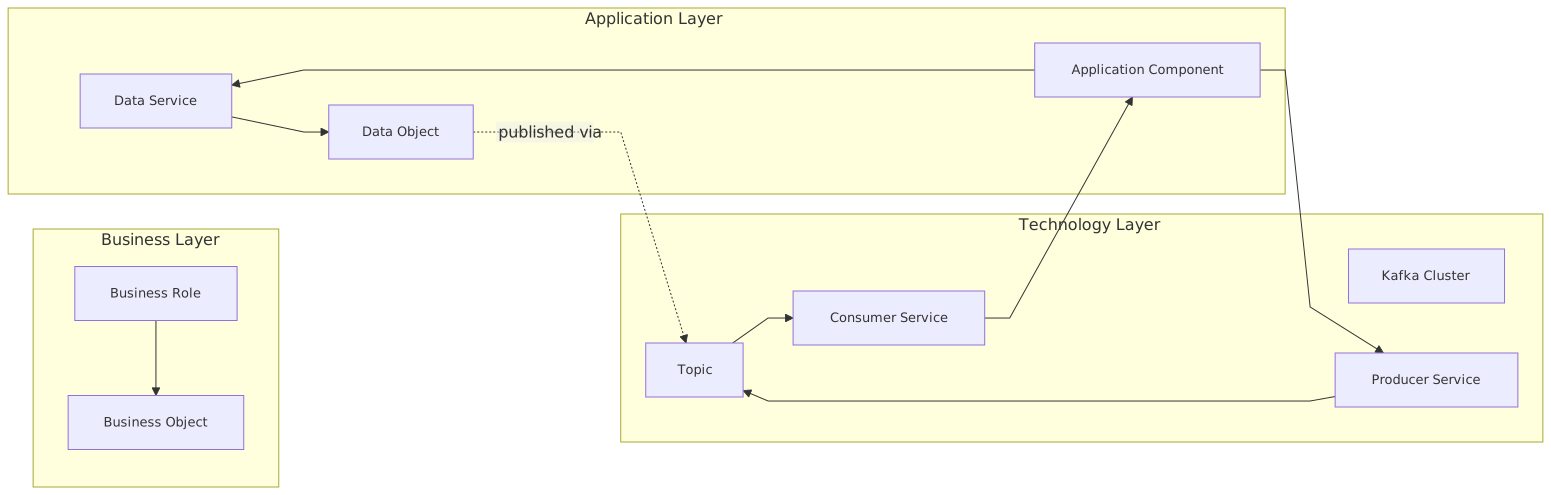
Architects draw:
- Kafka Cluster
- Producer App
- Consumer App
- Topic
- maybe Schema Registry
- maybe some cloud icon
And then they call it “data architecture.”
No. That’s a technology sketch.
A real data architecture for Kafka has to answer at least these questions:
- What business event is represented?
- Who owns the event definition?
- What data object or business object is changing?
- What identity is allowed to publish or consume?
- What is authoritative: the source system, the topic, or a downstream materialized view?
- What are the retention, replay, and compliance implications?
- What cloud or platform boundary matters operationally and legally?
- Which capability or value stream depends on this event stream?
ArchiMate gives you constructs to answer those questions across layers. Not perfectly. ArchiMate is not magic. But it is much better than freehand architecture mythology. ArchiMate modeling guide
How I think about ArchiMate for Kafka and data architecture
I use a simple rule:
Model four things, always: meaning, movement, control, and runtime.
1. Meaning
This is the semantic layer.
What does the event mean? Is CustomerAddressChanged a business event, a technical CDC event, or a convenience integration artifact? Those are not the same thing, and pretending they are the same creates long-term chaos.
In ArchiMate, this usually means linking:
- Business Object for the business concept
- Data Object for application-level representation
- Business Event or application behavior where appropriate
- Application Service exposing or consuming information
If all you model is a topic called customer.events.v2, you are not modeling architecture. You are modeling a string.
2. Movement
This is the flow layer.
How does data move from source to consumers? Through Kafka topics, stream processing, connectors, APIs, storage sinks, data lake ingestion, fraud engines, customer notification services, and so on.
In ArchiMate, this often includes:
- Application Component for producer/consumer services
- Data Object for event payloads
- Application Interface or service interaction
- Technology Service or Node/System Software for Kafka platform services
- Path/Communication Network if network context matters
3. Control
This is where most diagrams become suspiciously vague.
Who is allowed to publish? Who can read PII? Which service principal is mapped to which workload identity in cloud IAM? Is access topic-based, environment-based, domain-based? Are there policy enforcement points? Is encryption managed centrally? Is there schema governance? ArchiMate for governance
For this, ArchiMate can represent:
- Business Role and Actor for ownership and governance
- Application Component for IAM services
- Technology Service for identity federation, secret management, key management
- Constraint, Requirement, and Principle for policies
- relationships showing serving, assignment, access, and realization
This is where architecture becomes real. Kafka without IAM architecture is not enterprise architecture. It’s a demo.
4. Runtime
What actually runs where?
On-prem Kafka? Confluent Cloud? AWS MSK? Azure Event Hubs with Kafka protocol? Hybrid with private networking? Separate clusters by region? Shared platform? Dedicated regulated workloads? DR topology?
In ArchiMate:
- Node, Device, System Software, Technology Service
- deployment relationships
- cloud landing zones and network boundaries
- implementation/migration work packages if you are planning transitions
This matters because many “logical” Kafka architectures collapse when they hit cloud networking, IAM federation, cost allocation, or cross-region replication requirements.
A practical mapping: ArchiMate concepts for Kafka and data architecture
Here’s a table I’ve found useful in real work.
Notice what’s missing: “topic” as the center of the universe.
That’s deliberate. In implementation, topics matter a lot. In architecture, topics are important but not primary. The primary concern is the contract and the operating model around information exchange.
This is a contrarian point some engineers won’t love. But it holds up. Topic names are implementation details unless tied to business meaning, ownership, and policy.
Real architecture work: how this actually gets used
Let’s leave theory for a minute.
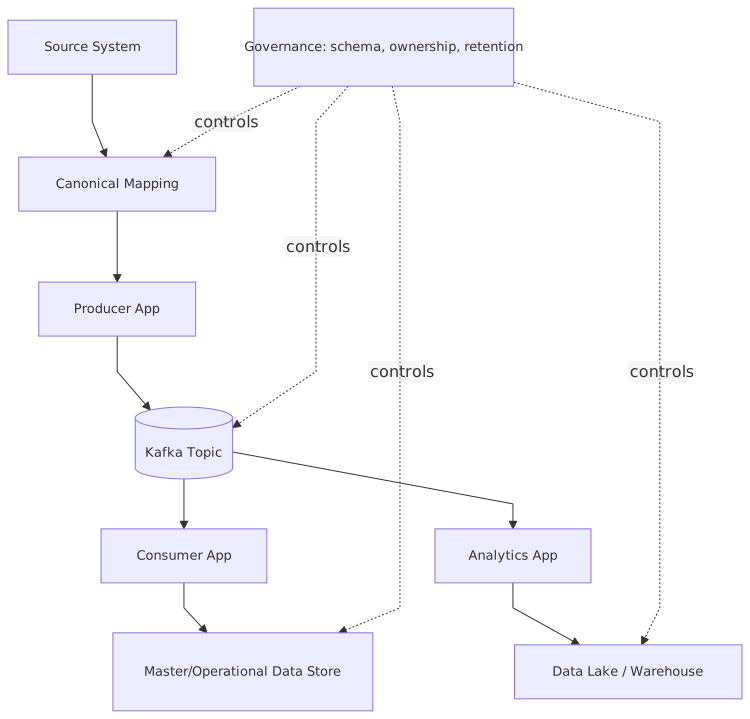
When I use ArchiMate in enterprise data architecture involving Kafka, I usually create three core views and sometimes a fourth.
View 1: Business-to-information view
This shows:
- business capabilities
- value streams or major processes
- business objects
- data ownership domains
- key events that matter to the business
Example in banking:
- Capability: Retail Account Management
- Capability: Fraud Detection
- Business Object: Customer
- Business Object: Payment
- Business Event: Payment Initiated
- Business Event: Customer KYC Updated
This view is for executives, product leads, risk, and domain owners. It is intentionally light on platform detail.
View 2: Application and event interaction view
This shows:
- source applications
- Kafka producers/consumers
- event contracts
- stream processors
- APIs where they coexist
- downstream analytics or operational data stores
This is where teams finally see that Kafka is not replacing everything. It sits alongside APIs, databases, batch interfaces, and data lake ingestion. Real enterprises are hybrid, and pretending otherwise is childish.
View 3: Security and platform control view
This is often the most neglected and the most important.
It shows:
- IAM provider
- service identities
- certificate or token flow
- topic/domain authorization model
- schema governance
- secrets management
- cloud network boundaries
- key management and encryption services
This is the diagram auditors, security architects, and platform engineers actually care about when things get serious.
View 4: Migration roadmap
Optional, but often necessary.
It shows:
- current-state MQ or batch integrations
- transitional coexistence
- target Kafka platform
- work packages
- sequencing constraints
- organizational changes
Most enterprises don’t move from “legacy integration” to “event-driven architecture” in one clean step. They move in awkward phases with duplicated patterns, political compromises, and temporary exceptions that outlive everyone’s patience.
ArchiMate is very good at representing that uncomfortable truth.
A real enterprise example: banking, Kafka, IAM, cloud
Let’s take a realistic scenario.
A regional bank is modernizing customer and payment event distribution. Today, customer updates are trapped in the core banking platform, fraud systems receive delayed batch feeds, digital channels call synchronous APIs too often, and the data lake gets nightly extracts. Security is fragmented. Some workloads are in AWS, some remain on-prem, and IAM is split across Active Directory, cloud IAM roles, and a central identity platform.
The bank decides to implement a Kafka-based event backbone.
Sounds simple. It isn’t.
The business drivers
- Reduce fraud detection latency from minutes to seconds
- Improve customer notification timeliness
- Enable near-real-time regulatory monitoring
- Decouple digital channels from core banking APIs
- Standardize event distribution across cloud and on-prem
The architectural reality
The bank now needs to model:
- Core Banking System as producer of customer and payment events
- Fraud Engine as consumer
- Notification Service as consumer
- Compliance Monitoring as consumer
- Data Lake ingestion via Kafka Connect
- IAM federation from enterprise identity to cloud workloads
- Separate topic domains for regulated and non-regulated data
- Encryption and schema enforcement
- Cross-environment promotion and access controls
- Cloud landing zones in AWS, with on-prem producers bridged securely
If you draw this as “Kafka in the middle,” you’ve already failed.
What the ArchiMate model should show
Business layer
- Capabilities: Customer Management, Payment Processing, Fraud Management, Regulatory Reporting
- Business Objects: Customer, Account, Payment, Alert
- Business Events: Payment Initiated, Payment Settled, Customer Details Changed
- Business Roles: Data Owner, Platform Owner, Security Administrator, Compliance Officer
Application layer
- Application Components: Core Banking, Fraud Engine, Notification Platform, Compliance Analytics, Mobile Banking Backend
- Application Services: Publish Payment Event, Consume Customer Update Stream, Fraud Scoring Service
- Data Objects: Payment Event, Customer Update Event, Fraud Alert Event
- Interfaces: Kafka producer/consumer interfaces, API interfaces where still needed
Technology layer
- Technology Services: Kafka Streaming Service, Schema Registry Service, IAM Federation Service, Key Management Service, Secrets Management Service
- Nodes/System Software: AWS MSK cluster, on-prem bridge components, stream processing runtime, cloud VPC networking
- Communication paths: private connectivity between on-prem and AWS, service-to-service trust paths
Motivation/governance
- Principles:
- Requirements:
- Constraints:
- Events are owned by domain teams, not the platform team
- PII cannot be replicated to shared analytics topics without masking
- Consumers must not depend on topic internals beyond registered schema contracts
- End-to-end encryption
- Auditable producer identity
- Schema compatibility enforcement
- Regulated workloads must remain within approved cloud accounts and regions
- Customer data access requires least-privilege authorization
That’s what real architecture looks like. Not glamorous. Very useful.
Where IAM fits, and why architects often get it wrong
Let me be blunt: many Kafka architecture diagrams are security theater.
They include a padlock icon, maybe “OAuth” in a corner, and everyone moves on. But IAM is not a side note. In enterprise Kafka systems, IAM determines whether your event backbone is governable or just dangerously convenient.
In cloud-heavy environments, especially banking, you need to model:
- workload identity for producers and consumers
- federation from enterprise identity to cloud runtime identities
- service account or role mapping
- topic-level authorization
- environment segregation
- secret and certificate lifecycle
- encryption keys and ownership
- human admin access paths
- audit logging and non-repudiation requirements
This is not implementation trivia. It changes architecture decisions.
For example:
- If IAM federation is weak, teams start using shared credentials.
- If topic authorization is inconsistent, data domains collapse into one giant shared cluster with broad read permissions.
- If cloud IAM is modeled separately from enterprise identity, support teams invent manual exceptions.
- If schema governance is disconnected from identity, anyone can publish structurally valid but semantically bad events.
ArchiMate helps because it lets you connect security controls to business and application concerns. That connection matters in architecture review boards and risk committees. Security teams don’t approve “Kafka.” They approve a trust model.
Common mistakes architects make with ArchiMate in Kafka environments
Let’s call these out properly.
1. Treating Kafka as the architecture
Kafka is a platform component, not the business architecture. If your diagrams start and end with Kafka, you’re architecture-centered on tooling, not enterprise outcomes.
2. Confusing events with database changes
A CDC feed from a customer table is not automatically a business event. Sometimes it is just an implementation artifact. Model the distinction. It matters for downstream trust and semantics.
3. Ignoring ownership boundaries
Shared topics without domain ownership become enterprise junk drawers. Every team publishes “customer-ish” data and nobody owns quality. ArchiMate should show ownership roles and service responsibility clearly. ArchiMate tutorial
4. Leaving IAM out of the main views
If identity, access, and trust only appear in a separate security appendix, your architecture is incomplete. In banks especially, IAM is a first-class architectural concern.
5. Modeling only current-state technology
Architects love to diagram what exists because it is easy. Harder work is modeling principles, target operating model, and migration steps. But that is where architecture earns its keep.
6. Overmodeling every topic
This is another contrarian view. You do not need a 200-topic ArchiMate diagram. That’s not architecture; that’s inventory. Model event domains, key contracts, critical flows, exceptions, and governance patterns.
7. Pretending event-driven means API-free
Real enterprises use both. A payment initiation command may still be synchronous API. Payment status distribution may be event-driven. Don’t force ideology onto architecture.
8. Not showing compliance constraints
Especially in banking, cloud region, data classification, encryption, retention, and audit constraints are not implementation notes. They shape the architecture from day one.
A practical modeling approach that works
Here’s the sequence I recommend in real engagements.
Step 1: Start from business capabilities and pain points
Don’t begin with Kafka clusters. Begin with:
- what business capability needs faster or broader data distribution
- what latency or coupling problem exists
- what risk or compliance issue exists
- what teams need autonomy
This keeps the model honest.
Step 2: Identify authoritative systems and event-worthy changes
Not every data change deserves an event. Choose meaningful state transitions and domain-significant facts.
In banking:
- Payment Initiated: yes
- Account Overdrawn: yes
- Customer Preferred Language Updated: maybe
- Internal ETL status changed: probably not as an enterprise event
Step 3: Define ownership and contracts
Who owns the event? Who approves schema changes? What compatibility rules exist? Which consumers are known versus open-ended?
ArchiMate can make these relationships visible instead of implied.
Step 4: Model trust and access before deployment
This is where mature architecture differs from slideware.
Before finalizing platform topology, model:
- producer identity
- consumer identity
- cloud account/subscription boundaries
- key management
- private network connectivity
- admin access
- audit requirements
Step 5: Add runtime and migration
Only after meaning, ownership, and trust are clear should you lock in deployment choices and transition sequencing.
That order matters. Otherwise, platform decisions lead the enterprise instead of serving it.
Why ArchiMate still matters in a cloud-native world
Some people think ArchiMate is too formal for modern architecture. Too slow. Too enterprise-y. Too abstract for product teams.
There is some truth in that criticism. ArchiMate can absolutely be abused by governance-heavy organizations that produce diagrams nobody reads.
But here’s the counterpoint: cloud-native systems increased the need for cross-layer clarity, not reduced it.
Kafka in cloud environments introduces:
- managed service dependencies
- ephemeral infrastructure
- multiple identity systems
- network segmentation
- cost and tenancy concerns
- regional resilience patterns
- platform product operating models
That is precisely where ArchiMate is useful. It gives you a way to express relationships that are otherwise trapped in tribal knowledge across platform, security, and application teams.
No, developers will not all become ArchiMate enthusiasts. They don’t need to. The point is not universal notation purity. The point is architectural coherence.
What good looks like
A good ArchiMate-based data architecture for Kafka should let different stakeholders answer different questions quickly.
A product owner should see:
- which capabilities are enabled
- which domain events matter
- which systems are changing
A security architect should see:
- trust boundaries
- IAM control points
- regulated data constraints
A platform engineer should see:
- runtime topology
- service dependencies
- shared versus dedicated platform services
A data architect should see:
- information ownership
- semantic contracts
- lineage-critical flows
- storage and consumption patterns
And an architecture review board should see:
- why the design exists
- what principles it follows
- what trade-offs were accepted
- what roadmap is realistic
If one diagram tries to do all of that, it will fail. Use multiple views. ArchiMate supports that. Good architects should too.
My contrarian take: sometimes the best ArchiMate model is smaller than you think
There’s a temptation in enterprise architecture to prove seriousness through detail. Resist it.
The best ArchiMate models for Kafka and data architecture are often surprisingly selective. They focus on:
- critical event domains
- ownership and trust
- major dependencies
- compliance-relevant flows
- migration-critical gaps
You do not need to model every connector, every topic, every microservice, every ACL. That becomes stale instantly.
What you do need is enough structure that the enterprise can make decisions:
- Should fraud consume directly from payment events or from a curated stream?
- Can regulated customer data cross cloud boundaries?
- Does IAM support workload federation for on-prem producers?
- Which events are enterprise contracts versus local implementation details?
- What is the phased migration from MQ and batch feeds?
That’s architecture.
Final thought
ArchiMate is not the goal. Better enterprise decisions are the goal.
For data architecture and Kafka systems, ArchiMate is useful when it exposes reality: business meaning, information ownership, trust boundaries, platform dependencies, and migration trade-offs. It is useless when it hides those things behind generic boxes and fashionable words.
If your Kafka architecture can’t explain who owns the data, who is allowed to publish it, why the business cares, and how the cloud/IAM model actually works, then you don’t have an enterprise architecture yet. You have a platform diagram and some hope.
Hope is not a strategy. And in banking, it definitely isn’t a control.
FAQ
1. Is ArchiMate too abstract to model Kafka systems properly?
No, but you have to use it with discipline. ArchiMate is not meant to replace implementation design. It should model the meaningful relationships: business events, data objects, application services, platform services, IAM controls, and deployment boundaries. If you try to model every topic partition and connector setting, you are using the wrong tool.
2. How do you represent Kafka topics in ArchiMate?
Usually indirectly, through Data Objects, Application Services, and sometimes application interaction views. In some cases, a topic can be shown as part of an application or technology service realization, but I would not make topics the center of the architecture. Model the contract and ownership first. Topics are containers; the enterprise cares about meaning and control.
3. What is the biggest mistake in Kafka data architecture?
Confusing transport with architecture. Teams think implementing Kafka means they now have an event-driven architecture. Not true. If semantics, ownership, IAM, schema governance, and compliance are weak, Kafka just distributes bad decisions faster.
4. How important is IAM in Kafka architecture for banks?
Critical. In banking, IAM is not an add-on. You need clear workload identities, authorization boundaries, encryption ownership, admin controls, and audit trails. Without that, your Kafka platform may function technically but fail security, risk, and compliance review. TOGAF roadmap template
5. Should Kafka replace APIs in enterprise architecture?
No. That idea is trendy and wrong. Kafka is excellent for distributing events and decoupling consumers from producers over time. APIs are still better for commands, synchronous validation, query access, and bounded transactional interactions. Mature architectures use both, intentionally.
Frequently Asked Questions
How is Kafka modeled in enterprise architecture?
Kafka is modeled in ArchiMate as a Technology Service (the broker) or Application Component in the Application layer. Topics are modeled as Application Services or Data Objects. Producer and consumer applications connect to the Kafka component via Serving relationships, enabling dependency analysis and impact assessment.
What is event-driven architecture?
Event-driven architecture (EDA) is an integration pattern where components communicate by publishing and subscribing to events rather than calling each other directly. Producers emit events (e.g. OrderPlaced) to a broker like Kafka; consumers subscribe independently. This decoupling improves resilience, scalability, and the ability to add new consumers without changing producers.
How do you document event-driven architecture?
Document EDA using UML sequence diagrams for event flow scenarios, ArchiMate application cooperation diagrams for producer-consumer topology, and data object models for event schemas. In Sparx EA, Kafka topics can be modeled as named data objects with tagged values for retention, partitioning, schema version, and owning team.