⏱ 20 min read
Event-driven systems age in public.
That is the uncomfortable truth many architecture decks skip. A request-response API can hide a fair amount of internal confusion behind a stable endpoint. An event stream cannot. Once an event escapes into Kafka, Pulsar, or any other broker, it becomes part message, part contract, part historical record. It will be replayed, cached, transformed, audited, misunderstood, and—if the organization is successful—depended on by teams you have never met. event-driven architecture patterns
This is why schema evolution governance matters so much. Not because architects enjoy inventing review boards or because platform teams need another control point. It matters because events are not just technical payloads. They are expressions of domain semantics over time. And the moment the business changes its language, operating model, or compliance posture, those semantics begin to drift. Left unmanaged, drift becomes entropy. Entropy becomes outages. Outages become executive interest.
A schema is not merely a list of fields. In an event-driven architecture, schema is the visible edge of the domain model. It tells consumers what happened, what the producer thought was important, what can be absent, what must be interpreted carefully, and what should never have been published in the first place. Governance, then, is not bureaucratic overhead. It is the discipline of keeping meaning stable while the business changes underneath you. EA governance checklist
The best schema evolution strategies are opinionated. They admit that change is inevitable, replay is sacred, compatibility is contextual, and governance without domain ownership is just paperwork with YAML. They also recognize a hard enterprise reality: most organizations do not have one event platform, one versioning strategy, one data classification standard, or one clean bounded context. They have many. Usually all at once. ArchiMate for governance
This article lays out a practical architecture for governing schema evolution in event-driven systems, especially in Kafka-based microservices estates. It takes a domain-driven view, assumes large-enterprise constraints, and treats migration as a first-class concern rather than an afterthought. There is no silver bullet here. Only better tradeoffs. microservices architecture diagrams
Context
In a greenfield story, event-driven systems sound elegant. A service publishes domain events. Other services subscribe. Teams move independently. Change is decoupled. The architecture diagram fits on one slide.
Then the enterprise arrives.
The order domain has been split three times. “Customer” means one thing in sales, another in billing, and something much uglier in identity. Data retention rules differ by region. Some consumers need near-real-time events; others depend on nightly batch reconciliation. Platform engineering provides a schema registry, but several teams still hand-roll JSON because “it’s faster.” One group publishes business events. Another publishes CDC topics and calls them domain events. A third uses the same topic for both integration and analytics because they had a deadline.
Now start evolving schemas in that environment.
One team wants to add a field. Another wants to rename a value in an enum. A third wants to split one event into three finer-grained ones because they finally discovered bounded contexts and would like everyone else to admire the enlightenment. Meanwhile, an audit team wants stronger lineage and legal wants proof that deprecated fields containing personal data are no longer emitted.
This is where governance enters the stage—not as centralized control over every change, but as a system of decision rights, compatibility rules, lifecycle policies, and automated checks that preserve interoperability without freezing delivery.
A good governance model answers a few uncomfortable questions clearly:
- Who owns an event schema?
- What kind of event is this: domain, integration, notification, CDC, analytical?
- What compatibility promise is being made?
- How do we classify breaking versus non-breaking changes?
- How long are old versions supported?
- How are changes rolled out across producers and consumers?
- How do we reconcile inconsistent historical data during migration?
- What happens when the semantic meaning changes, not just the shape?
If these questions are vague, the estate will invent its own answers. That always happens. And local optimization is how global chaos gets funded.
Problem
Schema evolution is rarely difficult in the narrow technical sense. Most serialization formats—Avro, Protobuf, JSON Schema—have some support for optional fields, defaults, unions, and versioning. Schema registries can enforce compatibility checks. CI pipelines can fail a build if a schema breaks backward compatibility.
Useful tools. Not sufficient architecture.
The real problem is not changing a schema. The real problem is changing a shared understanding safely across independent teams, asynchronous execution, historical replay, mixed consumer maturity, and uneven domain knowledge.
There are several layers to this problem.
First, syntactic compatibility is not semantic compatibility. Adding an optional field may be technically backward compatible, but it can still change meaning. A new orderStatusReason field might look harmless until a downstream fraud service begins treating null differently from unknown. The wire format survives. The business logic does not.
Second, event streams are durable history. When you evolve a schema, you are not just agreeing on future messages. You are making a statement about how new consumers interpret old facts. Replay turns every schema decision into a temporal design decision. It is architecture with a memory.
Third, enterprises almost always have heterogeneous consumers. Some are modern microservices using schema-aware deserializers. Others are old integration jobs parsing JSON with brittle assumptions. Some teams consume full payloads. Others use only key fields. A few have copied the schema into their own repositories and now regard your changes as hostile action.
Fourth, not every event deserves the same governance. A domain event like PaymentCaptured carries business meaning and needs semantic stewardship. A low-level CDC event on CUSTOMER_TABLE is a different creature. Treating them the same either creates paralysis or invites damage.
Finally, migration is where most schema strategies go to die. Teams define a versioning policy, publish one wiki page, and assume consumers will adapt. They won’t. Migration needs patterns: dual publish, translation layers, reconciliation jobs, observability, sunset criteria, and often a progressive strangler approach that allows old and new models to coexist until reality catches up.
Forces
Several forces pull against one another in schema evolution governance.
Stability versus speed
Consumers want stable contracts. Producers want freedom to evolve. The platform team wants one policy. The business wants Friday releases. Stability and speed are both legitimate demands. Governance is the art of deciding where to absorb change.
Domain purity versus enterprise pragmatism
Domain-driven design tells us to model events around bounded contexts and business language. Correct. But enterprises also need cross-context integration, reporting feeds, regulatory extracts, and migration bridges. A perfectly pure domain event model that ignores those needs simply pushes complexity elsewhere.
Backward compatibility versus semantic correction
Sometimes the old schema is wrong. Not merely inconvenient—wrong. It encodes an outdated business concept or leaks internal process state into external contracts. Backward compatibility can preserve bad semantics longer than is healthy. There are moments when the right move is to introduce a new event family and retire the old one deliberately.
Replayability versus simplification
Teams want to simplify payloads and reduce noise. But old events may need to remain interpretable for years. Replay demands discipline around defaults, transformations, and schema archives.
Central governance versus federated ownership
A central architecture group can define standards, but it should not become a ticket queue for every field addition. Event schemas live in domains. Governance must be federated, with central guardrails and local accountability.
Technical compatibility versus operational reality
A change may pass compatibility checks and still fail in production because one critical consumer uses a generated class pinned to an old version, or because a stream processor depends on field ordering, or because compaction semantics changed when the key evolved. Failure often enters through operations, not theory.
Solution
The solution is a schema evolution governance model built on four principles:
- Treat events as domain contracts, not transport blobs.
- Separate semantic versioning decisions from serialization mechanics.
- Govern by event class and ownership, not one-size-fits-all rules.
- Bake migration and reconciliation into the architecture from day one.
This means governance is both organizational and technical.
Organizationally, every event type has an owning domain team. That team is accountable for the event’s semantics, lifecycle, documentation, compatibility promise, and deprecation path. A lightweight cross-domain architecture forum only reviews changes that cross clear thresholds: breaking semantics, new shared canonical identifiers, regulated fields, or events consumed across multiple bounded contexts.
Technically, the platform provides:
- a schema registry with compatibility enforcement
- a contract catalog describing event purpose and ownership
- CI/CD checks for schema rules and deprecation policy
- event metadata standards
- replay and translation support
- observability on schema usage and consumer lag by version
But the most important idea is classification.
Not all events are equal. Govern them differently:
- Domain events: business facts within a bounded context, highest semantic governance
- Integration events: curated events for external consumers, stable and explicit
- Process or workflow events: state transitions used by orchestration, governed by process ownership
- CDC events: technical replication artifacts, never confused with domain truth
- Analytical events: reporting and telemetry payloads, optimized for analytical consumers
This classification sounds obvious. In practice it changes everything. It prevents teams from pretending a raw table mutation is a business event. It also prevents over-governing operational telemetry as if it were core domain language.
A strong pattern here is schema governance by compatibility tier:
- Tier 1: strict backward and forward compatibility, long deprecation windows
- Tier 2: backward compatibility only, moderate lifecycle controls
- Tier 3: best-effort compatibility, short-lived internal events
- Tier 4: transient technical streams, no external dependency allowed
This creates room for nuance. The payment ledger should not be governed like a cache invalidation event.
Architecture
At the architectural level, schema evolution governance sits between domain ownership and platform automation.

The key components are straightforward, but their roles matter.
Event schema repository
Schemas live with the code that produces them or in a dedicated contract repository owned by the producing domain. What matters is ownership clarity and traceability. Every schema should include:
- event name and classification
- owning bounded context
- business description
- compatibility tier
- key semantics and partitioning assumptions
- PII and regulatory classification
- deprecation policy
- allowed evolution rules
That sounds heavier than “just define Avro.” Good. It should be. A field called status without semantic context is architectural debt in plain clothes.
Schema registry
The registry enforces mechanical compatibility. It is necessary infrastructure, not governance by itself. The registry can validate whether a field removal breaks a backward-compatible contract. It cannot decide whether replacing approved with accepted changes legal meaning in underwriting. Humans must still do some work.
Event catalog
This is often missing. The registry stores schemas; the catalog stores intent. Consumers need to discover which event to use, who owns it, what SLA it carries, whether it is fit for integration, and what version lifecycle applies. Without a catalog, teams consume whatever topic they find first. That is how CDC becomes public API.
Compatibility checks in CI/CD
Every schema change should trigger automated analysis:
- syntax validation
- compatibility against prior versions
- metadata completeness
- forbidden changes by event tier
- sensitive field review
- required migration notes for breaking semantic shifts
Breaking changes should not silently reach the broker. They should fail in the pipeline or require explicit architectural sign-off.
Translation and anti-corruption layers
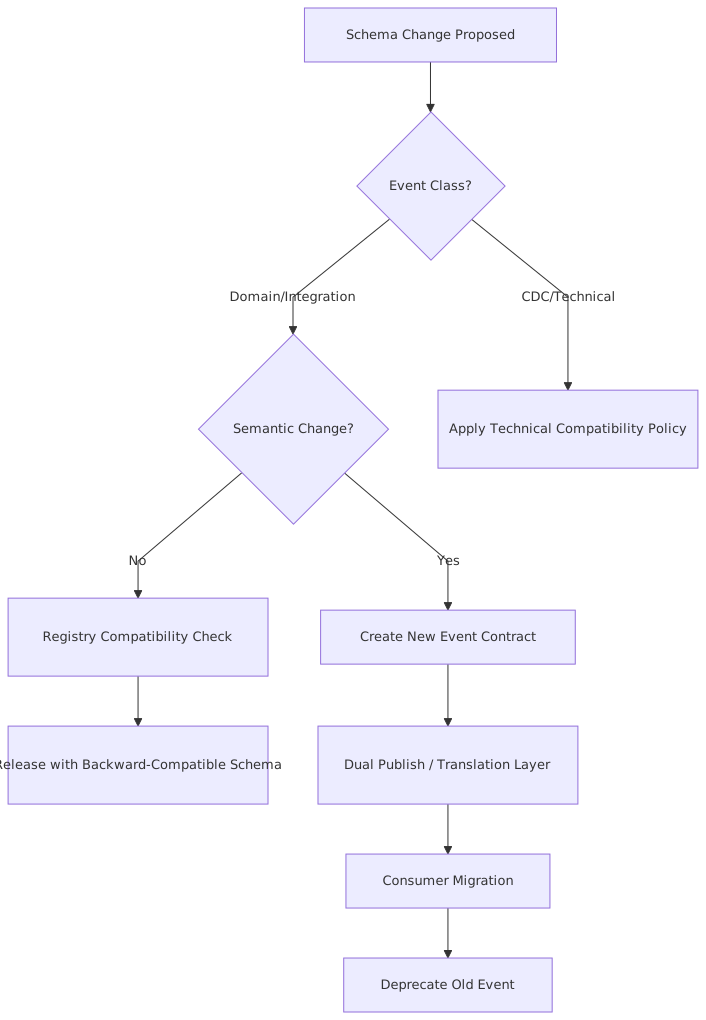
When semantics change materially, translation services or stream processors become essential. They allow old consumers to continue receiving the legacy shape while new consumers adopt a better model. This is a classic anti-corruption layer in event form: protecting one model from another while migration proceeds.
Versioning policy
Here is the opinionated part: do not overuse version numbers in topic names. Versioning by topic can be useful for major semantic breaks, but using customer-v1, customer-v2, customer-v3 for every routine change turns Kafka into a landfill.
Prefer:
- schema versioning in the registry for compatible evolution
- a new event name or topic only for meaningful semantic discontinuity
- explicit deprecation windows and consumer migration plans
If the meaning changes, say so. If only the shape evolves compatibly, let the tooling carry the burden.
Migration Strategy
Migration is the real architecture. Everything else is policy.
In most enterprises, schema evolution is not a clean jump from old to new. It is a negotiated coexistence across services, data stores, and reporting pipelines. This is where a progressive strangler approach works exceptionally well.
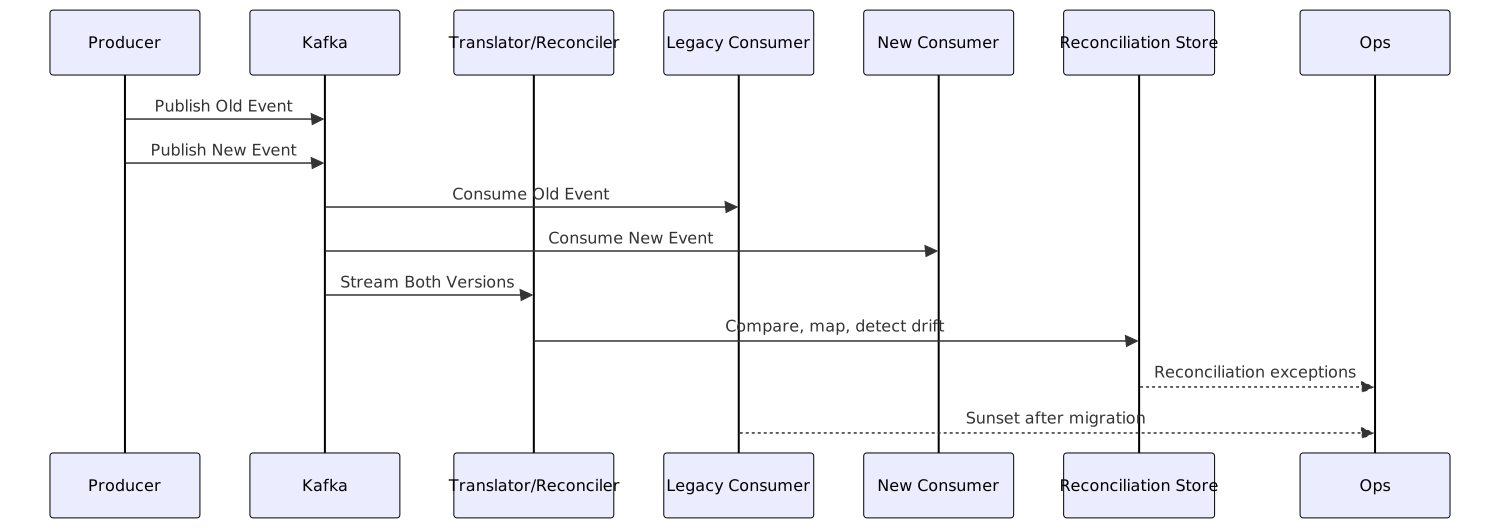
Instead of forcing all consumers to adopt a new event immediately, introduce the new schema or event model alongside the old one. Use translation, dual publishing, and reconciliation to gradually shift traffic and dependencies.
A sensible migration sequence looks like this:
1. Classify the change
Is this:
- additive and compatible
- structurally breaking but semantically equivalent
- semantically breaking
- a bounded-context correction
Only the first category should feel routine.
2. Establish migration artifacts
For non-trivial changes, define:
- source and target event contracts
- mapping rules
- default handling for missing values
- identity and correlation rules
- reconciliation strategy
- rollback approach
- deprecation deadline
If you cannot explain how old and new histories align, you are not ready to migrate.
3. Dual publish or transform
There are two common paths:
- the producer emits both old and new events
- a stream transformation layer derives the old shape from the new or vice versa
I usually prefer producer-owned dual publishing for short, explicit migrations where the producer has semantic control. I prefer transformation layers when many producers need shielding or when old semantics need careful normalization.
4. Reconcile
This is the part architects mention too briefly. Reconciliation is not optional when schemas evolve around critical business facts.
Suppose old OrderPlaced carried gross amount only, and the new event separates netAmount, taxAmount, and discountAmount. Historical reports and downstream services may not align during transition. A reconciliation process must compare old and new derived states, identify mismatches, and either backfill corrected projections or flag operational exceptions.
Reconciliation often includes:
- comparing read models built from old and new streams
- validating aggregate counts and monetary totals
- identifying orphan or duplicate events
- replaying historical events through new projections
- maintaining exception queues for manual resolution
Enterprises underestimate this work because it feels unglamorous. But this is where trust in the platform is won or lost.
5. Strangle old consumers
Migrate consumers incrementally. Track version adoption. Set objective retirement criteria:
- no production consumers on old contract
- no unresolved reconciliation gaps
- audit/archive complete
- support desk aware of retirement window
Then deprecate and remove with discipline. Nothing lingers forever unless nobody owns the ending.
Enterprise Example
Consider a large insurer modernizing claims processing.
The legacy core emits table-level updates from a claims database into Kafka using CDC. Downstream systems—fraud, customer communications, finance, regulatory reporting—consume those topics directly. It works, in the narrow sense that a bridge held together with tape works. Everyone depends on row mutations such as CLAIM_HEADER.UPDATED.
The modernization program introduces domain-oriented microservices around claims intake, adjudication, and payment. The architecture team wants proper domain events: ClaimRegistered, ClaimAssessed, ClaimApproved, ClaimRejected, ClaimPaid. Good move. But they cannot break the many existing consumers of CDC topics. Nor can they pause the business for a big-bang cutover.
So they establish a schema evolution governance model.
First, they classify CDC topics as technical streams, not enterprise integration contracts. This single decision is a turning point. Existing consumers are tolerated temporarily, but no new consumers may onboard to CDC. All new integrations must use curated integration events derived from domain services.
Second, the claims bounded context becomes the owner of the new event contracts. Every event is cataloged with business meaning, compatibility tier, and consumer guidance.
Third, they introduce a translation layer. Domain services publish rich business events. A stream processor maps those into legacy-shaped integration events where needed, preserving old consumers while insulating the new model from old assumptions.
Fourth, they run reconciliation. For six months, claim payment totals, rejection reasons, and settlement timelines are compared between old reporting pipelines and new event-derived projections. Several mismatches appear. Some stem from schema differences. Others expose latent defects in legacy interpretation that had gone unnoticed for years. Governance does not just protect systems here; it reveals institutional ambiguity.
Finally, they strangle dependencies. Fraud moves first to new events because semantics matter. Reporting moves later because history and consistency are harder. The customer communications system remains on a compatibility feed longer than anyone likes, because that is how enterprises work in real life.
The result is not perfection. It is controlled evolution. And that is the real goal.
Operational Considerations
Schema evolution governance fails if it lives only in design-time documentation. It must show up in operations.
Observability by schema version
You need to know:
- which producer versions are emitting
- which consumer groups are reading which versions
- deserialization failures by topic and schema
- fallback/default field usage rates
- translation layer lag and error rates
- reconciliation exception volume
If a new optional field is always null in production, that is not a schema success. It may indicate incomplete rollout or a domain misunderstanding.
Retention and replay
Replay is where old assumptions re-enter the building. Keep schema versions archived and resolvable. Ensure consumers can deserialize historical events. Test replay scenarios before major contract changes. A stream is only trustworthy if its history is interpretable.
Data classification and privacy
Governance must integrate with data policies. If an old event includes PII and the new one removes it, migration should ensure downstream stores are cleaned or masked appropriately. “We stopped publishing the field” is not the same as “the enterprise risk is gone.”
Consumer communication
A schema change without a communication channel is an incident waiting for a calendar invite. Maintain subscription lists, change notices, migration guides, and office hours for major event changes. Architecture is partly social infrastructure.
Testing beyond compatibility
Run contract tests, replay tests, shadow projections, and semantic regression tests. A schema that passes registry checks can still cause business divergence in stateful consumers.
Tradeoffs
A governed schema evolution model buys control at the cost of some friction.
The main tradeoff is between autonomy and safety. Producer teams lose the illusion that they can change payloads casually. In return, they gain a platform where consumers trust contracts enough to move faster independently. It is a good bargain, but teams feel the tax before they feel the dividend.
Another tradeoff is between elegant domain events and integration convenience. Rich domain events preserve semantics inside bounded contexts. Downstream consumers often want flattened, stable integration events. Supporting both creates more artifacts and more governance work. Ignoring the distinction creates worse coupling.
There is also a cost to dual running. Translation layers, reconciliation jobs, and sunset management consume effort. They can feel expensive compared to a forced cutover. Yet in large enterprises, forced cutovers are usually just expensive failures scheduled more confidently.
And there is a subtle risk: governance can become performative. Too many approvals, too many templates, too much central policing, and teams route around the process. The answer is automation, clear thresholds, and domain ownership—not another architecture review committee discovering relevance through tickets.
Failure Modes
Several failure modes appear repeatedly.
Schema registry as false comfort
Teams assume compatibility settings solve governance. They do not. Registry checks catch structural breakage, not semantic drift.
CDC masquerading as domain API
This is one of the worst habits in event-driven estates. CDC is useful, but when database mutation streams become public contracts, schema evolution becomes hostage to table design.
Topic version explosion
Creating a new Kafka topic for every contract change seems tidy until consumers must subscribe to five generations of the same business concept. Versioning should express semantic discontinuity, not indecision.
No deprecation enforcement
Without deadlines, metrics, and ownership, old schemas never die. Enterprises become museums of compatibility.
Missing reconciliation
Teams migrate producers and consumers but never compare outcomes. Silent divergence accumulates until financial controls or customer complaints expose it.
Semantic overloading
An event named OrderUpdated with fifty optional fields and many meanings is not flexible. It is a confession that nobody controlled the model.
When Not To Use
Do not apply heavyweight schema evolution governance everywhere.
If you are operating a small internal system with one team, short-lived consumers, and no replay or external dependencies, a lightweight approach may be enough. Strong local conventions and a modest compatibility check can suffice.
If the events are purely technical and ephemeral—say cache invalidation notifications inside one service boundary—formal cataloging and architecture review are overkill.
If your organization is not truly event-driven and mainly uses Kafka as a transport for point-to-point integration, be careful. Investing heavily in elaborate event governance while domains remain muddled and ownership unclear can produce process theater. Fix ownership and event purpose first.
And if you are in the middle of discovering the domain, avoid declaring a stable enterprise-wide canonical event model too early. Premature canonization is just another form of coupling.
Related Patterns
Several related patterns complement schema evolution governance.
Schema Registry provides technical validation and version storage.
Consumer-Driven Contracts help expose assumptions that registry checks miss, especially for critical integrations.
Anti-Corruption Layer is essential when translating between old and new semantics across bounded contexts.
Strangler Fig Pattern supports progressive migration from legacy event models to curated domain or integration events.
Event Versioning is useful, but only when tied to semantic policy rather than mechanical habit.
Outbox Pattern improves reliability of event publication, especially during migration when dual publishing must be consistent.
CQRS projections and replay are central to reconciliation and historical reinterpretation.
Most importantly, bounded contexts from domain-driven design provide the intellectual anchor. Schema governance without bounded contexts collapses into field management. The hard part is not choosing Avro versus Protobuf. The hard part is deciding whose language the event speaks, and for whom.
Summary
Schema evolution governance in event-driven systems is not a side concern. It is one of the central disciplines that separates a durable event platform from a noisy distributed mess.
The heart of the matter is simple: events are durable domain contracts. They carry meaning through time, across teams, and into places their producers do not control. That means schema changes are never just code changes. They are changes to shared understanding.
A good governance model is federated, domain-owned, automated where possible, and explicit about compatibility tiers. It distinguishes domain events from CDC, syntax from semantics, and routine additive change from genuine business-model discontinuity. It also treats migration as architecture, using progressive strangler techniques, dual publishing, translation layers, and reconciliation to move safely from old truth to better truth.
The enterprises that do this well are not the ones with the most documents. They are the ones that make meaning visible, ownership clear, migration deliberate, and retirement non-optional.
That is the real governance diagram, even when the boxes are hidden: keep the language honest while the system keeps moving.
Frequently Asked Questions
What is enterprise architecture?
Enterprise architecture aligns strategy, business processes, applications, and technology in a coherent model. It enables impact analysis, portfolio rationalisation, governance, and transformation planning across the organisation.
How does ArchiMate support architecture practice?
ArchiMate provides a standard language connecting strategy, business operations, applications, and technology. It enables traceability from strategic goals through capabilities and services to infrastructure — making architecture decisions explicit and reviewable.
What tools support enterprise architecture modeling?
The main tools are Sparx Enterprise Architect (ArchiMate, UML, BPMN, SysML), Archi (free, ArchiMate-only), and BiZZdesign. Sparx EA is the most feature-rich, supporting concurrent repositories, automation, scripting, and Jira integration.