⏱ 20 min read
Most event-driven architectures do not fail because Kafka is slow, or because microservices are too small, or because someone picked the wrong schema registry. They fail much earlier, in the language. event-driven architecture patterns
The rot starts innocently. One team publishes CustomerUpdated. Another publishes CustomerChanged. A third emits AccountModified, which really means “customer address changed unless marketing preferences changed, in which case look in another topic.” Soon the event catalog reads like a corporate thesaurus assembled during an outage. Integration becomes archaeology. Every subscriber must reverse-engineer intent from payloads, timestamps, and folklore.
This is the unglamorous truth: event-driven architecture is not primarily a transport problem. It is a semantics problem.
A business event taxonomy is the missing discipline. It gives events a shape, a hierarchy, and—more importantly—a meaning anchored in the domain. It separates facts from commands, business milestones from technical noise, immutable records from mutable convenience views. It turns the event stream from a pile of messages into a language the enterprise can actually reason about.
And that matters because events age badly when their semantics are loose. A REST endpoint can be deprecated and hidden behind a gateway. An event, once published and consumed by five departments and a reporting platform, becomes institutional memory. Badly named events become permanent liabilities.
So this article is about more than naming conventions. It is about using domain-driven design to create a business event taxonomy that survives scale, organizational entropy, and migration from old integration estates. We will look at the forces that shape a taxonomy, the architecture around it, how to introduce one through progressive strangler migration, and where it can go wrong. We will also be honest about when not to use it. Because not every integration problem deserves a grand event ontology.
Context
In a modern enterprise, events sit at the crossroads of operational systems, analytics, automation, compliance, and customer experience. Order systems emit fulfillment events. CRM platforms emit customer lifecycle events. Payment platforms emit authorization and settlement events. Identity systems emit access and credential events. Somewhere in the middle sits Kafka, or another event backbone, carrying both value and ambiguity at high speed.
The appeal is obvious. Events enable loose coupling, asynchronous processing, auditability, and reactive workflows. Microservices can publish facts about state transitions without coordinating every downstream consumer. Teams can move independently. New use cases can subscribe without modifying the source system. This is the good version of event-driven architecture. microservices architecture diagrams
The bad version looks similar in the infrastructure diagrams and very different in production. Teams publish whatever seems useful today. Payloads mix business meaning with implementation detail. Some events represent something that happened in the real world; others represent internal cache invalidation or row-level persistence changes. A consumer written by the finance team interprets an event differently from one written by operations. Analytics pipelines quietly fork the meaning again.
Without a taxonomy, event-driven architecture becomes a distributed argument.
Domain-driven design gives us the right lens here. Events are not generic integration envelopes. They are expressions of domain semantics. A PaymentCaptured event means something in a bounded context with explicit invariants, lifecycle rules, and ownership. A taxonomy should reflect that. It should help us answer basic but usually neglected questions:
- Is this event a business fact, a system notification, or a command in disguise?
- Which bounded context owns its meaning?
- What lifecycle stage does it represent?
- Can it be relied upon as an immutable historical record?
- Is it safe for broad consumption, or is it an internal implementation detail?
Those are architecture questions, not just naming questions.
Problem
Most enterprises inherit event catalogs, not design them.
The first wave usually comes from application teams exposing change-data-capture feeds, integration middleware emitting process notifications, and microservices publishing topic-per-service events. The second wave comes when downstream teams try to use those streams for reporting, orchestration, customer journeys, fraud detection, and regulatory evidence. At that point, the lack of taxonomy becomes expensive.
A few recurring problems show up.
First, semantic drift. The same event name means different things over time, or different systems emit similar names for different realities. OrderCompleted might mean “payment authorized” in one context and “physically shipped” in another. Consumers guess. Guesses become defects.
Second, hidden coupling. A subscriber starts depending on payload fields that were never part of the intended business contract. The producer changes an internal field and accidentally breaks three downstream processes. People call this an event contract issue. Usually it is a taxonomy issue first: the event was never properly classified as a stable business event versus a volatile internal event.
Third, event overload. Too many low-value events flood the platform: row changes, retries, heartbeat notices, intermediate workflow states, and technical chatter. The signal-to-noise ratio collapses. Architects then try to solve a semantic problem with more brokers, more topics, and more observability dashboards.
Fourth, governance paralysis. Once leadership notices the mess, the response is often a heavyweight enterprise event model with dozens of abstract categories and no practical ownership. Teams ignore it because it reads like an ontology project, not a delivery tool.
This is why a useful business event taxonomy must be concrete, domain-owned, and operationally relevant. If it cannot help a team decide whether to publish ClaimAdjudicated or ClaimStatusChanged, it is theater.
Forces
Several forces pull event taxonomies in competing directions.
Business meaning versus technical convenience
Engineering teams naturally publish the easiest thing: a state-change event from the service boundary or database log. That is technically convenient. But the business often cares about milestones, decisions, and commitments, not row mutations. PolicyRenewalOffered is richer than PolicyRecordUpdated. The former carries intent; the latter leaks implementation.
Local autonomy versus enterprise coherence
Bounded contexts should own their language. That is the core DDD move. But large enterprises also need cross-domain interoperability. Finance, risk, customer support, and data platforms cannot subscribe to fifty incompatible dialects. A taxonomy must preserve local meaning while creating enough consistency to make enterprise integration sane.
Stability versus expressiveness
Broadly reusable business events should be stable over time. But rich domain semantics often evolve. If the taxonomy is too rigid, teams route around it. If it is too loose, semantics decay. The sweet spot is a layered approach: stable classification and naming principles, with context-specific schemas versioned carefully.
Publish everything versus publish what matters
There is a seductive idea in event-driven systems: emit all changes and let consumers decide. In practice, that creates expensive downstream interpretation and weakens domain boundaries. Publish fewer, better events. Keep internal events internal. Treat broad publication as an act of product design.
Historical truth versus operational reality
Business events should be immutable facts. Yet enterprise operations involve retries, compensations, corrections, and reconciliations. A taxonomy has to support both the clean historical narrative and the mess of real systems. If a payment was “captured” and later reversed, the right answer is usually another business event, not rewriting history.
Solution
A business event taxonomy is a structured classification system for events based on domain meaning, ownership, lifecycle, and intended consumption.
The simplest useful version has three layers:
- Event class — what kind of thing is this?
- Domain category — which business area owns its meaning?
- Lifecycle event type — what business milestone or state transition does it represent?
At the top layer, I recommend a clear separation between:
- Business events: meaningful domain facts, stable enough for broad consumption.
- Domain internal events: useful within a bounded context, not intended as enterprise contracts.
- Technical events: infrastructure or platform notifications.
- Commands masquerading as events: messages that should not be published as historical facts.
That last category deserves blunt language. If your “event” says SendWelcomeEmail, it is probably not an event. It is a command. Calling commands events is one of the oldest tricks in distributed systems, and it buys confusion.
A practical taxonomy also distinguishes business event subtypes. Common categories include:
- Lifecycle events:
CustomerRegistered,OrderCancelled,PolicyExpired - Decision events:
LoanApproved,ClaimRejected - Commitment events:
ShipmentScheduled,PaymentAuthorized - Exception events:
DeliveryFailed,FraudSuspected - Correction events:
InvoiceVoided,PaymentReversed
These categories matter because they affect consumer expectations. A decision event often implies an authoritative business determination. A lifecycle event often marks progression. An exception event may trigger investigation and compensating processes. A correction event tells consumers not to reinterpret history silently.
Here is a simple taxonomy view.
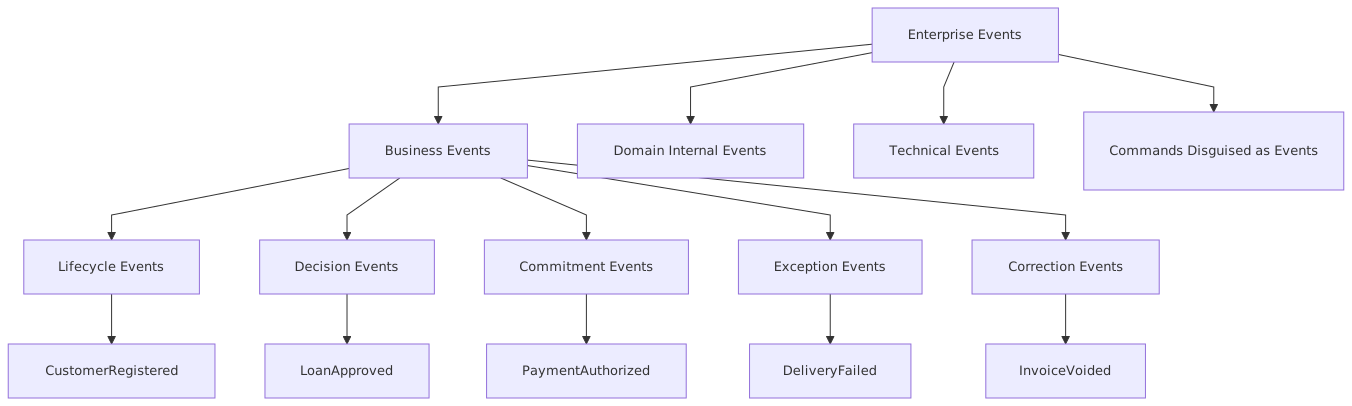
This is not bureaucracy. It is a design tool. If a proposed event cannot be placed sensibly in the taxonomy, that is a signal to revisit the model.
Domain semantics first
The event name should reflect the ubiquitous language of the bounded context. That means talking to domain experts, not just integration engineers. It means preferring ClaimSubmitted over ClaimCreated if the business sees submission as the meaningful milestone. It means recognizing that OrderAllocated and OrderReserved may have very different operational implications in supply chain.
A good event taxonomy gives names that age well because they are tied to domain concepts, not implementation mechanics.
Event metadata as part of the taxonomy
The taxonomy should not stop at names. Each business event should carry standard metadata such as:
- event id
- event class
- bounded context owner
- aggregate or business entity identifier
- occurrence time versus publication time
- causation id and correlation id
- schema version
- business key where relevant
- sensitivity and retention classification
This metadata is the difference between an event stream and an enterprise-grade record.
Architecture
A business event taxonomy sits across architecture layers. It is not just a naming list in Confluence.
At the producer side, each bounded context owns event creation and ensures events reflect domain transitions rather than persistence side effects. In a microservices environment, this typically means publishing from the application layer or via an outbox pattern rather than directly exposing database changes as enterprise business events.
At the platform side, Kafka topics, schema registry, event catalog, and governance workflows make the taxonomy discoverable and enforceable. Topic design should support domain ownership. A common pattern is topic families aligned with bounded contexts, with clear separation between public business event topics and private internal streams. EA governance checklist
At the consumer side, services, analytics pipelines, workflow engines, and data products subscribe according to event class and domain need. They should not need tribal knowledge to know whether an event is stable and business-meaningful.
A reference architecture looks something like this:
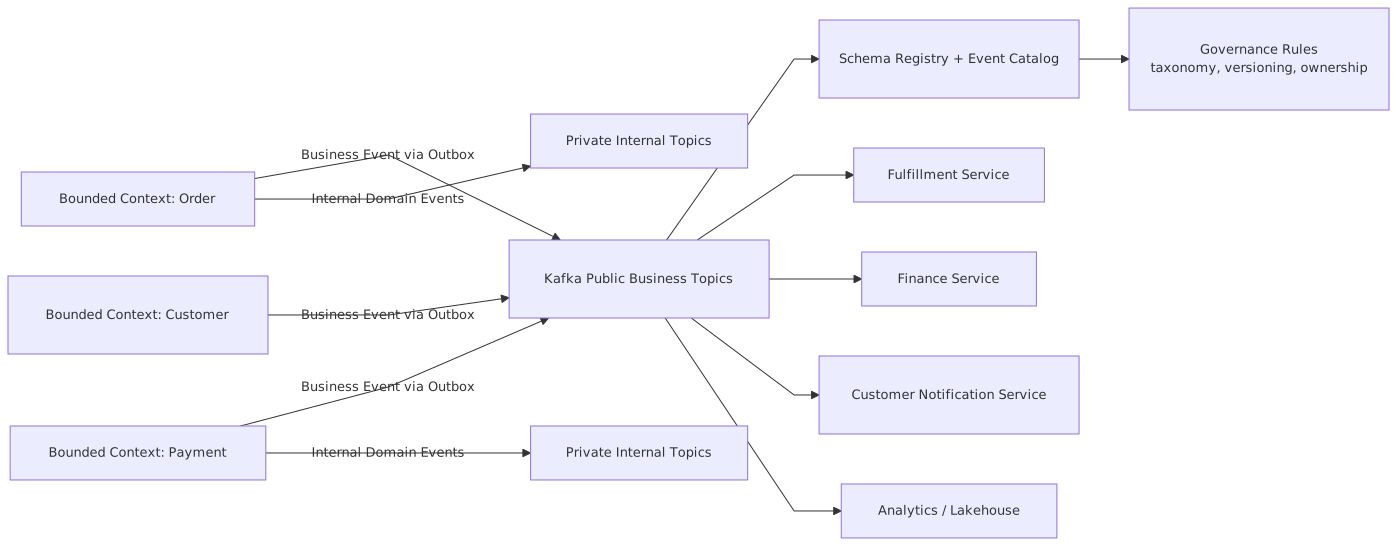
A few architectural opinions are worth stating plainly.
Public and private events should be different on purpose
Not every internal domain event should become a public enterprise event. In fact, most should not. Public business events are contracts. Internal domain events are implementation tools. Mixing the two creates brittle coupling and endless schema anxiety.
CDC is useful, but not a substitute for business events
Change data capture from databases can accelerate migration and support downstream replication. It can also be valuable for reconciliation. But CDC events are rarely good business contracts. They describe data mutations, not business meaning. Use CDC as plumbing, not language.
Event catalogs must be productized
A taxonomy hidden in PowerPoint is dead on arrival. Teams need a searchable event catalog with ownership, examples, lineage, quality indicators, and deprecation status. If developers can find a Kafka topic faster than they can understand what it means, governance has already failed. ArchiMate for governance
Reconciliation is part of the architecture
Event-driven architecture is often sold as if event streams are perfect truth. Real enterprises know better. Messages are delayed, duplicated, misordered, or temporarily lost from downstream projections. The architecture should include reconciliation processes: batch or streaming jobs that compare operational source-of-record states with downstream materialized views and raise correction workflows. The taxonomy should make correction and reversal events first-class citizens.
Migration Strategy
No large enterprise gets to pause and redesign its event vocabulary from scratch. Migration is where architecture earns its keep.
The sensible path is progressive strangler migration. Do not begin by forcing every team onto a global taxonomy council. Begin by introducing a public business event layer around the most valuable domains and strangling the old integration estate gradually.
A migration typically unfolds in phases.
Phase 1: Inventory and classify
Start by cataloging existing events, topics, integration messages, CDC feeds, and batch extracts. For each one, classify it:
- business event
- internal domain event
- technical event
- command
- data replication feed
This exercise exposes duplication and abuse quickly. It also reveals which events are already stable enough to be treated as business contracts and which should be quarantined behind anti-corruption layers.
Phase 2: Define target taxonomy for priority domains
Choose a small number of business-critical domains: order, payment, customer, claims, inventory. Work with domain experts and service owners to define the bounded-context language and target business events. Keep the first taxonomy sharp and practical.
Phase 3: Publish canonical business events alongside legacy integrations
This is the key strangler move. Existing systems keep operating, but new public business events are emitted from domain services or from translation components near legacy applications. Consumers are encouraged to adopt the new events first for net-new use cases, then for replacement of brittle point-to-point integrations.
Phase 4: Introduce translation and anti-corruption layers
Legacy event names and payloads often cannot be retired immediately. Put translation services in front of them. These services map old system messages into taxonomy-compliant business events, preserving lineage metadata. They also protect the new model from legacy semantics leaking inward.
Phase 5: Reconcile and decommission
Once downstream consumers rely on the new business event layer, measure gaps through reconciliation. Compare event-derived projections and reports with source systems. Use correction events and replay strategies to stabilize. Then decommission legacy feeds topic by topic.
The flow often looks like this:
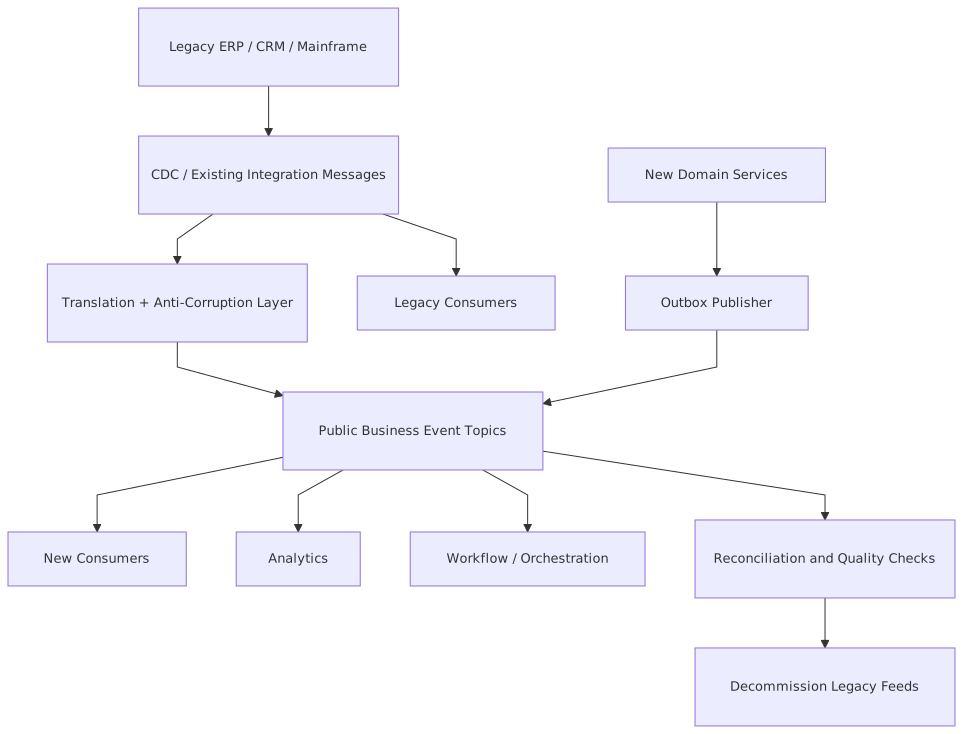
Reconciliation during migration
This deserves emphasis. During strangler migration, there will be periods when both old and new event pathways exist. Data will diverge. Timings will differ. Consumers will discover hidden assumptions. Reconciliation is not an afterthought; it is the safety rail.
Use business keys and correlation ids to compare source-of-record states against event-driven projections. Build daily or near-real-time checks for completeness, ordering anomalies, and semantic mismatches. Publish correction events rather than silently patching derived stores. The goal is confidence, not theatrical purity.
Enterprise Example
Consider a multinational insurer modernizing claims processing.
The company had a core claims platform on a mainframe, a separate policy administration suite, regional payment systems, and a customer portal built as microservices. Kafka had been introduced as the integration backbone, but each program used it differently. Some topics contained CDC from DB2 tables. Some contained orchestration signals from BPM tools. Some contained domain events from newer services. Teams all said they were “event-driven.” They were not speaking the same language.
The business pain was tangible. Customer service could not reliably answer “where is my claim?” because status interpretations differed between systems. Finance struggled to reconcile claim payments with claim decisions. Fraud analytics consumed raw table changes and inferred milestones incorrectly. Every downstream use case started with a semantics workshop.
The architecture team did one thing right: they did not start with a universal enterprise data model. They started with bounded contexts.
They identified Claims, Payments, Policy, and Customer Interaction as primary domains. For Claims, they worked with adjusters and operations leads to define a small set of public business events:
ClaimSubmittedClaimValidatedClaimAssignedClaimAdjudicatedClaimRejectedClaimPaymentAuthorizedClaimClosedClaimReopened
Notice what is absent: ClaimUpdated. That event existed in three systems and meant almost nothing.
Internally, the claims microservices still used finer-grained events such as document indexing complete, fraud rules evaluated, and reserve amount recalculated. Those remained private. Public topics carried only stable business milestones.
For the legacy mainframe, a translation service consumed CDC and workflow notifications, then emitted taxonomy-compliant business events when sufficient conditions were met. This was not perfect. There were edge cases where the translator had to hold state to determine whether a status change really represented ClaimAdjudicated. But it was better than asking every consumer to solve the puzzle separately.
Kafka topics were organized by domain and event visibility. Schemas were registered with mandatory metadata including bounded context owner, event class, business keys, and sensitivity classification. Analytics shifted from mining raw status changes to subscribing to explicit claims lifecycle events. Finance subscribed to decision and payment commitment events. Customer communications subscribed to lifecycle and exception events only.
The migration took eighteen months. During that time, a reconciliation service compared claim snapshots from the source systems with event-driven read models. This surfaced delayed translator logic, duplicate emissions from retry paths, and a nasty edge case where reopened claims were being treated as new claims by one regional platform. Because correction events were part of the taxonomy, they could address the issue explicitly instead of rewriting history in downstream stores.
The result was not magic. It was discipline. Integration lead time dropped because teams could discover and trust business events. Audit conversations improved because event semantics were explicit. Fraud models improved because they trained on real business milestones. And perhaps most importantly, the architecture gave the enterprise a shared language that was not trapped inside one application.
Operational Considerations
A taxonomy becomes real only when operations reinforce it.
Versioning
Schema evolution must preserve semantic compatibility, not just structural compatibility. Adding an optional field is easy. Quietly changing what approvedAmount means is not. Major semantic changes often deserve a new event type, not just a new schema version.
Ordering
Kafka can preserve order within a partition, not across the enterprise. Taxonomy design should avoid implying stronger ordering guarantees than the platform can provide. Consumers should treat events as facts with timestamps and causation, not as a perfectly ordered screenplay.
Idempotency and duplicates
At-least-once delivery is common. Business events need stable ids and consumers need idempotent handling. Otherwise correction and replay become dangerous. Duplicate PaymentAuthorized events are not a theoretical inconvenience; they are an incident report.
Retention and audit
Some business events carry regulatory value. Others are operationally transient. Taxonomy metadata should drive retention, archival, encryption, and access controls. This is especially important in customer and payment domains where data protection obligations apply.
Observability
Observability should include semantic quality, not just lag and throughput. Track orphaned events, schema misuse, unexpected event class publication, and event-to-business-state reconciliation rates. A healthy broker with unhealthy semantics is still an unhealthy architecture.
Tradeoffs
A business event taxonomy is worth doing. It is also not free.
It introduces governance, and governance can slow teams down if handled poorly. It requires domain modeling effort, which some organizations underinvest in because the benefits are indirect at first. It creates a distinction between public and private events that teams may find inconvenient. It may require translation layers during migration, and those layers add complexity.
There is also a philosophical tradeoff. A strong taxonomy discourages publishing raw change streams as public contracts. That is good for semantic clarity, but it may reduce flexibility for consumers who want every low-level change. The answer is usually to provide both—private replication feeds for specialized consumers and curated public business events for broad integration—but with clear labeling and different expectations.
Another tradeoff is centralization versus federation. If the taxonomy is too centralized, it becomes a bottleneck. If it is fully federated, terms diverge. The practical answer is federated ownership with lightweight central principles: each bounded context owns its business events, while an architecture function defines classification rules, metadata standards, and review for cross-domain publication.
Failure Modes
There are predictable ways this goes wrong.
The abstract model trap
The taxonomy becomes a giant enterprise ontology no delivery team can use. Everything is technically elegant and practically ignored.
The naming-only trap
The organization creates naming standards but does nothing about ownership, metadata, event classes, or public/private separation. The catalog looks tidy while semantics remain muddy.
CDC masquerading as domain design
Teams publish raw table changes under polished event names and call it done. Consumers still infer business meaning from implementation details. The old problem survives with better branding.
Command leakage
Workflow engines and orchestration tools publish “events” that are really instructions to downstream systems. Historical fact and requested action get mixed together. Auditing becomes confusing and consumers become tightly coupled to process flow.
No reconciliation
The architecture assumes streams are the truth and neglects reconciliation. Data products drift. Materialized views become inconsistent. Trust erodes quietly until the business falls back to manual reports.
Taxonomy without bounded contexts
A central team defines event names without clear domain ownership. This produces generic terms like EntityProcessed, which are almost impossible to govern meaningfully.
When Not To Use
This approach is not for every situation.
Do not invest heavily in a formal business event taxonomy for a small system with a handful of tightly coordinated consumers and little likelihood of reuse. A simple integration contract may be enough.
Do not force business events where the domain does not naturally communicate in events. Some interactions are genuinely request-response and transactional. Pretending otherwise adds latency and confusion.
Do not expose curated business events if your immediate need is raw data replication for one analytics pipeline. Use CDC directly, label it honestly, and avoid dressing plumbing up as semantics.
And do not attempt an enterprise-wide taxonomy before you have clear bounded contexts. Without domain boundaries, event categories become arguments about org charts.
Related Patterns
A business event taxonomy works well with several established patterns:
- Domain events: internal events within a bounded context; useful but not automatically public.
- Integration events: events intended for external consumption; often the public subset of domain-significant business events.
- Outbox pattern: reliable event publication tied to transactional state changes.
- Schema registry: manages event schemas and compatibility rules.
- Anti-corruption layer: translates legacy or foreign semantics into the target taxonomy.
- Event sourcing: sometimes complementary, but not required. Do not confuse an event-sourced aggregate stream with a public enterprise event contract.
- CQRS: consumers build read models from business events, often with reconciliation support.
- Saga or process manager: orchestrates long-running workflows, but should distinguish commands from business events carefully.
That last point matters. Sagas often tempt teams to emit process-step chatter as if it were domain fact. Resist that temptation. Workflows are not always the business.
Summary
A business event taxonomy is one of those architectural moves that sounds modest and changes everything.
It gives event-driven architecture a language rooted in domain-driven design. It distinguishes business facts from internal mechanics, commands, and technical noise. It helps Kafka-based platforms become integration backbones instead of message graveyards. It supports microservices without forcing every service to invent its own dialect. And during migration, it provides a practical target for progressive strangler patterns, translation layers, and reconciliation.
The core idea is simple: publish events that mean something in the business, classify them intentionally, and treat public event contracts as products.
Do that, and your event streams start to read like the business itself.
Fail to do it, and your architecture will still be event-driven—just driven by misunderstanding.
Frequently Asked Questions
What is enterprise architecture?
Enterprise architecture aligns strategy, business processes, applications, and technology in a coherent model. It enables impact analysis, portfolio rationalisation, governance, and transformation planning across the organisation.
How does ArchiMate support architecture practice?
ArchiMate provides a standard language connecting strategy, business operations, applications, and technology. It enables traceability from strategic goals through capabilities and services to infrastructure — making architecture decisions explicit and reviewable.
What tools support enterprise architecture modeling?
The main tools are Sparx Enterprise Architect (ArchiMate, UML, BPMN, SysML), Archi (free, ArchiMate-only), and BiZZdesign. Sparx EA is the most feature-rich, supporting concurrent repositories, automation, scripting, and Jira integration.