⏱ 22 min read
Backfill is where elegant event-driven architecture stops being a conference slide and starts becoming enterprise reality.
On the whiteboard, streaming systems look clean: events are produced, consumers react, state emerges, and everything hums along in near real time. Then a team asks an awkward but entirely normal question: How do we rebuild the last three years of customer state into the new platform without taking the business offline? That is the moment when architecture becomes less about purity and more about survival.
Most organizations do not begin with a perfect event backbone. They inherit batch jobs, mutable databases, half-documented source systems, and a collection of microservices that tell different versions of the truth. So when they introduce Kafka, stream processors, and domain events, they quickly discover that “just replay the events” is often a fantasy. Sometimes there are no usable historical events. Sometimes the old events are too noisy, too technical, or semantically wrong. Sometimes the target model did not even exist when the source data was first written.
Backfill, then, is not merely a data movement concern. It is a domain concern, a migration concern, and an operational risk concern. It sits right on the fault line between the old world and the new. Handle it badly and you get duplicate orders, phantom balances, stale customer entitlements, or a support organization drowning in reconciliation tickets. Handle it well and you can progressively strangle a legacy core while the business keeps trading.
This article takes a hard look at streaming backfill strategies in event streaming systems, especially in Kafka-centric microservice estates. The goal is not to worship one pattern. The goal is to understand the forces, choose the least dangerous approach, and respect the domain semantics all the way through. event-driven architecture patterns
Context
Event streaming architectures promise a useful thing: the business can react to change as change happens. That matters in fraud detection, inventory allocation, claims handling, customer notifications, and any domain where time is part of the value proposition.
But real enterprises almost never start from zero. They modernize in place.
A bank introduces Kafka to decouple customer onboarding from downstream risk checks. A retailer adds streaming to synchronize inventory across stores and e-commerce. A logistics company builds domain services around shipment state while the transport management system remains the system of record. In every one of these cases, a new event-driven platform must coexist with historical data and legacy behavior.
That creates a two-speed problem:
- The live stream carries new facts as they happen.
- The backfill path reconstructs old facts, old state, or old inferred meaning so the target system starts from somewhere useful.
These are not the same thing. Treating them as the same thing is one of the oldest mistakes in streaming migration.
A live event often captures a business moment: OrderPlaced, PaymentAuthorized, ShipmentDispatched. A backfill record may come from a denormalized table row, a snapshot export, a CDC trail, or a nightly file. The architecture question is not simply, “Can I push historical data through Kafka?” Of course you can. The real question is, “Can I push historical data through Kafka without lying about what it means?”
That is where domain-driven design earns its keep. Backfill is not just replay. It is translation into a bounded context.
Problem
A target service or event-driven platform needs historical state to operate correctly, but the historical truth lives in systems that were never designed for event replay.
Common triggers include:
- introducing a new microservice that needs a complete aggregate view
- replacing a legacy batch integration with a streaming one
- rebuilding read models for analytics or operational decisioning
- migrating from database integration to domain events
- onboarding a new downstream consumer that cannot wait months to accumulate state naturally
- recovering after logic errors or corrupted state stores
The naive answer is usually one of these:
- Bulk load everything, then start streaming.
- Replay every old event into the new system.
- Use CDC as if it were a perfect business event stream.
Each can work. Each can also create a mess.
Bulk loads often miss in-flight changes and require a difficult cutover window. Replay assumes old events are complete, version-compatible, and semantically trustworthy. CDC captures row mutations, not business intent. A row changing from status='A' to status='B' is not necessarily the same thing as PolicyActivated.
So the problem is broader than data synchronization. It is this:
> How do we backfill a streaming architecture so the target systems become correct enough, fast enough, and safely enough, while preserving domain meaning and maintaining business continuity?
That “correct enough” matters. In enterprise architecture, there is no free lunch. Sometimes exact reconstruction is possible. Sometimes a pragmatic approximation plus reconciliation is the only sensible move.
Forces
Backfill strategy is shaped by a set of competing forces. Ignore any one of them and the architecture will come back to bite you.
1. Domain semantics versus technical availability
The source system may expose tables, logs, and file extracts. That does not mean it exposes the right business facts.
If the target bounded context needs customer eligibility, a raw subscription row is only the start. The row may not encode why the customer became eligible, when they became eligible in business time, or which policy version governed the decision. Technical history is not business history.
2. Ordering and causality
Streaming systems care about sequence. So do domains.
Backfilled data often arrives out of temporal order, especially when extracted from partitions, shards, or multiple legacy systems. Yet downstream consumers may assume causality: AccountOpened before CardIssued, ClaimRegistered before ClaimApproved.
Backfill that violates causal assumptions can create impossible states.
3. Scale and operational window
A one-time backfill of 50 million customers is one thing. A rolling backfill of 40 billion account transactions is another. Throughput, retention, topic compaction, broker load, and consumer lag become first-class architectural concerns.
4. Dual-run coexistence
During migration, the old and new worlds both run. That means duplicates, drift, timing mismatches, and two systems making decisions from slightly different state. Progressive strangler migration is usually the right move, but it introduces coexistence complexity by design.
5. Consumer contract stability
Historical payloads may not match current event schemas. Even if they do structurally, they may not be valid semantically. A consumer written for live business events may break or, worse, silently compute the wrong result when fed synthetic backfill events.
6. Reconciliation and auditability
In regulated or financially sensitive domains, “we think it’s fine” is not an architecture. You need traceability: source reference, transform lineage, replay scope, exception handling, and proof that the target state aligns with source truth within agreed tolerances.
7. Cost of delay
Sometimes the perfect historical rebuild is too expensive or too slow. A business launch date, separation deadline, or compliance commitment may force a phased accuracy model: critical domains first, lower-value history later.
Architecture is often choosing which pain you can afford.
Solution
The cleanest way to think about backfill is to separate it into three distinct concerns:
- Historical extraction – obtain old data or old events from source systems.
- Semantic transformation – translate historical records into target domain meaning.
- Controlled ingestion – load the translated history into the streaming ecosystem in a way consumers can safely absorb.
That sounds obvious. It is not how many programs behave. Too many teams blur extraction with domain interpretation and then wonder why downstream services become fragile.
A practical pattern is to treat backfill as a first-class migration pipeline, not an ad hoc script. It should have its own contracts, observability, controls, and runbooks. In other words: if the business depends on it, it deserves architecture.
There are four dominant strategies.
Strategy 1: Snapshot backfill plus live tail
This is the workhorse pattern.
You extract a point-in-time snapshot of source state, load it into the target domain representation, then pick up subsequent changes from CDC or live events after a high-water mark. This works well when the target mostly needs current state, not a perfect event history.
Good fit:
- customer profiles
- product catalogs
- account preferences
- inventory positions
Not a great fit:
- domains where every historical transition matters independently, such as audit-grade ledgering or legal case progression
Strategy 2: Event reconstruction
When historical business events are missing or unusable, you derive synthetic domain events from source state changes or snapshots. This is common in legacy modernization.
For example, a policy administration platform may not emit PolicyBound; it may only show status mutations and effective dates. A reconstruction pipeline infers bounded domain events that the target context understands.
Useful, but dangerous. Synthetic events are interpretations. They must be labeled, versioned, and governed as such.
Strategy 3: Raw replay from retained event log
If you already have a high-quality event log with durable retention and stable schemas, replay is the simplest and most honest approach. Kafka, event stores, or archived immutable logs can make this attractive.
The catch is that most enterprises overestimate the quality of their historical event streams. Old topics may contain integration events, not domain events. They may encode producer implementation details. They may have evolved through schema changes that consumers can no longer process.
Strategy 4: Parallel read-model rebuild
Sometimes you should not backfill the events at all. Instead, rebuild the target read model directly from historical source data, then let live events keep it current going forward.
This is often the best choice for analytics projections, search indexes, recommendation stores, and operational read models that do not need every prior domain transition.
That last point is worth underlining: not every target needs historical event fidelity. Many need accurate state, not an archaeological record.
Architecture
A solid backfill architecture separates the historical path from the live path while giving them a controlled convergence point.

This shape matters.
The Historical Extract stage is intentionally technical. It knows how to pull rows, snapshots, files, or archived messages. It should not contain business policy if you can avoid it.
The Semantic Backfill Translator is where bounded context logic lives. This component maps source structures into target domain events, commands, or state mutations. It is the place to encode ubiquitous language: customer, policy, shipment, claim, entitlement. Not row 43 from table X.
The Merge and Dedup Layer is where many migrations succeed or fail. It must decide how backfill and live streams interact:
- prefer live if timestamps collide
- reject stale backfill after a cutover point
- ignore duplicate business keys
- preserve idempotency across retries
- route ambiguous records for reconciliation
This merge is not plumbing. It is policy.
Domain semantics discussion
This is where domain-driven design becomes more than decoration.
Suppose the source system has an order_status column. Over ten years, operations used values like NEW, BOOKED, ALLOCATED, RELEASED, CLOSED, and a few dozen exception statuses no one fully trusts. The new Order Management bounded context, however, is built around explicit events such as OrderPlaced, InventoryReserved, OrderReleasedToWarehouse, OrderCompleted, OrderCancelled.
A backfill cannot simply emit OrderStatusChanged. That is technically easy and semantically lazy. It pushes ambiguity downstream. Consumers now have to reverse-engineer old meanings, and every consumer will do it differently. You have spread migration pain across the estate.
A better design centralizes that interpretation in the translator, where the bounded context owns it. Some source rows may map cleanly. Some may require enrichment from related data. Some may be impossible to classify confidently and should be quarantined for review.
That is the right kind of honesty. Domain boundaries should absorb ambiguity, not leak it.
State versus event targets
Not every consumer should ingest the same backfill form.
- Stateful services may prefer snapshots or upserts keyed by aggregate ID.
- Event-sourced services may require canonical event sequences.
- Read models may only need a current-state image plus later deltas.
- Analytics consumers may be fine with append-only historical facts and correction records.
One backfill format for all consumers is a tempting simplification. It usually produces the wrong abstraction.
Migration Strategy
The safest migration is usually progressive strangler migration, not big-bang replacement. You introduce the new stream-based capability at the edges, let it prove itself, then gradually shift authority.
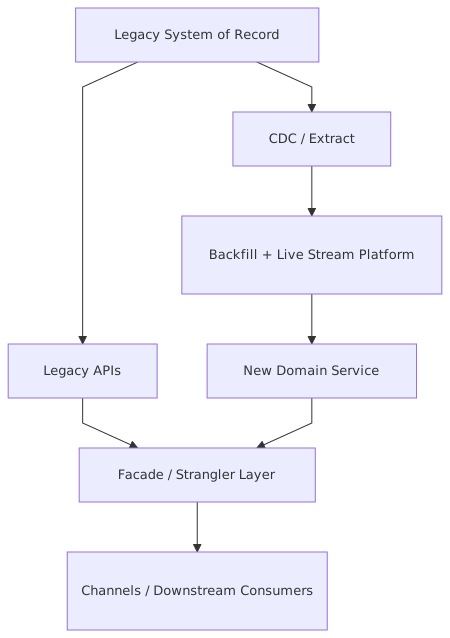
The strangler layer is a pragmatic device. It routes some capabilities to the legacy system, some to the new service, and evolves over time. During this coexistence period, backfill is what gives the new service enough historical context to behave credibly.
A sensible migration sequence looks like this:
- Establish source truth and target semantics.
Identify what business facts the new bounded context actually needs. This is harder than extracting all columns.
- Backfill into non-authoritative read models first.
Build confidence with dashboards, search, customer views, or decision support before moving transactional authority.
- Introduce live tail processing.
Once the historical baseline is loaded, continue with CDC or domain events from a clear watermark.
- Run reconciliation in parallel.
Compare legacy and new outputs, not just row counts. Compare domain outcomes.
- Shift selected business flows.
Route low-risk cases or a subset of tenants, geographies, or product lines to the new platform.
- Retire legacy responsibilities incrementally.
Avoid one giant switch. Architecture should lower blast radius, not concentrate it.
Watermarks and cut lines
Every migration needs a clear line between “history” and “live.” Without one, you invite duplicates and gaps.
Typical cut-line mechanisms include:
- source commit timestamp
- monotonically increasing change number
- business effective date
- Kafka offset checkpoint
- batch extraction ID combined with CDC LSN
Be careful here: business time and system time are not the same. A claim created today may be effective for an incident from last month. A payment correction can alter prior accounting periods. If downstream behavior depends on business effective time, a cut-line based only on database commit time may be insufficient.
That is not a reason to despair. It is a reason to be explicit.
Reconciliation discussion
Reconciliation is the grown-up part of migration. It answers the question nobody wants to ask in steering committees: How will we know we are wrong?
You need reconciliation on at least three levels:
- Record-level: Was every eligible source entity represented in the target?
- State-level: Does the target aggregate state match source truth within defined rules?
- Outcome-level: Do business decisions or downstream outputs align?
For example, in insurance:
- record-level says every active policy exists in the new service
- state-level says policy premium, status, endorsements, and coverage dates align
- outcome-level says renewal notices generated by the new platform match expected customer population
Most teams stop at record counts. Record counts are comforting and often useless.
A strong backfill design includes:
- source identifiers carried through lineage
- deterministic transformation versioning
- exception queues for unclassifiable data
- rerunnable backfill partitions
- reconciliation dashboards by domain slice, not just technical topic metrics
Enterprise Example
Consider a global retailer modernizing order fulfillment.
The legacy estate has:
- a monolithic ERP
- store inventory databases
- an e-commerce platform
- nightly stock adjustment jobs
- batch file integrations to warehouses
The target architecture introduces Kafka, domain-oriented microservices, and an event-driven fulfillment platform. New services include Order Service, Inventory Reservation Service, Shipment Orchestration Service, and Customer Notification Service.
The business requirement sounds simple: the new platform must understand all open orders and current inventory before it can take live traffic.
Simple requirements are often where complexity hides.
The domain challenge
Legacy systems disagree on semantics:
- the ERP tracks “booked orders”
- e-commerce tracks “submitted carts”
- stores track “allocated picks”
- warehouse feeds report “release status”
None of these map directly to the new fulfillment bounded context. An “open order” in one system may already be partially shipped in another. Inventory may be counted physically, financially, or reservably depending on source. If you backfill naively, the new reservation engine will overpromise stock and customers will get split shipments or cancellations.
So the architecture team defines explicit domain concepts:
- Customer Order
- Fulfillment Line
- Reservable Inventory
- Shipment Leg
- Exception Hold
Then they build a semantic translation layer that composes multiple sources. It does not just ingest rows; it determines business meaning.
The migration approach
They choose snapshot backfill plus live tail.
- Extract all open orders and inventory positions as of a defined watermark.
- Translate source data into canonical domain events and state snapshots.
- Load target services and read models.
- Start CDC from the watermark on ERP and store inventory databases.
- Reconcile reservations, shipment releases, and cancellation decisions daily.
- Route a subset of online orders in one region through the new orchestration service.
- Expand region by region.
This is progressive strangler migration in practice. The legacy ERP remains system of record for some flows while the new platform gains authority incrementally.
What they learned
First, synthetic events were useful but limited. For old orders, they could infer OrderAccepted and InventoryReserved, but not every intermediate business step. So they decided that historical events were valid for state reconstruction and analytics, but not for customer-facing notification replay. Good choice. Nobody wants to send three-year-old “your item has shipped” messages because a replay pipeline got enthusiastic.
Second, reconciliation had to be domain-specific. Technical checks showed 99.8% row match. But business reconciliation found a more serious issue: bundle products were treated as reservable units online but as decomposed components in stores. The new platform initially reserved both, effectively double-counting stock. Classic enterprise problem: the data moved correctly; the meaning did not.
Third, topic design mattered. They separated:
- backfill control topics
- synthetic domain event topics
- live domain event topics
- reconciliation exception topics
That kept consumers from accidentally mixing migration noise with business-as-usual processing.
Here is a simplified lifecycle:
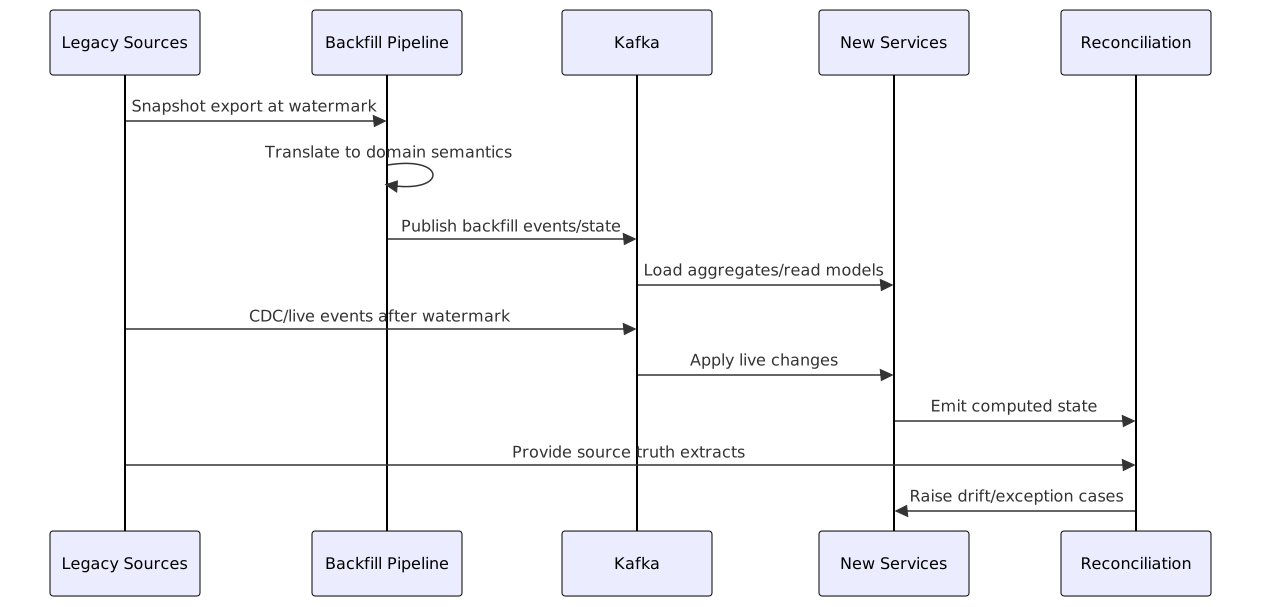
The retailer eventually retired several nightly interfaces and reduced fulfillment latency from hours to seconds. But the success was not because Kafka magically fixed integration. It was because the team treated backfill as a domain migration problem rather than a data plumbing task.
Operational Considerations
Backfill architecture lives or dies in operations.
Idempotency
Every stage must tolerate retries. Historical extracts rerun. publishers crash. consumers rebalance. duplicate records happen. If a backfill cannot be rerun safely, it is a one-shot stunt, not an enterprise capability.
Use stable business keys, deterministic event IDs, and versioned transforms.
Throughput isolation
Backfill can swamp live traffic if you let it. Separate topics, quotas, consumer groups, or even clusters may be justified for very large migrations. If your customer checkout latency degrades because a history load is saturating brokers, you have designed recklessly.
Schema governance
Backfill payloads should be explicit about origin and semantics:
- source system
- extract time
- business effective time where known
- transform version
- synthetic versus native event marker
Consumers need to know what they are looking at.
Observability
Standard streaming metrics are necessary but insufficient. Lag, throughput, and partition skew matter, but so do:
- entities processed by domain type
- rejection rates by semantic rule
- reconciliation drift by business category
- stale watermark detection
- duplicate suppression counts
Metrics should tell a migration story, not just a broker story.
Data quality and exception handling
Some history will be incomplete, contradictory, or malformed. Build for it.
Create explicit exception streams and triage processes. Silent dropping is poison. In large enterprises, the ugly records are usually where the business risk lives.
Retention and compaction choices
Compacted topics are useful for current-state backfill. Immutable append topics are better when downstream replay or audit is required. Many estates need both. There is no virtue in forcing one retention model onto every domain.
Tradeoffs
There is no universal best strategy. There are only tradeoffs made visible.
Snapshot plus live tail is simple and practical, but it may lose detailed transition history.
Raw event replay preserves original sequence, but only if the original events were high quality and still consumable.
Synthetic event reconstruction helps bridge legacy gaps, but it introduces interpretation risk.
Direct read-model rebuild is fast and often sufficient, but it bypasses event-centric invariants and may not serve future replay needs.
Another tradeoff is organizational. Central platform teams often want a generic backfill framework. Domain teams need semantic control. Both are right. The answer is usually a shared technical backbone with domain-owned translation rules. Platforms should standardize mechanics, not meaning.
A final tradeoff is speed versus certainty. If you wait until every edge case is modeled, modernization will stall. If you rush without reconciliation, drift will become production reality. Mature architecture accepts staged certainty: most critical semantics first, measured expansion after.
Failure Modes
Backfill failures are rarely dramatic at first. They are subtle, cumulative, and expensive.
Semantic drift
The target receives technically valid records that encode the wrong business meaning. This is the most dangerous failure because systems continue operating while gradually corrupting decisions.
Duplicate authority
Legacy and new systems both act on the same business entity without clear ownership boundaries. You get double notifications, conflicting reservations, or inconsistent customer balances.
Gap at the cut line
Snapshot finishes at one timestamp, live stream starts at another, and the overlap logic is wrong. Some records are lost; others are double-applied. This happens more often than teams admit.
Ordering illusions
Historical records are published in extraction order rather than business causal order. Consumers compute impossible states and then cache them confidently.
Poison consumers
Backfill payloads trigger edge paths in consumers never tested against historical variation. A consumer built for pristine live events chokes on old nulls, legacy enums, or synthetic event sequences.
Reconciliation theater
The program reports “successful migration” because row totals align, while high-value business outcomes are wrong. A dangerous kind of success.
When Not To Use
Streaming backfill is powerful, but it is not always the right tool.
Do not use it when:
- the target only needs a small, static reference dataset better handled by simple batch load
- the cost of reconstructing historical semantics exceeds the business value of that history
- the source data is so poor that synthetic event generation would create fiction rather than useful truth
- strict transactional migration with atomic cutover is required and coexistence is not acceptable
- the domain is low-change and a periodic snapshot is entirely adequate
- downstream consumers cannot safely distinguish historical synthetic events from live business events
Sometimes a plain old migration script and a maintenance window are the honest answer. Architects should not force streaming into places where it adds ceremony but not value.
Related Patterns
Several adjacent patterns often appear alongside backfill.
- Change Data Capture (CDC): useful for live tailing and sometimes for historical reconstruction, but not a substitute for domain modeling.
- Outbox Pattern: helps future event quality by publishing reliable domain events from transactional services.
- Event Sourcing: ideal for replay if you already have it; very expensive to retrofit just to solve migration.
- CQRS Read-Model Rebuild: often preferable when the target concern is query optimization, not business event fidelity.
- Strangler Fig Pattern: the practical migration posture for most legacy replacement programs.
- Competing Consumers and Idempotent Consumer: operational necessities when replay and retries are involved.
- Reconciliation Pipeline: not glamorous, but essential in enterprise transformation.
These patterns are cousins, not substitutes. A good architecture uses them in combination.
Summary
Backfill is where event streaming architecture meets the real enterprise: old systems, new domains, conflicting truths, and no permission to stop the business.
The right strategy begins by asking what the target actually needs: current state, historical sequence, or simply enough context to operate safely. From there, the architecture should separate extraction from semantic translation and isolate historical ingestion from live processing. That keeps technical plumbing from smuggling domain ambiguity into downstream services.
Domain-driven design matters here because migration is fundamentally about meaning. A backfill that preserves bytes but loses business semantics is not a success. It is deferred failure.
Progressive strangler migration is usually the safest path. Build historical baseline, tail live changes, reconcile relentlessly, and shift authority a little at a time. Respect watermarks. Design for idempotency. Expect ugly data. Assume some source records cannot be mapped cleanly. Architecture that cannot admit ambiguity is architecture headed for production incidents.
The memorable line is this: streams are easy; truth is hard.
If you treat backfill as a first-class migration capability, with domain semantics, reconciliation, and operational discipline, event streaming can modernize the enterprise without rewriting history badly. If you treat it as a bulk copy with Kafka branding, it will eventually remind you that the business keeps score.
Frequently Asked Questions
What is event-driven architecture?
Event-driven architecture (EDA) decouples services by having producers publish events to a broker like Kafka, while consumers subscribe independently. This reduces direct coupling, improves resilience, and allows new consumers to be added without modifying producers.
When should you use Kafka vs a message queue?
Use Kafka when you need event replay, high throughput, long retention, or multiple independent consumers reading the same stream. Use a traditional message queue (RabbitMQ, SQS) when you need simple point-to-point delivery, low latency, or complex routing logic per message.
How do you model event-driven architecture in ArchiMate?
In ArchiMate, the Kafka broker is a Technology Service or Application Component. Topics are Data Objects or Application Services. Producer/consumer services are Application Components connected via Flow relationships. This makes the event topology explicit and queryable.