⏱ 21 min read
Distributed systems rarely fail in the places architects draw on whiteboards. They fail in the seams. In the tiny gap between “the database commit succeeded” and “the event was published.” That gap looks harmless in a design review. In production, it becomes a graveyard of lost business facts, duplicated messages, broken projections, phantom orders, and audit trails that cannot explain what really happened.
This is why the transaction outbox pattern matters.
Not because it is fashionable. Not because Kafka made asynchronous integration popular. But because enterprises run on records of truth, and records of truth become dangerous when state changes and business events drift apart. If an Order is marked as paid in the database but the PaymentReceived event never leaves the service, then the architecture has done something worse than failing: it has lied.
The outbox pattern is one of those rare integration patterns that earns its keep the hard way. It accepts that distributed transactions across a service database and a broker are usually the wrong fight to pick. Instead, it makes a stricter promise: if a business transaction commits, the corresponding event will be durably recorded in the same transaction and published later in a reliable, observable way.
That sounds modest. It is not. It is the difference between hoping two technologies behave atomically and designing a system that acknowledges reality.
This article goes deep into the transaction outbox pattern in event-driven microservices, including the outbox flow diagram, domain semantics, migration strategy, Kafka considerations, reconciliation, failure modes, and the uncomfortable tradeoffs that experienced architects learn not to hide. event-driven architecture patterns
Context
Microservices changed how teams package change, not the laws of consistency. A service owns its data. It modifies state in its database. It informs the rest of the estate through events. That is the promise. Yet the moment you split state mutation from event publication across two technologies—say PostgreSQL and Kafka—you invite inconsistency.
A classic enterprise flow makes the problem concrete:
- Customer submits an order.
- Order Service validates business rules and writes an order row.
- It should then publish
OrderPlaced. - Inventory, Payment, Fulfillment, and Analytics subscribe.
Now ask the ugly questions:
- What if the order row commits and Kafka publish fails?
- What if Kafka publish succeeds but the service crashes before it records local status?
- What if retries produce duplicate events?
- What if consumers observe
OrderCancelledbeforeOrderPlacedfor the same aggregate because of partitioning mistakes or replay behavior?
These are not edge cases. They are Tuesday.
The transaction outbox pattern exists for one reason: to protect business truth when local transaction boundaries and messaging boundaries do not line up. It is especially relevant in event-driven architectures built on Kafka, RabbitMQ, Pulsar, or cloud messaging services, and in domains where events are not mere notifications but facts with downstream consequences.
This is where domain-driven design thinking matters. We are not simply moving rows around. We are expressing domain events that carry business meaning: InvoiceIssued, ShipmentDispatched, PolicyBound, ClaimApproved. The outbox pattern is not just a messaging trick. It is a mechanism for preserving domain semantics across boundaries.
Problem
The naive implementation is almost always the same:
- Start application transaction.
- Update business state in the database.
- Commit.
- Publish event to broker.
Or the reverse:
- Update business state.
- Publish event.
- Commit.
Both are broken in different ways.
If the database commit happens first and publication fails, then the service state has changed but the rest of the world never hears about it. Downstream services remain stale. In a choreography-based system, the process simply stops. In reporting systems, data drifts. In regulated environments, auditability becomes suspect.
If the event is published first and the database commit later fails, then consumers react to something that never actually happened. That is worse. A false event is poison. It causes compensations, reversals, support calls, and expensive forensic analysis.
The obvious response is “use a distributed transaction.” In practice, that is often a trap. Two-phase commit across databases and brokers is operationally heavy, poorly supported across many modern platforms, and deeply at odds with the autonomy goals of microservices. Architects who reach for XA usually rediscover why the industry spent years moving away from it. microservices architecture diagrams
So the real problem is this:
How do we ensure that a business state change and the publication of its corresponding event are tied together reliably, without distributed transactions?
That is the question the transaction outbox answers.
Forces
Every pattern survives because it balances real forces. The outbox pattern is no different.
1. Atomicity of business facts
When a service changes business state, the domain event describing that change must not be optional. In many domains, the event is part of the business outcome, not an integration side effect.
A useful mental model: the database row is the local truth; the event is the exported truth. Enterprises get into trouble when those two truths diverge.
2. Microservice autonomy
Each service should own its persistence and messaging decisions. Coordinating a global transaction across storage and broker erodes that autonomy and creates tight runtime coupling.
3. At-least-once reality
Brokers, networks, connectors, and consumers fail. Retrying is inevitable. Exactly-once is a narrow technical property in specific scopes; it is not a substitute for business-level idempotency. The outbox pattern embraces this rather than denying it.
4. Ordering requirements
Many domains care about event order per aggregate. If AccountOpened, FundsDeposited, and AccountFrozen arrive out of order, downstream projections may become invalid. The outbox design must preserve enough sequencing to support business semantics.
5. Operability
Architectures that are elegant but opaque do not survive enterprise operations. The platform team needs observable lag, replay capability, dead-letter handling, reconciliation jobs, and cleanup strategies. The outbox adds reliability, but it also adds moving parts.
6. Migration constraints
Most enterprises are not greenfield. They are dragging decades of packaged systems, batch interfaces, direct database integrations, and brittle ESB flows behind them. The outbox pattern needs to fit progressive migration, not demand a heroic rewrite.
Solution
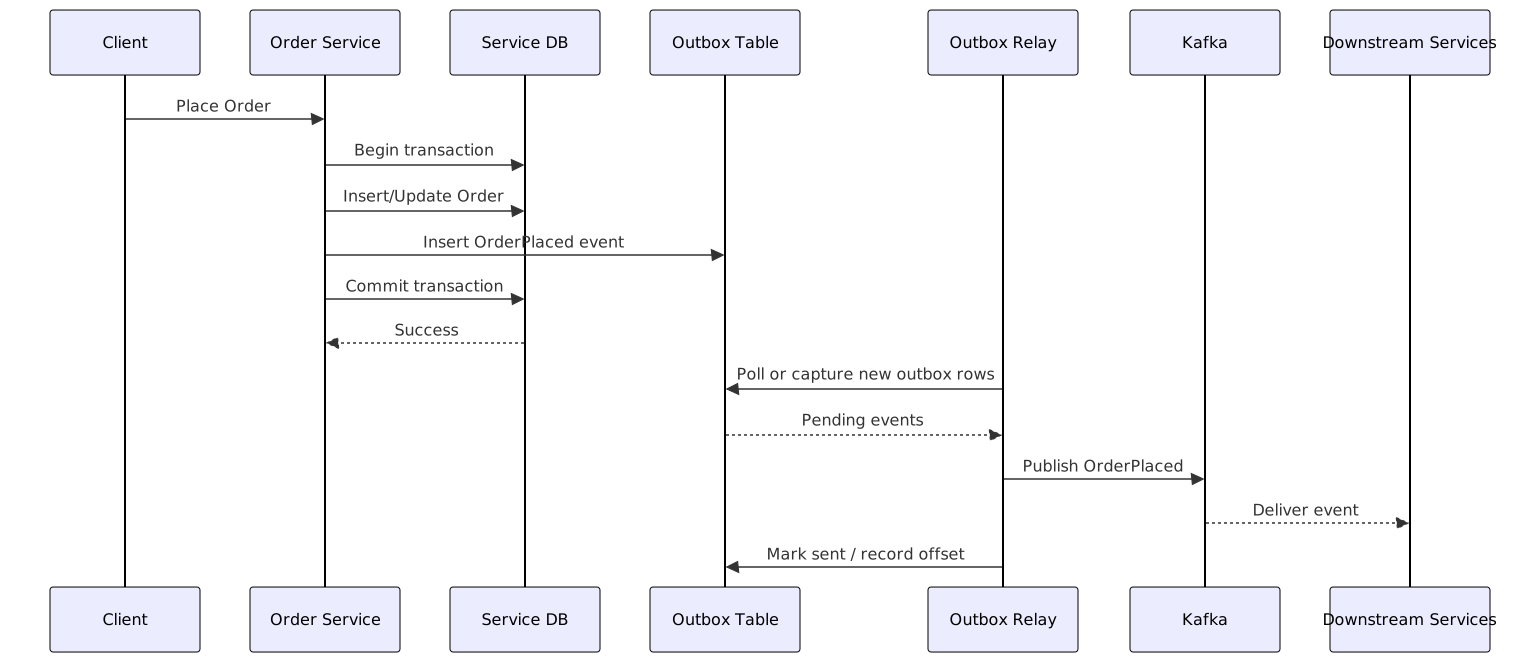
The transaction outbox pattern stores the event in an outbox table inside the same database transaction that updates the business data. A separate relay process later reads unsent outbox records and publishes them to the message broker.
That is the pattern in one sentence. The power is in the details.
Inside the service transaction:
- Persist the aggregate change.
- Persist one or more outbox records representing domain or integration events.
- Commit once.
After commit:
- A publisher process reads pending outbox entries.
- Publishes them to Kafka or another broker.
- Marks them as sent, or records publication metadata.
The key move is subtle and profound: we move the atomic boundary from database-plus-broker to database-only. We stop pretending the broker can participate in the transaction. We instead make event creation part of the same durable local commit as the business state change.
Here is the core outbox flow diagram.
There are two common implementation styles:
- Polling publisher
An application component or background worker periodically queries the outbox table for unsent rows and publishes them.
- Transaction log capture / CDC
Change data capture tooling such as Debezium reads database log changes and streams outbox rows to Kafka. This reduces polling overhead and often scales better.
Both are valid. Neither is magic.
A good outbox record usually includes:
event_idaggregate_typeaggregate_idevent_typepayloadheadersor metadataoccurred_atsequence_numberor versionstatuspublished_at- correlation or trace identifiers
- tenant or business partition key where relevant
This structure matters because events are not just transport envelopes. They are domain statements. A PolicyCancelled event should mean the same thing in underwriting, billing, customer communication, and analytics. If event names and payloads are sloppy, the outbox will faithfully publish nonsense at scale.
Architecture
The basic shape is simple. The enterprise-grade shape is not.
Core components
- Domain model / application service
- Transactional database
- Outbox table
- Relay or CDC connector
- Kafka topic(s)
- Consumers with idempotency
- Monitoring and reconciliation
A typical service flow looks like this:

Domain semantics first, integration second
This is where many implementations go sideways. Teams often treat the outbox as a technical dump of CRUD changes. That produces low-value event streams like CustomerUpdated with a giant payload and no bounded meaning. Consumers then scrape fields and infer business intent. That is not event-driven architecture. It is remote database coupling with extra steps.
With domain-driven design, the outbox should capture meaningful domain events generated by aggregate behavior. For example:
OrderPlacedOrderConfirmedPaymentAuthorizedShipmentPacked
These events emerge from domain decisions, not table updates. The aggregate version can become the event sequence anchor. That gives ordering and supports deterministic replay per aggregate.
There is often a second layer of events too: integration events. Domain events are internal and rich with business language; integration events are externalized contracts shaped for other services. Some teams publish domain events directly. Others map them into integration events in the relay layer or application layer. The tradeoff is between purity and stability.
My bias: keep the domain language intact inside the service boundary, and publish integration contracts deliberately. Enterprise estates change. An event stream lasts longer than the team that first emitted it.
Ordering and Kafka partitioning
If ordering matters per aggregate, partition by aggregate identifier. That keeps all events for one entity on the same Kafka partition and preserves relative order for that key.
But be careful: ordering is not global. Kafka gives order within a partition, not across topics or the whole system. If downstream logic assumes total order across all business events, the architecture is lying again.
A practical pattern is:
- Topic by business capability or aggregate family
- Key by aggregate ID
- Include aggregate version or sequence in payload/header
- Consumers validate monotonic progression where necessary
Relay design choices
The relay can be:
- Embedded worker in the service
- Separate publisher service
- CDC connector streaming directly from the database log
Polling is straightforward and easy to understand. It can also be wasteful, create lock contention if done poorly, and introduce lag spikes under load.
CDC is elegant at scale and often pairs naturally with Kafka. But it introduces platform complexity, connector operations, schema management concerns, and a stronger dependency on database log access.
There is no universal winner. In a modest estate, a polling relay is often enough. In a high-throughput platform with dozens of services and Kafka as the backbone, CDC is frequently the better long-term choice.
Data retention and cleanup
Outbox tables grow relentlessly if ignored. That is one of the unglamorous truths of the pattern. You need a retention policy:
- delete sent rows after a safe period
- archive for audit if required
- partition large tables by date or status
- ensure cleanup does not interfere with relay scans
Outbox tables are operational assets, not just developer conveniences.
Migration Strategy
No serious enterprise adopts the outbox pattern everywhere in one sweep. That is fantasy architecture. The right move is a progressive strangler migration.
Start where consistency pain is highest: order capture, payments, claims, booking, policy administration, customer master, fulfillment. Places where missed events cost money or trust.
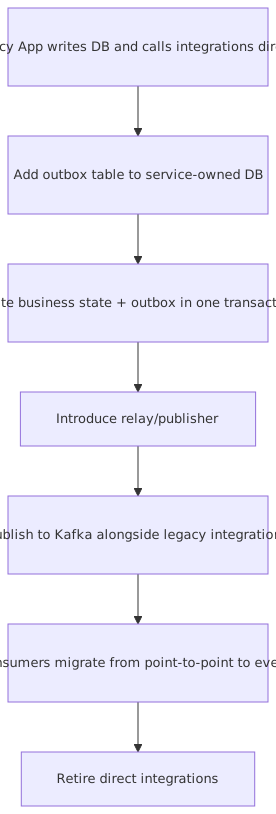
A useful migration progression looks like this:
Step 1: Identify transactional seams
Find use cases where state changes and notifications are split today. Usually these are implemented with:
- synchronous REST calls after commit
- broker publish in application code without local durability
- ESB mediation after database updates
- triggers writing to integration tables
- batch extraction jobs
Catalog them by business criticality and failure impact.
Step 2: Introduce the outbox in one bounded context
Do not start with the entire platform. Pick one bounded context with a clear aggregate boundary. Orders are ideal. So are invoices. Avoid the most politically entangled legacy domain first.
Write both aggregate state and outbox rows in one transaction. Keep the existing integration path running if needed.
Step 3: Dual publish carefully
During migration, you may publish events while also maintaining legacy interfaces. This is dangerous because divergence can emerge between the old channel and the new one. Put reconciliation in place from day one.
Step 4: Move consumers incrementally
Let one or two downstream services consume the Kafka event instead of direct service calls or database extracts. Prefer read-side or non-critical consumers first, then core process participants.
Step 5: Strangle old paths
Once confidence is established, retire direct couplings: synchronous fan-out, fragile ETL jobs, or ESB routes that duplicate event semantics.
Reconciliation is not optional
Migration always creates periods where two integration truths coexist. You need reconciliation jobs and business controls, not just technical hope.
Reconciliation typically compares:
- committed business rows vs outbox rows
- outbox rows vs broker offsets or publication markers
- published events vs consumer-applied projections
- source-of-record counts vs downstream materialized views
A mature architecture assumes drift will happen and makes drift visible. This is not pessimism. It is professionalism.
Enterprise Example
Consider a global retailer modernizing its order management platform.
The legacy estate had an ERP system, a web commerce platform, a warehouse system, a CRM, and finance applications. Order creation happened in a central order database. After commit, the application synchronously called inventory reservation, customer notification, fraud screening, and reporting interfaces. Some were REST APIs, some MQ messages, some direct database writes through integration middleware.
The symptoms were painfully familiar:
- Orders occasionally persisted without inventory reservation.
- Notifications were sent for orders later rolled back due to downstream failures.
- Peak-season retries generated duplicate fulfillment requests.
- Reporting lagged by hours because one extractor fell behind.
- Support teams had no single place to answer, “Was the order event actually emitted?”
The retailer did not replace everything. That would have been career-ending architecture. Instead, they introduced the outbox pattern inside a new Order Service bounded context.
What changed
When an order was placed:
- Order aggregate state was written to PostgreSQL.
- An
OrderPlacedintegration event was inserted intoorder_outboxin the same transaction. - Debezium captured outbox changes from the database log and published to Kafka.
- Inventory, Fraud, CRM, and Analytics consumed from Kafka.
- Existing ERP feeds remained temporarily in place.
Domain semantics mattered
The team resisted publishing generic table-change events. Instead, they defined explicit business events:
OrderPlacedOrderConfirmedOrderBackorderedOrderCancelled
Each event had a business owner and semantic definition. That sounds bureaucratic until the first conflict. Finance wanted “confirmed” to mean payment settled. Operations wanted it to mean accepted for fulfillment. Without clear domain semantics, event names become political fiction.
Results
The architecture did not eliminate duplicates; it made them manageable. Consumers implemented idempotency keys using event_id and aggregate version checks. Event lag became visible through dashboards. A reconciliation job compared orders in “placed” status with outbox publication markers and Kafka topic counts.
Within six months:
- order integration failures became traceable end-to-end
- direct synchronous fan-out reduced dramatically
- support could inspect a single outbox lineage per order
- downstream teams decoupled release cycles from the Order Service
The retailer still had hard problems. Warehouse systems could be offline. Fraud scoring could return late. ERP interfaces remained cranky. But the system stopped losing facts in the crack between database and broker. That alone paid for the pattern.
Operational Considerations
This is the section many articles skip. It is also where systems live or die.
Idempotency everywhere it matters
The outbox relay may publish a message more than once. Kafka producers may retry. Consumers may replay after failure. Therefore:
- each event needs a stable unique ID
- consumers must deduplicate or make handlers naturally idempotent
- side effects such as email, payment capture, or shipment creation need business dedupe keys
If your consumers cannot tolerate duplicates, the outbox will expose that weakness quickly.
Monitoring lag
Track at least:
- age of oldest unsent outbox row
- count of unsent rows
- publish error rates
- time from
occurred_atto broker publish - consumer lag for key downstream services
The outbox is a queue in disguise. Queues demand visibility.
Relay concurrency
If multiple relay instances run, coordinate safely:
- claim rows with status transitions
- use
SELECT ... FOR UPDATE SKIP LOCKEDwhere appropriate - avoid double-publishing races
- ensure retries do not starve older failed rows forever
Schema evolution
Events evolve. Consumers linger. Contracts survive longer than code. Version your event schemas deliberately and prefer additive changes. If using Kafka with schema registry, make compatibility rules explicit. If using JSON without governance, prepare for accidental breaking changes. EA governance checklist
Security and compliance
Outbox payloads often contain sensitive business data. Do not dump the entire aggregate blindly into the payload. Apply data minimization, field-level encryption where needed, tenant isolation, and retention controls that align with regulation.
Reprocessing and replay
Replaying from Kafka may rebuild projections, but it does not solve every reconciliation need. Sometimes you must republish outbox records for a time window or regenerate integration events from business state. Design for this before an incident forces the issue.
Tradeoffs
The transaction outbox pattern is good. It is not free.
What you gain
- reliable coupling of local state change and event recording
- no distributed transaction between database and broker
- improved auditability and observability
- better support for event-driven microservices
- controlled publication pipeline for Kafka and other brokers
What you pay
- more tables, code, and operational machinery
- eventual consistency instead of immediate broker publication
- duplicate delivery risk remains
- cleanup and retention become real concerns
- ordering is limited and must be designed carefully
- reconciliation work is now part of the architecture
This is the central tradeoff: the outbox buys consistency of intent, not instantaneous consistency of propagation.
That is usually the right bargain. But be honest about it. A system can commit business state and still take seconds—or longer under incident conditions—to publish the event. If downstream actions are user-visible, product teams need to understand those semantics.
Failure Modes
Patterns are best understood by how they fail.
1. Relay stalled
The service commits business data and writes outbox rows, but the relay stops due to deployment failure, credentials issue, or connector outage. Events accumulate. The system is internally correct but externally silent.
Mitigation:
- monitor lag aggressively
- make relay health first-class
- support safe catch-up after outage
2. Duplicate publication
The relay publishes to Kafka, crashes before marking the outbox row sent, restarts, and republishes.
Mitigation:
- at-least-once assumptions
- idempotent consumers
- event IDs and dedupe stores where needed
3. Out-of-order events
Rows are published in a different order than aggregate changes, or partition keys are wrong, or consumers process concurrently without regard to sequence.
Mitigation:
- partition by aggregate ID
- include sequence/version
- validate order-sensitive consumers
4. Payload drift
The outbox event schema changes incompatibly. Some consumers break silently, others misinterpret the event.
Mitigation:
- contract governance
- schema compatibility rules
- consumer contract testing
5. Table bloat and performance degradation
The outbox table becomes enormous. Polling scans slow down. Indexes balloon. Application transactions suffer.
Mitigation:
- partition tables
- archive/delete sent rows
- use CDC where polling is no longer efficient
6. Semantic mismatch
The event is technically published reliably, but it carries the wrong business meaning. This is the most expensive failure because the plumbing looks healthy while the business process rots.
Mitigation:
- event modeling with domain experts
- bounded context discipline
- explicit semantic definitions
That last one deserves emphasis. Most integration disasters are semantic, not mechanical.
When Not To Use
Architects earn trust by saying no as clearly as they say yes.
Do not use the transaction outbox pattern when the problem does not justify the machinery.
1. Simple CRUD systems with no meaningful asynchronous consumers
If no other service cares about the state change in a business-critical way, an outbox is likely overengineering.
2. Systems already built around event sourcing
If the event store is already the source of truth, the outbox may be redundant. You may still need integration publication patterns, but not necessarily a separate outbox table.
3. Very low-scale batch integrations
A nightly export with acceptable delay and straightforward recovery may not need the complexity of an outbox.
4. Domains requiring strict synchronous confirmation across participants
If the business truly demands immediate all-or-nothing behavior across multiple systems, the outbox’s eventual propagation may be unacceptable. Even then, pause before reaching for distributed transactions; often the domain can be redesigned around sagas or process states instead.
5. Teams without operational discipline
This one is blunt, but true. If the organization cannot monitor lag, manage schemas, handle retries, and implement idempotent consumers, an outbox will not save them. It will simply move the failure into a more subtle form.
Related Patterns
The outbox pattern sits in a family of patterns, and confusion between them is common.
Saga
A saga coordinates a distributed business process through events and compensations. The outbox helps publish saga-triggering events reliably, but it is not a saga itself.
Event Sourcing
Event sourcing stores events as the primary source of truth. The outbox stores events alongside state changes in a conventional persistence model. They solve different problems, though they can coexist.
Change Data Capture
CDC is often the implementation mechanism for an outbox relay. It is a transport technique, not the pattern itself. Capturing arbitrary table changes is not equivalent to publishing meaningful domain events.
Inbox Pattern
The inbox pattern records consumed messages to support idempotent handling. Outbox and inbox together create a more robust boundary: reliable send and reliable receive.
CQRS
Command-query responsibility segregation often benefits from reliable event publication to update read models. The outbox can feed those projections.
Strangler Fig Pattern
For migration, the outbox is often one of the vines wrapped around legacy integration paths. It enables progressive replacement rather than a single, risky cutover.
Summary
The transaction outbox pattern is one of the most practical answers to a stubborn problem in event-driven microservices: how to ensure a business state change and its corresponding event stay together without distributed transactions.
Its genius is not complexity. It is restraint.
Instead of demanding impossible atomicity across a database and Kafka, it narrows the atomic boundary to something we can actually control: the local transaction. Business data and outbox event commit together. Publication happens afterward through a relay or CDC pipeline. That shift turns an unreliable seam into a managed, observable flow.
But the pattern only works well when treated as part of the domain, not just middleware plumbing. Event names must reflect business semantics. Ordering must align with aggregate boundaries. Consumers must be idempotent. Reconciliation must be designed in, especially during progressive strangler migration. And operations must watch lag, retries, schema evolution, and outbox growth with the same seriousness they give any production queue.
Used well, the outbox pattern gives enterprises something precious: confidence that committed facts will not disappear on the way out of a service. Used badly, it becomes another table, another connector, and another source of false certainty.
That is the real lesson. Reliability in distributed systems does not come from optimism. It comes from designing for the crack in the sidewalk, because that is where production always finds a way to trip you.
Frequently Asked Questions
What is a service mesh?
A service mesh is an infrastructure layer managing service-to-service communication. It provides mutual TLS, load balancing, circuit breaking, retries, and observability without each service implementing these capabilities. Istio and Linkerd are common implementations.
How do you document microservices architecture for governance?
Use ArchiMate Application Cooperation diagrams for the service landscape, UML Component diagrams for internal structure, UML Sequence diagrams for key flows, and UML Deployment diagrams for Kubernetes topology. All views can coexist in Sparx EA with full traceability.
What is the difference between choreography and orchestration in microservices?
Choreography has services react to events independently — no central coordinator. Orchestration uses a central workflow engine that calls services in sequence. Choreography scales better but is harder to debug; orchestration is easier to reason about but creates a central coupling point.