⏱ 21 min read
Most enterprise systems lie about time.
Not maliciously. Usually politely. A customer record shows the current address, the current credit limit, the current account owner, the current status. Clean. Neat. Useful—right until somebody asks the awkward question: what did we believe to be true last Tuesday at 14:03, and why did we believe it? That is where many architectures stop being systems of record and start being systems of convenience.
Temporal queries exist for that awkward question.
And in event-sourced systems, they are not a luxury bolted on for auditors and compliance people. They are the natural consequence of storing history as a first-class citizen. If your event store is the ledger of the business, temporal querying is how you read the ledger as it stood at a point in time, over a time range, or under a particular business interpretation. This is where architecture gets interesting, because time in software is never just one thing. There is event time, processing time, publication time, effective time, correction time, legal time. Domains care deeply about the difference, even when databases do not.
That distinction matters. A payment “happened” when the customer authorized it. It was “recorded” when the service wrote an event. It was “observed” by downstream systems when Kafka delivered the message. It may become “effective” when settlement completes. If we collapse those into one timestamp, we are not simplifying the model. We are deleting business truth. event-driven architecture patterns
This article looks at temporal queries in event stores through the lens of enterprise architecture: domain-driven design, event sourcing, migration from transactional systems, Kafka-driven microservices, reconciliation, and the messy tradeoffs that show up in real organizations. We will cover how to structure the solution, where it fails, and when you should resist the temptation to use it at all. microservices architecture diagrams
Context
Event sourcing changes the shape of persistence. Instead of storing the latest state, we store the sequence of domain events that produced that state. The aggregate can be rebuilt by replaying events. Read models can be projected. Audit trails come almost for free. But the real architectural payoff is subtler: the system stops treating the past as discarded implementation detail.
That is especially valuable in large enterprises, where time is part of the domain. Insurance policies are backdated. Trades are corrected after the market closes. Orders are amended after submission. Entitlements change under contractual rules. Healthcare records are updated with late-arriving observations. A conventional CRUD model usually keeps only the latest row and maybe some change history for compliance. An event-sourced model keeps the decisions, facts, and transitions.
Temporal queries are the operational expression of that history. They answer things like:
- What was the account balance as of end-of-day Friday?
- Which discount rules were in force when this quote was generated?
- What did customer service see on screen before a corrective event arrived?
- Which events were known to the fraud engine at the moment it rejected the transaction?
- What was the inventory projection before the warehouse system replayed a delayed message?
Those are not niche questions. They drive disputes, reconciliation, regulatory reporting, customer support, and root-cause analysis.
Yet many teams discover too late that storing events is not enough. Temporal querying requires disciplined event semantics, predictable ordering rules, projection strategies, and a clear stance on bitemporality. Otherwise the event store becomes a diary nobody can read under pressure.
Problem
The simple story says: “just replay the stream to a timestamp.” The enterprise story is harder.
In a toy event store, each aggregate stream is ordered, events are immutable, clocks are synchronized, and one timestamp is enough. In a real company, none of that is fully true. Events arrive late. Some are corrections. Some are compensations. Some belong to multiple bounded contexts but carry different meanings. Streams may be partitioned across Kafka topics, persisted in separate stores, or rebuilt into materialized views. Teams need point-in-time answers not only for one aggregate but across customers, orders, invoices, positions, or claims.
Now the awkward questions multiply:
- Which timestamp defines “as of”? Event occurrence time or ingestion time?
- How do we answer cross-aggregate temporal queries without replaying millions of streams?
- How do we handle retroactive corrections?
- What if a read model was rebuilt after the fact—does that change historical answers?
- Can Kafka offsets serve as a temporal boundary?
- How do we reconcile event-store truth with legacy systems still acting as source of record during migration?
These are not implementation details. They are domain decisions with architectural consequences.
A surprisingly common failure is to treat temporal querying as a technical reporting feature and leave semantics vague. Teams then ship event stores where events have a single created_at, projections overwrite history, and corrections mutate read models without preserving why they changed. Months later, audit asks for “what did you know at the time?” and the architecture responds with a shrug.
Forces
Several competing forces shape temporal query design.
1. Domain truth versus technical convenience
Domain-driven design teaches us to model the language of the business, not the accidental language of storage. If the domain distinguishes occurrence, effective date, and booking date, your events probably should too. The architecture must honor ubiquitous language, even when that creates extra complexity.
2. Auditability versus performance
The purest temporal answer often comes from replaying events to the desired boundary. That is also the slowest answer at scale. Enterprises need both fidelity and operationally acceptable latency. So they introduce snapshots, temporal indexes, and precomputed projections. Every optimization trades simplicity for speed.
3. Local consistency versus distributed reality
Within an aggregate stream, order is manageable. Across aggregates and microservices, order is political. Kafka can preserve order within a partition, not across the enterprise. Temporal queries spanning many entities often require approximation, explicit consistency boundaries, or business-defined reconciliation rules.
4. Immutability versus correction
Event sourcing thrives on immutable facts. But businesses revise facts. A trade is corrected. A shipment is rebooked. A customer birth date was entered incorrectly. The trick is not whether corrections happen—they always do—but whether your model captures them as domain events with meaning rather than technical edits that erase causality.
5. Migration speed versus semantic purity
Most enterprises do not get to start greenfield. They migrate from relational systems, batch feeds, mainframes, and point-to-point integrations. During migration, the event store may not yet be the sole source of truth. Temporal queries must coexist with legacy history tables and reconciliation jobs. The architecture has to survive impurity for a long time.
Solution
The practical solution is this: treat time as a domain concept, not a database feature, and design your event store and read models around explicit temporal semantics.
That usually means four things.
First, events need more than one temporal marker. At minimum, you should distinguish:
- Occurred at: when the business fact happened.
- Recorded at: when the system accepted and persisted the event.
- Effective at: when the business wants the event to take effect, if different.
- Optionally observed at or published at for integration timelines.
Second, temporal queries should be served through purpose-built projections, not ad hoc replay of the raw store for every request. Replaying streams is fine for debugging and low-volume aggregate reconstruction. It is not how you answer enterprise-scale “show all active policies as of month-end” queries.
Third, the architecture should embrace bitemporal thinking where the domain requires it. One axis answers “what was true in the business world at this effective time?” The other answers “what did our system know at this record time?” Auditors, finance teams, and operations often need one or the other, and they are not the same question.
Fourth, every temporal answer needs an explicit consistency contract. If a query spans multiple streams or services, document whether it is:
- exact within one aggregate,
- exact within one bounded context as of a projection checkpoint,
- eventually consistent across contexts,
- or reconstructed from multiple systems and subject to reconciliation.
This is where architects earn their salary: not by hiding ambiguity, but by naming it.
Temporal semantics in the domain
Suppose we model an insurance policy. A premium adjustment may be entered today, backdated to the start of the month, and published to downstream billing tomorrow. Those are three distinct times. If the customer disputes a charge, support may ask:
- What premium was effective on the policy on March 1?
- What premium did our billing service know on March 5?
- What premium statement did the customer portal show on March 5 at 10:00?
Those are different temporal queries over related but distinct models. A good event architecture makes this explicit instead of pretending a single timestamp can answer everything.
Architecture
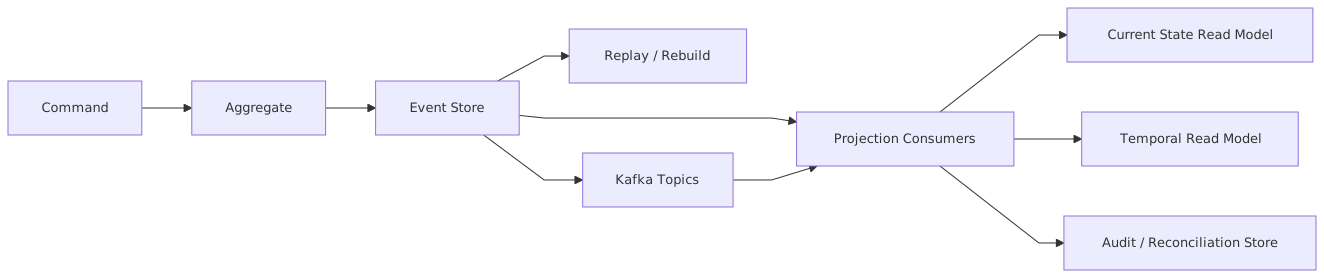
The core architecture has three layers: event store, projection pipeline, and temporal query models.
1. Event store design
The event store is the authoritative sequence of domain events per aggregate or entity stream. Each event should carry:
- event id
- aggregate id / stream id
- stream version
- event type
- payload
- metadata
- occurred_at
- recorded_at
- effective_at if applicable
- causation and correlation ids
- actor / source system if useful
Do not bury semantics in generic metadata just because the platform allows it. If effective_at matters to the business, model it explicitly and validate it in domain logic.
A useful rule: if a business user could ask about it, it belongs in the domain model, not merely in infrastructure headers.
2. Projection pipeline
Temporal queries are almost always served by projections. The projection consumers read events from the store directly or via Kafka topics and build read models optimized for query patterns.
Typical temporal projection patterns include:
- As-of snapshots: store current state plus validity intervals.
- State transition log: persist each state change with
valid_fromandvalid_to. - Periodic snapshots: checkpoint state daily/hourly to reduce replay cost.
- Versioned documents: maintain immutable versions keyed by effective range and record range.
- Ledger balances: precompute balances at meaningful boundaries like end-of-day.
For aggregate-level queries, replaying from the stream plus snapshot may be enough. For analytical or cross-entity queries, use dedicated temporal tables or OLAP stores.
3. Query models and timelines
Temporal query models should support at least these forms:
- Point-in-time by entity: “Order 123 as of 2026-02-10T14:00Z”
- Time-range history: “All status changes for claim 456 this month”
- Portfolio as-of query: “All active contracts as of quarter-end”
- Knowledge-time query: “What did system X know by cutoff T?”
- Difference query: “What changed between two temporal boundaries?”
Here is a simple timeline view of a corrected event sequence:
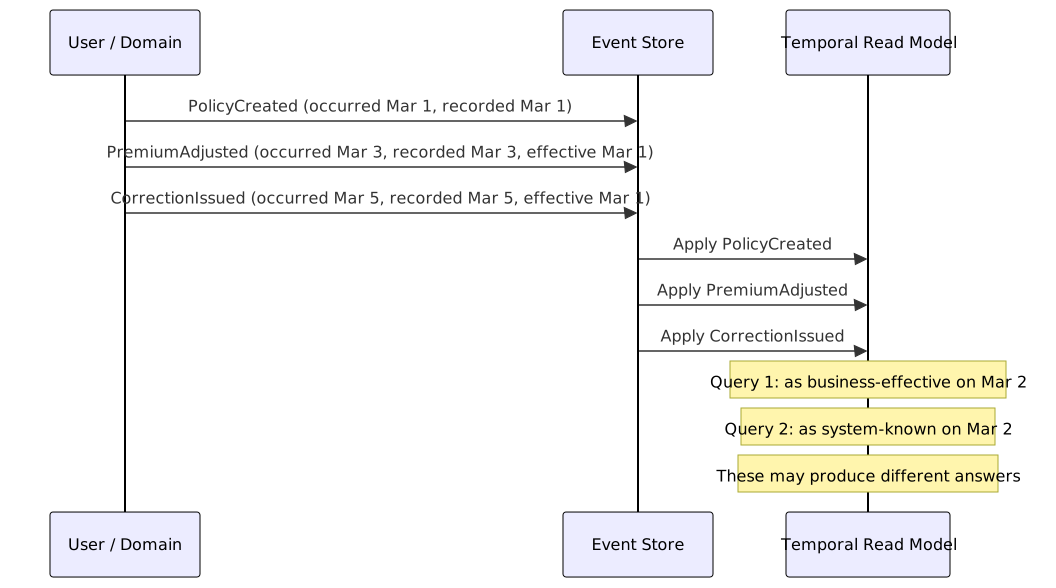
That difference is the heart of bitemporal design. Without it, backdated corrections become architectural landmines.
4. Kafka and microservices
Kafka is useful here, but not magical. It is a transport and log, not the domain model.
In a microservices estate, the event store may publish domain events to Kafka for downstream projections and integration. That is sensible. But do not confuse Kafka topic retention with durable event sourcing semantics. Kafka offsets are excellent for consumer checkpoints; they are poor substitutes for business time unless your domain explicitly defines them as such.
Use Kafka for:
- fan-out to multiple temporal projections,
- building read models in separate services,
- replaying consumers after schema evolution,
- reconciliation pipelines,
- integration with analytics or lakehouse platforms.
Do not use Kafka alone as your only answer to temporal querying unless you are willing to own the retention, ordering, compaction, schema governance, and replay semantics as part of your event store contract. EA governance checklist
5. Bounded contexts matter
Temporal queries should respect bounded contexts. “Account balance” in payments may not mean the same thing as “available funds” in treasury. “Customer address” in CRM may differ from “risk domicile” in compliance. A single enterprise-wide temporal model is often a fantasy with a large budget.
Use domain-driven design to define where temporal truth is authoritative. Then integrate between contexts with published language and explicit translation. Otherwise you end up with temporal inconsistency disguised as data integration.
Migration Strategy
This is where theory meets mud.
Most organizations adopting event sourcing already have a transactional system with current-state tables, history tables, CDC feeds, nightly batches, and a compliance archive nobody trusts. The mistake is to demand a big-bang migration to pure event sourcing. That is not architecture. That is theatre.
Use a progressive strangler migration.
Start by identifying one bounded context where temporal queries deliver real business value: claims adjustments, order lifecycle, billing changes, entitlement management, trade corrections. Introduce event capture there first. Build temporal read models for one or two high-value queries. Keep the legacy system alive while proving semantics and operational fitness.
A practical migration path looks like this:
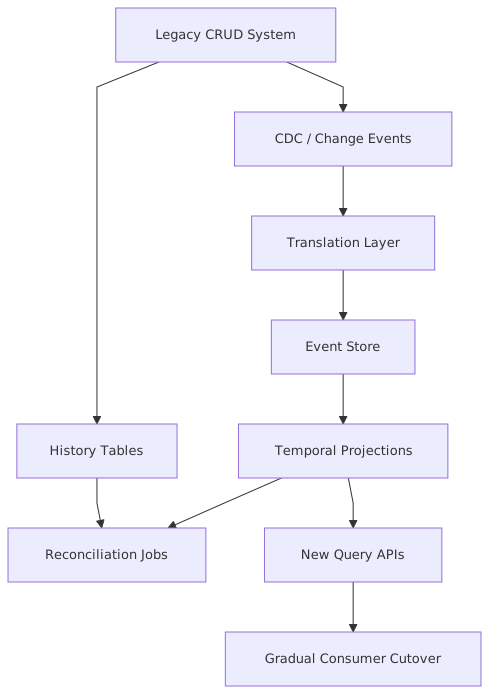
Step 1: mine and translate history carefully
Legacy tables do not contain domain events. They contain state transitions implied by row changes. That is not the same thing. A changed status column from PENDING to APPROVED may reflect one business event, several hidden decisions, or a technical correction. Translation needs domain knowledge.
This is where domain experts matter. Sit with operations, finance, compliance, and support. Ask what transitions actually mean. Event sourcing punishes lazy semantics.
Step 2: dual-run temporal queries
Run new temporal projections alongside existing reports. Compare answers. Expect disagreements. Some will reveal bugs in the new model. Others will expose hidden flaws in legacy reports that have gone unnoticed for years. That is healthy. Reconciliation is not just a validation step; it is a discovery process.
Step 3: introduce reconciliation as a product capability
Reconciliation is not a temporary migration script. In large enterprises it becomes a permanent feature. Late events, integration gaps, and correction workflows never disappear entirely. Build tooling to compare:
- event-store-derived state,
- legacy source state,
- downstream service projections,
- and financial or operational control totals.
Track deltas, aging, and root causes.
Step 4: cut over query consumers gradually
Move APIs and reporting consumers to the new temporal read models incrementally. Do not force all use cases onto one projection. Customer support may need knowledge-time views; finance may need effective-time month-end views; operations may need processing-time views.
Step 5: retire or constrain legacy write paths
The dangerous middle state is allowing uncontrolled writes into both old and new systems. Strangler migration works only when write authority becomes progressively narrower. Otherwise reconciliation becomes archaeology.
Enterprise Example
Consider a multinational insurer modernizing policy administration.
The legacy platform stored the current policy state in Oracle, with some change-history tables and nightly exports to billing, claims, CRM, and regulatory reporting. Customer disputes were painful because support could see current premium and endorsements, but not reliably answer what the customer had been entitled to when an invoice was generated. Backdated endorsements were common. Corrections were routine. Regulators cared about both effective dates and booking dates.
The insurer introduced event sourcing for the policy bounded context, not the whole enterprise. Each policy became an aggregate stream with events such as:
PolicyCreatedCoverageAddedCoverageRemovedPremiumRecalculatedEndorsementAppliedEndorsementCorrectedPolicyCancelledReinstatementProcessed
Each event carried occurred, recorded, and effective dates. The event store published events to Kafka. Three projections were built:
- Current servicing view for the customer service portal.
- Effective-time policy timeline for quote, billing, and dispute analysis.
- Record-time audit ledger for compliance and operational investigation.
The migration started with endorsements only. Legacy policy creation still happened in the old platform, but endorsement changes were translated into domain events and persisted in the new store. Temporal query APIs were introduced for support users handling billing disputes.
What happened in practice?
First, the team discovered that “policy effective date” meant three different things depending on the department. Good. Better to discover that in architecture workshops than in court.
Second, reconciliation surfaced hundreds of historical anomalies where legacy nightly batches had overwritten adjustments in downstream billing. The event-derived timeline showed exactly when the business intended a change, when the core system recorded it, and when billing consumed it. This transformed dispute resolution from argument to evidence.
Third, they learned a hard lesson about Kafka. A few downstream teams assumed topic order across partitions represented enterprise time. It did not. During a replay, some temporal reports came out inconsistent because consumers mixed policy-level exactness with portfolio-level approximation. The fix was not more infrastructure. It was a sharper consistency contract and dedicated as-of projection checkpoints.
Over two years, the insurer strangled more policy change workflows into the event-sourced context, then exposed curated events to billing and claims. They did not event-source everything. Customer correspondence and static reference data remained conventional. Sensible architecture is selective.
Operational Considerations
Temporal architectures are elegant in whiteboard sessions and expensive in production if you ignore operations.
Storage growth
Events accumulate forever, or at least for a very long time. Temporal projections can be even larger than the raw event store, especially if you keep full versioned state. Compression, archival policy, snapshot frequency, and retention strategy matter. If regulation allows archival tiers, use them. If not, budget honestly.
Rebuild time
Any serious event-sourced system must be able to rebuild projections. The question is how long that takes and what you do while it happens. Design for:
- projection checkpoints,
- parallel rebuild,
- deterministic replay,
- backfill windows,
- and query degradation behavior during rebuild.
A projection that takes five days to rebuild is not a read model. It is a hostage situation.
Schema evolution
Events are immutable; schemas are not. Temporal querying amplifies schema evolution pain because old events remain queryable. Use versioned event contracts, upcasters where needed, and disciplined compatibility rules. Test replay across historical data, not just current payloads.
Clock discipline
If you rely on timestamps, your clocks matter. Use synchronized infrastructure clocks, but more importantly validate domain-provided times. A branch system may submit a backdated event with legitimate business meaning. Another may submit nonsense because of local clock drift. Your model should distinguish those cases.
Security and privacy
History is useful until it is sensitive. Temporal stores often preserve personal data longer and more completely than CRUD systems. That collides with privacy rules. You need patterns for redaction, tokenization, cryptographic shredding, or payload minimization while preserving event integrity. This is one of the places where “immutable” meets regulation and loses the argument unless designed carefully.
Observability
You need to observe:
- event ingestion lag,
- projection lag,
- replay backlog,
- reconciliation deltas,
- late-arriving event volume,
- correction rates,
- and query latency by temporal mode.
Temporal correctness is an operational quality, not just a modeling virtue.
Tradeoffs
Let’s be plain about it: temporal querying in event stores buys power at the price of complexity.
Benefits
- Strong auditability and traceability
- Point-in-time reconstruction
- Better support for correction and dispute workflows
- Richer business insight into process history
- Natural fit for domains with meaningful state transitions
- Improved root-cause analysis across service interactions
Costs
- More complicated event design
- Additional storage and projection infrastructure
- Harder schema evolution
- Semantic complexity around time definitions
- Eventual consistency across microservices
- Longer onboarding for developers and analysts
The biggest tradeoff is between semantic richness and operational simplicity. If you model multiple time axes correctly, the business gets sharper answers. The engineers get a more intricate system. There is no trick to avoid that. You either pay in architecture now or in forensic analysis later.
Failure Modes
Temporal query architectures tend to fail in familiar ways.
1. Single timestamp thinking
Teams use one timestamp field for everything. Then late events, backdating, and corrections become impossible to interpret. The system can replay history but cannot explain it.
2. Event streams with weak domain meaning
If events are thin wrappers around CRUD updates—CustomerUpdated, RecordChanged, StatusSet—temporal queries become shallow. You have chronology, but not causality.
3. Treating Kafka as the event store
Kafka is excellent plumbing. But if retention, compaction, and topic design are driven by infrastructure convenience rather than domain retention and replay needs, you will lose business history at the worst possible moment.
4. Cross-service temporal fantasy
Teams promise exact as-of answers across many microservices without a unifying consistency boundary. They cannot deliver. The fix is either tighter transactional boundaries, explicit checkpointing, or admitting eventual consistency.
5. Overbuilding bitemporality
Not every domain needs full bitemporal machinery. Some teams add it everywhere “just in case” and drown in complexity. Model the times the business actually reasons about.
6. Ignoring reconciliation
Migration teams assume once the event store is live, truth is settled. In reality, parallel systems, retries, dead letters, and manual interventions keep creating mismatches. Without reconciliation, temporal confidence decays quietly.
7. Rebuilds that change historical answers unexpectedly
A projection bug gets fixed and the rebuilt read model now answers last year’s query differently. Sometimes that is correct. Sometimes it is a governance nightmare. You need policy: when do historical answers change, and how do you communicate that? ArchiMate for governance
When Not To Use
Event-sourced temporal querying is not the default answer for all persistence problems.
Do not use it when:
- The domain is simple CRUD with little need for historical interpretation.
- Regulations require only coarse audit logs, not point-in-time reconstruction.
- Query patterns are mostly current-state lookup.
- The team lacks discipline for domain event modeling.
- Storage, replay, and operational maturity are limited.
- You cannot clearly define temporal semantics with the business.
- The bounded context has low business volatility and no material value in historical analysis.
A reference data service for product categories probably does not need event-sourced temporal querying. A customer preference store often does not either. Use history tables or database temporal features where appropriate. Architecture should be precise, not evangelical.
Also be wary in high-volume telemetry-style domains where events are observational rather than domain decisions. You may want a time-series or stream-processing architecture instead of full event sourcing.
Related Patterns
Temporal queries in event stores sit alongside several related patterns.
CQRS
CQRS is the natural companion. Command-side event streams and query-side temporal projections fit well together. But remember: CQRS without clear temporal semantics just gives you two models that disagree faster.
Snapshots
Snapshots reduce replay cost for aggregate reconstruction and sometimes for point-in-time queries. They are an optimization, not the source of truth.
Bitemporal modeling
Essential for domains with both effective-time and record-time requirements. Common in finance, insurance, HR, and regulated operations.
Audit log pattern
Useful, but weaker than event sourcing. Audit logs usually capture technical changes after the fact. Event sourcing captures domain transitions as the primary record.
Outbox pattern
Important when publishing domain events from transactional systems during migration. Helps maintain reliable integration with Kafka and downstream projections.
Sagas and process managers
Long-running business processes often consume and emit events over time. Temporal queries can help explain why a saga reached a decision based on what it knew at the time.
Reconciliation pattern
Critical in migration and in distributed estates. Compare independently derived views and drive correction workflows.
Summary
Temporal queries are where event sourcing grows up.
Storing events is easy to romanticize. Querying them correctly across time, corrections, microservices, and migration realities is where the architecture proves itself. The right approach is not to replay everything forever and hope for the best. It is to model time explicitly in the domain, project it deliberately for the questions the business actually asks, and define consistency boundaries with honesty.
A few opinions, then, to end on.
If time matters to the business, put it in the model.
If correction matters, preserve both what changed and what was believed before.
If migration is involved, reconcile relentlessly.
If you cannot explain the meaning of “as of” in plain business language, you are not ready to build the feature.
And if your architecture cannot answer “what did we know then?” it does not truly remember— it only stores artifacts.
In enterprise systems, memory is not nostalgia. It is control.
Temporal querying in an event store gives you that control, but only if you treat history as a domain asset rather than a technical afterthought. Done well, it gives operations sharper diagnostics, finance cleaner close processes, support defensible answers, compliance evidence, and architects something rare: a system that can tell the truth about its past.
Frequently Asked Questions
What is CQRS?
Command Query Responsibility Segregation separates read and write models. Commands mutate state; queries read from a separate optimised read model. This enables independent scaling of reads and writes and allows different consistency models for each side.
What is the Saga pattern?
A Saga manages long-running transactions across multiple services without distributed ACID transactions. Each step publishes an event; if a step fails, compensating transactions roll back previous steps. Choreography-based sagas use events; orchestration-based sagas use a central coordinator.
What is the outbox pattern?
The transactional outbox pattern solves dual-write problems — ensuring a database update and a message publication happen atomically. The service writes both to its database and an outbox table in one transaction; a relay process reads the outbox and publishes to the message broker.