⏱ 19 min read
Event ordering is one of those topics that looks clean on a whiteboard and turns feral in production.
In the conference room, people say things like “we need events in order” as if order were a universal property, a law of nature, something you can buy by checking the right box in Kafka. Then the real world turns up: retries, parallel consumers, partition rebalances, network jitter, multiple writers, stale clocks, mobile clients coming back online after a tunnel ride, and business processes that were never truly sequential in the first place. What looked like a tidy technical requirement becomes a debate about domain semantics, business risk, and the price you are willing to pay for certainty.
That is the real architecture question. Not “how do I guarantee order?” but “what kind of order matters, where does it matter, and what are we willing to spend to preserve it?”
Because order is expensive. Global order is especially expensive. And in distributed systems, expensive guarantees are rarely free of side effects. They cost throughput, autonomy, operability, and often plain human sanity.
This is why event ordering deserves better treatment than the usual slogan-level advice. In event streaming, especially in Kafka-centric microservices estates, ordering is not binary. It is a portfolio of tradeoffs across bounded contexts, aggregates, consumer expectations, failure modes, and migration constraints. Some parts of the business need strict sequencing. Others only need causality. Others can tolerate reconciliation later. Good architecture starts by telling those apart.
Context
Modern enterprises use event streaming for many reasons: integration between microservices, near-real-time analytics, audit trails, customer activity tracking, operational workflows, and increasingly as a backbone for domain events. Kafka often sits in the middle because it gives durable logs, scalable consumption, replay, and a nice balance between operational maturity and developer ergonomics. event-driven architecture patterns
But Kafka’s ordering model is often misunderstood.
Kafka preserves order within a partition, not across a topic, not across topics, not across services, and certainly not across an entire enterprise. If two events for the same business entity land in different partitions, you have already traded away order whether you meant to or not. If producers retry without idempotence, if consumers process in parallel, if a workflow spans services that each emit their own events, then “ordered stream” becomes a much narrower truth than the architecture slide implied.
This matters because business people do not ask for partition order. They ask for things like:
- “A payment must not settle before authorization.”
- “A policy cancellation must not be applied before reinstatement is evaluated.”
- “A customer address update should not be overwritten by stale data.”
- “Inventory should not go negative because reservation and release were processed in the wrong sequence.”
These are domain statements. They are not infrastructure statements. If you approach them as Kafka tuning problems only, you will design the wrong system with great confidence.
Domain-driven design helps here. Order is rarely an enterprise-wide concern. It is usually attached to a bounded context and often even narrower, to an aggregate boundary. An Order aggregate may need a strict command and event sequence. A Customer Profile context may tolerate eventual convergence from multiple upstreams with reconciliation. A Risk context may care about event-time windows more than write-time order. The architecture gets healthier the moment you stop speaking about “ordering” as one thing.
Problem
The problem is simple to describe and awkward to solve: event consumers often assume a meaningful sequence, while distributed systems routinely violate that assumption.
There are several reasons:
- Multiple producers write events about the same business concept.
- Partitioning strategies optimize scale rather than semantic grouping.
- Retries and duplicates reintroduce messages at inconvenient moments.
- Consumer parallelism reorders processing even when broker order is intact.
- Cross-service workflows produce causally related events without a single serialization point.
- Backfills and replays inject old facts into live flows.
- Clock-based ordering lies with a straight face.
The worst failures happen when teams blur together three distinct notions:
- Transport order: the order messages appear in a log.
- Processing order: the order consumers actually handle them.
- Business order: the sequence that matters to domain meaning.
Those three line up less often than people think.
Imagine a retail platform. The Order service emits OrderPlaced. The Payment service emits PaymentAuthorized. The Fulfillment service emits ShipmentCreated. A cancellation request arrives during a payment retry storm. If teams rely on arrival order across topics, someone will eventually ship a cancelled order or cancel an order that already shipped. Not because Kafka is broken. Because the architecture confused local log order with end-to-end business sequencing.
Forces
Several forces pull in opposite directions.
1. Domain correctness versus scale
Strict ordering usually means serializing work around a key. That improves correctness for that key but reduces parallelism. If your busiest customer, account, or order becomes hot, your throughput bottleneck is no longer the cluster. It is the semantic choice you made.
2. Autonomy versus coordination
Microservices promise local ownership. Strong ordering across services usually requires some shared sequencing strategy, centralized orchestration, or tighter coupling through keys and contracts. In other words, the bill for ordering is often paid in autonomy.
3. Latency versus certainty
If consumers wait for missing sequence numbers or hold back processing until causally prior events arrive, latency rises. If they process immediately and reconcile later, certainty drops. Every enterprise picks its poison, though many pretend they picked neither.
4. Availability versus consistency
During partial failures, a strict ordering design may stop processing to preserve sequence guarantees. A more available design may continue and repair later. There is no neutral setting here. This is classic distributed systems territory disguised as middleware configuration.
5. Technical order versus business time
An insurance endorsement created today may have an effective date in the past. A banking transaction may be posted after settlement windows close. Event arrival order is not always the order the business cares about. Sometimes “late but valid” beats “first in log.”
6. Migration reality versus greenfield purity
Enterprises rarely start with a clean event model. They have batch interfaces, relational systems of record, ESBs, duplicate masters, and APIs that leak implementation details. Ordering guarantees must survive migration, not just architecture diagrams.
Solution
The pragmatic solution is not to chase universal ordering. It is to apply the minimum viable ordering guarantee at the right domain boundary.
That usually leads to a set of principles.
Define order in domain terms
Ask what actually must be sequenced:
- Commands for one aggregate?
- State transitions within one workflow?
- Facts for one customer?
- Version changes for a product catalog item?
- Ledger postings for one account?
If nobody can describe the semantic boundary, they are not asking for ordering. They are asking for comfort.
Prefer per-aggregate or per-entity ordering
In domain-driven design, aggregates are natural serialization points because they protect invariants. If business correctness depends on sequence, publish and consume events keyed by aggregate identifier. In Kafka terms, partition by the aggregate key so all events for that entity land in the same partition.
This gives you a powerful but limited guarantee: order per key, not globally. Most enterprises can live with that once they think clearly.
Carry explicit version or sequence metadata
If a consumer cares about sequence, do not force it to infer order purely from broker position or timestamps. Add fields such as:
aggregateVersionsequenceNumbercausationIdcorrelationIdeventTimesourceSystemVersion
That lets consumers detect gaps, stale updates, or duplicate delivery.
Design consumers for idempotency and monotonic updates
Even with per-key ordering, duplicates and retries happen. Consumers should be able to process the same event twice without harm and reject stale versions. “Last write wins” is not a strategy unless you enjoy data corruption with a modern label.
Accept reconciliation where the domain allows it
Not every context needs blocking behavior. In many enterprise flows, it is better to process optimistically, detect inconsistency, and run repair or compensation than to stall the whole pipeline waiting for perfect sequence. Reconciliation is not a hack. In the right bounded context, it is the architecture.
Keep transactional boundaries honest
If you need atomic state change plus event publication, use an outbox pattern rather than wishful thinking. The biggest source of phantom ordering bugs is not Kafka. It is code that updates a database and emits an event in separate steps, then crashes in the middle.
Architecture
A robust event ordering architecture usually combines a few well-known patterns, but with discipline about where each belongs.
Core pattern: ordered per aggregate
The classic approach is:
- A service handles a command for an aggregate.
- It updates aggregate state transactionally.
- It writes a domain event to an outbox with incremented aggregate version.
- An outbox relay publishes to Kafka using the aggregate ID as partition key.
- Consumers maintain idempotent projections or downstream actions, checking sequence or version.
That gives one writer and one sequence per aggregate. It is not glamorous, but it is reliable.

This pattern aligns nicely with domain-driven design. Aggregates are where invariants live, so that is where sequencing should be enforced. If a customer can only have one active loyalty tier transition at a time, serialize customer-tier events per customer. If payments are independent by account, sequence per account.
Cross-service business flow: causality, not total order
For multi-step processes across services, stop dreaming of a universal sequence and model causality instead. Use correlation IDs and explicit state machines. A saga or process manager can observe events and drive the next steps without requiring all services to share one ordered stream.
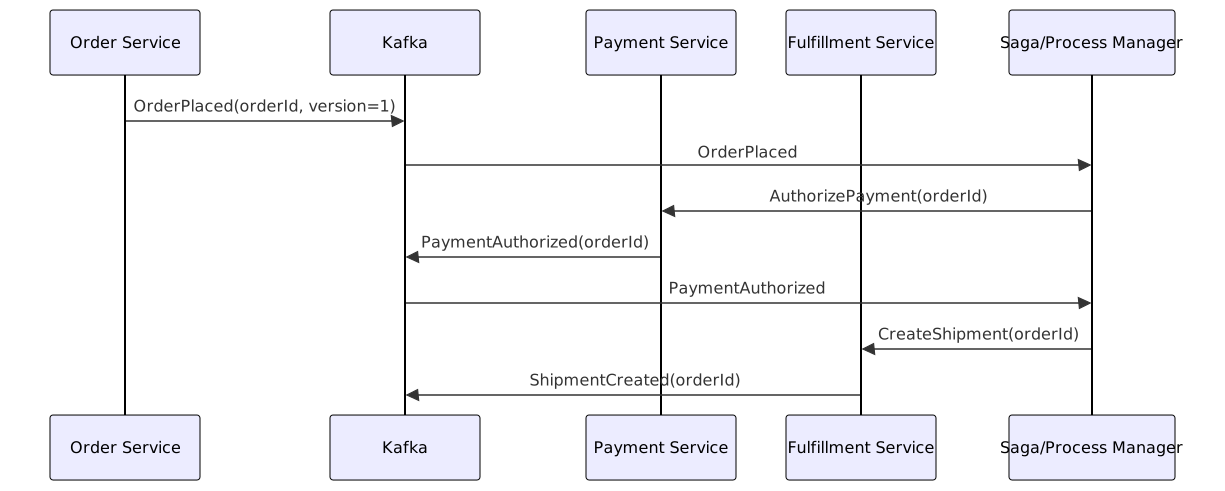
Notice what matters here: not a total order across everything, but the fact that ShipmentCreated should happen after PaymentAuthorized for the same order flow. That is a causality rule expressed by orchestration or choreography, not an infrastructure guarantee about all events in the platform.
Consumer-side reorder buffers, used sparingly
Sometimes consumers do need short-range resequencing. Perhaps the producer attaches sequence numbers, and occasional transport or processing skew means event 43 arrives before 42. A small per-key reorder buffer with timeout can help. But this is a tactical mechanism, not a foundation. Big reorder buffers become silent memory leaks and latent failure amplifiers.
Event-time versus processing-time models
For analytical or risk domains, the right answer may be stream processing with event-time windows and watermarking. This is a different kind of ordering problem. You are no longer protecting aggregate invariants; you are computing correct results in the face of late-arriving data. The architecture should say so plainly. Do not use event-time tooling to solve aggregate command sequencing, and do not use aggregate sequencing to fake temporal analytics.
Migration Strategy
Most enterprises do not get to rebuild ordering from scratch. They inherit mixed integration styles and then layer Kafka over the top. This is where architecture either earns its keep or becomes decorative.
The sensible path is a progressive strangler migration.
Start by identifying the business capabilities where ordering actually matters. Not every integration deserves first-class treatment. Pick the flows where wrong order creates money loss, regulatory exposure, or customer harm: payments, policy changes, inventory reservation, entitlement grants, account state transitions.
Then introduce an event backbone alongside existing interfaces, not instead of them. Wrap legacy systems with anti-corruption layers. Publish events from the system of record using an outbox or change data capture where direct domain events are not yet possible. At this stage, be explicit that these early events may reflect legacy transaction order, not perfect domain intent.
Next, tighten semantics one bounded context at a time:
- Define aggregate keys.
- Introduce versioned domain events.
- Align Kafka partitioning with those keys.
- Make consumers idempotent.
- Add reconciliation for known gaps.
- Move more downstream processes to consume the ordered-per-key stream instead of batch extracts or ESB calls.
Over time, you retire fragile point-to-point sequencing assumptions and replace them with local, explicit guarantees.
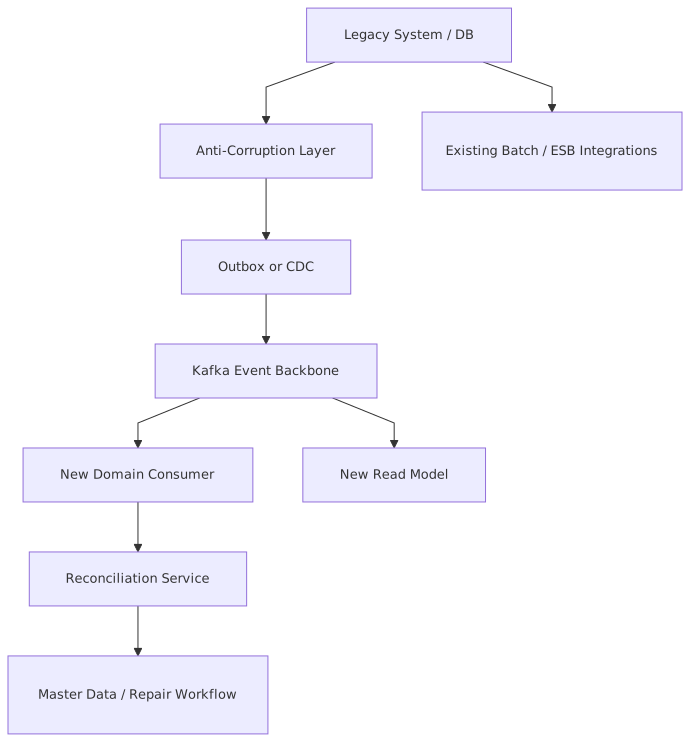
This migration needs one unpleasant but necessary practice: parallel truth comparison. During strangler migration, run old and new processing side by side and compare outcomes. Ordering bugs often hide for weeks because the happy path looks fine. The drift appears in exceptions, retries, and edge timing. Reconciliation dashboards are not optional decoration during migration. They are your radar.
A further migration caution: CDC is useful, but CDC is not domain modeling. Database log order is not always business event order. If a legacy application updates five tables in one transaction, the emitted change records may not map cleanly to the domain event you actually need. Use CDC as a bridge, not a theology.
Enterprise Example
Consider a large insurer modernizing its policy administration estate.
The old world had a policy core platform, a billing engine, a claims platform, several channel apps, and a thicket of nightly batch jobs. Endorsements, cancellations, reinstatements, and payment status changes moved between systems at different times, often through flat files and ESB transformations. When policy volume was low, the cracks were tolerable. As digital channels increased change frequency, the cracks became losses.
One recurring issue involved policy cancellation and reinstatement. A customer could request cancellation, then a service agent could reverse it after payment correction, all while downstream billing and document systems were receiving updates. The legacy architecture assumed file arrival order implied business order. It did not. The billing engine would sometimes process a stale cancellation after reinstatement and stop direct debit. Documents would issue contradictory letters. Customer service spent hours reconciling cases by hand.
The modernization team did something wise: they did not try to create a globally ordered enterprise stream of all policy events. That would have been expensive nonsense.
Instead, they modeled ordering around the Policy aggregate in the Policy Administration bounded context. Every state-changing policy command incremented a policy version. Domain events such as PolicyCancelled, PolicyReinstated, and PolicyEndorsed carried policyId, policyVersion, effective date, and causation metadata. Kafka topics were partitioned by policyId.
Downstream consumers behaved differently based on their context:
- The Billing context required monotonic policy state and rejected stale versions.
- The Document context accepted events out of sequence but regenerated policy correspondence from the latest materialized view if drift was detected.
- The Analytics context used event time and tolerated late arrivals.
They also added a reconciliation service that compared downstream state against the authoritative policy snapshot for any policy with version gaps or failed consumer processing. This was not an admission of defeat. It was the grown-up part of the design.
The result was not perfect order everywhere. It was much better: explicit order where business invariants demanded it, eventual convergence where the business could tolerate it, and operational repair where the real world misbehaved.
That is enterprise architecture. Not denial. Deliberate compromise.
Operational Considerations
Ordering guarantees are made or broken in operations.
Partition strategy is a business decision
Too many teams treat partition keys as throughput tuning. They are semantic design choices. If you partition order events by region for load balancing, you may have already destroyed per-order order. Use keys that align with the domain entity requiring sequence.
Beware hot partitions. The more your architecture depends on one-key serialization, the more likely a few high-volume entities become hotspots. Some domains can shard further. Some cannot. If your biggest customer produces half the traffic, architecture will feel that truth eventually.
Producer settings matter
Kafka producer idempotence and appropriate acknowledgment settings reduce duplicate and reorder risk during retries. If you care about order and run loose producer settings in production, you are building a sports car and filling the tires with soup.
Consumer concurrency can undo broker ordering
A topic partition may be ordered, but if a consumer application fans events for the same key into multiple worker threads, you have reintroduced race conditions. Keep per-key processing serialized where sequence matters.
Rebalances are not innocent
Consumer group rebalances can cause in-flight processing duplication, lag spikes, and state transfer hiccups. If your sequence handling depends on local memory only, a rebalance will eventually teach you humility. Persist offsets and sequence state where needed.
Observability should include semantic lag
Infrastructure lag is not enough. Measure:
- out-of-order event detections
- stale version rejections
- sequence gap frequency
- reconciliation backlog
- per-key hotspot metrics
- time to convergence after repair
Good operations make ordering visible as a business quality signal, not just a broker metric.
Replay is a feature and a trap
Reprocessing from Kafka is one of its great strengths. It is also how teams rediscover that their consumers were never truly idempotent. Before you celebrate replay, prove that projections and side effects can survive it. External calls, email sends, and payment actions need side-effect guards.
Tradeoffs
Here is the blunt version.
Strict global ordering
Pros
- Simplest mental model
- Easier reasoning for some consumers
Cons
- Poor scalability
- High coordination cost
- Often impossible across services
- Creates central bottlenecks
- Usually unnecessary
This is the architecture equivalent of insisting all city traffic use one lane because lane changes are confusing.
Per-partition or per-key ordering
Pros
- Scales well enough
- Matches aggregate semantics
- Natural fit for Kafka
- Useful and practical
Cons
- No cross-key order
- Hot partition risk
- Requires disciplined key design
- Consumers still need idempotency
This is the sweet spot for many event-driven microservices. microservices architecture diagrams
Best-effort ordering with reconciliation
Pros
- High throughput
- Better availability
- More tolerant of legacy migration
- Good fit where correctness can be repaired
Cons
- More complex operations
- Requires repair workflows
- Drift becomes a managed reality
- Harder to explain to teams who want absolutes
For many enterprises, this is the honest design for non-core or multi-master domains.
Consumer-side resequencing
Pros
- Helps with short disruptions
- Can isolate some producer limitations
Cons
- Adds latency
- Memory/state complexity
- Timeout edge cases
- Easy to overuse
Useful as seasoning, not as the meal.
Failure Modes
This is where ordering discussions become real.
Stale update overwrite
Consumer receives version 8, then version 7. Without version checks, it overwrites good state with stale state. This is one of the most common and most embarrassing failures.
Hidden dual writers
Two services both publish “authoritative” events for the same business entity. Their event streams interleave unpredictably. Teams then spend months inventing precedence rules that should have been domain ownership decisions.
Reordered side effects
A projection is fine, but external actions are not. For example, AccessRevoked and then AccessGranted arrive close together. Processing flips the order during retries, and a user remains locked out. Side effects need stronger sequencing and deduplication than pure read models.
Poison event blocks ordered partition
If one malformed event on a partition cannot be processed and the consumer stops to preserve order, that entire key stream or partition backs up. Dead-letter strategies become tricky because skipping may violate sequence assumptions.
Replay-induced duplicate business actions
A replay republishes shipping notifications, premium collection requests, or loyalty credits because downstream consumers were not designed for replay-safe side effects.
False confidence from timestamps
Teams sort by event timestamp and think they restored order. Clocks drift, clients lie, and effective dates differ from processing dates. Time is evidence, not truth.
When Not To Use
You should not invest heavily in strict event ordering when the domain does not require it.
Do not use heavyweight ordering guarantees for:
- telemetry and clickstream pipelines
- loosely coupled notifications
- analytics where event-time processing is the real need
- domains with naturally commutative updates
- low-value integration flows where batch reconciliation is cheaper
- cross-enterprise partner feeds you do not control
Also be cautious when your data model has no clear aggregate ownership. If five systems can mutate the same concept with equal legitimacy, ordering alone will not save you. You have a mastership and domain boundary problem first.
And do not force event sourcing just because ordering matters. Event sourcing can make sequence explicit, but it also increases modeling and operational complexity. If your need is simply reliable domain event publication from CRUD-based services, outbox plus per-aggregate versioning is often enough.
Related Patterns
Several patterns regularly sit next to ordering decisions.
Transactional Outbox
Ensures state change and event publication stay in sync. Essential when event order needs to reflect committed domain state.
Saga / Process Manager
Coordinates causally ordered business workflows across services without pretending there is one globally ordered stream.
Idempotent Consumer
A non-negotiable companion pattern. Ordering without idempotency is brittle theater.
Event Sourcing
Makes aggregate event order first-class. Powerful where domain history matters deeply, but not a blanket recommendation.
CQRS
Often paired with event streaming. Read models must cope with eventual consistency and possible resequencing concerns.
Anti-Corruption Layer
Crucial in migration. Protects modern domain semantics from legacy message formats and dubious sequencing assumptions.
Reconciliation / Repair Workflow
Underused and undervalued. Enterprises need explicit drift detection and repair, especially in strangler migrations and multi-system domains.
Summary
Event ordering in event streaming is not a switch. It is a set of choices about where sequence carries business meaning and how much complexity you will accept to preserve it.
The best designs are not the ones with the strongest guarantees everywhere. They are the ones with precise guarantees in the places that matter.
Use domain-driven design to find those places. Usually they sit at aggregate boundaries inside bounded contexts, not across the whole enterprise. In Kafka, partition by the key that represents that boundary. Publish events transactionally. Carry versions. Make consumers idempotent. Model causality for cross-service workflows. Reconcile where perfection is too expensive or impossible.
And during migration, be honest. Legacy estates are messy. Progressive strangler migration, anti-corruption layers, parallel comparison, and repair loops are not signs of weak architecture. They are signs that the architects have met reality.
If there is one memorable line worth keeping, it is this:
Order is not a technical feature. It is a business promise with an operational price tag.
Pay for it where it protects meaning. Refuse to overpay where it does not. That is the tradeoff. That is the craft.
Frequently Asked Questions
What is event-driven architecture?
Event-driven architecture (EDA) decouples services by having producers publish events to a broker like Kafka, while consumers subscribe independently. This reduces direct coupling, improves resilience, and allows new consumers to be added without modifying producers.
When should you use Kafka vs a message queue?
Use Kafka when you need event replay, high throughput, long retention, or multiple independent consumers reading the same stream. Use a traditional message queue (RabbitMQ, SQS) when you need simple point-to-point delivery, low latency, or complex routing logic per message.
How do you model event-driven architecture in ArchiMate?
In ArchiMate, the Kafka broker is a Technology Service or Application Component. Topics are Data Objects or Application Services. Producer/consumer services are Application Components connected via Flow relationships. This makes the event topology explicit and queryable.