⏱ 22 min read
Event-driven architecture often fails for a boring reason dressed up as a technical one: nobody can answer a simple question.
Who owns this event stream?
Not who provisioned the Kafka topic. Not who wrote the producer first. Not who shouts loudest in the architecture review. I mean ownership in the real enterprise sense: who defines the semantics, who can evolve the contract, who is accountable for quality, and who gets called when downstream teams discover that “CustomerUpdated” means six different things depending on which microservice emitted it. microservices architecture diagrams
This is the quiet fault line under many event-driven systems. Teams invest in Kafka, stream processing, schema registries, and data platforms, then discover they have built a fast, scalable way to spread ambiguity. The event broker becomes a city without zoning laws. Every street has traffic. Nobody knows who maintains the bridges. event-driven architecture patterns
Event stream ownership is the discipline that puts boundaries back into the system.
It is not a broker feature. It is not just governance. And it is definitely not a naming convention exercise. It is a design decision rooted in domain-driven design, bounded contexts, and the uncomfortable reality that enterprises are full of overlapping truths. A billing system and a CRM can both “know” the customer, but they do not mean the same thing by customer. If both publish customer events into a shared stream without clear ownership, consumers get a polluted domain model and architects get a false sense of decoupling.
The core idea is simple and surprisingly hard to enforce: an event stream should be owned by the bounded context that has the authority to assert the business fact represented in the stream.
That line matters. “Authority to assert the business fact” is the test. If the Payments context can declare that a payment was authorized, then Payments owns the stream of payment authorization events. If Customer Management can declare that a legal customer profile changed, then it owns the customer profile event stream. Other services may consume, enrich, project, cache, or react. They do not redefine the meaning of the event. They do not co-own the stream just because they depend on it.
This article goes deep on that point: what event stream ownership means, why it matters in Kafka and microservices environments, how to model it with domain semantics, how to migrate toward it using a progressive strangler strategy, and where it breaks down. Because it does break down. Every pattern earns its keep by surviving contact with enterprise reality.
Context
Event-driven architecture has become the default answer for enterprises trying to untangle brittle integration landscapes. Legacy ESBs gave way to Kafka clusters. Batch file transfers became change data capture pipelines. Point-to-point APIs got wrapped in asynchronous choreography. The promise is attractive: loose coupling, scalable integration, near-real-time processing, and teams that can move independently.
But event-driven systems do not remove coupling. They move it.
Instead of temporal coupling through synchronous APIs, you get semantic coupling through events. Instead of runtime dependency on a request, you get long-lived dependency on a stream contract. Instead of one team breaking another with a changed endpoint, one producer can quietly poison a dozen consumers by changing the meaning of an event field or publishing facts it was never truly entitled to assert.
The result is familiar in large organizations:
- multiple producers write to streams that look shared but mean different things
- Kafka topics are treated as technical channels rather than domain artifacts
- downstream services infer business truth from integration noise
- event names are broad, attractive, and misleading:
CustomerChanged,OrderUpdated,StatusModified - data platforms ingest everything, then spend years building lineage and reconciliation around avoidable ambiguity
A healthy event-driven architecture needs more than event publication. It needs ownership boundaries that align with the business model.
That is where domain-driven design is not optional window dressing. Bounded contexts provide the conceptual map. Aggregates tell us where business invariants live. Published language constrains what a team promises externally. Event stream ownership is the operationalization of those ideas in a distributed event backbone.
Problem
The architectural problem can be stated bluntly:
Without explicit ownership, event streams become shared semantic space, and shared semantic space decays.
Decay happens in predictable ways.
First, multiple systems publish similar events about the same business entity. CRM emits CustomerUpdated. Billing emits CustomerChanged. Digital channels emit ProfileAmended. All are technically valid from their own viewpoint. None is globally authoritative. Consumers either pick one arbitrarily, merge them badly, or build reconciliation logic that should never have been necessary.
Second, stream evolution becomes political. A producer adds fields for its own local need. Another producer starts emitting the same event type with a slightly different lifecycle. Consumers depend on accidental properties. Over time the stream ceases to represent a coherent domain fact and becomes a dump of “things related to customers.”
Third, ownership confusion drives operational confusion. Who approves schema changes? Who handles quality incidents? Who documents semantic edge cases? Who can deprecate the stream? If the answer is “the platform team,” you probably do not have domain ownership; you have infrastructure custody pretending to be ownership.
Finally, data consistency suffers. In event-driven microservices, you rarely get one canonical database. You get local truth plus asynchronous propagation. That only works if the source of truth for each evented fact is clear. Otherwise reconciliation turns into archaeology.
This is why stream ownership is not merely a governance concern. It is a prerequisite for trustworthy distributed systems. EA governance checklist
Forces
Several forces pull architects in opposite directions.
Business autonomy vs enterprise consistency
Domain teams want autonomy. They should. A team responsible for Payments should not need a cross-enterprise committee to publish a payment event. But autonomy without semantic boundaries creates inconsistency at scale. Enterprises need enough discipline that independently built services still compose into a coherent whole.
Local optimization vs global understanding
A team often publishes events in the shape that is easiest for its local service model. That is rational. It is also how integration semantics get leaked from internal implementation details. The enterprise needs streams that reflect business facts, not table changes wearing a JSON disguise.
Speed vs stewardship
Fast-moving teams resist heavy approval processes. They are right to resist theater. But event streams are long-lived contracts. A sloppy stream can outlive the service that created it. Ownership introduces stewardship. Stewardship introduces friction. Some friction is healthy.
Platform centralization vs domain authority
Kafka platform teams naturally want standardization, security, and lifecycle control. Good. But if they become de facto owners of streams, the architecture inverts. Platform should enable ownership, not absorb it. Domain teams own meaning; platform teams own the road, not the destination.
Integration convenience vs domain purity
Shared topics and generic event types are convenient. They make it easy to “just publish something.” But convenience is the sugar high of enterprise architecture. You pay later in reconciliation, lineage confusion, and consumer breakage.
Historical systems vs target state design
Most organizations are not starting clean. They already have legacy systems, CDC feeds, integration topics, and duplicate facts across applications. Ownership in this world is discovered and negotiated, not simply designed on a whiteboard.
Solution
The solution is to assign single semantic ownership of each event stream to the bounded context that is authoritative for the business fact represented by the stream.
That sentence is doing real work, so let’s unpack it.
Single semantic ownership
A stream should have one owner in the semantic sense. One team, one bounded context, one accountable authority for what the events mean. This does not mean only one technical producer process forever. It means all production to that stream is governed by one context’s business authority and one published language.
If there are multiple technical emitters, they act on behalf of the same owning context under strict contract control. In practice, though, multiple producers to the same business stream are usually a smell.
Authoritative for the business fact
Ownership belongs to the system that can legitimately say “this happened” in the language of the domain.
Examples:
- Order Management owns
OrderPlaced,OrderCancelled,OrderFulfillmentRequested - Payments owns
PaymentAuthorized,PaymentCaptured,PaymentFailed - Customer Profile owns
CustomerRegistered,CustomerProfileCorrected - Identity & Access owns
UserCredentialReset, but notCustomerProfileUpdated
A common mistake is assigning ownership based on who has the most complete data record. That is not enough. The owner is not whoever stores the widest table. The owner is whoever owns the decision, invariant, and lifecycle.
Published language, not internal state leakage
Owned event streams should expose business events, not low-level persistence changes where avoidable. “OrderPlaced” is stronger than “OrderRowInserted.” “AddressCorrected” is stronger than “CustomerRecordUpdated.” CDC can help migration, but it should not become your domain model by accident.
Consumer freedom without semantic redefinition
Consumers can create projections, caches, read models, alerts, and local denormalized views. They may combine multiple streams. They may derive their own internal events. What they should not do is republish a domain stream as though they now own the source fact.
That is how semantic drift begins: a downstream system turns an upstream business event into a new “shared” truth. Then another team consumes the republished stream. Soon nobody remembers where the fact actually originated.
Here is a simple ownership model.
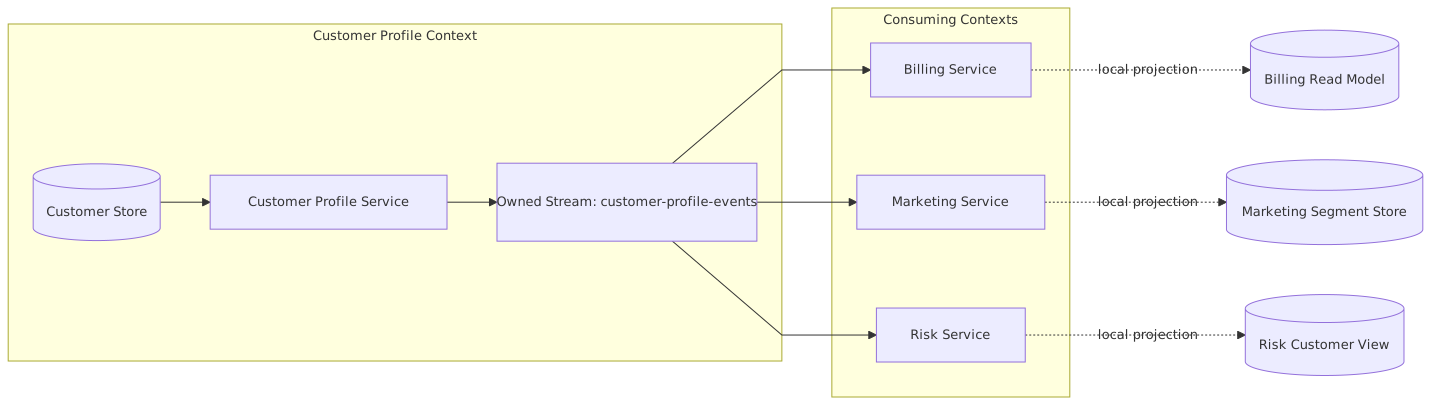
The stream is not “owned by Kafka.” It is owned by the Customer Profile context. Billing and Marketing are free to consume it and build their own views. They are not free to redefine what a customer profile correction means.
Architecture
A workable architecture for event stream ownership in Kafka and microservices environments usually has five parts.
1. Bounded contexts mapped to stream domains
Start with the domain map, not the topic inventory. If your event catalog predates your context map, you likely have technical streams with accidental semantics.
Each bounded context should identify:
- the business facts it is authoritative for
- the aggregates or lifecycle roots from which events emerge
- the externally published language
- the consumers it expects, without overfitting to them
This is classic domain-driven design applied to asynchronous boundaries. It matters because stream ownership is fundamentally a semantic architecture decision.
2. Streams as products with named owners
Every stream should have explicit metadata:
- owning team
- owning bounded context
- business purpose
- event taxonomy
- schema lifecycle rules
- retention and replay policy
- SLOs for publication and data quality
- deprecation path
This sounds administrative until the first incident. Then it becomes oxygen.
3. Transactional publication from the system of authority
The owner should publish events from the system where the authoritative state transition occurs. In microservices, this often means the outbox pattern rather than direct dual writes.
If Order Management commits an order placement, the event should be emitted reliably from that committed business transaction boundary. Kafka is the transport. The service transaction is the source of truth.
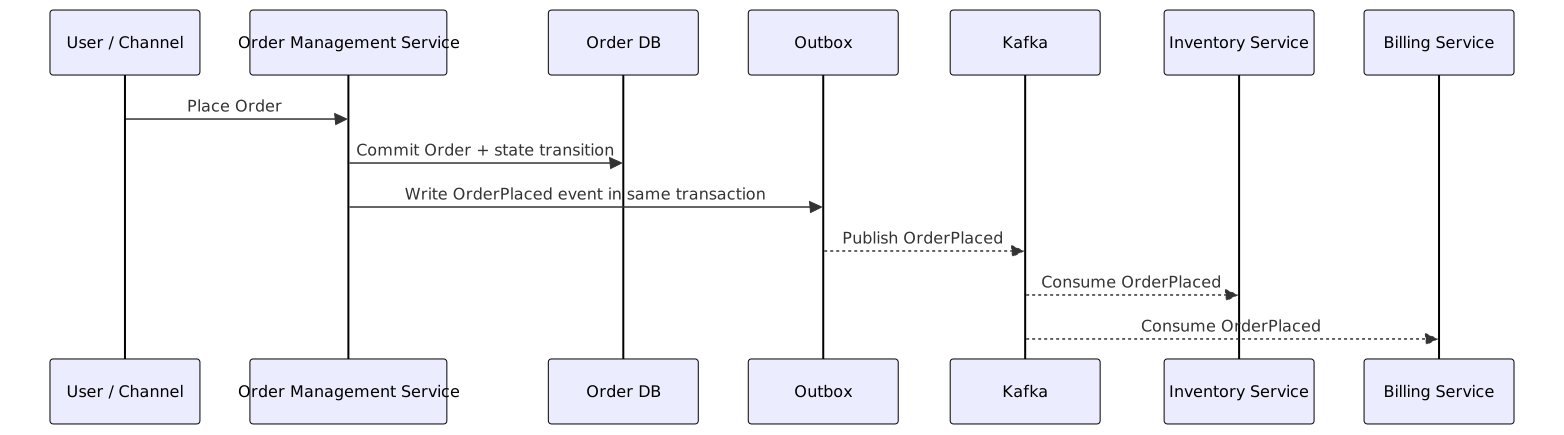
This matters because stream ownership without publication integrity is theater. If the owner can lose events, duplicate them uncontrollably, or emit events that do not correspond to committed facts, consumers will route around the stream and trust erodes.
4. Schema and semantic versioning
Schema registries help, but compatibility rules are not enough. Backward-compatible nonsense is still nonsense. Ownership includes semantic stewardship: event meaning, allowed transitions, field interpretation, and deprecation strategy.
The dangerous changes are often not structural. A field called status remains a string while its meaning shifts under everyone’s feet. Architects tend to underestimate semantic versioning because JSON lets them.
5. Reconciliation paths
Even in well-designed event-driven systems, reconciliation is necessary. Not because ownership failed, but because distributed systems fail in practical ways: dropped consumers, delayed partitions, replay bugs, poison messages, upstream defects, and historical corrections.
A mature ownership architecture includes:
- replayable streams where appropriate
- point-in-time rebuild capability for downstream projections
- reconciliation jobs between source-of-truth stores and derived read models
- audit trails of event publication and consumption
- idempotent consumer design
Ownership does not eliminate reconciliation. It makes reconciliation tractable by clarifying which side is authoritative.
Migration Strategy
Most enterprises do not get to design ownership greenfield. They inherit shared topics, CDC firehoses, duplicate producers, and “temporary” integration feeds that became strategic. So the migration question matters as much as the target design.
The right migration approach is usually progressive strangler migration.
Not a heroic rewrite. Not a broker replatform masquerading as architecture. A strangler.
Step 1: Classify existing streams
Take inventory and classify streams into categories:
- authoritative domain streams
- integration streams
- CDC-derived technical streams
- shared ambiguous streams
- consumer-specific derived streams
This exercise is often sobering. Many organizations discover they have very few true domain streams and a great many technical change feeds.
Step 2: Identify semantic conflicts
For each important business concept—customer, order, payment, policy, shipment—map which systems publish related events and what they mean. You are looking for semantic overlap and contradiction, not just duplicate fields.
This is where domain semantics discussion gets real. For example:
- CRM “customer” may mean marketing identity
- Billing “customer” may mean bill-to account
- Identity “user” may mean credential holder
- Risk “party” may mean legal entity under assessment
These are not synonyms. Treating them as one shared stream is how enterprises create integration debt with modern tooling.
Step 3: Nominate authoritative contexts
For each business fact, identify the bounded context with authority to assert it. This may be politically difficult. Good architecture usually is.
Sometimes the answer is not the oldest system or the largest database. It is the system that owns the decision and lifecycle. A ledger should own settlement facts even if a CRM displays them.
Step 4: Introduce canonical owned streams beside legacy streams
Do not cut consumers over all at once. Publish new owned streams in parallel. Legacy streams continue to exist while consumers migrate.
For example, keep a broad customer-events topic alive while introducing:
customer-profile-eventscustomer-credit-eventscustomer-consent-events
Each with explicit ownership and semantics.
Step 5: Build translation and anti-corruption layers
Legacy producers may not align with target domain language. Use translation services or stream processors as anti-corruption layers. Their job is to transform ambiguous or technical events into clean, owned domain events until source systems can be improved.
This is a place for restraint. Translation layers should be transitional architecture, not permanent semantic laundries.
Step 6: Reconcile during migration
Parallel streams create temporary duplication. Reconciliation becomes essential:
- compare event counts and aggregates across old and new streams
- validate key business states
- inspect drift by customer, order, or account
- maintain traceability from legacy event IDs to new event IDs
Without disciplined reconciliation, migration becomes faith-based.
Step 7: Strangle consumer dependency on ambiguous streams
Move consumers one by one to owned streams. Track who still depends on shared ambiguous topics. Put deprecation dates on legacy streams and enforce them. “We will migrate later” is enterprise dialect for “this topic will outlive us all.”
Here is a migration picture.
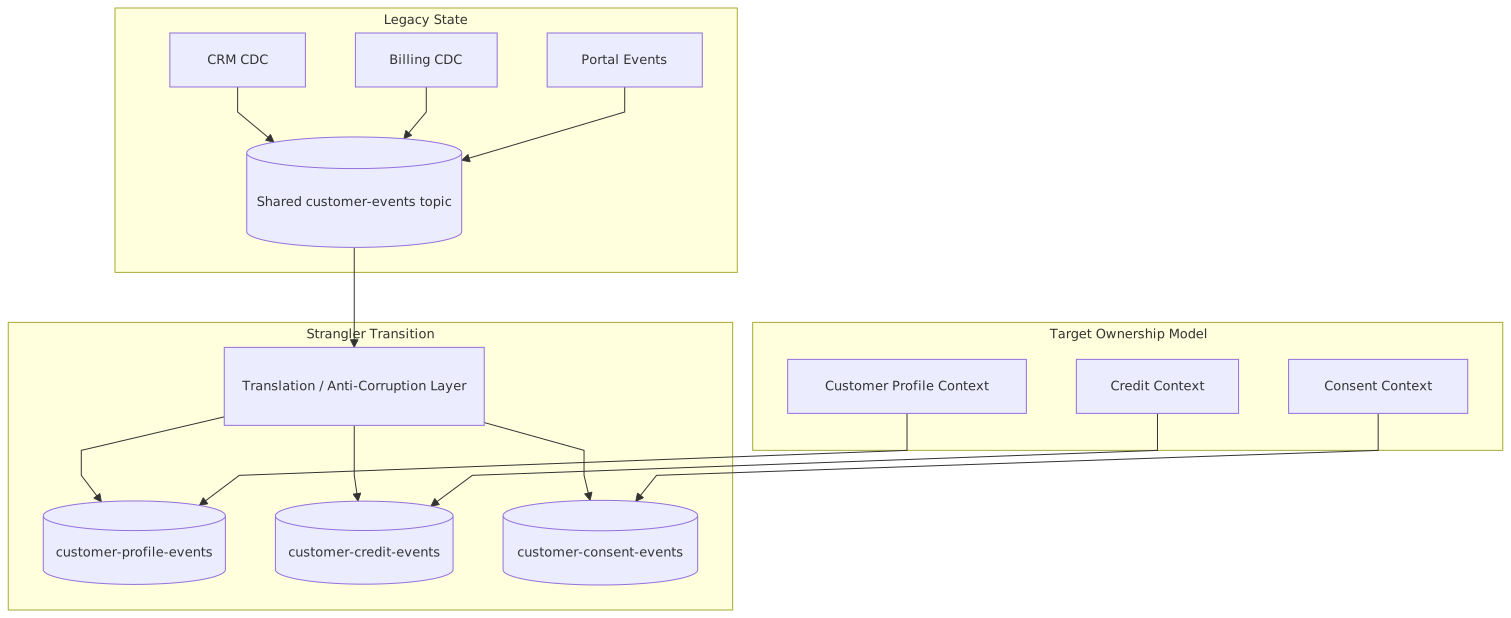
The anti-corruption layer is a bridge, not a destination. The target state is direct publication from authoritative contexts.
Enterprise Example
Consider a large retail bank modernizing customer and account servicing across channels. It has a Kafka platform, over a hundred microservices, and three major legacy systems:
- a CRM used by branch and call center staff
- a core banking platform for accounts and balances
- a digital profile service used by online and mobile channels
For years, teams published to a shared Kafka topic called customer-updates. The topic seemed useful because “customer” was a universal concept. In reality it was a semantic junk drawer.
The CRM published when a relationship manager changed contact details. Core banking published when a legal name correction was synchronized to account records. The digital profile service published when a user updated marketing preferences. Fraud systems consumed the topic for risk scoring. Marketing consumed it for segmentation. Notifications consumed it for email updates.
Then a regulatory incident hit. A customer revoked marketing consent in digital channels, but downstream marketing systems continued to contact them for 36 hours. Why? Because the consent change was emitted as just another customer-updates event, buried among contact and profile changes, with semantics consumers interpreted inconsistently. Some consumers treated missing consent fields as “no change.” Others inferred defaults. One replay process overwrote a newer consent state with an older CRM-originated profile event.
This was not a Kafka problem. It was an ownership problem.
The bank re-modeled the domain around bounded contexts:
- Customer Profile for legal identity and profile attributes
- Consent Management for marketing and privacy consent
- Account Servicing for account-holder relationships
- Identity & Access for digital credentials and login identity
The architecture changed in a disciplined way:
customer-updateswas frozen as a legacy integration stream.- New owned streams were introduced:
- Consent Management became the single owner of consent events.
- Consumers had to subscribe to the owned stream relevant to their decision.
- A reconciliation service compared consent state in the source system with downstream marketing projections.
- The migration was tracked consumer by consumer over nine months.
- customer-profile-events
- customer-consent-events
- account-party-events
- digital-identity-events
The outcome was not just cleaner diagrams. Auditability improved. Consumer logic became simpler. The bank could answer regulators with confidence about where consent authority lived and how downstream systems were corrected after delayed delivery or replay. Most importantly, the architecture now reflected a truth business people recognized: profile, consent, account relationship, and digital identity are related, but they are not the same domain fact.
That is the real test of event stream ownership. If your business stakeholders cannot recognize the boundaries, your event model is probably too technical.
Operational Considerations
Ownership lives or dies in operations.
Topic design in Kafka
Kafka topics should generally align to owned stream boundaries, not arbitrary technical partitioning of “all business events.” There are exceptions, but as a default, one owned domain stream maps cleanly to one topic or a tightly governed topic family.
Partitioning strategy should align with ordering needs inside the owned fact space. For example, ordering by orderId for order lifecycle streams is sensible. Ordering by a vague customer key across unrelated event types is usually not.
Access control
Only the owning context should have write permission to the owned stream. This is one of the simplest and most effective controls. Read access can be broad; write access should be narrow.
If many teams can write to a domain stream, ownership is mostly decorative.
Observability
Owned streams need observability beyond broker health:
- publication lag from business commit to stream
- schema violation rates
- dead-letter trends
- replay frequency
- consumer lag by critical downstreams
- reconciliation discrepancy rates
An architect who only monitors Kafka throughput is watching the highway and ignoring whether the cargo is wrong.
Data quality and stewardship
Ownership implies data quality stewardship. The owning team should define and monitor quality dimensions such as completeness, timeliness, validity, and consistency with source invariants.
Replay and retention
Retention is not only a storage cost decision. It is a recovery and governance decision. For some domain streams, long retention enables downstream rebuilds and forensic analysis. For others, privacy constraints or volume patterns may require compaction or controlled snapshots. ArchiMate for governance
Documentation
Real documentation matters here:
- business meaning of events
- source-of-truth statement
- field glossary
- lifecycle examples
- edge cases
- deprecation notices
Schema alone is not documentation. It is shape, not meaning.
Tradeoffs
No serious architectural pattern comes free.
Clear ownership reduces flexibility for casual producers
Teams cannot simply emit to any stream they find useful. That slows ad hoc integration. Good. Ad hoc publication is how semantic sprawl starts. Still, it means more coordination upfront.
More streams, fewer ambiguities
A mature ownership model often increases the number of streams because broad generic streams split into sharper domain streams. This improves meaning but can increase topology complexity, consumer subscriptions, and operational overhead.
Domain purity can frustrate analytics teams
Data and analytics teams often prefer broad unified streams for convenience. They are not wrong to want easy access. But convenience for downstream analytics should not drive domain ownership. Use curated analytical models or lakehouse ingestion on top of owned streams rather than collapsing semantics at the source.
Migration is messy
Parallel publication, anti-corruption layers, and reconciliation all cost time and money. The enterprise always asks, “Why can’t we just standardize the old topic?” Sometimes you can. Often you cannot, because the semantics are already compromised beyond repair.
Ownership may expose organizational weakness
The architecture forces accountability. Some enterprises are structurally unready for that. If no team really owns the domain capability end to end, assigning stream ownership reveals the operating model problem rather than solving it.
Failure Modes
There are recurring ways this pattern goes wrong.
Ownership by infrastructure team
The platform team manages topic creation, schemas, ACLs, and retention. Useful. Then slowly everyone treats the platform team as owner. Semantic decisions drift into a central group detached from the domain. The result is tidy governance and muddy meaning.
False ownership based on database authority
A legacy master data system is declared owner because it stores the “golden record.” But the actual business decision is made elsewhere. The stream then represents replicated data, not authoritative business events.
Shared stream with namespaced event types
Teams keep one giant topic and namespace event types to simulate ownership. Sometimes this is workable for technical reasons, but often it becomes a compromise that preserves all the consumer confusion while adding taxonomy debates.
Downstream republishing as authoritative source
A consumer builds a useful materialized view, then republishes changes as a new enterprise stream. Soon others consume the derived stream and bypass the real source. Reconciliation complexity explodes.
Ignoring reconciliation
Teams believe clean ownership removes the need for reconciliation. Then a consumer outage, poison message, or backfill bug causes state divergence. Without reconciliation, confidence in the architecture collapses at the first serious incident.
Semantic overreach
A team overclaims ownership of a broad concept like “customer” when in fact it only owns one subdomain aspect. This is common and dangerous. In large enterprises, broad nouns are traps.
When Not To Use
Event stream ownership is powerful, but not universal.
Do not lean heavily on this pattern when:
You have a small system with limited integration surface
If a single team owns the whole application and eventing is mostly internal, formal stream ownership processes may be unnecessary overhead.
Events are ephemeral technical signals
Not every topic is a domain stream. Retry queues, observability streams, cache invalidation notifications, and internal workflow signals may not need the same semantic ownership model.
The organization cannot support bounded-context accountability
If teams are not aligned to business capabilities and ownership is fragmented across project matrices, enforcing stream ownership may create paperwork without authority. Fix the operating model first, or at least acknowledge the limit.
You are in early discovery and domain boundaries are still fluid
During early product discovery, event models may need to evolve rapidly. Heavy governance too early can calcify bad assumptions. Use lightweight conventions first, then harden ownership as the domain stabilizes.
You only need batch analytical ingestion
If the primary need is historical analytics rather than operational domain integration, a data product or lake ingestion model may be a better organizing principle than domain event stream ownership.
This is not an ideology. It is an architectural tool. Use it where semantic integrity matters.
Related Patterns
Several patterns work closely with event stream ownership.
Outbox pattern
Essential for reliable publication from the authoritative transaction boundary.
Domain events
Owned streams should generally carry domain events, not leaked persistence mechanics, when the use case supports it.
Anti-corruption layer
Critical during migration from legacy systems or when integrating across bounded contexts with incompatible models.
Event-carried state transfer
Useful, but only if the owner is truly authoritative for the transferred state.
CQRS and materialized views
Consumers can build projections freely without taking ownership of the source fact.
Data mesh
There is overlap in spirit: domain-aligned ownership, product thinking, discoverability. But data mesh is broader and analytically oriented. Event stream ownership is narrower and operationally focused on event semantics in distributed systems.
Change Data Capture
Helpful for migration and integration, dangerous when mistaken for domain event design. CDC is a tool, not a language.
Summary
Event-driven architecture succeeds or fails on semantics long before it fails on throughput.
Event stream ownership is the practice of assigning each stream to the bounded context that has the authority to assert the business fact the stream represents. That gives you clear contracts, cleaner evolution, better operational accountability, simpler consumer reasoning, and more trustworthy reconciliation. It also forces hard decisions about domain boundaries, source of truth, and organizational accountability.
The rule is simple enough to fit on a wall:
The team that owns the business fact owns the event stream. Everyone else consumes, derives, or translates. Nobody else gets to redefine the truth.
In Kafka and microservices landscapes, this principle is the difference between an event backbone and a semantic swamp.
If you are migrating from a messy estate, take the strangler path: classify streams, expose semantic conflicts, nominate authoritative contexts, publish owned streams in parallel, use anti-corruption layers, reconcile aggressively, and deprecate ambiguous shared streams with discipline.
And remember the uncomfortable part: ownership is not about control for its own sake. It is about preserving meaning under scale. In enterprise architecture, that is rarer than people admit. Systems can survive latency. They can survive duplication. They can survive a bad quarter of delivery.
They do not survive sustained ambiguity very well.
That is why event stream ownership matters. Not because the diagram looks neat, but because truth in distributed systems needs a home.
Frequently Asked Questions
What is enterprise architecture?
Enterprise architecture aligns strategy, business processes, applications, and technology in a coherent model. It enables impact analysis, portfolio rationalisation, governance, and transformation planning across the organisation.
How does ArchiMate support architecture practice?
ArchiMate provides a standard language connecting strategy, business operations, applications, and technology. It enables traceability from strategic goals through capabilities and services to infrastructure — making architecture decisions explicit and reviewable.
What tools support enterprise architecture modeling?
The main tools are Sparx Enterprise Architect (ArchiMate, UML, BPMN, SysML), Archi (free, ArchiMate-only), and BiZZdesign. Sparx EA is the most feature-rich, supporting concurrent repositories, automation, scripting, and Jira integration.