⏱ 19 min read
There’s a point in every event-driven system where the architecture stops looking elegant and starts looking like an airport during a storm.
Flights are still “scheduled.” Screens still show destinations. The control tower still speaks in calm language. But the gates are full, the incoming planes are circling, the baggage handlers are overwhelmed, and every decision now has a cost that wasn’t visible on the whiteboard. That is what backpressure feels like in reactive microservices. Not a theoretical concern. Not a niche tuning problem. A traffic problem in a city you already built. microservices architecture diagrams
A lot of teams discover this too late. They adopt Kafka, split a monolith into services, make everything asynchronous, and assume the decoupling will somehow absorb infinite load. It won’t. Asynchrony does not remove capacity constraints; it merely moves them. A queue is not a solution to overload. Often it is just a very polite way of delaying failure. event-driven architecture patterns
The practical question, then, is not whether event flow will saturate. It will. The real architectural question is whether saturation is part of your design language. Can the system express “slow down,” “shed this work,” “defer that work,” “preserve customer intent,” and “reconcile later” in a way that respects the business domain? Or does it simply keep accepting work until the platform becomes a crime scene?
This is where backpressure patterns matter. And not just at the transport level. The serious work happens at the seam between technical flow control and domain semantics. A payment authorization event is not the same as a recommendation refresh. A stock reservation command is not the same as an audit emission. If your architecture treats all backlog as equal, your operations team will eventually discover the business hierarchy by watching what hurts most during an incident.
This article looks at event-driven backpressure patterns for reactive microservices, especially in Kafka-centric enterprise landscapes. We’ll talk about queue saturation states, bounded consumers, selective degradation, lag-aware routing, reconciliation, strangler migration, and where the whole idea becomes the wrong tool. This is architecture as practiced in production, not architecture as imagined in vendor decks.
Context
Reactive microservices are usually sold on four promises: responsiveness, resilience, elasticity, and message-driven communication. Those promises are real. They’re also incomplete.
In the enterprise, event-driven systems sit inside messy operational realities: legacy ERPs with nightly jobs, customer channels with bursty traffic, fraud models that spike CPU usage, warehouse platforms that go dark for maintenance, and teams with inconsistent maturity around observability. In that world, event flow is never just flow. It is inventory.
Every topic, stream, queue, retry channel, dead-letter store, outbox table, and compacted log is a form of work inventory. Inventory ages. Inventory carries risk. Inventory becomes expensive when it waits in the wrong place. Manufacturing figured this out decades ago; software teams keep relearning it one Kafka partition at a time.
Backpressure, in this setting, is the collection of mechanisms by which a system prevents downstream consumers, dependencies, and state stores from being overwhelmed. But a narrow transport-level definition misses the more important point: enterprise systems need business-aware backpressure. They must control not only how fast bytes move, but also which business intents continue, which are delayed, and which are safely refused.
That is where domain-driven design earns its keep. A domain model is not just for code organization. It is the language that lets us distinguish hard commitments from soft enrichments, scarce resources from derived views, and regulatory events from convenience events. Without that distinction, overload handling becomes random, and random overload handling is just another form of outage.
Problem
The standard failure pattern is painfully familiar.
A producer emits faster than a consumer can process. Consumer lag grows. Retry topics swell. Downstream stores start timing out. More retries are generated. Consumer groups rebalance under stress. Throughput drops further. Operations scales infrastructure, but the real bottleneck is an external dependency or a hot partition caused by a skewed key. Meanwhile upstream services continue publishing because the broker still accepts writes. The queue becomes a historical monument to bad assumptions.
There are three hard truths here.
First, Kafka is very good at durable ingestion, but durability is not flow control. It will faithfully preserve your ability to be overwhelmed later.
Second, microservices increase the number of buffers in a system. Buffers are useful, but they hide instability until delay becomes customer-visible. You haven’t eliminated coupling; you’ve converted temporal coupling into lag.
Third, “just autoscale the consumer” only works when the bottleneck is truly parallelizable and downstream dependencies can tolerate the increased concurrency. Many enterprise bottlenecks cannot. A payment gateway with a rate limit, a mainframe adapter with a fixed connection pool, or a database table with row-level contention doesn’t care how optimistic your horizontal scaling policy looks in Terraform.
The queue saturation problem is therefore not merely a throughput issue. It is a control problem. The architecture needs explicit saturation states and corresponding behaviors.
Forces
Several competing forces shape a good backpressure design.
Throughput versus correctness
Fast systems that silently drop important intent are not robust. On the other hand, strict end-to-end preservation of every event can turn a minor slowdown into systemic collapse. You need to decide what must be preserved exactly, what can be recomputed, and what can be discarded.
Latency versus durability
Persisting to Kafka before processing improves resilience and decoupling. It also means your customer may perceive “accepted” long before business completion is possible. That can be perfectly acceptable for some domains and disastrous for others.
Technical priority versus domain priority
A small event payload is not necessarily low-value work. A massive analytics event may be expendable. Architecture should follow business criticality, not message size or implementation convenience.
Local autonomy versus global coordination
Teams want independently deployable services. Backpressure often requires shared conventions: topic classes, retry semantics, timeout policies, saturation signals, and operational thresholds. Pure local freedom produces global chaos.
Eventual consistency versus reconciliation burden
Delaying or rejecting non-critical work under pressure is often the right move. But every deferred path creates a reconciliation obligation. If you postpone updating read models or notifying third parties, you need a deliberate repair mechanism, not wishful thinking.
DDD boundaries versus platform simplification
From a domain-driven design perspective, bounded contexts should express their own semantics. From a platform perspective, operators want standardized patterns. Good architecture finds a small set of reusable backpressure mechanics while allowing domain-specific policy.
Solution
The core idea is simple: treat backpressure as a first-class business and technical concern, not an accidental side effect of queue length.
A robust event-driven backpressure architecture usually combines five moves.
1. Classify event flows by domain semantics
Not all events deserve equal treatment. Start by classifying flows into categories such as:
- Commitment events: business facts that represent customer or legal commitments
- Coordination commands: messages that trigger scarce downstream actions
- Derived projections: read-model updates, search indexing, cache refreshes
- Observability and analytics events: telemetry, clickstream, enrichment feeds
- Compensating and reconciliation events: repair and recovery workflows
This is classic DDD thinking applied to operations. If an OrderPlaced event and a SearchIndexUpdated event go through the same saturation policy, you have ignored the domain.
2. Introduce explicit saturation states
Backpressure becomes manageable when services expose and react to state transitions rather than a vague notion of “the queue seems high.”
A useful model is:
- Normal: consumers healthy, lag within SLO, full processing enabled
- Constrained: rising lag or dependency slowness; begin controlled degradation
- Saturated: critical lag or downstream bottleneck; reject, defer, or shed selected work
- Recovery: load subsiding; replay deferred work carefully to avoid surge-on-surge
These states should influence publishers, consumers, orchestration policy, and operational dashboards.
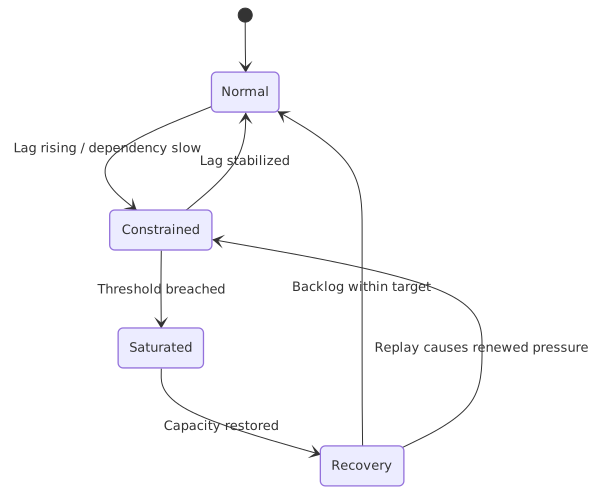
The diagram looks simple. The discipline is in making the transitions explicit and observable.
3. Separate durable intake from scarce processing
One of the most effective patterns is to accept durable business intent into a broker or outbox, then gate scarce downstream processing with bounded worker pools, token buckets, or partition-aware concurrency controls.
This preserves critical business facts while preventing consumer stampedes against limited dependencies. In practice, the consumer becomes a scheduler, not just a parser of events.
4. Degrade selectively, not universally
When saturation arrives, stop doing optional work first. Pause projection consumers. Reduce enrichment fan-out. Collapse duplicate updates by key. Coalesce events into snapshots. Slow non-critical publishing. Preserve the flows that matter to the business.
This is where a lot of architectures fail. They either continue everything until everything dies, or they apply blunt throttling that harms the most important workflows.
5. Build reconciliation as a designed path
Deferred or skipped work is not free. If projections are paused, if notifications are held, or if enrichment is skipped, the architecture needs reconciliation jobs, replay windows, idempotent handlers, and authoritative sources of truth.
Backpressure without reconciliation is just data drift with better vocabulary.
Architecture
A practical enterprise architecture for event-driven backpressure has several layers.
Producer-side controls
Producers should know whether they are publishing critical facts, optional enrichments, or transient signals. That lets them:
- write critical facts to durable channels
- collapse or sample low-value events during constrained states
- avoid unbounded local buffers
- propagate correlation and causation metadata for replay and reconciliation
If using the outbox pattern, the outbox becomes a disciplined intake mechanism. It gives transactional consistency at the boundary of a service and avoids dual-write anomalies. But it must not become an excuse to emit every tiny state twitch as a business event.
Broker and topic design
Kafka matters here because topic design shapes backpressure behavior:
- partition keys determine hot-spot risk
- retention policies determine how long backlog can survive
- compaction can reduce replay burden for state-like topics
- separate topics by criticality and consumption characteristics
- isolate retries from primary traffic to avoid poisoning throughput
- use dead-letter handling sparingly and intentionally
A single giant topic carrying all event classes is operationally cheap in the short run and strategically foolish in the long run.
Consumer-side admission control
Consumers need bounded concurrency and dependency-aware flow control. That includes:
- max in-flight messages per partition or handler type
- bulkheads by downstream dependency
- circuit breakers around slow services
- token-based or rate-limited processing for third-party APIs
- pausing partitions or consumer groups when lag is less dangerous than collapse
- workload shaping, such as processing one expensive event for every N cheap ones
In a reactive stack, this often shows up as bounded demand and non-blocking pipelines. But the architecture matters more than the framework. You can build a beautifully reactive service that still melts a downstream Oracle cluster.
Queue saturation state signaling
The system should publish saturation state changes as operational signals or control events. That enables upstream services and dependent consumers to adjust behavior.

Notice the deferred work store. In many enterprises that store is not Kafka alone. It may be a relational table for exact auditability, an object store for bulk payloads, or a workflow engine for human-visible backlog.
Domain semantics and bounded contexts
DDD gives shape to these controls. Each bounded context should define:
- which events are facts versus notifications
- which commands represent scarce domain actions
- acceptable delay by use case
- invariants that cannot be violated under pressure
- compensations and reconciliation rules
An Inventory context, for example, may decide that stock reservation commands are high criticality and must be durably recorded, while search projection updates can lag by fifteen minutes without business harm. A Customer Insights context might happily sample or batch events under pressure. These are not generic platform decisions. They are domain decisions with platform implementation.
Migration Strategy
Most enterprises do not get to redesign for backpressure from scratch. They inherit synchronous chains, batch interfaces, and legacy dependencies with all the grace of a concrete bridge.
That means migration matters.
The best strategy is usually progressive strangler migration, not wholesale replacement. Start by identifying the domains where overload currently causes the highest business pain: checkout, claims adjudication, payments, order orchestration, shipment allocation. Do not begin with a low-value service simply because it is easy. Architecture should chase leverage.
A sensible migration path looks like this:
- Map current demand and bottlenecks
Find where work accumulates now. DB connection pools, thread pools, external APIs, batch handoffs, JVM heap pressure, partition skew. Backpressure patterns are pointless if you are guessing about the constraint.
- Introduce an outbox at critical boundaries
Capture durable business facts without dual-write risk. This creates a trustworthy intake stream.
- Externalize optional side effects first
Move projections, notifications, enrichments, and analytics to asynchronous consumers before moving hard business commitments. This gives teams operational practice with lag and replay.
- Add bounded consumers and saturation state metrics
Before scaling out, learn to say “enough.” Put in lag thresholds, dependency health checks, and controlled degradation.
- Create deferred-processing and reconciliation paths
This is the part teams skip because it is less glamorous than a streaming diagram. It is also the part that separates production-grade migration from event theater.
- Strangle synchronous downstream calls behind event-driven orchestrators
Replace the most fragile synchronous chains with command/event workflows that can absorb variability.
- Retire legacy paths only after reconciliation confidence is proven
Parallel run, compare outcomes, inspect drift, and reconcile discrepancies. When business and operations trust the new path, then decommission.
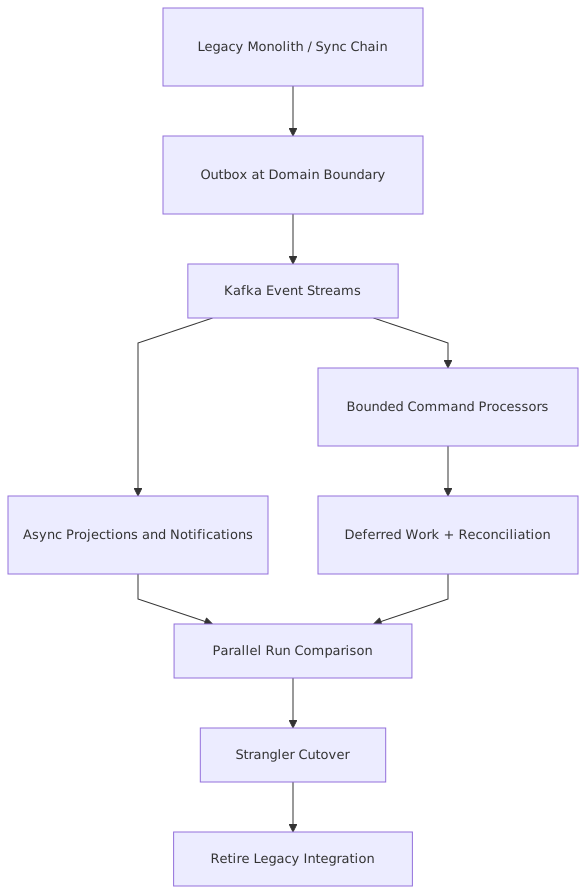
The migration reasoning is straightforward: move low-risk side effects first, prove observability and replay, then move scarce and critical workflows. If you invert that order, you will create justified fear of event-driven architecture.
Enterprise Example
Consider a global retailer modernizing order fulfillment.
The legacy estate has an order management monolith, a warehouse management system, a payment gateway, and several regional inventory stores. During seasonal campaigns, order spikes cause synchronous checkout calls to inventory and fraud systems to slow down. The business symptom is ugly but common: customers can place orders, but confirmations lag, stock appears inconsistent, and warehouse release jobs start failing in waves.
The target architecture introduces Kafka between core bounded contexts: Ordering, Payment, Inventory, Fulfillment, and Customer Notification.
At first, the team does what many teams do. They emit OrderPlaced, PaymentAuthorized, InventoryReserved, PickingStarted, ShipmentCreated, and a dozen projection and analytics events. Every consumer scales independently. On paper this looks modern.
Then Black Friday happens.
Inventory reservation becomes the bottleneck because one regional inventory database hits lock contention on hot SKUs. Consumer lag on InventoryReserved commands rises. Retry topics inflate because timeouts are treated as transient. Notification services continue consuming events happily and send “order received” messages quickly, while actual allocation lags by hours. Search and recommendation pipelines keep updating because they are easy to process, consuming compute while critical reservation falls behind. Support calls rise because the customer journey and the operational truth have diverged.
A better backpressure architecture would do the following:
- classify stock reservation as a scarce, high-priority domain action
- durably ingest OrderPlaced and PaymentAuthorized facts
- apply bounded concurrency and per-SKU or per-region admission control in Inventory
- collapse repeated projection updates by key
- pause recommendation and low-priority enrichment consumers under constrained state
- mark orders as “accepted, allocation pending” rather than implying immediate completion
- maintain a reconciliation job that compares order facts to reservation outcomes and repairs missing transitions
This changes the user experience, but in a truthful way. The system stops pretending certainty when it only has durable intent.
That is a hard but healthy architectural move. Enterprises are often tempted to optimize for immediate-looking responses. Under sustained load, honesty beats optimism.
Operational Considerations
Backpressure lives or dies in operations.
Measure the right things
Queue depth alone is insufficient. Track:
- consumer lag by topic, partition, and business flow
- message age, not just count
- processing time distribution by handler type
- downstream dependency saturation
- retry rate and retry success latency
- deferred work inventory
- reconciliation drift
- replay throughput and replay-induced pressure
Message age is often more important than queue length. A small queue of very old payment commands is worse than a large queue of low-value analytics events.
Observe by domain
Dashboards should be organized around business capabilities, not only infrastructure. “Inventory reservation lag” means more than “topic X lag.” Operations needs to know what the queue represents.
Design idempotency seriously
Replay and reconciliation require idempotent consumers, deduplication keys, and stable business identifiers. Without that, every repair action risks doubling the damage.
Prevent retry storms
Retries are a form of amplification. If the downstream dependency is saturated, naive retry policies increase pressure exactly where the system is weakest. Use exponential backoff, jitter, bounded attempts, and, often, deliberate deferral instead of immediate retry.
Handle poison messages carefully
A malformed or semantically invalid event can block a partition if mishandled. But dead-lettering every failure is also lazy architecture. Some messages are poison because the code is wrong, some because the reference data is late, and some because the event itself violates domain invariants. Treat those differently.
Plan replay windows
Kafka retention is not a strategy by itself. Know how far back you can replay, how long projections take to rebuild, and which consumers can tolerate duplicate historical load.
Watch partition skew
Hot keys are the silent killer of event-driven scalability. In domains with natural skew—popular products, large customers, certain regions—partitioning strategy and consumer design matter as much as broker sizing.
Tradeoffs
There is no free lunch here.
Backpressure-aware architectures improve resilience, but they add complexity. You will need more explicit policy, more monitoring, more metadata, more operational playbooks, and more design conversations with the business.
Selective degradation preserves critical workflows, but it creates temporary inconsistency. Customers may see accepted orders before allocation is complete. Internal users may view stale projections. That can be entirely acceptable if the domain semantics are clear; it can also be unacceptable in regulated or safety-critical contexts.
Deferred work protects hot paths, but it creates inventory that must be reconciled. Every backlog is a future bill.
Kafka improves decoupling and recovery potential, but it can encourage teams to emit too many events and mistake retention for architecture. Durable chaos is still chaos.
DDD helps distinguish priorities, but it requires real domain modeling effort. If the organization is not willing to define bounded contexts and business invariants, backpressure policy will drift into accidental local decisions.
Failure Modes
The failure modes are worth naming because they recur.
The infinite queue fantasy
Teams assume the broker can absorb any burst and forget that customer time still passes. Eventually the backlog ages past business usefulness.
Uniform throttling
Everything gets slowed equally. Low-value work survives while high-value work misses deadlines. This is architecture without business literacy.
Retry amplification
A slow dependency causes retries; retries worsen the dependency; the incident becomes self-inflicted.
Hidden saturation
The broker looks healthy, but consumers are silently falling behind because of expensive handlers, skewed partitions, or blocked external calls.
Reconciliation theater
There is a “reconciliation process,” but it is undocumented, rarely tested, and impossible to run safely at scale. In other words, there is no reconciliation process.
Semantic drift
Publishers and consumers disagree on what an event means. During overload, this becomes catastrophic because replay and deferred handling depend on stable semantics.
False success states
The system acknowledges customer intent too early and in language that implies a completed business outcome. Later correction becomes reputationally expensive.
When Not To Use
Event-driven backpressure patterns are powerful, but they are not universal.
Do not use them when the domain requires tight synchronous confirmation with very low tolerance for ambiguity. Certain trading systems, safety controls, or strongly consistent operational commands need deterministic responses more than they need asynchronous elasticity.
Do not introduce Kafka and elaborate saturation state machines for a small system with stable traffic, a single team, and a simple database-backed workflow. A well-designed modular monolith with a job queue may be the superior architecture.
Do not use asynchronous deferral as camouflage for poor capacity planning. Backpressure should shape overload gracefully, not normalize chronic under-provisioning.
Do not rely on eventual consistency when legal or financial obligations require immediate, authoritative commitment semantics and there is no acceptable compensation path.
And do not use domain language you haven’t earned. If the organization cannot define which workflows are critical and what “accepted” means in each context, the event-driven machinery will simply make confusion more durable.
Related Patterns
Several patterns frequently travel with backpressure design:
- Outbox Pattern for reliable event publication from transactional boundaries
- Inbox / Deduplication Pattern for idempotent consumption
- Bulkhead Pattern to isolate scarce dependencies
- Circuit Breaker to prevent cascading failure
- Competing Consumers where work is parallelizable and bounded correctly
- Saga / Process Manager for long-running distributed coordination
- CQRS when read models can be degraded independently of write-side commitments
- Strangler Fig Pattern for incremental migration from synchronous legacy paths
- Rate Limiting and Token Buckets for dependency-aware processing
- Dead Letter Queues used narrowly for non-retriable failures
- Snapshotting and Compaction for reducing replay and projection rebuild cost
These patterns are not a recipe book. They are tools. The architecture comes from how you combine them around domain semantics and operational reality.
Summary
Backpressure in reactive microservices is not a plumbing detail. It is one of the central architectural disciplines of event-driven enterprise systems.
The key move is to stop treating overload as a generic infrastructure concern and start treating it as a domain-informed control problem. Define event classes by business meaning. Introduce explicit queue saturation states. Protect scarce downstream actions with bounded consumers and admission control. Degrade selectively. Reconcile deliberately. Migrate progressively through a strangler strategy rather than a big-bang rewrite.
Kafka can be an excellent backbone for this style, but only if you remember what it is and what it is not. It is a durable log, not a magic sink for unresolved system tension.
The best event-driven architectures don’t promise infinite scale. They promise intelligible behavior under stress. That is a much more valuable property. Any system can look fast on a quiet Tuesday. Real architecture shows itself on the day demand arrives all at once and refuses to be polite.
Frequently Asked Questions
What is a service mesh?
A service mesh is an infrastructure layer managing service-to-service communication. It provides mutual TLS, load balancing, circuit breaking, retries, and observability without each service implementing these capabilities. Istio and Linkerd are common implementations.
How do you document microservices architecture for governance?
Use ArchiMate Application Cooperation diagrams for the service landscape, UML Component diagrams for internal structure, UML Sequence diagrams for key flows, and UML Deployment diagrams for Kubernetes topology. All views can coexist in Sparx EA with full traceability.
What is the difference between choreography and orchestration in microservices?
Choreography has services react to events independently — no central coordinator. Orchestration uses a central workflow engine that calls services in sequence. Choreography scales better but is harder to debug; orchestration is easier to reason about but creates a central coupling point.