⏱ 21 min read
Event streaming systems rarely fail because Kafka is slow. They fail because meaning leaks. event-driven architecture patterns
A team adds a field. Another team renames one. A downstream service silently assumes “status” still means what it meant six months ago. Then, one Friday afternoon, finance totals no longer match order totals, customer support sees phantom refunds, and everyone starts blaming the broker. But the broker is innocent. The damage happened upstream, in the quiet drift between schemas and the business concepts they were meant to represent.
This is why schema diff visualization matters.
Not as a decorative engineering artifact. Not as a compliance checkbox. But as a practical way to make change visible in an event-driven estate where dozens of services evolve at different speeds and where data contracts are really business contracts wearing technical clothes. In a healthy enterprise architecture, a schema diff is not just “field A was added.” It is an explicit picture of what changed in the language of a domain, which consumers are exposed, whether the change is backward compatible, and what migration path avoids turning a clean stream into a pile of compensating logic.
In other words: if events are the bloodstream of a distributed enterprise, schema diff visualization is the scan that shows where clotting will begin.
This article looks at schema diff visualization in event streaming from an enterprise architecture point of view: not just how to compare Avro or Protobuf definitions, but how to interpret differences through domain-driven design, how to migrate without stopping the world, how to reconcile divergent histories, and how to avoid the common trap of treating technical compatibility as semantic safety.
Context
Most large organizations now have some version of the same story. They began with point-to-point integrations, graduated to APIs, then embraced event streaming for decoupling, scale, and near-real-time processing. Kafka became the event backbone. Microservices multiplied. Data products appeared. Teams published events with names like OrderCreated, PaymentAuthorized, CustomerUpdated, and InventoryReserved.
At first, it looked elegant.
Then the estate matured. Teams split bounded contexts. Legacy systems remained in play. New products demanded richer payloads. Regulatory fields arrived. Existing fields changed meaning. Event versions drifted across environments. Consumers implemented their own assumptions. A data lake ingested everything and trusted too much.
The complexity was not in producing events. The complexity was in evolving them while keeping the enterprise coherent.
A schema registry helps, but only partially. Compatibility rules can detect structural issues. They are good at spotting broken readers and writers under a chosen serialization model. They are not good at telling you that customerType = GOLD used to mean “premium pricing eligible” but now means “marketing loyalty tier.” Structurally identical. Semantically dangerous.
That is the essential context. In event streaming, schema evolution is unavoidable. Visualization becomes valuable when it stops being a developer convenience and becomes architectural instrumentation.
Problem
The basic problem sounds technical: how do we show the difference between one event schema and another?
That is too small. The real problem is this:
How do we make event contract evolution understandable enough that teams can change fast without corrupting shared business meaning?
A raw diff of JSON, Avro, or Protobuf files is not enough. It tells you text changed. It does not tell you whether the domain changed, which downstream bounded contexts will be affected, whether historical replay still works, or whether a migration should be dual-run, transformed in-flight, or blocked outright.
There are several recurring forms of pain:
- Structural drift: fields added, removed, renamed, or type-changed.
- Semantic drift: the same field remains, but its business meaning changes.
- Behavioral drift: consumers infer new workflow behavior from event changes.
- Temporal inconsistency: replayed historical events do not fit today’s schema or semantics.
- Cross-context contamination: one bounded context publishes internal concepts as though they were enterprise facts.
This is where most teams get cut. They build event streaming as transport architecture and neglect contract architecture. Then every schema evolution becomes a negotiation in Slack.
A diff diagram is useful because it turns invisible coupling into visible coupling. But to be worthy of enterprise use, it must show more than syntax. It must illuminate domain semantics, compatibility class, impacted consumers, migration path, and reconciliation strategy.
Forces
Architecture exists because forces pull in different directions. Schema diff visualization sits in the middle of several hard ones.
1. Autonomy versus shared meaning
Microservices promise team autonomy. Event streams create shared facts. Those two ideas live in tension. Teams want freedom to evolve their models. Enterprises need stable cross-domain meaning. A publisher can change an event quickly; the organization pays for misunderstanding slowly.
2. Backward compatibility versus domain clarity
Sometimes the cleanest domain model change is a breaking change. A field named amount really should become grossAmount and netAmount. A status enum really should split because it collapsed two different business states. Compatibility rules encourage preserving the old shape; domain thinking encourages naming the truth.
3. Streaming immediacy versus historical replay
An event stream is both a live feed and a historical log. A schema change may work for new consumers in real time, yet fail catastrophically when a replay job tries to rebuild state across three years of prior events. Enterprises forget this all the time. “Works in prod” is not the same as “works on replay.”
4. Platform standardization versus context-specific semantics
Central platform teams want standard tooling: schema registries, policy gates, diff reports, topic conventions. Domain teams need language that respects bounded contexts. A universal schema policy that ignores context becomes bureaucracy. No policy becomes entropy.
5. Technical compatibility versus semantic compatibility
This one is the killer. Kafka, Avro, and Protobuf can help preserve reader/writer compatibility. They cannot guarantee that the event still means the same thing. The enterprise problem is not only “can I deserialize it?” but “can I still trust it?”
Solution
The architecture answer is to treat schema diff visualization as a governed contract-evolution capability, not a file comparison tool.
That means three things.
First, diffing must happen at multiple layers:
- Syntax layer: what changed in the schema artifact?
- Compatibility layer: is this backward, forward, or fully compatible for the serialization strategy?
- Semantic layer: what changed in the business meaning?
- Impact layer: which consumers, topics, streams, lake pipelines, and replay jobs are exposed?
- Migration layer: what transition pattern applies?
Second, the diff must be visual. Humans reason better about change with shape, flow, and impact than with 200 lines of red-green text. A good diff diagram tells a story: old event, new event, mapped fields, deprecated fields, transformed semantics, downstream consumers, and cutover stages.
Third, the capability must be embedded into delivery flow. If visualization only appears in architecture review decks, it is already too late. It belongs in pull requests, schema registry checks, CI pipelines, and release governance. EA governance checklist
A mature implementation usually includes:
- a schema registry or contract catalog
- a diff engine for Avro/JSON Schema/Protobuf
- semantic annotations maintained by domain teams
- lineage metadata showing producers and consumers
- policy gates for compatibility and required migration notes
- generated diagrams for human review
- runtime telemetry validating adoption and drift
The opinionated point is this: schema diff visualization should be a product, not a script. If event contracts matter to your enterprise, invest accordingly.
Architecture
At the heart of this architecture are three models, and confusing them is expensive.
- Canonical schema representation
A normalized structural model of the event contract. This enables diffing across versions even if source formats differ.
- Domain semantic model
Metadata describing the meaning of fields and events in the language of the bounded context: business definitions, invariants, lifecycle expectations, ownership, and deprecation intent.
- Consumption graph
The network of producers, topics, consumer groups, stream processors, lake ingestors, and external integrations that rely on the event.
When a producer proposes a schema change, the platform computes a diff not just against the previous schema version but against the semantic model and the consumption graph.
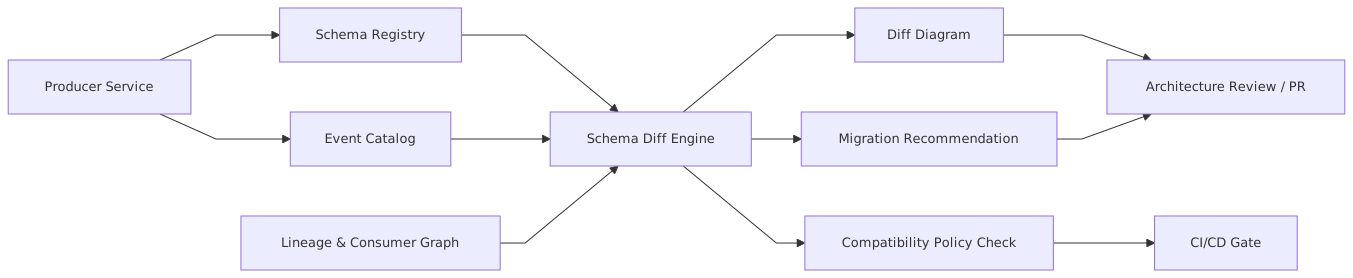
This architecture works best when event contracts are treated as first-class artifacts. The domain team owns the meaning. The platform team provides the mechanics. Governance supplies the guardrails without becoming a traffic jam. ArchiMate for governance
Domain-driven design thinking
This is where many articles go soft. They say “align schemas with business domains” and leave it there. That is not enough.
In domain-driven design, events are not integration leftovers. They are expressions of domain facts within or across bounded contexts. A schema diff is therefore a clue that one of several things has happened:
- the domain concept evolved legitimately
- the team discovered a modeling mistake
- the event was carrying too much internal state
- another bounded context depended on an interpretation it never should have assumed
For example, OrderAccepted in the Ordering context may mean “commercial acceptance.” In Fulfillment, teams may incorrectly treat it as “warehouse ready.” A schema diff that adds fraudReviewState might expose that the event was overloaded all along. The right architectural move may not be to add more fields. It may be to split the event into clearer domain events or publish a separate integration event.
This is why semantic annotations matter. Each field should carry more than a type. It should have:
- a business definition
- whether it is mandatory in domain terms or only technically optional
- source of truth
- allowed value semantics
- privacy classification
- deprecation timeline
- replay expectations
Without this, a diff engine is just comparing syntax. Enterprises need meaning-aware change review.
What a useful diff diagram should show
A useful schema diff diagram generally includes:
- unchanged fields
- added fields, with defaulting behavior
- removed or deprecated fields
- type changes
- renamed fields with explicit mappings
- semantic changes flagged manually or heuristically
- compatibility classification
- impacted consumers and confidence level
- migration stages
Here is a simplified example.

That little dotted line matters. It tells reviewers that this is not just a rename. It is a semantic split. If you miss that distinction, you will pass a technical compatibility check and still break the business.
Runtime validation
Design-time diffing catches intent. Runtime validation catches reality.
Once a new schema version is live, the platform should observe:
- proportion of events by schema version
- consumer deserialization failures
- transformation fallback rates
- null/default field rates for newly added fields
- lag by consumer version
- replay success rates
- reconciliation mismatch rates
Architecturally, this creates a feedback loop. Diff visualization is not static documentation; it is the front end of controlled evolution.
Migration Strategy
A schema change in an enterprise stream is rarely a switch. It is a campaign.
The right migration pattern is usually a progressive strangler approach: preserve flow, introduce translation, move consumers incrementally, reconcile differences, then retire old contracts deliberately. This is much safer than “big bang version 2 topic” migrations, which tend to produce duplicated logic and permanent parallel worlds.
The migration strategy depends on the class of change.
Class 1: additive, backward-compatible changes
If a field is added with safe defaults and unchanged semantics, migration is straightforward. Update consumers when convenient, monitor uptake, and eventually enforce use if needed.
Class 2: structural but mappable changes
Field renames, type widening, or split fields often require an adapter layer. A stream processor or producer-side translator can emit both old and new shapes during transition.
Class 3: semantic changes
These are dangerous. When meaning changes, not just structure, you need explicit coexistence and usually a new event version or a new event name. Old and new semantics should run side by side long enough to prove consistency and allow downstream remediation.
Class 4: bounded-context correction
Sometimes the event itself was wrong for cross-context sharing. In that case, migration may involve introducing a new integration event derived from the internal domain event and gradually moving consumers to the better boundary.
A classic strangler flow looks like this:
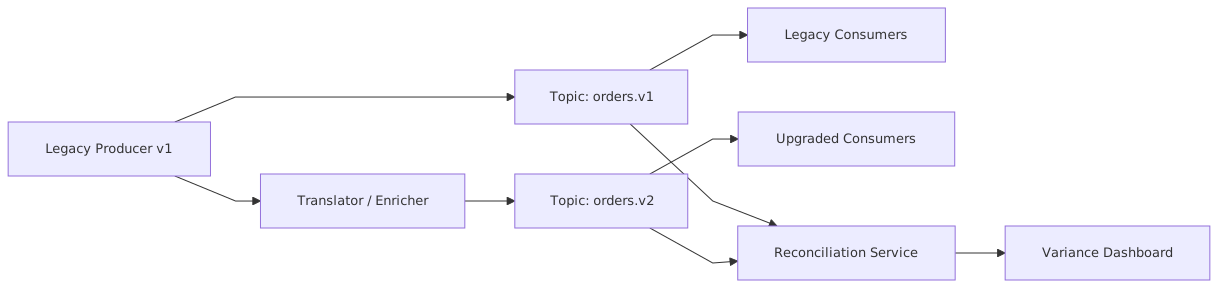
Why strangler migration works
Because event streaming punishes impatience. Consumers upgrade at different speeds. Analytics pipelines lag behind product services. External partners are slower still. A translator or anti-corruption layer buys time and isolates breakage.
The strangler pattern also forces one healthy discipline: you can only retire the old path when measurement proves the new path is complete enough.
Reconciliation discussion
No serious migration should happen without reconciliation. If old and new schemas are both live, you need a way to compare outcomes.
Reconciliation can happen at several levels:
- event-level: did v1 and v2 represent the same business fact?
- field-level: after transformation, do core values align?
- aggregate-level: do order, payment, inventory, or customer states converge?
- financial/control totals: do counts and sums match across pipelines?
- process-level: did downstream workflows complete with equivalent business results?
The danger is assuming transformed events are correct because they deserialize. They might still lose precision, collapse states, or alter timing semantics.
A robust reconciliation service usually:
- correlates by business key and event time
- compares mapped fields and derived totals
- distinguishes expected divergence from defects
- records unresolved variances for investigation
- supports replay after mapping fixes
In a regulated enterprise, reconciliation is not optional. It is the only honest answer to “how do you know migration preserved the business?”
Enterprise Example
Consider a large retail bank modernizing its card and payment estate.
The bank had a legacy card authorization platform publishing COBOL-derived messages into middleware. During a Kafka migration, an integration service translated these into an event called CardTransactionPosted. Over time, dozens of consumers attached themselves: fraud scoring, customer notifications, loyalty points, finance settlement, dispute management, and a cloud data platform.
The original schema contained fields like:
transactionAmountmerchantIdpostedDatetransactionTypereversalFlag
It looked stable, but the domain was muddy. Some consumers interpreted postedDate as accounting date. Others treated it as customer-visible booking date. transactionType mixed card present/not present logic with fee categories. reversalFlag was used for both charge reversals and temporary authorization releases.
Then the bank introduced real-time pending transaction visibility in its mobile app. The domain model had to improve. The new event family distinguished:
- authorization
- clearing
- reversal
- adjustment
And split financial semantics into:
authorizedAmountclearedAmountbillingAmountaccountingDatebookingDatelifecycleState
A text diff was useless. Structurally, everything changed. Semantically, even more.
The architecture team implemented schema diff visualization tied to a business glossary and consumer lineage graph. The diff did two essential things.
First, it showed that this was not “v2 of the same event” in a trivial sense. It was a correction to an overly broad contract. Several downstream services were relying on accidental semantics.
Second, it revealed migration groups:
- mobile app and notification services could move early to richer pending-state events
- finance settlement required dual-run and reconciliation for two accounting cycles
- loyalty points had to remain on old clearing semantics until product rules were rewritten
- data platform pipelines needed a historical backfill strategy with semantic tagging
The bank chose a strangler migration:
- legacy integration continued publishing the old event
- a new payments domain service emitted the new event family
- a transformation service generated a compatibility projection for old consumers
- reconciliation compared balances, counts, and dispute cases across both paths
- retirement of the old schema happened by consumer cohort, not by date proclamation
The important lesson was not technical. It was organizational. Visualization gave business and engineering a shared artifact. When dispute management said, “this field no longer means what our process assumes,” everyone could see it. That changed the conversation from “your consumer is broken” to “our contract was underspecified.”
That is enterprise architecture at its best: making the real problem discussable.
Operational Considerations
A schema diff capability becomes real only when it survives operations.
Schema governance in the pipeline
Every schema change should trigger:
- structural diff generation
- compatibility analysis
- semantic annotation review
- consumer impact lookup
- migration classification
- approval policy depending on blast radius
Low-risk additive changes might pass automatically. Semantic changes should require explicit review. Not all governance deserves a meeting, but some absolutely do.
Topic strategy
Avoid using topic versioning as the first reflex. New topics are useful for semantically distinct events or where operational isolation is needed. But topic proliferation is an easy way to create fragmentation. Often, one topic with explicit schema versioning and transitional transformation is cleaner. Sometimes it is not. The deciding factor is semantic clarity, not fashion.
Consumer inventory
You cannot manage migration if you do not know who consumes what. This sounds obvious and is routinely false in large organizations. Maintain a consumer registry sourced from Kafka metadata, service catalogs, stream processing deployments, and data platform subscriptions. Unknown consumers are where “safe” schema changes go to die. enterprise architecture with ArchiMate
Historical replay
Always test schema evolution against replay. Not only latest messages. Real historical slices. Event streaming systems carry time as a first-class concern. A schema diff process that ignores replay is a fair-weather architecture.
Security and compliance
Diffs should include classification changes. If a new field introduces personally identifiable information or regulated financial data, the impact is larger than serialization compatibility. Lineage and retention policies may need updates. Masking and access control may need changes as part of the migration.
Observability
Good operational dashboards show:
- schema version distribution over time
- incompatible message rejection rates
- transformation failures
- consumer lag by schema capability
- reconciliation variances
- deprecation burn-down
If you cannot see contract adoption, you are governing by optimism.
Tradeoffs
There is no free lunch here. A richer schema diff capability buys clarity at the cost of discipline.
Benefit: better change safety
You catch dangerous changes earlier, especially semantic ones.
Cost: metadata maintenance
Semantic annotations and consumer lineage need upkeep. If no one owns them, they rot.
Benefit: clearer migrations
Teams get recommended migration paths instead of improvising ad hoc adapters.
Cost: slower trivial changes
Even simple changes may feel heavier if governance is overdesigned.
Benefit: improved domain language
Forcing teams to describe field meaning exposes weak modeling and overloaded events.
Cost: uncomfortable truth
Many existing events are semantically sloppy. Visualization will reveal that, and remediation takes time.
Benefit: stronger replay and reconciliation discipline
This matters enormously in finance, retail, telecom, logistics, and healthcare.
Cost: platform complexity
You are building a real capability: registry integration, graph analysis, runtime telemetry, diagram generation. That is not a side quest.
My bias is clear: for a modest event landscape, do not overbuild. For a large enterprise Kafka estate with dozens of producer teams and critical downstream dependencies, this investment pays for itself the first time it prevents a semantic break from escaping into production.
Failure Modes
There are a few predictable ways this goes wrong.
1. Treating compatibility as correctness
The event passes Avro backward compatibility checks, so the team ships it. Later they discover downstream pricing logic used the field in a different business sense. This is the most common failure: syntax succeeded, semantics failed.
2. Diffing artifacts without lineage
A beautiful diff diagram that ignores who consumes the event is theater. Impact is what turns change into architecture.
3. Metadata fiction
Teams fill in semantic annotations once to satisfy governance, then never update them. The platform now projects certainty where none exists. Bad metadata is worse than no metadata because people trust it.
4. Big-bang migration fantasies
Someone announces that all consumers must switch to v2 by quarter-end. Some do. Many do not. The old version lingers without monitoring, and now two truths live forever. This is how integration estates become archaeological sites.
5. No reconciliation
Transformations silently lose nuance. The migration appears green until finance month-end exposes a mismatch. Reconciliation delayed is reconciliation weaponized.
6. Version explosion
Every meaningful change creates a new topic, event name, and pipeline. Soon the estate has dozens of near-duplicate streams and no retirement discipline. This is complexity disguised as purity.
7. Ignoring domain boundaries
A central architecture team imposes one canonical event model across all bounded contexts in the name of consistency. The result is vague, bloated schemas that satisfy nobody and force every team to map around a “standard” that means too little.
When Not To Use
Schema diff visualization is useful, but not universally worth the machinery.
Do not build a heavy semantic diff platform if:
- you have a small number of services with tightly coordinated deployments
- your events are internal implementation details with no external consumers
- your schema changes are rare and your domain is stable
- the cost of migration mistakes is low
- you do not yet have basic schema registry and consumer inventory in place
In those environments, a simpler discipline is enough:
- schema registry compatibility checks
- explicit versioning rules
- lightweight change logs
- direct producer-consumer communication
Also, do not use this as an excuse to avoid fixing poor domain design. A diff tool cannot rescue an event model that is fundamentally wrong. If every release produces semantic confusion, the problem is likely your bounded contexts or event definitions, not your visualization.
And one more blunt point: if your organization will not maintain metadata, lineage, and governance ownership, do not pretend you have semantic diffing. You have diagrams with confidence theater.
Related Patterns
Schema diff visualization fits naturally with several adjacent patterns.
Schema Registry
The operational anchor for versioned contracts and serialization compatibility. Necessary, but not sufficient.
Consumer-Driven Contracts
Useful when specific consumers have explicit expectations. In event streaming, these should be applied carefully so publishers do not become captive to every consumer’s internal convenience.
Anti-Corruption Layer
Critical during migration or when exposing internal domain events to other bounded contexts. Often the right place for translation between old and new event semantics.
Strangler Fig Pattern
The migration backbone for replacing legacy event contracts incrementally while keeping the stream alive.
Event Versioning
Still necessary, but should be guided by semantic boundaries rather than blind incrementing.
Event-Carried State Transfer
Relevant because larger payloads increase compatibility sensitivity and semantic ambiguity. The more state you carry, the more careful evolution must be.
CQRS and Event Sourcing
Especially important where replay is fundamental. Schema changes must respect historical rebuild and temporal meaning, not only live processing.
Reconciliation and Data Quality Controls
A practical companion pattern during migration and dual-running. It closes the loop between intended and actual equivalence.
Summary
Schema diff visualization in event streaming is not about making schemas look pretty. It is about making change legible before it becomes operational damage.
In a Kafka and microservices estate, event contracts are where technical design meets business semantics. A field added casually in one service can ripple into fraud scoring, finance, analytics, customer communication, and regulatory reporting. That is why raw schema diffs are too weak. Enterprises need visualized, governed, meaning-aware diffs that combine structural change, semantic intent, consumer impact, and migration guidance.
The sound architecture approach is straightforward, though not simplistic:
- treat schemas as first-class contracts
- enrich them with domain semantics
- connect them to a real consumer lineage graph
- classify change by compatibility and meaning
- migrate with a progressive strangler strategy
- reconcile old and new paths before retirement
- observe adoption and variance in production
The hardest lesson is also the most important one: schema evolution is a domain problem disguised as a technical one.
Once you see that, the rest of the architecture gets clearer. You stop asking only whether a consumer can read the next message. You start asking whether the enterprise can still trust what the message says.
That is the real diff that matters.
Frequently Asked Questions
What is event-driven architecture?
Event-driven architecture (EDA) decouples services by having producers publish events to a broker like Kafka, while consumers subscribe independently. This reduces direct coupling, improves resilience, and allows new consumers to be added without modifying producers.
When should you use Kafka vs a message queue?
Use Kafka when you need event replay, high throughput, long retention, or multiple independent consumers reading the same stream. Use a traditional message queue (RabbitMQ, SQS) when you need simple point-to-point delivery, low latency, or complex routing logic per message.
How do you model event-driven architecture in ArchiMate?
In ArchiMate, the Kafka broker is a Technology Service or Application Component. Topics are Data Objects or Application Services. Producer/consumer services are Application Components connected via Flow relationships. This makes the event topology explicit and queryable.