⏱ 21 min read
Most architecture failures do not begin with a dramatic outage. They begin with a quiet compromise.
A team has a transactional system that still works, mostly. Orders go in. Payments clear. Customer service can search just enough to survive the day. Then the business asks for richer dashboards, near-real-time operational views, cross-domain search, fraud scoring, recommendation feeds, SLA tracking, regulatory audit slices, and executive metrics that somehow must all be “live.” The old model bends. Teams pile reporting queries onto OLTP tables, add caches, clone databases, create ETL jobs, and gradually build a palace on top of a swamp.
Shadow read models are one of the more pragmatic ways out.
They are not glamorous. They do not usually show up in conference talks with dramatic names. But in large enterprises, they are often the difference between a clean migration and a long, expensive rewrite that dies in committee. A shadow read model lets you build a new read-side representation of the business without immediately ripping out the old system of record. It sits in the shadows at first—fed by events, change data capture, or integration messages—then proves itself, reconciles with reality, and only later earns production traffic.
That matters because architecture is not merely about structure. It is about sequencing risk.
In CQRS, we split command and query concerns because they have different jobs. Commands protect invariants. Queries answer questions. The tragedy in many enterprise systems is that those responsibilities are blurred until both suffer. The write model becomes distorted by reporting convenience. The read path becomes constrained by transactional design. Shadow read models restore that separation gradually, which is why they fit so well in migration-heavy organizations.
This article digs into the pattern in a way architects actually need: not as a slogan, but as a set of design choices with consequences. We will look at domain semantics, migration strategy, Kafka-based integration, reconciliation, failure modes, and where this pattern absolutely should not be used. event-driven architecture patterns
Context
CQRS is often described too neatly. Commands change state. Queries read state. Different models, maybe different stores. That’s true, but the real enterprise story is messier.
Most organizations do not start with clean bounded contexts and event-driven microservices. They start with a large operational estate: ERP platforms, order management systems, policy admin systems, customer master records, billing platforms, warehouse systems, CRM tools, and a few “temporary” SQL Server databases that have somehow outlived three CIOs. Each system carries part of the truth, and none of them tells the whole story in a way the business actually wants to consume.
A shadow read model emerges when one team needs a better query model than the source system can reasonably provide, but cannot yet replace the source of truth.
That “cannot yet” is doing a lot of work.
Maybe the transactional system is too risky to modify. Maybe it is vendor-managed. Maybe it has hundreds of hidden dependencies. Maybe the organization wants to move toward domain-aligned microservices but still runs a core monolith. Maybe there is a strategic push toward Kafka and event streaming, but only some domains are ready. In all these cases, a shadow read model is a bridge pattern: a way to build better read capabilities around an existing write core. microservices architecture diagrams
The shadow part matters. Initially, this read model is not authoritative. It is derivative. It learns from the source system. It is validated against existing outputs. It serves low-risk consumers first. It gets compared, tuned, and reconciled. Only after the organization gains confidence does it become a primary read endpoint for some business capabilities.
That’s the real shape of enterprise modernization. Not a clean cut. A careful shadow.
Problem
The basic problem sounds simple: the operational write model is a poor fit for the questions the business needs answered.
But that simplicity hides several deeper architectural tensions:
- Transactional schemas are optimized for correctness and update paths, not for query composition.
- Read requirements often span multiple bounded contexts.
- Legacy systems expose too little semantic information.
- Reporting and search use cases put load on systems designed for command processing.
- Migrations fail when teams try to replace both command and query paths at once.
The anti-pattern is familiar. Teams attempt to satisfy new read use cases by stretching the existing system. They add indexes, replica databases, stored procedures, materialized views, cron-based ETL, and ad hoc APIs. Each step appears rational. The result is accidental architecture: hard to reason about, slow to evolve, and semantically muddy.
The domain problem is even more important than the technical one.
A read model is not just a projection of tables. It is a projection of meaning. If a business asks, “Show me at-risk enterprise customers with overdue invoices and open severity-1 incidents,” that is not a query against one aggregate. It is a business concept assembled across domains: Customer, Billing, Support, Risk. The old write models may never have represented that idea directly because they were built to record transactions, not to answer operational questions.
A shadow read model gives that concept a home.
Not in the command model. Not in a reporting spreadsheet. In a dedicated read-side model shaped around the language of the consumer.
That is classic domain-driven design thinking. The read model belongs to a bounded context too. It has ubiquitous language. It names concepts intentionally. It translates source events into business-facing query structures. If teams miss this, they end up with a “shadow database” that is merely another copy of legacy confusion.
Forces
This pattern exists because several forces pull in different directions.
1. Business wants richer reads now
Executives, operations teams, service desks, compliance officers, and customer-facing channels all want faster, more contextual read experiences. They do not care that the source platform was designed in 2008.
2. Source systems are risky to change
Core systems often hold revenue-critical invariants. Modifying them is expensive, politically fraught, and sometimes contractually constrained. Vendor packages are especially stubborn.
3. Query load threatens write stability
Reporting queries, search endpoints, and operational dashboards can starve transactional workloads. Separating read models can protect core write paths.
4. Domain semantics are fragmented
What the business considers a single view may be spread across many systems. A shadow read model often becomes the first place where those semantics are intentionally composed.
5. Event quality is uneven
In greenfield CQRS, one imagines pristine domain events. In enterprises, the feed may come from Kafka topics with mixed quality, CDC streams from Oracle, integration events from ESBs, or batch files. The architecture must tolerate imperfect upstream signals.
6. Migration must be incremental
Big-bang rewrites are where architecture optimism goes to die. Progressive strangler migration is safer: build a new read path in parallel, verify it, then cut over slice by slice.
7. Consistency expectations vary
Some queries tolerate seconds of lag. Others do not. The pattern works best where read-side eventual consistency is acceptable and understood by consumers.
These forces make shadow read models attractive, but also dangerous if oversold. The architect’s job is not to cheerlead the pattern. It is to know where the seams are.
Solution
A shadow read model is a query-optimized representation of domain information built alongside an existing write system, initially in parallel and without immediate authority.
In practical terms:
- The existing operational system continues to own commands and transactional consistency.
- Changes from that system are emitted or captured as events, integration messages, or CDC records.
- A projection pipeline transforms those changes into one or more read models optimized for specific query use cases.
- The new read model is validated through reconciliation against current outputs or source data.
- Consumers are moved gradually, often behind a routing layer or feature flags.
- Over time, the read model may become the preferred query source, even while writes still land in the old system.
That progression is the key. A shadow read model is not just a read replica. It is an intentional, semantically designed query model that starts life in parallel.
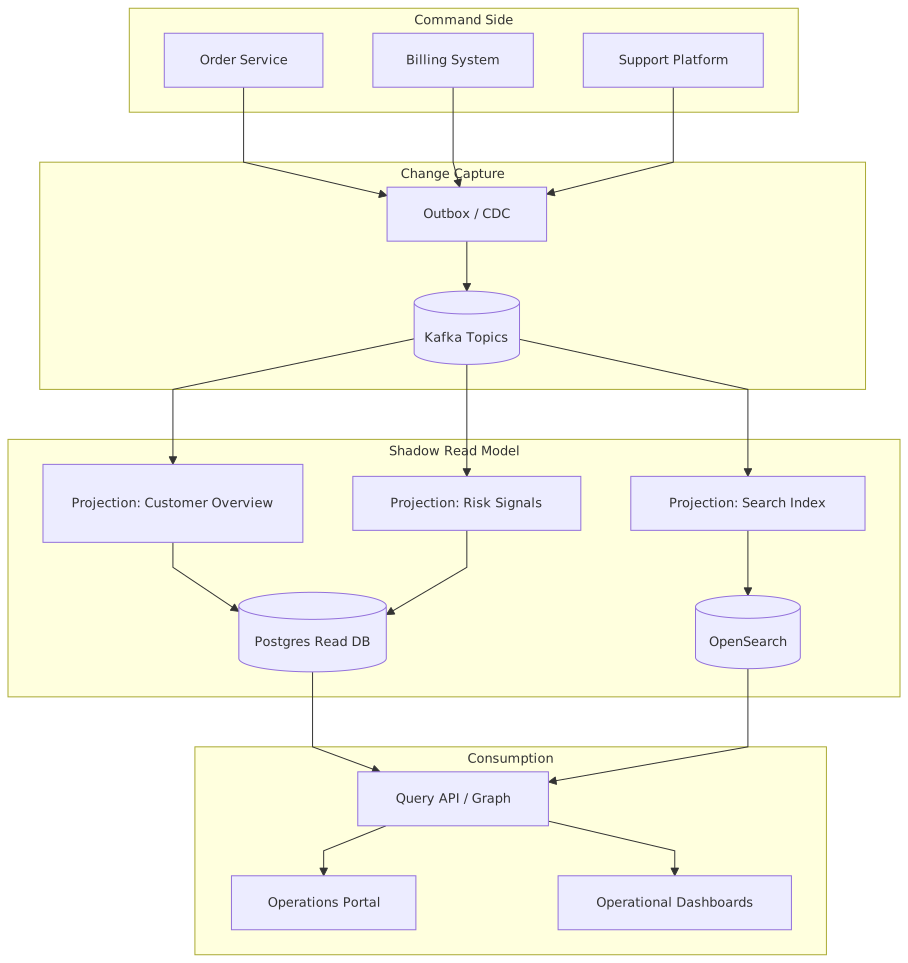
Here is a simplified architecture.

The projection service is where meaning gets imposed. It maps source changes into domain-oriented query structures. That may involve denormalization, enrichment, correlation across services, temporal calculations, or status derivation.
This is where many implementations either shine or collapse.
If the projection layer is treated as dumb plumbing, the read model becomes brittle and opaque. If it is allowed to express domain semantics clearly, the read side becomes a strategic asset. For example:
- “ShipmentDelayed” may be derived from shipping milestones and SLA rules, not emitted directly.
- “HighValueCustomerAtRisk” may combine revenue, complaint patterns, and churn indicators from multiple contexts.
- “OpenExposure” in insurance may require policy, claim, and reserve semantics.
That is not database reshaping. That is domain modeling.
Architecture
A mature shadow read model architecture usually includes five elements:
1. Source of change
This may be:
- Domain events from services
- Kafka integration events
- CDC streams from legacy databases
- Outbox messages from monoliths
- Scheduled extracts as a temporary step
Domain events are ideal when you control the source and the event schema reflects business meaning. CDC is often the practical choice when you do not.
Opinionated view: if you can add an outbox to the source system, do that before betting your future on raw CDC alone. CDC tells you that rows changed. It does not always tell you what the business meant.
2. Event backbone
Kafka is a common fit because it decouples producers from multiple projections, supports replay, and aligns with enterprise event streaming strategies. But Kafka is not the pattern. It is the transport.
Use topics aligned to domain boundaries where possible, not giant technical streams named after databases. If your topic names read like table dumps, you are exporting storage structure, not business intent.
3. Projection services
Projection services subscribe to changes and build specialized views. Some teams use one service per read model; others use one per bounded context with multiple projections inside. Either can work, but keep ownership clear.
Projection logic should be:
- Idempotent
- Replayable
- Versioned
- Observable
- Explicit about ordering assumptions
4. Read stores
The store depends on query shape:
- Elasticsearch / OpenSearch for search-heavy views
- PostgreSQL for relational read composition
- Redis for low-latency key/value lookups
- Cassandra or DynamoDB for high-scale access patterns
- Column stores for analytical-ish operational reads
A shadow read model is not one database. It is a pattern that may produce several fit-for-purpose stores.
5. Query interface and routing
Consumers should not couple directly to the projection store if avoidable. Expose a query API, BFF, or federated access layer. This gives you room for fallback, canary routing, and semantic versioning.
A more detailed view:
Domain semantics and bounded contexts
This deserves direct attention. In domain-driven design, a read model should not become a dumping ground for unresolved language conflicts.
Suppose Sales says “customer,” Billing says “account,” Support says “tenant,” and Identity says “party.” If your shadow read model merges these without an explicit semantic mapping, you have built a lie with good performance.
A proper design asks:
- Which bounded context owns each concept?
- What does the consumer actually need?
- Where must translation happen?
- Which fields are raw facts, and which are derived interpretations?
- What temporal semantics apply?
The best shadow read models are honest about these distinctions. They often store:
- source facts
- derived states
- derivation timestamps
- provenance metadata
That provenance matters during debugging and reconciliation. When a user asks, “Why does the dashboard say this account is delinquent?” you need more than a value. You need lineage.
Migration Strategy
This pattern earns its keep in migration.
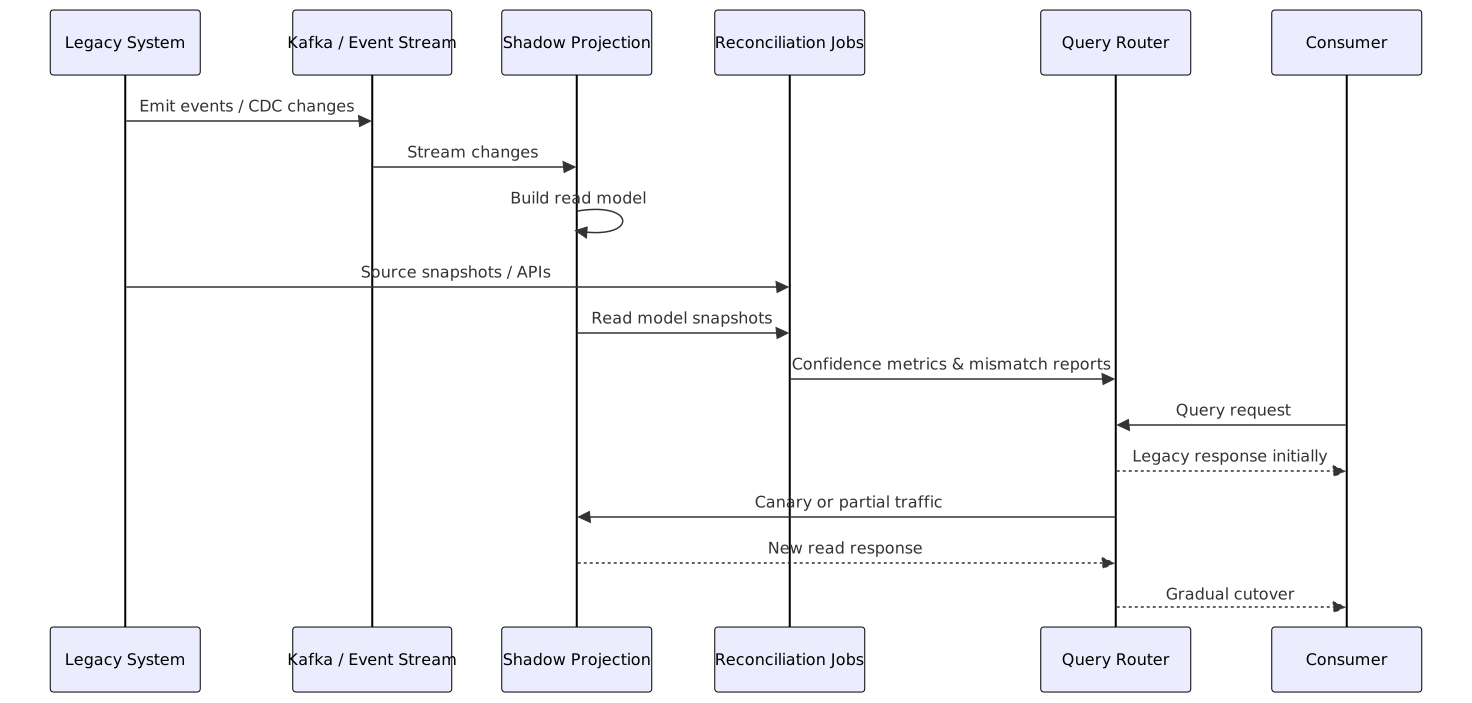
A progressive strangler migration with shadow reads usually follows this path:
- Identify a high-value read use case
Pick something painful enough to matter, but bounded enough to manage. Customer 360 views, order tracking, claim status portals, inventory visibility, and operational work queues are common candidates.
- Model the target read semantics
Start with the questions users ask, not source tables. Define the domain language of the read model.
- Establish change capture
Use outbox, domain events, or CDC. If the source emits poor events, introduce a translation layer rather than infect every consumer with source quirks.
- Build the projection pipeline
Make it replayable from day one. If you cannot rebuild the read store from history, you have created a fragile artifact.
- Run in shadow
Populate the new model, compare outputs, and expose it only to internal or low-risk consumers first.
- Reconcile
Compare the shadow model to source truth or legacy reads. Investigate semantic mismatches, lag, dropped events, duplicate processing, and ordering issues.
- Cut over query traffic gradually
Use feature flags, tenant-based routing, region-based rollout, or specific endpoints.
- Retire old read paths selectively
Do not rush. Leave fallback routes until confidence and observability are solid.
Here is the migration shape:
Reconciliation is not optional
This is where serious teams separate themselves from optimistic ones.
Because shadow read models are derivative, they can drift. Drift may come from:
- Missing events
- Duplicate events
- Out-of-order delivery
- Semantic transformation bugs
- Source corrections not reflected downstream
- Hard deletes not modeled correctly
- Partial cross-domain joins
Reconciliation should include:
- Row or entity counts
- Key business totals
- Field-level comparisons for critical attributes
- Lag monitoring
- Temporal correctness checks
- Exception buckets for irreconcilable cases
In many enterprises, reconciliation becomes its own small product. Good. It should. It is the trust engine of the migration.
Enterprise Example
Consider a global insurer modernizing claims operations.
The core policy and claims systems are legacy platforms: one vendor package for policy administration, one homegrown claims platform, one billing system, and a CRM used by agents and contact centers. Executives want a unified “claims exposure dashboard” showing, in near real time:
- open claims by region
- reserve changes
- overdue investigations
- related policy status
- payment anomalies
- claimant contact risk
- catastrophe event grouping
The existing reporting approach is a nightly warehouse load plus ad hoc SQL extracts. It is too slow for field operations and too brittle for catastrophe response.
A rewrite of the claims core is off the table. It would take years and threaten regulatory reporting.
So the architecture team introduces a shadow read model.
Domain thinking first
They define a bounded context for Claims Operational Insight. It does not own claims adjudication. It owns the query language used by operations managers and catastrophe coordinators.
Its read model includes concepts like:
- ClaimExposure
- ReserveTrend
- InvestigationSLAStatus
- PaymentAnomalySignal
- PolicyCoverageSummary
- CatEventCluster
Notice these are not direct tables in any source system. They are operational semantics.
Event sourcing? No. Event-informed? Yes.
The source landscape is mixed:
- Policy admin emits some business events
- Claims platform only supports CDC
- Billing publishes payment messages to Kafka
- CRM exposes APIs and some event notifications
The team builds a Kafka backbone with topic contracts for normalized integration events. A translation service converts CDC changes from the claims database into domain-relevant events such as ClaimOpened, ReserveAdjusted, ClaimClosed, and InvestigationAssigned. This is imperfect, but far better than projecting directly from row changes.
Read-side construction
Projection services build:
- a PostgreSQL store for dashboard aggregates and drill-downs
- an OpenSearch index for adjuster and claim search
- a Redis cache for high-frequency claim header lookups
For six months, the dashboard runs in shadow for internal operations leaders. Every number is compared to the nightly warehouse and sampled against transactional APIs. Mismatches are triaged.
What they found
Not glamorous bugs. Real ones.
- Reserve changes arriving out of order after batch corrections
- Claims reopened without a consistent event in the source feed
- Soft-deleted policy endorsements causing false coverage gaps
- Catastrophe grouping rules that differed subtly between business units
- CRM contacts merged asynchronously, creating duplicate claimant identities
This is what shadow models are for: finding the truth before the business depends on the illusion.
Eventually the insurer routes regional operations teams to the new query API. Dashboard latency drops from hours to seconds. More importantly, the business gains a language for operational claims exposure that never existed coherently in any source system.
That is the enterprise payoff. Not just performance. Better semantics.
Operational Considerations
Shadow read models live or die on operations.
Observability
Track:
- consumer lag by topic and partition
- projection processing time
- replay duration
- reconciliation mismatch rate
- stale entity counts
- dead-letter volume
- query latency and error rates
You need dashboards that tell you not only whether the system is up, but whether the read model is trustworthy.
Replay and rebuild
Assume you will need to rebuild projections. Maybe you changed logic. Maybe data got corrupted. Maybe a topic was backfilled.
Design for:
- deterministic replay
- schema version handling
- backfill throttling
- partition-aware rebuild
- blue/green read store replacement
If replay is terrifying, the architecture is unfinished.
Schema evolution
Event contracts change. So do read needs.
Use versioned event schemas, consumer tolerance for additive change, and explicit transformation layers. Never let every projection interpret source evolution in its own ad hoc way.
Data retention and privacy
Shadow read models copy data. That means they copy compliance obligations too.
Consider:
- PII minimization
- field-level encryption
- retention windows
- right-to-erasure propagation
- auditability of derivations
Architects love to talk about events until the privacy office arrives. Then the real design begins.
Consistency communication
Consumers must understand freshness guarantees. Expose timestamps like:
lastUpdatedFromSourceprojectionVersiondataFreshnessSeconds
Hidden eventual consistency causes support tickets and political backlash. Visible eventual consistency earns trust.
Tradeoffs
This pattern is useful because it shifts complexity. It does not remove it.
Benefits
- Protects write systems from read load
- Enables query models aligned to business language
- Supports gradual migration
- Encourages domain decomposition
- Provides a path from legacy systems to event-driven architecture
- Allows multiple read optimizations for different use cases
Costs
- More moving parts
- Event and schema governance overhead
- Reconciliation effort
- Eventual consistency
- More storage and data duplication
- Operational burden around replay and drift detection
The central tradeoff is simple: you accept asynchronous complexity in exchange for semantic clarity and evolutionary change.
In many enterprises, that is a good deal. In some, it is an expensive hobby.
Failure Modes
Architects should name failure modes plainly.
1. Shadow database, not shadow read model
The team copies source tables into another store and calls it CQRS. There is no domain semantic improvement, only duplicated confusion.
2. No ownership of read semantics
Everyone contributes fields. No one owns meaning. The read model becomes a political compromise instead of a bounded context.
3. CDC worship
Teams assume row changes are enough. They are not. CDC can feed a model, but by itself it rarely captures the domain intent needed for robust projections.
4. Reconciliation theater
A dashboard says “99.8% matched” but nobody investigates the 0.2%, which happens to contain the highest-value customers or claims.
5. Ignored temporal semantics
The read model combines facts from different times and presents them as one coherent present. That creates subtle business lies.
6. Over-centralized “enterprise read platform”
A central platform team tries to build one giant canonical read model for the whole enterprise. This usually collapses under semantic disagreement and delivery bottlenecks.
7. Premature authority
The organization routes critical traffic to the shadow model before lineage, lag, and drift controls are mature. Confidence evaporates after the first discrepancy.
8. Replay paralysis
Projection code cannot handle reprocessing, so every schema or logic change becomes a production migration nightmare.
If a pattern needs a slogan, use this one: build shadows slowly, or they become ghosts.
When Not To Use
Shadow read models are not universally wise.
Do not use them when:
Strong read-after-write consistency is mandatory
If a user command must be reflected instantly and exactly in the next read, and no lag is tolerable, a separate shadow read model may be the wrong fit.
Read requirements are simple
If a relational replica or a few indexed views solve the problem cleanly, use the simpler tool. Not every query problem deserves Kafka and projections.
The source domain is still unstable
If upstream business semantics are changing weekly, building polished read projections may be premature. First stabilize the language.
You lack operational discipline
Without monitoring, replay strategy, reconciliation, and schema governance, a shadow read model is just deferred confusion. EA governance checklist
The organization wants a hidden replacement rewrite
If leadership is secretly using “shadow read model” as camouflage for an eventual big-bang replacement of the whole system, be careful. That road is littered with budget burn.
Cross-domain semantics are unresolved
If there is no agreement on what “customer,” “policy exposure,” or “active order” means, a shadow read model will harden disagreement into code.
Sometimes the right answer is boring: fix the existing query path, improve indexing, add a cache, or split one reporting workload. Architecture maturity includes the ability to resist fashionable complexity.
Related Patterns
Shadow read models sit near several other patterns, but they are not the same thing.
CQRS
Shadow read models are a migration-friendly implementation of the query side of CQRS, especially where writes remain in an existing system.
Materialized views
A shadow read model is often a distributed, domain-aware materialized view. The difference is that it is usually fed asynchronously and designed around domain queries, not just SQL optimization.
Event sourcing
You do not need event sourcing to use shadow read models. Event sourcing gives excellent replay and projection support, but many enterprises use shadow reads with outbox events or CDC.
Outbox pattern
A strong companion pattern. It gives reliable event publication from transactional systems and is often a better source than raw CDC.
Strangler fig pattern
This is the migration frame around the pattern. Shadow reads are one of the cleanest ways to strangle legacy query paths before touching command paths.
API composition
Sometimes a read requirement can be met by composing calls at request time. That works for some use cases, but once latency, scale, or complex derived semantics enter the picture, precomputed shadow read models usually win.
Summary
Shadow read models are one of those patterns that look modest on a whiteboard and prove profound in real enterprises.
They let you separate query concerns from fragile transactional cores without demanding an immediate rewrite. They create room for better domain semantics. They support progressive strangler migration. They allow Kafka, microservices, and event-driven techniques to add value even when the write side is still old-world. Most importantly, they force an organization to confront what its data actually means.
That last point is the real story.
A good shadow read model is not a copy. It is an interpretation, designed deliberately, validated relentlessly, and migrated cautiously. It gives the business a clearer mirror than the source systems ever could. But mirrors can distort. That is why reconciliation, provenance, and explicit freshness matter so much.
Use the pattern when the business needs richer reads, the write side is hard to change, and eventual consistency is acceptable. Avoid it when the requirements are simple, the semantics are unsettled, or the operational muscle is absent.
And never forget the discipline underneath the elegance: events can be late, source systems can lie, and derived state can drift.
The point of the shadow is not to pretend it is the object.
The point is to let the enterprise move toward a better shape before it has the courage—or the budget—to step fully into the light.
Frequently Asked Questions
What is CQRS?
Command Query Responsibility Segregation separates read and write models. Commands mutate state; queries read from a separate optimised read model. This enables independent scaling of reads and writes and allows different consistency models for each side.
What is the Saga pattern?
A Saga manages long-running transactions across multiple services without distributed ACID transactions. Each step publishes an event; if a step fails, compensating transactions roll back previous steps. Choreography-based sagas use events; orchestration-based sagas use a central coordinator.
What is the outbox pattern?
The transactional outbox pattern solves dual-write problems — ensuring a database update and a message publication happen atomically. The service writes both to its database and an outbox table in one transaction; a relay process reads the outbox and publishes to the message broker.