⏱ 20 min read
Event-driven architecture has a dirty secret: the hard part is rarely the broker, the throughput, or the partitions. The hard part is time.
Time is what breaks neat diagrams. Time is what turns a clean event contract into a graveyard of “v1”, “v2-final”, and “v2-final-fixed”. Time is what makes yesterday’s sensible domain model become today’s liability. In an event-driven system, data does not just move through space across services; it moves through history. And history is where most architectures go to become expensive.
That is why schema evolution deserves more respect than it usually gets. Teams often treat it as a serialization concern, a registry concern, or a developer tooling concern. It is all of those things, but first it is a business concern. A schema is not merely a shape of bytes. It is an agreement about meaning. Change the shape carelessly and consumers break. Change the meaning carelessly and the business breaks while all the tests still pass.
In enterprise systems, this gets amplified. Kafka topics live for years. Consumers are added by teams who were not in the room when the original event was designed. Data products are derived from streams long after the source team has moved on. Regulatory retention means old events cannot simply disappear. The event log becomes part operational backbone, part historical record, part political compromise. And somewhere in the middle of it all, somebody needs to rename customerId, split address into structured fields, or redefine what “order confirmed” actually means.
You do not solve that with a version field alone.
The right approach to schema evolution in event-driven architecture combines domain-driven design, explicit versioning strategy, compatibility governance, migration planning, and operational discipline. It accepts a simple truth: schemas evolve because the business evolves. Good architecture allows that evolution without forcing synchronized deployments, mass replay disasters, or semantic drift that slowly poisons every downstream service. EA governance checklist
This article lays out how to do that in a pragmatic way. Not in the style of a standards committee, but in the way enterprises actually survive contact with legacy systems, Kafka estates, and dozens of microservices written by teams with different incentives. event-driven architecture patterns
Context
Event-driven systems promise decoupling. Producers emit facts. Consumers react independently. Teams deploy at their own pace. The platform scales. Everyone smiles in the architecture review.
Then reality arrives.
A producer adds a required field. An analytics consumer fails deserialization. A fraud service reads an old event with new semantics and quietly downgrades risk. A reconciliation job finds mismatches between the event stream and the system of record because one service interpreted “cancellation” as “customer-initiated” and another interpreted it as “any terminal undo state”. Nobody notices for three weeks because the dashboards aggregate both versions together.
This is the nature of long-lived event streams. They are durable, shared, and asynchronous. That combination is powerful, but unforgiving.
In a request-response API, contract changes can often be coordinated, fronted by gateways, or managed with endpoint versioning. In event-driven architecture, especially with Kafka, the producer does not know all current or future consumers. It publishes into a stream that becomes shared infrastructure. That stream is not just integration plumbing. It is a published domain language. And published languages are hard to change once the organization starts depending on them.
Domain-driven design is useful here because it reminds us that an event is not an integration DTO with a trendy transport. An event expresses something that happened in a bounded context. If the domain meaning is weak, schema evolution will become a sequence of accidental technical edits. If the domain meaning is clear, evolution has a fighting chance of staying coherent.
Put differently: changing an event schema is often changing part of the business vocabulary. Treat it with the same care you would a core ledger rule or a customer pricing model.
Problem
The obvious problem is compatibility. Consumers built against one schema may not be able to read another.
But the deeper problems are more subtle.
First, there is structural change: adding fields, removing fields, changing types, moving from flat to nested structures, introducing enums, splitting one event into several, or consolidating many into one.
Second, there is semantic change: the event name stays the same, but its meaning shifts. OrderShipped once meant “label printed”; now it means “carrier accepted package”. That change is more dangerous than a renamed field because systems continue running while silently disagreeing.
Third, there is temporal coexistence: old and new producers, old and new consumers, replay jobs, historical topics, compacted state stores, and downstream lakehouses all process different vintages of the same event family at the same time.
Fourth, there is organizational asymmetry: the producer team wants speed, downstream teams want stability, platform teams want governance, and nobody wants a release train.
These are not edge cases. They are the normal operating conditions of a serious enterprise event platform.
Forces
A good architecture article should admit the forces honestly. Schema evolution is a balancing act between competing concerns.
Stability versus autonomy
Consumers want stable contracts. Producers want freedom to evolve. If the producer is locked forever, the domain calcifies. If the producer changes freely, every consumer becomes a hostage.
Domain purity versus integration pragmatism
DDD encourages events that reflect bounded context semantics, not enterprise-wide canonical fantasies. That is right. But enterprises still need interoperability. Too much local purity and every downstream team must reverse-engineer meaning. Too much canonical ambition and the event model becomes bloated, generic, and lifeless.
Backward compatibility versus forward progress
Supporting every historical shape forever sounds safe until it creates crippling complexity in producers, consumers, and stream processors. Yet breaking compatibility casually turns the event backbone into a sequence of migrations disguised as incidents.
Replayability versus reinterpretation
One of Kafka’s strengths is replay. But replay only helps if you can still interpret old events correctly. If semantics changed without explicit version handling, replay can produce different business outcomes than the original processing.
Governance versus throughput
Schema registries, compatibility checks, and approval workflows reduce breakage. They also create friction. Friction is not always bad. But too much of it and teams route around the platform with opaque JSON blobs and private topics.
Data correctness versus migration cost
Sometimes the only clean solution is to publish a new event type, backfill historical state, and reconcile downstream projections. That is expensive. So teams cut corners. Later the enterprise pays interest.
Solution
The practical solution is not “always backward compatible” or “just use Avro with a schema registry.” Those are useful tactics, not architecture.
The architecture pattern that works is this:
- Model events as domain facts within bounded contexts.
- Treat schema and semantic versioning separately.
- Prefer additive change within an event version line.
- Use new event types for major semantic shifts.
- Introduce translation at the edges, not ambiguity in the middle.
- Adopt progressive migration using a strangler approach.
- Support reconciliation as a first-class capability.
- Govern compatibility automatically, not ceremonially.
A healthy event ecosystem has a simple bias: preserve meaning, contain blast radius, and make migration deliberate.
Start with domain semantics
If an event is named CustomerUpdated, you have already made life harder than necessary. Updated what? Address? Status? Consent? Risk profile? Generic events age badly because every new requirement gets stuffed into them like a loft full of old furniture.
Events should express meaningful business moments: CustomerAddressChanged, MarketingConsentWithdrawn, OrderAllocatedToWarehouse, PaymentAuthorizationExpired. That granularity matters because schema evolution is easier when the event meaning is narrow and explicit.
This is straight DDD thinking. Events belong to a bounded context. They are part of that context’s ubiquitous language. They should not attempt to be universal truth for the whole enterprise. Other contexts can translate them into their own language.
Separate structural versioning from semantic versioning
Most teams conflate them. That is a mistake.
- Structural versioning deals with the schema shape: fields, types, optionality.
- Semantic versioning deals with business meaning.
Adding an optional field might be a structural change with no semantic impact. Redefining the meaning of an existing field is a semantic change even if the schema is identical.
In practice:
- Minor structural changes can stay within the same event type if compatibility rules hold.
- Semantic changes should usually produce a new event type or at least an explicitly new major version consumed as a different contract.
If OrderConfirmed changes from “payment approved” to “warehouse accepted fulfillment,” do not hide that behind a schema tweak. Publish a different event. Ambiguity is poison in event logs.
Prefer additive evolution
Add fields. Deprecate fields. Avoid removing or retyping fields in-place. This is not because additive change is pretty; it is because asynchronous systems punish synchronized upgrades.
A producer can usually add optional data without breaking tolerant consumers. A consumer can ignore fields it does not understand. This is the sweet spot.
But additive change has limits. If the added field becomes required for correct interpretation, you have not really done an additive change. You have created a latent breaking change.
Use translators and anti-corruption layers
Downstream consumers should not be forced to ingest every historical version directly if that creates chaos. A translation layer can normalize events into an internal model or a versioned canonical stream for a particular platform use case.
That is not a call for one giant enterprise canonical model. Those usually collapse under their own ambition. It is a call for local anti-corruption layers where needed. Translate at context boundaries. Keep the ugliness at the edge.
Architecture
A workable versioned schema architecture in Kafka-based microservices usually includes these elements: microservices architecture diagrams
- Event producers publishing domain events
- Schema registry enforcing compatibility policies
- Version-aware consumers using tolerant readers
- Translation services or stream processors for normalization
- Dual-publish or bridge components during migration
- Reconciliation and audit pipeline to detect divergence
- Topic lifecycle governance for deprecation and retirement
Here is the basic flow.
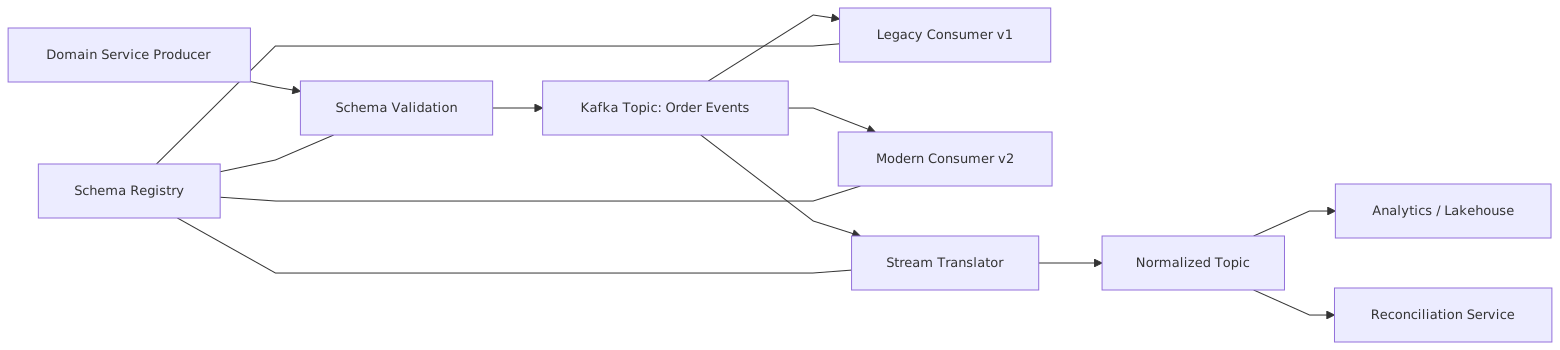
This diagram hides the difficult truth: consumers are not all equal. Some are stateful stream processors. Some write to operational stores. Some produce derived events. Some feed audit systems that cannot tolerate interpretation drift. Your compatibility strategy has to account for each class of consumer.
Topic and event design
A common question is whether to version the schema within one topic or create new topics per major version. The answer is: it depends on the change.
Use the same topic when:
- the event meaning is materially the same
- compatibility can be maintained
- consumers can safely process mixed structural versions
Use a new event type or topic when:
- semantics changed
- ordering across versions is no longer straightforward
- migration requires side-by-side validation
- consumer populations are radically different
I am opinionated here: changing semantics in the same topic is usually a false economy. It saves a little short-term setup and creates long-term interpretive debt.
A versioned event envelope
The envelope should help with operational clarity without pretending to solve semantics by itself. Typical metadata includes:
- event type
- schema version
- producer version
- occurred-at timestamp
- event id
- aggregate or business key
- correlation and causation ids
- optional tenant or jurisdiction markers
That metadata gives you observability and routing leverage. It does not replace clear event design.
Consumer strategy: tolerant but not blind
Consumers should use a tolerant reader pattern: ignore unknown fields, supply defaults where appropriate, and branch behavior by version where necessary.
But tolerance has a limit. A consumer that silently defaults critical fields can become functionally wrong while technically “compatible.” The mantra should be: tolerant in syntax, strict in meaning.
Migration Strategy
This is where most architecture papers become vague. Migration is not a side note. Migration is the whole game.
The enterprise-safe approach is a progressive strangler migration. You do not replace old contracts in one dramatic move. You surround them, translate them, dual-run them, compare outcomes, and retire them deliberately.
Phase 1: Introduce the new schema or event
Publish the new version alongside the old one. If semantics changed, create a new event type. If it is a structural additive change, update the schema under compatibility rules.
Phase 2: Bridge old and new worlds
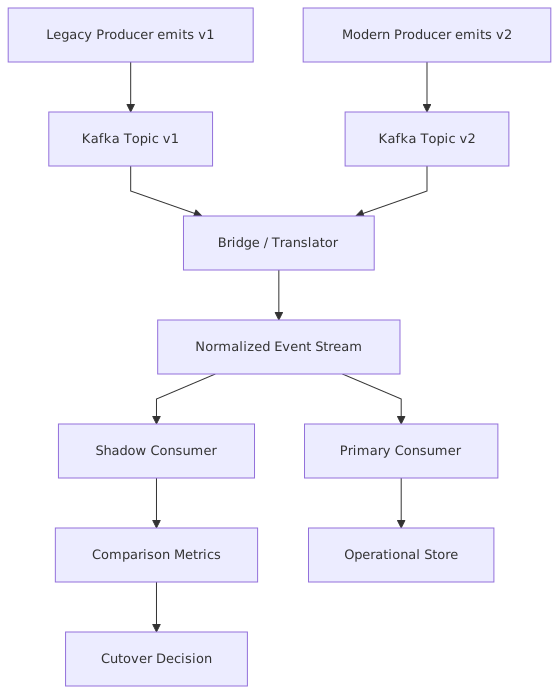
Use a translator or bridge service so downstream systems can continue operating while teams migrate at different speeds.
Phase 3: Dual-run and compare
Have critical consumers process both paths in parallel, writing to shadow stores or emitting comparison metrics. This is essential in financial, customer, and inventory domains.
Phase 4: Reconcile
Reconciliation is the grown-up part of event migration. It means checking whether projections, balances, statuses, or derived facts produced from old and new event paths agree. If they do not, you investigate before cutover.
Phase 5: Cut over by consumer cohort
Move low-risk consumers first. Then internal operational consumers. Then externally reported or regulated consumers. Last come the systems that can trigger money movement, customer communication, or compliance outcomes.
Phase 6: Deprecate and retire
Set a sunset date. Monitor remaining readers. Stop pretending deprecated means retired.
Here is the migration flow in simple terms.
Reconciliation deserves its own design
Most teams mention reconciliation as if it were a batch report someone can run later. That is too weak.
Reconciliation should answer:
- Did both old and new pipelines produce the same business result?
- If not, is the difference expected due to intentional semantic change?
- Which entities are affected?
- Can we replay or compensate safely?
For event-sourced or projection-heavy systems, reconciliation often compares materialized views by business key and event window. For ledger or financial domains, it may compare balances, totals, and invariant checks. For customer domains, it may compare state snapshots plus key lifecycle transitions.
If you cannot reconcile, your migration is built on hope. Hope is not an architecture.
Enterprise Example
Consider a large insurer modernizing claims processing.
The legacy estate has a claims mainframe publishing nightly extracts. A newer claims intake platform emits Kafka events. Downstream systems include fraud detection, customer notifications, regulatory reporting, finance, and a lakehouse for actuarial analysis. The original event, ClaimUpdated, is a monster: dozens of fields, sparse population, and overloaded semantics. It can mean status change, reserve adjustment, policy validation, or customer document receipt depending on which fields moved.
This works, in the same way an overloaded extension cord works right before it starts smoking.
The enterprise decides to move toward a domain-driven event model aligned to bounded contexts:
ClaimFiledClaimCoverageValidatedClaimReserveAdjustedClaimDocumentReceivedClaimApprovedForPaymentClaimClosed
This is not cosmetic. It reflects actual business moments and separates concerns across claims, policy, finance, and customer communication contexts.
The migration cannot be big-bang. Too many systems depend on ClaimUpdated. So the architecture team introduces a strangler path:
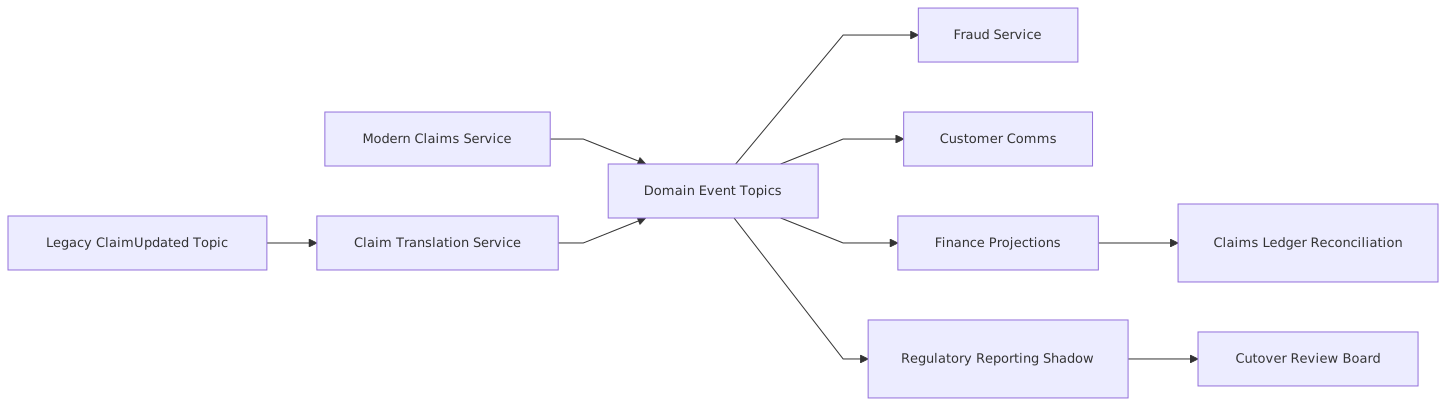
- Legacy
ClaimUpdatedcontinues on the existing topic. - A translation service parses old events and emits normalized domain events where confidence is high.
- The modern claims service emits the new domain events directly.
- Downstream consumers are grouped by criticality.
- Fraud and analytics consume both old-derived and new-native domain events into shadow models.
- Finance uses reconciliation against the claims ledger and payment system before cutover.
- Regulatory reporting remains on the legacy path until semantic confidence is proven.
A simplified target view looks like this:
What happened in practice?
First, they discovered semantic ambiguity in the old event was far worse than the documentation suggested. The translator could not infer intent reliably for some historical updates. That led to a blunt but healthy decision: not all legacy events would be transformed. Some downstream consumers would remain on legacy feeds until source systems were upgraded.
Second, reserve adjustment events required much stricter semantics than the existing schema conveyed. A field called amount existed in both gross and net senses depending on the source application. Same field name, different business meaning. This is exactly why schema evolution is not merely technical. They introduced explicit event types and fields for reserve basis and valuation timestamp.
Third, reconciliation caught a serious defect before cutover. The new customer notification service treated ClaimClosed as customer-visible closure, but some claims could be administratively closed and then reopened. Legacy notifications had hidden business rules around closure reason. Without reconciliation and shadow running, customers would have received misleading messages.
This is the pattern. Enterprises do not suffer because schema changes are impossible. They suffer because meaning was never made explicit, migration was underfunded, and nobody owned reconciliation.
Operational Considerations
A schema evolution architecture lives or dies operationally.
Schema registry and compatibility rules
Use a schema registry. Enforce compatibility automatically in CI/CD and at publish time where appropriate. The exact mode matters:
- backward compatibility supports new consumers reading old data poorly
- forward compatibility supports old consumers reading new data
- full compatibility is safer but more restrictive
- transitive compatibility matters for long-lived streams
Do not set one enterprise-wide rule and pretend the matter is settled. Different event families need different policies. Regulated audit streams may demand more conservatism than ephemeral operational streams.
Observability
Track:
- schema version adoption by topic and consumer group
- deserialization failures
- unknown field usage
- fallback/default usage rates
- dual-run divergence metrics
- replay outcomes by version
- lag segmented by event version
Version adoption dashboards are not glamorous, but they are what keep deprecation honest.
Replay and backfill
Replay is powerful and dangerous. Before replaying:
- confirm version-aware consumers can interpret historical payloads
- validate semantics of old events against current code paths
- define idempotency and compensation behavior
- isolate replay traffic if downstream side effects exist
Backfills should be treated as controlled migrations, not casual batch jobs.
Data retention and archival
Long retention means long compatibility obligations. If you retain seven years of Kafka topic history or offload events to object storage for replay, your schema strategy must account for archaeology. Someone in 2029 will read a 2023 event and ask what status=3 meant. Leave breadcrumbs.
Governance
Good governance is mostly automation plus a few hard rules:
- every event has an owning team
- semantic change requires explicit review
- deprecations have published timelines
- topics have lifecycle states
- consumers must register ownership and criticality
- no opaque payload blobs on shared enterprise topics
The goal is not bureaucracy. The goal is to stop undocumented change from masquerading as agility.
Tradeoffs
There is no free lunch here.
Versioned schemas and compatibility rules reduce breakage, but they add cognitive load. Translation layers preserve decoupling, but they can become permanent complexity. Dual-publishing lowers migration risk, but it increases operational burden and can create ordering problems. Rich domain events improve semantics, but they demand more domain maturity from teams.
Progressive strangler migration is safer than big-bang replacement, but it extends the coexistence period. During coexistence, you pay for both worlds. That cost is real. It is still usually cheaper than a platform-wide synchronized migration.
Another tradeoff is between local bounded-context models and enterprise-wide discoverability. Strongly local event models are healthier in principle, but they can frustrate downstream analytics and reporting teams. The answer is not to flatten all domain nuance into canonical mush. The answer is to build explicit downstream normalization where cross-context analysis is genuinely needed.
Failure Modes
Schema evolution fails in recognizable ways.
Semantic drift hidden behind compatibility
The schema passes compatibility checks, but the meaning changed. This is the most common and most dangerous failure mode.
Zombie fields
Deprecated fields remain forever because some unknown consumer still depends on them. Nobody dares remove them, and nobody knows whether they still mean anything.
Dual-write inconsistency
During migration, producers emit both old and new events, but not atomically. Consumers see divergence and nobody can explain whether it is a bug or timing.
Translation as guesswork
Legacy payloads lack enough information to produce correct new events, so translators infer meaning. Inference turns into institutionalized fiction.
Replay surprises
A replay runs current business logic against historical events whose semantics no longer align. The system rebuilds state that never existed operationally.
Consumer blindness
Tolerant readers ignore new fields that actually matter for correctness. The consumer stays up while becoming wrong.
Topic sprawl
Every change creates a new topic, version, and branch until the platform resembles a storage unit no one can navigate.
When Not To Use
Not every event-driven system needs heavy schema evolution machinery.
If the event stream is short-lived, internal to one team, and has tightly coordinated deployment, a simple additive JSON contract may be sufficient. If the system is really command-oriented and events are merely implementation detail, do not overbuild a grand versioning framework.
Likewise, if your domain semantics are still volatile and poorly understood, freezing them into shared enterprise event contracts may be premature. In that case, keep events local, use anti-corruption layers, and let the domain settle before publishing broadly.
And if your main integration problem is synchronous transactional consistency across a handful of systems, event-driven architecture may not be the right hammer at all. A badly chosen event backbone with elaborate schema governance is still a badly chosen architecture. ArchiMate for governance
Related Patterns
Several related patterns fit naturally with schema evolution.
- Tolerant Reader: consumers ignore unknown structural elements.
- Anti-Corruption Layer: translate external event models into local domain language.
- Strangler Fig Pattern: progressively replace legacy event contracts and consumers.
- Outbox Pattern: ensures reliable publication from transactional boundaries.
- Event Versioning: explicit structural contract evolution.
- Event-Carried State Transfer: useful but increases schema coupling if overused.
- Event Sourcing: raises the stakes because the event log is the source of truth.
- CQRS Projections: often require reconciliation during migration and replay.
- Data Mesh-style Data Products: benefit from clear contract ownership and version transparency.
These patterns are complementary. None of them absolve you from thinking clearly about business meaning.
Summary
Schema evolution in event-driven architecture is really the discipline of letting systems change without forcing the enterprise to hold its breath.
The core idea is simple: schemas are not just technical contracts. They are expressions of domain semantics across time. If you treat them as serialization trivia, you will get brittle consumers, silent semantic drift, and migration projects that look cheaper than they are right up until they fail.
The architecture that works is deliberate and slightly conservative. Model events as meaningful domain facts. Prefer additive structural change. Separate schema shape from business meaning. Use new event types when semantics shift. Migrate progressively with a strangler approach. Build translators where needed, but do not let them become engines of fiction. Reconcile before cutover. Govern compatibility with automation. Track what versions are actually in use. Retire old contracts on purpose.
In Kafka and microservices environments, this is not optional maturity theater. It is basic survival.
A good event backbone should feel like a railway, not a minefield. Trains can be upgraded, routes can be extended, old rolling stock can be retired. But only if the gauges are known, the signals are clear, and everyone agrees what station they are actually heading toward.
Frequently Asked Questions
What is enterprise architecture?
Enterprise architecture aligns strategy, business processes, applications, and technology in a coherent model. It enables impact analysis, portfolio rationalisation, governance, and transformation planning across the organisation.
How does ArchiMate support architecture practice?
ArchiMate provides a standard language connecting strategy, business operations, applications, and technology. It enables traceability from strategic goals through capabilities and services to infrastructure — making architecture decisions explicit and reviewable.
What tools support enterprise architecture modeling?
The main tools are Sparx Enterprise Architect (ArchiMate, UML, BPMN, SysML), Archi (free, ArchiMate-only), and BiZZdesign. Sparx EA is the most feature-rich, supporting concurrent repositories, automation, scripting, and Jira integration.