⏱ 21 min read
Event-driven architecture has a habit of looking elegant on whiteboards and turning feral in production.
At first, everything seems wonderfully decoupled. Teams publish events. Other teams subscribe. Kafka hums away in the background like a dependable utility. A few services become a few dozen. A handful of event types becomes hundreds. Then the quiet damage starts. One team adds a field with a slightly different meaning. Another reuses an event name for a new business purpose. A third team “temporarily” emits malformed payloads to unblock a release. Nobody notices immediately because asynchronous systems are forgiving right up until they are not. By the time the incidents begin, the architecture diagram still looks clean. The reality is a swamp of implied assumptions.
This is where a data contract registry earns its keep.
Not as bureaucracy. Not as a prettier schema repository. And certainly not as an excuse to centralize all design decisions in some architecture review board that mistakes delay for governance. A proper data contract registry is a mechanism for preserving meaning at scale. It gives event streams the thing they usually lose first under growth pressure: shared semantics. EA governance checklist
If you run event-driven systems with Kafka, microservices, and independent teams, you are already operating a distributed semantic system whether you admit it or not. The only real question is whether those semantics are explicit, versioned, discoverable, and governable—or scattered across code, tribal memory, Confluence pages, and incident postmortems. microservices architecture diagrams
A data contract registry is one answer. Not the only answer. But often the right one when events stop being local implementation details and start becoming enterprise assets.
Context
Most enterprises do not adopt event-driven systems because they are fashionable. They adopt them because the business has become too dynamic for tightly coupled request-response integration alone. Orders need to trigger fulfillment, fraud detection, notifications, inventory adjustments, billing, analytics, and machine learning pipelines. Customer state changes must fan out across sales, support, digital channels, and compliance platforms. The enterprise needs motion.
Kafka often becomes the backbone because it solves a practical problem well: durable event streaming at scale. Microservices fit because teams want autonomy. Domain-driven design enters because the real challenge is not transport; it is understanding. The hard part is deciding what an OrderPlaced event actually means, which bounded context owns it, what invariants it promises, and which changes are safe over time.
That last point is where many organizations stumble. They invest heavily in brokers, pipelines, CI/CD, and observability but leave event semantics weakly governed. They have schemas, perhaps in Avro, Protobuf, or JSON Schema. They may even use a schema registry. Yet they still suffer semantic drift. Why? Because schema compatibility is not business compatibility.
A field can be syntactically valid and semantically disastrous.
Consider a customer domain. One team emits customerStatus = ACTIVE to mean “eligible for purchases.” Another interprets it as “identity verified.” Both pass validation. Both are wrong from the other's point of view. This is not a serialization problem. It is a contract problem.
A data contract registry addresses this larger concern. It stores more than message structure. It captures ownership, lifecycle, compatibility policy, domain definitions, classification, usage expectations, deprecation rules, and links between producer promises and consumer assumptions. In other words, it acts as the semantic catalog for event collaboration.
Done well, it becomes part of the socio-technical architecture, not just the technical one.
Problem
In event-driven systems, producers and consumers are decoupled in time and deployment. That is the blessing. It is also the trap.
Because consumers are not directly invoked, producers rarely feel the full impact of breaking changes. Because topics can outlive services, old assumptions remain active long after the original team has moved on. Because multiple consumers read the same event, one “small” change can ripple into analytics, operations, fraud, and customer experience all at once.
The common symptoms are painfully familiar:
- Event names that reflect implementation rather than domain intent
- Fields added without clear semantics
- Topics reused for new purposes because “it was already there”
- Consumers depending on undocumented optional fields
- No reliable owner for a contract after a team reorg
- Breaking changes introduced under the banner of “backward compatible enough”
- Duplicate but slightly different events representing the same business fact
- Regulatory and data classification concerns discovered after propagation
This creates a peculiar enterprise failure mode: local optimization with global semantic decay.
A plain schema registry helps with wire compatibility. It is necessary, but not sufficient. It can tell you whether a field was added in a technically compatible way. It usually cannot tell you whether the field changes the business meaning of the event, whether PII classification now violates downstream retention policies, whether the event is still published from the authoritative bounded context, or whether a consumer has embedded assumptions that are now invalid.
What enterprises need is not just schema validation. They need contract governance that respects domain ownership and delivery velocity. ArchiMate for governance
That is the role of the registry in this article: a managed source of truth for event contracts, sitting between domain modeling and runtime integration.
Forces
Architects should be suspicious of patterns that pretend there are no tensions. This one has plenty.
Team autonomy vs enterprise consistency
Microservices live on autonomous teams. Enterprises live on shared meaning. If teams cannot move independently, the platform becomes slow and political. If teams can publish anything with any meaning, the platform becomes fast and chaotic. A contract registry is an attempt to hold the line between those two bad outcomes.
Syntax vs semantics
A schema tells you shape. A contract tells you intent. Event-driven systems need both. The registry must not degrade into a glorified list of fields.
Evolution vs stability
Events need to evolve. Businesses change. New channels appear. Regulations shift. But consumers need predictability. The architecture must support change without making every release a coordination exercise across dozens of teams.
Domain boundaries vs integration convenience
Domain-driven design tells us to respect bounded contexts. Enterprise integration constantly tempts us to blur them. Shared enterprise topics become semantic dumping grounds. A registry should reinforce ownership, not erase it.
Governance vs bureaucracy
The moment a registry becomes a central committee, developers route around it. The moment it becomes optional, quality collapses. Good governance is mostly automation with a small amount of sharp human review where meaning truly changes.
Operational speed vs historical correctness
Streaming systems prize low latency. Enterprises still need reconciliation, audit, and lineage. Contracts must describe not only the happy path but also how events behave under replay, correction, and backfill.
Solution
The core idea is simple: treat event definitions as first-class contracts governed by domain ownership and stored in a registry that is integrated into delivery pipelines and runtime discovery.
Not a wiki. Not a PDF. Not a side spreadsheet maintained by one heroic architect. A registry.
A useful data contract registry usually stores these dimensions together:
- Contract identity: event name, bounded context, owning team, version
- Schema definition: Avro, Protobuf, JSON Schema, or equivalent
- Semantic definition: business meaning of the event and each field
- Compatibility policy: backward, forward, full, or custom semantic rules
- Lifecycle state: proposed, active, deprecated, retired
- Data classification: PII, PCI, confidential, public, retention constraints
- Operational metadata: topic mappings, partitioning expectations, key semantics
- Quality rules: required fields, enumerations, invariants, validation logic
- Usage references: producers, known consumers, lineage, criticality
- Migration guidance: replacement contracts, deprecation timelines, mapping notes
The point is not to create exhaustive metadata for its own sake. The point is to make event contracts safe to discover, evolve, and operate.
In a mature architecture, contract changes follow a path something like this:
- Domain team proposes a new event or version.
- Contract is reviewed in the context of bounded context ownership and business language.
- Automated checks validate syntax, compatibility, classification, and policy.
- Contract is registered and published with status and version metadata.
- Producer CI/CD pipelines can only emit approved contract versions.
- Consumer teams can discover contracts, subscribe with confidence, and test compatibility.
- Deprecations are managed through lifecycle policies, not surprise announcements.
This shifts integration from tribal agreement to managed collaboration.
Registry vs schema registry
This distinction matters. A schema registry manages serialization compatibility. A data contract registry manages semantic and operational agreements around data exchange. In many enterprises, the right answer is not to replace the schema registry but to wrap or extend it.
Think of the schema registry as the gearbox and the contract registry as the dashboard, service history, and rules of the road. You need the gearbox. You also need to know where you are going and what happens if the oil light turns on.
Architecture
At a high level, the registry sits in the path of design-time governance and delivery-time enforcement, while runtime systems continue to use Kafka and service-local processing. event-driven architecture patterns

This architecture has a few important characteristics.
1. Contract ownership is aligned to bounded contexts
A sales team should not own fulfillment events. A customer profile team should not define billing semantics. This sounds obvious until enterprise programs start creating “shared” integration teams that become de facto owners of everything and experts in nothing.
In domain-driven design terms, the contract should be owned by the bounded context that is authoritative for the underlying business fact. The event is a published language artifact of that context. The registry should make this ownership explicit.
That single choice reduces a surprising amount of confusion.
2. Contracts are versioned independently of topics
Topics are transport channels. Contracts are semantic agreements. Tying them too tightly creates brittle integration. You want the ability to support multiple contract versions on the same stream where appropriate, or to shift topic strategy without redefining the business event model.
3. Compatibility includes domain rules
A schema-compatible change can still be contract-breaking. For example:
- changing units from dollars to cents
- repurposing a field without renaming it
- introducing nullable states that invalidate previous invariants
- changing event timing from “fact completed” to “intent initiated”
A strong registry allows custom policy checks, not just serializer-level checks.
4. Discovery matters as much as validation
In large organizations, half the integration pain comes from not knowing what already exists. Teams create duplicate events because finding the right event is harder than inventing a new one. The registry should provide searchable semantics, examples, owners, lineage, and lifecycle state.
5. Runtime should remain loosely coupled
The registry should inform runtime behavior, not become a latency-critical dependency for every message. Producers and consumers should resolve and cache contract metadata through CI/CD, deployment packaging, or local control planes. If your event path depends on a synchronous registry lookup per message, you have built an avoidable outage.
Here is a more detailed view.
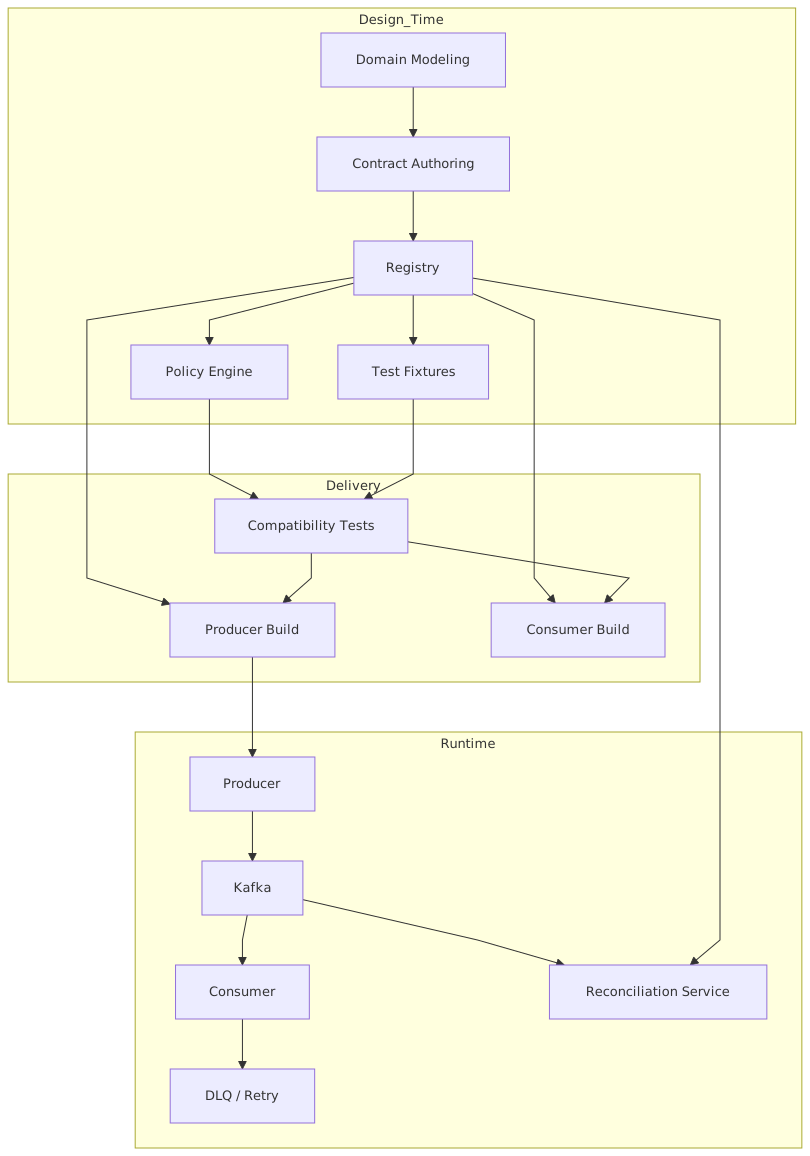
Notice the reconciliation service. That is not an afterthought. In real enterprises, streams drift, consumers fail, and historical correction is unavoidable. Contracts need to support not just forward processing but also reconciliation logic: replays, compensations, late arrivals, and corrective events. A contract registry should document whether an event is immutable fact, a revision, a snapshot, or a compensating signal. Without that, reconciliation turns into guesswork.
Domain semantics discussion
This is the heart of the matter.
A contract should answer questions like:
- Is this event a domain fact or an integration convenience?
- Does it represent state transition, state snapshot, or business notification?
- What business moment does it correspond to?
- Which fields are authoritative and which are denormalized copies?
- What is the semantic key?
- Can events arrive out of order?
- Are corrections emitted as new facts or updates?
- What exactly does absence mean for optional fields?
These are domain semantics, not transport trivia. They determine whether consumers can safely build workflows, projections, and audit trails.
If the registry only stores field types, it has missed the point.
Migration Strategy
Enterprises rarely get to start clean. Usually there is already a Kafka estate, a homegrown schema store, a zoo of payload conventions, and a collection of consumers that are more fragile than anyone admits.
So migration must be progressive. This is classic strangler thinking: do not stop the world, do not rewrite everything, and do not pretend every legacy interface can be purified in one program increment.
Start by wrapping existing reality with governance rather than replacing it.
Phase 1: Inventory and classify
Catalog existing topics, event types, producers, consumers, owners, and schemas. This is usually messier than expected. Many “events” turn out to be command-like messages or CDC artifacts masquerading as domain signals. Fine. Label them honestly.
Classify each stream into categories:
- domain event
- integration event
- technical/CDC event
- notification
- snapshot
- legacy opaque payload
This classification is not cosmetic. It helps determine where contract rigor matters most.
Phase 2: Register without enforcing
Create the registry and onboard existing contracts in a passive mode. Pull from current schema registries where possible. Add minimal semantic metadata: owner, domain, description, classification, lifecycle.
At this stage, focus on discoverability. The first win is making the landscape visible.
Phase 3: Enforce on new contracts
Do not try to retroactively perfect every old stream. That is how programs die. Instead, require all new event contracts to enter through the registry with policy validation and ownership metadata.
This creates a clean frontier between governed future and tolerated past.
Phase 4: Strangle high-value domains
Pick domains where semantic confusion is expensive: orders, payments, customer identity, claims, inventory. Introduce canonical event contracts owned by the relevant bounded contexts. Deprecate overlapping legacy messages by routing producers to the new contracts and offering consumer adapters where necessary.
Phase 5: Add compatibility and deprecation gates
Once teams trust the workflow, tighten controls:
- block unauthorized schema changes
- require semantic diff review for sensitive contracts
- enforce deprecation windows
- require PII classification before publication
- fail builds that reference retired versions
Phase 6: Reconciliation and replay support
Finally, integrate the registry with replay tooling, data quality monitoring, and reconciliation services. This is where the architecture matures from “governed publishing” to “operable event platform.”
A strangler migration is not glamorous, but it works because it respects enterprise gravity.
Here is the migration pattern visually.

Enterprise Example
Consider a large retailer operating e-commerce, stores, fulfillment centers, and customer loyalty across multiple regions. They have Kafka at the center, roughly 180 microservices, and around 1,200 event types if you count all variants and historical versions. On paper, this sounds modern. In practice, they had four separate definitions of what an order was.
The digital commerce domain emitted OrderCreated when the customer clicked “Place Order.” Payment emitted OrderAuthorized after fraud and funds checks. Fulfillment had OrderReleased when inventory was reserved. Analytics consumed all of them as “placed order” signals depending on which pipeline had been built first. Executive dashboards were inconsistent. Customer service saw one status; warehouse operations saw another. Finance had reconciliation gaps because cancellation semantics differed by channel.
The fix was not to create one mega-event called OrderEverythingHappened. The fix was to bring domain-driven clarity and contract discipline.
The retailer defined bounded contexts explicitly:
- Commerce owns customer purchase intent and checkout submission
- Payment owns authorization and capture outcomes
- Fulfillment owns reservation, pick, pack, and ship events
- Customer Care owns service case interactions
- Finance owns accounting postings
Then they established a data contract registry layered over their existing schema registry. Each contract required:
- owning domain team
- business description
- event type classification
- state transition semantics
- key definition
- timing guarantees
- PII tags
- compatibility rules
- replacement/deprecation references
A critical move was separating domain facts from integration views. For example, Commerce.OrderSubmitted became the authoritative event for customer intent. A separate Enterprise.OrderLifecycleUpdated integration event was produced downstream for broad consumption where a simplified lifecycle model was needed. The registry made the distinction explicit. Teams could no longer casually treat every event as canonical.
Migration used a strangler approach. Existing consumers kept running. New consumers were directed to the registered contracts. For legacy consumers that depended on old payloads, the platform team provided translation services and versioned adapters. Over nine months, they reduced duplicate order-related contracts from 47 to 16, retired seven high-risk legacy topics, and—more importantly—cut cross-team release coordination for order changes dramatically.
One of the best outcomes was not technical. It was organizational. The registry gave product, operations, and engineering a shared language for discussing events. Once semantics became visible, architecture reviews got shorter and incidents got less mysterious.
That is usually the sign of a good architectural move: less drama in rooms full of smart people.
Operational Considerations
A registry is only useful if it participates in operations, not just design.
CI/CD integration
Contract validation should be embedded in pipelines. Producers should fail builds when trying to publish unregistered or policy-violating contracts. Consumers should be able to run compatibility tests against producer fixtures or contract examples.
Sample payloads and test fixtures
Every contract should include representative examples, edge-case fixtures, and negative cases. This seems mundane. It is not. Most semantic confusion becomes obvious when teams look at realistic payloads rather than abstract field lists.
Observability
Track:
- contract version usage by producer and consumer
- deprecated version traffic
- schema validation failures
- semantic validation failures
- DLQ rates by contract
- replay/reconciliation activity by event type
If you cannot see which versions are alive, deprecation becomes theater.
Reconciliation support
Real enterprises need a path to recover from missed events, consumer outages, and data divergence. The registry should help answer:
- Is replay safe?
- Is the event immutable?
- Are duplicate deliveries tolerated?
- Is ordering required per key?
- What is the correction mechanism?
- Is there a compensating event type?
This is especially important in Kafka ecosystems where replay is both a superpower and a foot-gun.
Security and data governance
Contracts must carry data classification and retention metadata. Once PII lands on a topic, it tends to spread with remarkable efficiency. The registry is a practical place to put red lines around what may be published and who may consume it.
Runtime caching and resilience
Do not make runtime event processing depend on constant synchronous registry access. Resolve contracts at build or deploy time, cache metadata locally, and design for registry outages. Governance systems should not sit directly in the blast radius of every message.
Tradeoffs
A data contract registry is a strong pattern, but it is not free.
Benefit: semantic discipline
Cost: process overhead
Teams must write and maintain better definitions. Some will call this friction. They are partly right. It is productive friction. Still, if the process is too heavy, teams will game it.
Benefit: safer evolution
Cost: slower casual change
You cannot “just add a field” anymore, at least not in critical domains. That is healthy, but it will frustrate teams used to unilateral change.
Benefit: discoverability and reuse
Cost: temptation toward false standardization
A registry can encourage useful reuse. It can also encourage architects to over-standardize across domains that should remain distinct. Similar names do not mean identical concepts.
Benefit: enterprise governance
Cost: central platform dependency
Even if the runtime is decoupled, the development workflow now depends on a platform capability. That means funding, product management, and support must be real, not honorary.
Benefit: better compliance posture
Cost: metadata upkeep
Classifications, ownership, and lifecycle information decay unless maintained. A stale registry is worse than no registry because people trust it.
The right question is not whether there is overhead. There is. The right question is whether your event estate is large and business-critical enough that unmanaged semantics are already costing more.
In many enterprises, they are.
Failure Modes
Patterns fail in recognizable ways. A mature architect plans for that.
1. The registry becomes a schema graveyard
Teams upload schemas, nobody writes semantics, and the portal fills with half-described artifacts. Search degrades. Trust collapses. Adoption dies quietly.
2. Governance turns into a review board bottleneck
If every contract change waits for a weekly committee, teams will bypass the process with “temporary” topics and side channels. Automation should do most of the work. Human review should focus on true semantic change and cross-domain impact.
3. Contracts ignore bounded contexts
A central team creates generic enterprise events detached from domain ownership. They look reusable and become meaningless. Everyone consumes them differently. This is integration theater.
4. Versioning policy is too lax
Breaking semantic changes sneak through because the rules only check serializer compatibility. Consumers continue running until a business discrepancy appears weeks later.
5. Versioning policy is too strict
Minor additions become expensive. Teams clone topics or contract names just to avoid process pain. You get fragmentation instead of evolution.
6. Reconciliation is forgotten
The registry supports only forward publication. Then the first major replay happens and nobody knows whether events are idempotent, corrective, or snapshot-based. Recovery becomes manual and political.
7. Ownership decays after reorgs
This one is very enterprise. Teams change names, products merge, applications move, and the owner field in the registry becomes fiction. Unowned contracts are risk magnets.
When Not To Use
Not every event-driven system needs a full data contract registry.
Do not lead with this pattern when:
- you have a small number of services maintained by one tight team
- events are internal implementation details with short lifetimes
- your integration style is mostly synchronous APIs with limited eventing
- your event volume is low and business criticality is modest
- domain boundaries are still too unstable to formalize contracts sensibly
In these cases, a plain schema registry plus lightweight conventions may be enough.
Also, do not use a contract registry as a substitute for domain modeling. If your teams cannot agree on the business language, putting bad concepts into a registry will only institutionalize confusion. A registry amplifies clarity, but it also amplifies muddle.
And do not build one if you lack the operational discipline to maintain it. Dead governance tooling is a museum of good intentions.
Related Patterns
A data contract registry sits alongside several adjacent patterns.
Schema Registry
Handles serialization and compatibility for Avro, Protobuf, or JSON schemas. Essential, but narrower in scope.
Event Catalog
Provides discovery and documentation of event streams. A contract registry often includes this capability, but with stronger governance and policy enforcement.
Consumer-Driven Contracts
Useful where consumers validate assumptions against providers. In eventing, this can complement a contract registry, especially for critical integrations, though care is needed to avoid consumers dictating producer domain models.
Canonical Data Model
Sometimes used to standardize enterprise integration. Use sparingly. In event-driven systems, a single canonical model often flattens bounded contexts and creates semantic compromise. Better to prefer domain-owned contracts with explicit translation where needed.
Anti-Corruption Layer
Crucial during migration. Helps legacy consumers and producers interact with governed contracts without infecting new models with old semantics.
Outbox Pattern
Relevant for reliable event publication from transactional services. The registry governs what is published; the outbox helps ensure it is published consistently.
Data Lineage and Catalog
Often integrated with the registry for governance, discovery, and audit. Especially important when events feed analytics and AI systems.
Summary
Event-driven systems fail less often because of brokers than because of meaning.
Kafka will move bytes all day long. Microservices will deploy independently. Topics will multiply. None of that guarantees a coherent enterprise language. Without explicit contracts, event streams become a distributed rumor mill: technically valid, operationally busy, and semantically unreliable.
A data contract registry is a practical architectural response. It turns event definitions into governed assets. It aligns ownership with bounded contexts. It gives teams a way to evolve contracts safely. It supports migration through a strangler approach rather than a rewrite fantasy. It improves reconciliation, discoverability, and compliance. And it does so without sacrificing the basic strength of event-driven architecture: loose runtime coupling.
But it is not magic. Used badly, it becomes bureaucracy, a stale catalog, or a semantic landfill. Used well, it becomes something much more valuable: a shared map of enterprise meaning.
That is what large event-driven systems need most. Not just more messages. Better promises.
Frequently Asked Questions
What is enterprise architecture?
Enterprise architecture aligns strategy, business processes, applications, and technology in a coherent model. It enables impact analysis, portfolio rationalisation, governance, and transformation planning across the organisation.
How does ArchiMate support architecture practice?
ArchiMate provides a standard language connecting strategy, business operations, applications, and technology. It enables traceability from strategic goals through capabilities and services to infrastructure — making architecture decisions explicit and reviewable.
What tools support enterprise architecture modeling?
The main tools are Sparx Enterprise Architect (ArchiMate, UML, BPMN, SysML), Archi (free, ArchiMate-only), and BiZZdesign. Sparx EA is the most feature-rich, supporting concurrent repositories, automation, scripting, and Jira integration.