⏱ 21 min read
CQRS always sounds cleaner on a whiteboard than it feels in production.
On the whiteboard, the command side protects the truth, the query side serves the business, and events flow like well-behaved couriers between them. The arrows are neat. The boundaries are crisp. Architects smile. Then the system goes live, sales changes a discount rule, finance introduces a compliance hold, operations retries a failed message, and a regional service goes half-dark for forty minutes. Suddenly the command model and query model are no longer dancing together. They are drifting apart like two clocks in different rooms.
That drift is not an edge case. It is the normal weather of a CQRS system.
The real question is not whether command and query models diverge. They do. The real question is whether the architecture treats that divergence as a known force in the system, with language, controls, and recovery paths. Mature enterprise architecture does not pretend eventual consistency is harmless. It gives it shape. It names the failure modes. It decides which forms of divergence are tolerable, for how long, and for whom.
This is where many CQRS designs go wrong. Teams focus on separating reads and writes as a mechanical pattern, but they skip the hard part: preserving domain semantics while the two models evolve independently. They create a write model that speaks in aggregates and invariants, and a read model that slowly becomes a reporting warehouse with API endpoints bolted onto it. Over time, the command side still thinks in terms of intent—approve loan, reserve inventory, terminate policy—while the query side thinks in denormalized convenience. The models no longer disagree only in timing. They disagree in meaning.
That is command-query drift. And if you ignore it, your architecture becomes a polite liar.
This article looks at that drift as an architectural concern, not just a synchronization bug. We will talk about why it happens, how domain-driven design helps contain it, what a pragmatic solution looks like in Kafka and microservices environments, how to migrate toward CQRS without detonating an existing estate, and when you should refuse the pattern altogether. event-driven architecture patterns
Context
CQRS is attractive because enterprise systems are rarely symmetrical. The things we need to protect on the write side are not the same as the things we need to optimize on the read side.
The command model exists to preserve business truth. It enforces invariants. It decides whether an action is allowed. It speaks the language of the domain. A customer cannot close an account with uncleared obligations. A shipment cannot be dispatched without allocated stock. A claim above threshold requires secondary review. These are not database rules. They are business rules, and they belong near the command model.
The query model exists to answer questions efficiently. Which orders are delayed in the northeast region? What is the policy exposure by broker and product line? Which customers are likely to churn in the next 30 days? These questions demand denormalized, searchable, often precomputed structures. They do not want aggregate roots and transactional boundaries. They want speed, shape, and relevance.
That asymmetry is exactly why CQRS exists.
In a monolith, some of this tension is hidden because reads and writes share the same schema. The compromise is built into the database design. In a distributed architecture—especially with event-driven microservices and Kafka—the separation becomes explicit. Commands mutate domain state in one bounded context. Events are published. Read models subscribe and project. APIs and UIs consume projections, indexes, materialized views, caches, and search stores. microservices architecture diagrams
This gives teams room to optimize each side independently. It also introduces a dangerous illusion: that as long as the projections are “eventually consistent,” the architecture is sound.
It is not enough.
Eventual consistency describes timing. Drift describes semantic distance. Those are different things.
A query model may be only seconds behind and still be dangerously wrong if it flattens domain concepts beyond recognition. Conversely, a query model may be minutes behind and still be acceptable if the business understands the lag and the semantics remain faithful. Architecture lives in that distinction.
Problem
Let us name the problem more precisely.
Command model drift is the divergence between the authoritative domain state and the representation used for queries, decisions, or downstream operations.
This drift appears in three common forms:
- Temporal drift
The read model lags behind the command model because of asynchronous processing, retries, outages, backpressure, or replay.
- Transformational drift
The read model reshapes domain facts into denormalized views that lose nuance, collapse states, or infer data in ways the command model would not accept.
- Semantic drift
The language and meaning of the read model evolve separately from the domain. Different teams add fields, status labels, filters, and joins until the query side describes a different business reality.
That last one is the killer. Temporal lag is expected. Semantic drift is architectural debt with a friendly face.
A classic example appears in order management. The command side may represent an order through domain states such as PendingValidation, Confirmed, Allocated, PartiallyShipped, Completed, and Cancelled, with transitions constrained by inventory, payment, fraud, and fulfillment rules. The query side starts with a simple customer portal view: “open”, “shipped”, “closed.” Fine enough at first. Then customer service adds “awaiting stock,” logistics adds “picked,” finance adds “payment issue,” and marketing wants “VIP rush.” Eventually the read model becomes a business taxonomy of convenience, not a faithful projection of domain meaning. Different channels interpret those statuses differently. Reports disagree. Support screens say one thing, downstream automation says another.
The command side governs reality. The query side governs perception. Enterprises get into trouble when perception outruns reality.
Here is the shape of the problem in a typical event-driven CQRS flow:
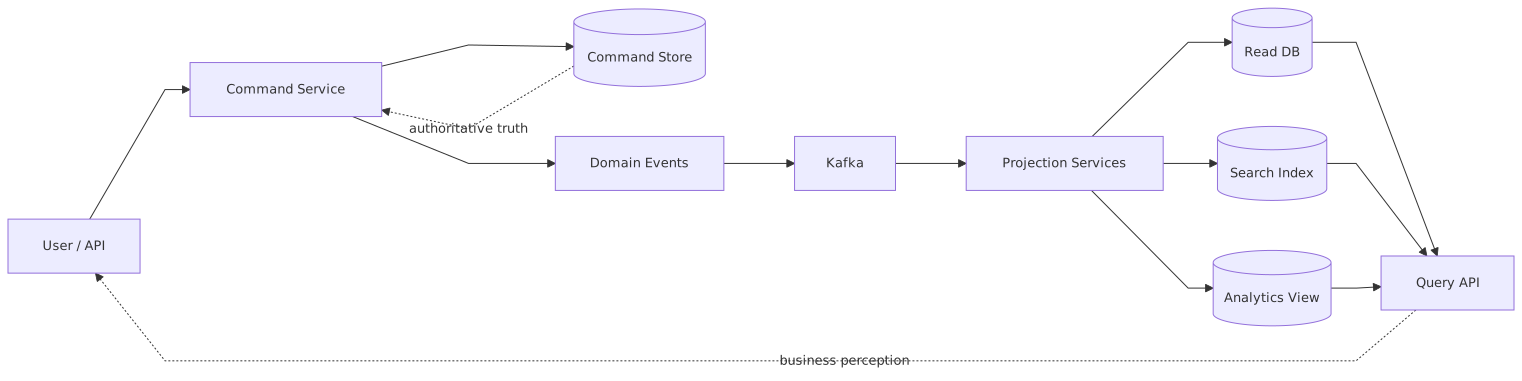
The architecture itself creates multiple places where divergence can happen:
- command handlers emit incomplete or ambiguous events
- event schemas evolve
- projection services apply transformations differently
- replay logic produces different outcomes than live processing
- compensating actions arrive out of order
- query APIs compose data from several bounded contexts with inconsistent freshness
This is not sloppiness. This is the natural byproduct of distributed systems meeting business complexity.
Forces
Good architecture is rarely about choosing the “right” pattern. It is about balancing forces without lying to yourself about the cost.
CQRS drift sits at the intersection of several competing forces.
1. Domain integrity vs read performance
The command side wants rich models, transactional consistency, and strict invariants. The query side wants flattened structures, broad joins, and latency measured in milliseconds. If you optimize one too aggressively, you distort the other.
Domain-driven design is useful here because it reminds us that not all models are meant to do the same job. A bounded context earns the right to define its own language and rules. But DDD also demands discipline: a projection is allowed to simplify structure, not invent business truth.
2. Local autonomy vs enterprise coherence
Microservices promise team autonomy. Kafka gives asynchronous decoupling. But the enterprise still needs coherent meaning across channels, reports, and operations.
One team may publish OrderFulfillmentDelayed. Another projects it as shipment_status = delayed. A third interprets it in analytics as “supply chain exception.” All reasonable. Yet if no one curates the domain semantics, the enterprise ends up with many local truths and no shared one.
3. Availability vs correctness
During a projection outage, do you continue serving slightly stale reads or block users? There is no universal answer. In many domains, stale is tolerable. In others—trading, payment authorization, inventory reservation under tight stock—it is not.
The trick is to decide this by business capability, not by platform habit.
4. Independent evolution vs schema discipline
Events evolve. Read models evolve faster. Product teams want to add fields, labels, and search facets. If the event contracts are too rigid, teams move slowly. If they are too loose, projection semantics rot.
5. Replayability vs side effects
Read models should be rebuildable. That is one of the great operational strengths of event-driven CQRS. But many enterprises accidentally let projections acquire side effects: sending notifications, triggering workflows, updating external systems. Then replay becomes dangerous.
A projection that cannot be replayed safely is not a projection. It is hidden process logic.
Solution
The practical solution is not “keep the models in sync.” That is naïve. The solution is to govern drift intentionally.
I would put it this way:
> In CQRS, the query model is not a copy of the command model. It is a derivative with a contract.
That contract has four parts.
1. Preserve domain semantics explicitly
The command model is the source of business truth. Events emitted from it must describe meaningful domain facts, not low-level persistence noise.
Bad event:
OrderRowUpdated
Better event:
InventoryReservedForOrderOrderPaymentAuthorizationFailedOrderReleasedForFulfillment
This is classic domain-driven design thinking. Events should come from the ubiquitous language of the bounded context. If the event stream is semantically weak, the read side is forced to infer meaning. Inference is where drift breeds.
2. Classify read models by tolerance for divergence
Not all read models are equal. Treating them the same is one of the more expensive mistakes in enterprise CQRS.
A useful classification is:
- Informational reads: dashboards, search results, trend views. Staleness acceptable.
- Operational reads: customer service screens, workflow queues, case management. Limited staleness acceptable with clear freshness indicators.
- Decision-support reads: data used to trigger business action. Require stronger reconciliation controls.
- Authoritative decision reads: reads that gate commands or compliance decisions. Often should query the command side directly or use validated snapshots.
Once you classify read models this way, architecture decisions get sharper. Some projections can lag. Some need watermarking. Some should not be projections at all.
3. Make reconciliation a first-class capability
Reconciliation is not a cleanup task for operations after the incident. It is a normal architectural function.
You need mechanisms to answer:
- Which events were published but not projected?
- Which projections are behind, and by how much?
- Which query records conflict with command truth?
- Can we rebuild the read model deterministically?
- Can we identify semantic mismatches, not just missing rows?
This means maintaining offsets, idempotent consumers, replayable event streams, projection versioning, and domain-level reconciliation reports.
4. Expose freshness and confidence
Most systems hide read-model lag until it hurts. Better systems surface it.
A query response should be able to carry metadata like:
- projection timestamp
- event offset or watermark
- source bounded context
- confidence or consistency level
This is not overengineering. It is honesty in software form.
Architecture
A robust architecture for managing CQRS drift has a few recognizable characteristics.
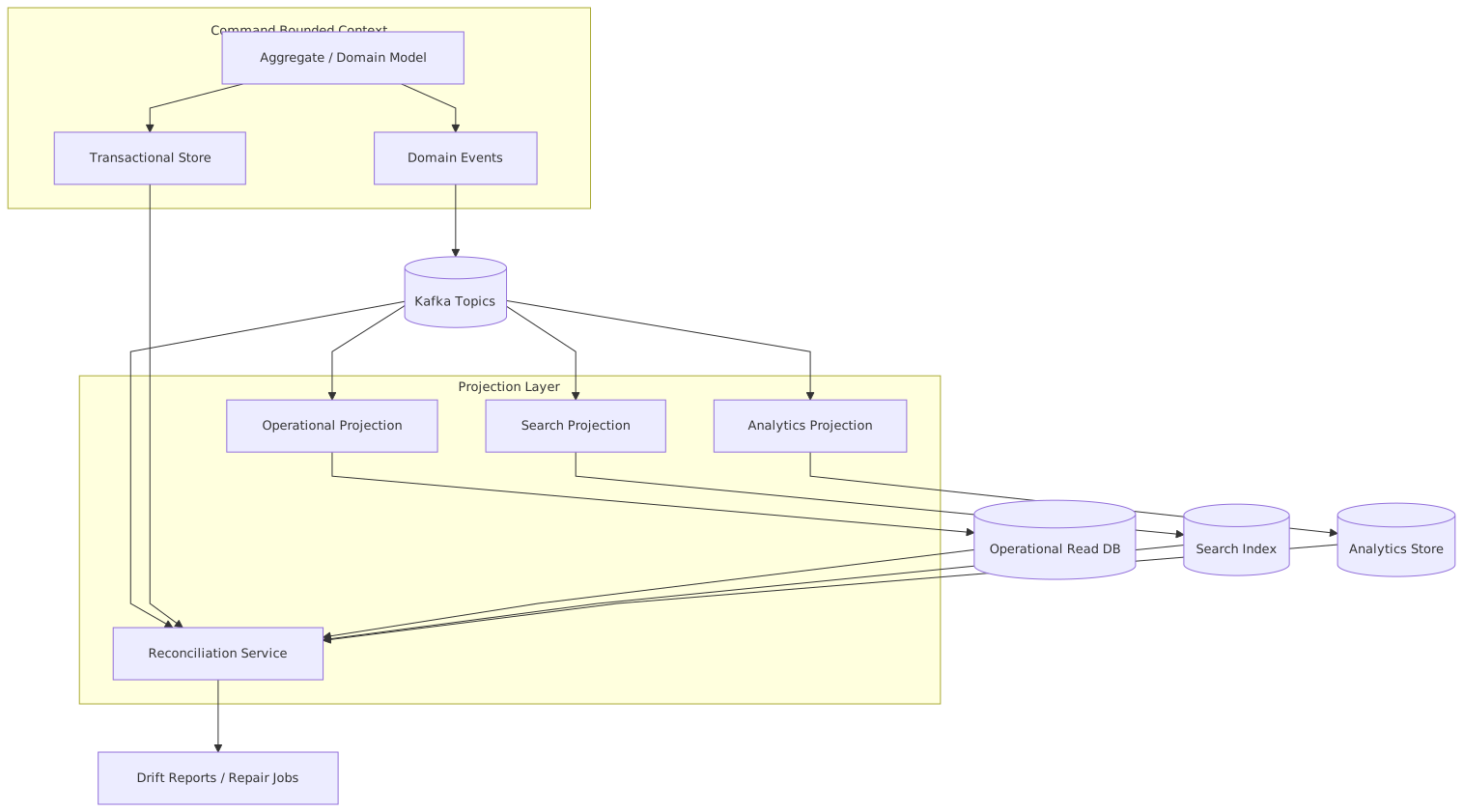
First, the command side remains boring in the best possible sense. It owns transactions, aggregates, invariants, and domain events. It should not know about denormalized search screens or BI filters.
Second, the event backbone—Kafka in many enterprises—acts as a distribution fabric, not as a semantic escape hatch. Topic design matters. Ordering guarantees matter. Partition strategy matters. Schema evolution matters. A sloppy Kafka estate produces elegant PowerPoint and miserable operations.
Third, projection services are treated as deterministic translators. They subscribe to domain events, apply versioned transformations, and populate one or more read stores optimized for specific access patterns: relational read databases, Elasticsearch or OpenSearch indexes, Redis caches, analytical tables, or graph stores.
Fourth, the architecture separates read convenience from business authority. If a process step requires authoritative truth, it does not rely on a potentially stale projection just because that is easier.
Here is a simple divergence-aware architecture:
Domain semantics and projection contracts
A projection contract should state more than the event schema. It should state the semantic mapping.
For example:
OrderConfirmedmeans customer intent accepted and commercial checks passed.- It does not imply inventory reserved.
- It does not imply payment settled.
- In the operational read model, it maps to
commercial_status = confirmed. - In the customer portal, it may map to
order_status = processing.
That sounds tedious. It is less tedious than explaining to the board why two “confirmed order” reports disagree by 14%.
Kafka-specific concerns
Kafka is often the backbone for CQRS in microservices shops because it supports fan-out, replay, and independent consumers. It is a strong fit, but only if you respect its tradeoffs.
- Partitioning by aggregate key preserves order for a single entity, not across the whole business process.
- Cross-topic consistency is not guaranteed.
- Consumer lag is normal; unmeasured consumer lag is negligence.
- At-least-once delivery means projections must be idempotent.
- Retention settings affect rebuild and auditability.
- Schema registry discipline matters more than teams think.
If events represent domain facts, Kafka gives you a resilient way to distribute truth. If events are vague change notifications, Kafka simply broadcasts ambiguity faster.
Migration Strategy
Very few enterprises get to start fresh. Most have a transactional system of record, reporting SQL views nobody fully understands, and a strategic mandate to “move to event-driven microservices” before the budget cycle ends. That is where architecture becomes less about purity and more about migration safety.
The right migration pattern here is usually a progressive strangler.
Do not split command and query models everywhere at once. Start where read and write forces are already pulling apart and where divergence can be observed safely.
A sensible path looks like this:
Step 1: Identify hot read paths
Pick areas where the current model is clearly compromised:
- expensive reporting queries hitting OLTP
- operational screens requiring many joins
- search workloads abusing the transactional schema
- APIs with read latency or lock contention issues
These are good candidates because the value of a query model is visible without changing core command semantics immediately.
Step 2: Establish event publication from the existing system
Even a modular monolith can publish domain events. They may come from transaction outbox patterns before you reach full event sourcing. That is fine. Event sourcing is not a prerequisite for CQRS.
What matters is that emitted events reflect business facts and are durably published.
Step 3: Build one projection at a time
Create read models for specific use cases, not for “all reporting.” A customer order summary view. A service agent case screen. A fulfillment queue.
The narrower the first projection, the easier it is to reason about drift and reconciliation.
Step 4: Run in shadow mode
Serve the old read path and the new projection side by side. Compare outputs. Measure lag. Find mismatches. This is where semantic drift reveals itself before users depend on it.
Step 5: Introduce reconciliation before cutover
Do not wait until production incidents to invent repair jobs. Build replay, offset tracking, and consistency reports before the new query model becomes operationally critical.
Step 6: Gradually route consumers to the new query model
This is the strangler pattern in practice. Migrate by capability and user journey, not by technology layer. Keep authoritative decisions on the old path until confidence in projection integrity is real.
Here is the migration shape:

A word of caution: teams often use CDC alone as a shortcut. CDC can help bootstrap events or projections, but row-level database change capture is a poor substitute for domain events. CDC tells you what changed in storage. Domain events tell you what happened in the business. Those are not the same.
Enterprise Example
Consider a large insurer modernizing its policy administration estate.
The legacy platform handled policy issuance, endorsements, cancellations, billing links, and claims notifications in a single core system. Customer service screens relied on direct relational queries over a heavily normalized schema. Performance degraded every renewal season. The enterprise wanted faster self-service portals, broker dashboards, and operational work queues. It also wanted to split capabilities into microservices over time using Kafka as the event backbone.
The first instinct from one delivery team was predictable: create a policy read service fed by all available changes, denormalize everything, and move all channels to it. That would have been a mistake.
Insurance domains are thick with semantics. A “policy active” status in billing, claims, underwriting, and compliance does not always mean the same thing. A policy can be issued but not in force. It can be renewed but under payment hold. It can be cancelled prospectively or rescinded retrospectively. Flattening this too early into one read model would have created an attractive lie.
Instead, the architecture separated read models by bounded context and user purpose.
- The Policy Administration command model remained authoritative for issuance, endorsement, cancellation, and contractual state.
- The Customer Service operational projection presented customer-facing status with freshness indicators and explanatory states.
- The Broker dashboard projection optimized for portfolio views, renewal risk, and commission-facing summaries.
- The Compliance work queue projection tracked regulatory holds and review states with stronger reconciliation and tighter freshness thresholds.
Events such as PolicyIssued, EndorsementApplied, PolicyCancellationScheduled, PolicyCancelled, PaymentHoldPlaced, and PaymentHoldReleased were published through Kafka using an outbox pattern from the legacy core.
The subtle but crucial design move was semantic mapping. The customer portal could display “Active,” but only according to a policy projection rule that considered in-force date, cancellation timing, and payment hold semantics. The compliance queue did not reuse that label. It used domain-specific flags aligned with regulatory processes.
This was not duplication for duplication’s sake. It was bounded-context integrity on the read side.
The insurer then ran old and new query paths in parallel for three months. Reconciliation exposed several failure modes:
- delayed hold release events caused portal statuses to remain stale
- one projection interpreted future-dated cancellation as immediate inactive status
- replay of historical events surfaced a schema evolution bug where older endorsements lacked a field later assumed mandatory
These issues were fixed before broad cutover. More importantly, the business learned to ask a better question: not “is the read model current?” but “current enough for which decision?”
That is architecture doing its job.
Operational Considerations
CQRS drift becomes an operational issue long before it becomes a theoretical one.
Lag monitoring
You need more than Kafka consumer lag. Consumer lag tells you the projection is behind the topic. It does not tell you whether the user-visible model is acceptably fresh.
Track:
- topic lag by consumer group
- end-to-end event age
- last successful projection timestamp per bounded context
- query freshness SLA by read model type
- discrepancy counts from reconciliation jobs
Idempotency and replay
Projection handlers must be idempotent. Duplicates are normal. Replays are normal. Restarts are normal. If processing an event twice corrupts the view, the design is brittle.
Store projection checkpoints carefully. Version transformations. Make rebuilds routine enough that the team is not afraid of them.
Versioning
Semantic changes in events are more dangerous than structural changes. Adding a field is easy. Changing the meaning of a status is explosive.
Use schema versioning, yes. But also maintain semantic release discipline:
- event meaning changes should be explicit
- projections may need side-by-side versions
- old and new mappings may coexist during migration
Reconciliation design
There are two broad forms:
- Mechanical reconciliation: compare counts, offsets, checksums, timestamps, missing records.
- Domain reconciliation: compare business facts and statuses according to domain rules.
Mechanical reconciliation catches dropped projections. Domain reconciliation catches lies.
You need both.
Human operations
Support teams need to know whether to trust the screen in front of them. If an operational read model is stale, the UI should say so. If a workflow queue is degraded, users should know the fallback path. Hidden uncertainty creates the ugliest incidents because people make confident bad decisions.
Tradeoffs
CQRS with divergence-aware design is powerful, but it is not free.
What you gain
- scalable, specialized read paths
- cleaner write-side domain models
- decoupled evolution of channels and reporting
- replayability and rebuild of views
- better alignment with event-driven microservices
What you pay
- semantic governance overhead
- more moving parts
- harder debugging across command, event, and projection layers
- consistency windows the business must understand
- reconciliation and operational tooling that many teams underestimate
The biggest tradeoff is cultural. CQRS demands that the enterprise stop treating the database as the whole truth. Truth is split across command state, event history, and materialized perception. If the organization is not prepared to operate that way, the pattern quickly becomes ceremony wrapped around confusion.
Failure Modes
Architects should be able to describe not just how a design works, but how it fails. Here are the recurring failure modes.
1. Event impoverishment
Events are too technical or too generic, so projections infer business meaning from storage changes. The read side drifts semantically because the event stream never had enough meaning.
2. Projection business logic creep
Teams sneak decision logic into projections because it is convenient. Soon the read side starts deciding what should happen, not merely presenting what has happened. Rebuild becomes unsafe. Different projections produce different outcomes.
3. Read model overreach
A query store becomes the de facto integration hub for analytics, APIs, operations, and workflow triggers. It starts as a view and ends as an accidental system of record.
4. Replay non-determinism
Projection logic depends on wall-clock time, external service calls, mutable reference data, or side effects. Rebuilding from the same events yields different results. Confidence collapses.
5. Bounded context leakage
One context’s convenience statuses leak into others. Soon customer service, billing, and compliance all use a label invented for the portal. Shared confusion follows.
6. Freshness blindness
The system serves stale reads without any indication of age. Humans and downstream systems treat them as current and make bad operational decisions.
When Not To Use
Not every problem needs CQRS. Some need restraint.
Do not use CQRS if:
- the domain is simple and CRUD-oriented
- read and write shapes are not materially different
- the team lacks eventing discipline and operational maturity
- consistency requirements are strict and immediate across all interactions
- the estate cannot support reconciliation, replay, and monitoring
- the business is not willing to reason about freshness and divergence
I would go further. If your team is using CQRS mostly because “we are moving to microservices,” stop. That is architecture by fashion. Splitting reads and writes without a real asymmetry in the domain often creates more drift than value.
Similarly, if the query side is going to be used as authoritative input to the same transaction path that the command side governs, ask whether you are solving a real problem or just adding asynchronous suspense to a synchronous domain.
Related Patterns
Several patterns sit close to this topic.
Event Sourcing
Often paired with CQRS, but not required. Event sourcing gives a natural event history and replay story, which helps with projection rebuild and audit. It also raises the bar for modeling discipline. Use it where auditability and temporal behavior matter, not as decoration.
Transactional Outbox
A practical bridge in migration. It allows the command-side transaction and event publication to remain consistent without distributed transactions.
Strangler Fig Pattern
Essential for progressive migration from legacy reporting and shared schemas. Replace read capabilities gradually while preserving business continuity.
Materialized View
A useful framing for query models. But unlike simple database materialized views, CQRS projections live in a semantic landscape and may require reconciliation against domain truth.
Saga / Process Manager
Relevant when commands and events span several services. Be careful not to confuse process state with read-model state. They solve different problems.
Anti-Corruption Layer
Very useful when legacy systems publish weak or foreign semantics. Protect the new domain and projection models from inherited conceptual mess.
Summary
The command model and query model in CQRS are supposed to be different. That is the point. The danger begins when they become different in ways nobody can explain.
A little lag is normal. A lot of semantic drift is not.
The command side should remain the custodian of business truth, expressed in a domain-driven language with explicit invariants. The query side should optimize for access, but under a contract that preserves meaning, exposes freshness, and supports reconciliation. Kafka and microservices can make this architecture scale beautifully, but they do not remove the need for semantic discipline. If anything, they make that discipline more important.
The best CQRS systems are not the ones with the fanciest diagrams. They are the ones that can answer, calmly and quickly, three very practical questions:
- What is authoritative here?
- How far behind is the view I am looking at?
- How do we repair it when it drifts?
If your architecture can answer those, you have a system. If it cannot, you have a distributed rumor.
Frequently Asked Questions
What is CQRS?
Command Query Responsibility Segregation separates read and write models. Commands mutate state; queries read from a separate optimised read model. This enables independent scaling of reads and writes and allows different consistency models for each side.
What is the Saga pattern?
A Saga manages long-running transactions across multiple services without distributed ACID transactions. Each step publishes an event; if a step fails, compensating transactions roll back previous steps. Choreography-based sagas use events; orchestration-based sagas use a central coordinator.
What is the outbox pattern?
The transactional outbox pattern solves dual-write problems — ensuring a database update and a message publication happen atomically. The service writes both to its database and an outbox table in one transaction; a relay process reads the outbox and publishes to the message broker.