⏱ 5 min read
Case Study: Delivering Advanced Apache Kafka Training to a European Union Agency
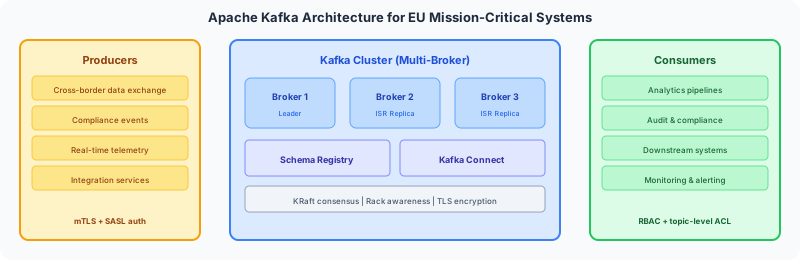
How We Designed and Delivered Production-Grade Event Streaming Expertise for a Mission-Critical Public Sector Environment
Modern European institutions are increasingly moving toward event-driven architectures to support secure cross-border data exchange, real-time processing, and scalable digital platforms. At the heart of many of these transformations lies Apache Kafka. application cooperation diagram

This case study explains how we designed and delivered a comprehensive, architecture-focused Kafka training program for a European Union agency operating in a high-availability, high-security, regulatory-driven environment.
1. The Context: Why the EU Agency Needed Advanced Kafka Expertise
The agency was modernizing its IT landscape as part of a broader digital transformation initiative. Several key drivers shaped the need for Kafka training:
- Increasing data volumes across distributed systems
- Cross-border data exchange requirements
- Strict availability SLAs
- Security and compliance constraints
- Hybrid cloud and on-premise deployment models
- Long lifecycle systems with complex integration landscapes
The organization had already identified Apache Kafka as the strategic backbone for real-time data streaming. However, there were critical challenges:
- Architects needed deep understanding of distributed log architecture.
- DevOps teams required operational best practices.
- Developers needed guidance on safe integration patterns.
- Security teams required assurance that Kafka could meet EU-grade security standards.
Rather than generic vendor training, the agency required a customized, architecture-driven, enterprise-grade program aligned with public-sector constraints.
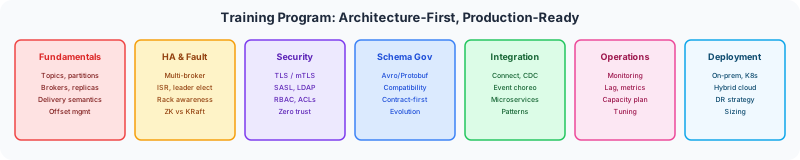
2. Training Design Approach: Architecture-First, Production-Ready
The training was structured around four principles:
- Architecture before tools
- Production realism over theory
- Security by design
- Operational sustainability
Instead of focusing only on APIs and coding examples, the program emphasized: modeling integration architecture with ArchiMate
- Enterprise Architecture alignment
- Distributed systems principles
- Failure scenarios and resiliency design
- Governance and data contract management
- Security architecture in regulated environments
Audience:
- Enterprise architects
- Solution architects
- DevOps engineers
- Senior backend developers
- Security architects
3. Apache Kafka Architecture Fundamentals
Key concepts covered:
- Topics and partitions
- Brokers and replication
- Producers and consumers
- Consumer groups and offset management
- Delivery semantics (at-most-once, at-least-once, exactly-once)
Participants developed a strong understanding of scalability, durability, and ordering guarantees in distributed streaming systems.
4. High Availability & Fault Tolerance Design
Mission-critical systems require resilience by design. Topics included:
- Multi-broker cluster strategy
- Replication factor design
- Leader election and ISR
- Rack awareness
- Failure recovery mechanisms
- ZooKeeper vs KRaft architecture
Teams evaluated operational complexity and migration strategies toward modern Kafka deployments.
5. Security Architecture for Regulated Environments
Security topics included:
- TLS encryption and mTLS
- SASL authentication mechanisms
- LDAP / Active Directory integration
- Role-Based Access Control (RBAC)
- Topic-level authorization
- Network segmentation and zero-trust approaches
Security teams gained confidence in deploying Kafka under strict compliance requirements. ArchiMate modeling standards
6. Schema Registry & Data Governance
Long-lived systems require disciplined schema management.
Covered:
- Avro, Protobuf, JSON schemas
- Schema compatibility modes
- Backward and forward compatibility
- Contract-first design
- Governance workflows between teams
Participants practiced safe schema evolution and breaking change management.
7. Kafka Connect & Integration Patterns
Integration topics: integration architecture diagram
- Kafka Connect architecture
- Source and Sink connectors
- Change Data Capture (CDC)
- Microservices integration patterns
- Event choreography vs orchestration
Practical scenarios reflected real EU infrastructure constraints.
8. Monitoring, Observability & Operations
Operational maturity determines platform success.
Covered:
- Broker and consumer metrics
- Lag monitoring
- Capacity planning
- Retention strategies
- Throughput optimization
- Performance tuning
Teams learned to detect bottlenecks and respond to incidents effectively.
9. Deployment Models: On-Prem, Cloud & Hybrid
Deployment strategies analyzed:
- On-premise clusters
- Kubernetes-based deployments
- Hybrid connectivity models
- Disaster recovery strategies
- Infrastructure sizing and cost planning
10. Hands-On Workshops
Practical labs included:
- Designing a production-ready cluster
- Simulating broker failures
- Secure producer/consumer configuration
- Schema evolution scenarios
- Monitoring under load
Participants left with implementation confidence, not just theoretical knowledge.
11. Outcomes
The engagement delivered:
- Architectural clarity
- Security validation
- Reduced operational risk
- Production readiness roadmap
- Cross-team alignment
12. Strategic Impact
Beyond training, the initiative strengthened:
- Event-driven mindset adoption
- Governance maturity
- Long-term scalability planning
- Cross-border integration capability
- Operational discipline
Conclusion
Enterprise-grade Kafka adoption in public sector environments requires more than technical knowledge. It demands architectural rigor, security-first design, governance discipline, and operational maturity. EA governance checklist
This engagement demonstrated how tailored, architecture-driven training accelerates safe Kafka adoption in mission-critical EU systems.
For expert guidance on enterprise architecture, explore our enterprise architecture consulting, architecture capability development, and Sparx EA consulting. Get in touch.
Frequently Asked Questions
What is enterprise architecture?
Enterprise architecture is a discipline that aligns an organisation's strategy, business operations, information systems, and technology infrastructure. It provides a structured framework for understanding how an enterprise works today, where it needs to go, and how to manage the transition.
How is ArchiMate used in enterprise architecture practice?
ArchiMate is used as the standard modeling language in enterprise architecture practice. It enables architects to create consistent, layered models covering business capabilities, application services, data flows, and technology infrastructure — all traceable from strategic goals to implementation.
What tools are used for enterprise architecture modeling?
Common enterprise architecture modeling tools include Sparx Enterprise Architect (Sparx EA), Archi, BiZZdesign Enterprise Studio, LeanIX, and Orbus iServer. Sparx EA is widely used for its ArchiMate, UML, BPMN and SysML support combined with powerful automation and scripting capabilities.