⏱ 20 min read
Event-driven systems rarely fail because teams cannot publish messages. They fail because nobody can answer a simpler, more dangerous question: who owns the meaning of this event?
That is the quiet disaster in many enterprises. Kafka is humming, topics are multiplying, microservices are proliferating, and architecture diagrams look modern enough to impress a steering committee. Yet underneath the polish sits a semantic slum. “CustomerUpdated” means one thing to billing, another to CRM, and something subtly incompatible to digital channels. Teams think they are sharing facts. In reality, they are exchanging interpretations.
This is where event schema ownership becomes serious architecture work, not clerical governance. A schema is not just a JSON or Avro document. It is a contract about the business. It encodes the language of a domain, the timing of a fact, the granularity of change, and the boundary of responsibility. If ownership is vague, every downstream team becomes a part-time anthropologist. EA governance checklist
And anthropology does not scale.
The practical question is not whether an enterprise should define event ownership. It must. The real question is how to map ownership in a way that preserves domain semantics, supports autonomy, allows migration from legacy integration estates, and avoids turning the platform team into the Ministry of Truth. Good ownership mapping creates local clarity and global interoperability. Bad ownership mapping creates a distributed monolith with nicer tooling.
This article lays out an opinionated approach. It leans on domain-driven design, accepts that migration is political as much as technical, and treats reconciliation as a first-class capability rather than an embarrassing afterthought. The goal is simple: make event schemas trustworthy enough that teams can move independently without inventing private dictionaries.
Context
In a typical enterprise event-driven landscape, several patterns emerge quickly.
A core system of record emits change events. Upstream applications publish domain events. Downstream services consume them to update local views, trigger workflows, or enrich analytics streams. Kafka often sits at the center because it is durable, scalable, and good at preserving ordered logs within partitions. Around it grow schema registries, stream processors, API gateways, and observability dashboards. event-driven architecture patterns
None of that is the hard part.
The hard part is the semantic geometry between teams. A customer domain might be touched by sales, onboarding, risk, servicing, payments, marketing, and data science. Each of those groups has valid reasons to model customer data differently. One cares about legal identity, another about householding, another about consent, another about active product relationships. If they all publish “customer” events without ownership discipline, the platform becomes a high-speed channel for ambiguity.
Domain-driven design gives us the right lens. Event schemas should not be organized around tables, integration convenience, or the shape of a user interface. They should emerge from bounded contexts. The owning team is not merely the team that writes bytes to Kafka. It is the team accountable for the meaning, lifecycle, quality, and evolution of that event within a domain boundary.
That distinction matters. A platform team may host the registry. A middleware team may route topics. A data engineering team may replicate streams into the lakehouse. But if none of them owns the domain semantics, they are only moving crates around the dock. They do not know what is inside.
Problem
Enterprises usually stumble into schema ownership problems in predictable ways.
First, they begin with integration pragmatism. “Let’s publish what the source system already knows.” That often means table-shaped payloads, generic CRUD events, or records produced by CDC tooling straight off a database log. This is expedient, and sometimes useful, but it confuses data change with business meaning.
Second, multiple teams start extending or reinterpreting the same events. Optional fields accumulate. The schema grows by sediment. Nobody wants to break downstream consumers, so nobody removes anything. Event names become broad enough to be harmless and vague enough to be useless.
Third, consumers begin compensating for semantic gaps. They join multiple topics, infer missing state, cache stale reference data, or hard-code assumptions about event ordering. At that point, ownership has already leaked downstream. If a consumer must understand upstream implementation quirks to use an event safely, the event contract is weak.
Fourth, a governance reaction arrives. Committees are formed. Registries become approval workflows. Naming conventions turn into theology. Teams wait for central sign-off to add a field. The result is not clarity but bottleneck.
The enterprise is then stuck between two bad options: complete decentralization, which breeds semantic drift, or central control, which kills flow.
Ownership mapping is the middle path. It says each event schema has a clear accountable owner anchored in a bounded context, but interoperability rules are explicit and discoverable. You decentralize semantics to the right domain teams while standardizing the mechanics of evolution.
Forces
Several forces pull against each other here.
Domain autonomy versus enterprise consistency
Teams need freedom to model their domain honestly. A fraud service should not shape its events around how CRM thinks about parties. But enterprises also need consistency in cross-cutting concepts like identifiers, time semantics, classification codes, and privacy markers.
The trick is to standardize the grammar, not the story.
Producer convenience versus consumer usability
Producers naturally want to emit events that are easy to publish. Consumers need events that are easy to understand and use. These are not the same thing. A producer-friendly event often mirrors internal storage. A consumer-friendly event reflects business intent. Architecturally, you should side with semantic usability over local convenience, because the cost of confusion multiplies downstream.
Stability versus evolution
Schemas must evolve. Business changes. Regulations arrive. Channels expand. But unconstrained evolution creates a museum of deprecated fields and accidental compatibility guarantees. You need enough stability that consumers can rely on contracts, and enough flexibility that producers do not freeze.
Real-time propagation versus truth reconciliation
Event-driven systems create the seductive illusion that if everything is streamed, everything is consistent. It is not. Consumers miss events. Replay logic changes. Legacy systems emit malformed records. Some updates arrive out of order. Reconciliation is not a sign of failure. It is how grown-up enterprises acknowledge physics.
Local bounded contexts versus shared master data
Many domains overlap. Product, customer, account, order, and location are notorious examples. Ownership mapping must distinguish between authoritative creation of facts and derived or contextual interpretation of facts. Otherwise every service becomes a rival source of truth.
Solution
The core solution is to define event schema ownership as a domain responsibility model, not a platform metadata exercise.
Each event schema should have:
- A semantic owner
The bounded context responsible for the meaning of the event and its lifecycle.
- A publishing owner
Usually the same as the semantic owner, but not always. In migration scenarios, an integration layer may publish on behalf of a legacy system while domain ownership remains elsewhere.
- A compatibility policy
Explicit rules for additive change, deprecation, versioning, field retirement, and consumer notification.
- A scope statement
What business fact the event represents, and equally important, what it does not represent.
- Authoritative identifiers and temporal semantics
Which identifier is canonical, whether the event captures occurrence time or processing time, and whether it reflects a fact, command outcome, snapshot, or state transition.
- Reconciliation contract
How downstream consumers detect gaps, repair divergence, and bootstrap state.
- Stewardship metadata
Contact team, SLA expectations, data classification, lineage, retention policy, and quality indicators.
This sounds straightforward, but the practical design move is more subtle: tie event ownership to bounded contexts, not entities.
For example, “Customer” is almost never a single ownership domain in a large enterprise. Party identity may be owned by onboarding. Credit posture by risk. Marketing preferences by engagement. Service status by customer operations. Trying to force one universal customer event usually creates either mush or monarchy. Better to publish context-specific events with explicit relationships than a falsely universal schema.
A good ownership map distinguishes several event classes:
- Domain events: business-significant facts, owned by a bounded context.
- Integration events: consumer-oriented representations derived from domain events for broader use.
- CDC or technical change events: low-level change notifications, useful but not semantically authoritative.
- Reference events: updates to shared codes or master data dimensions.
- Reconciliation events or snapshots: periodic state materializations for repair and synchronization.
This separation prevents a common category error: treating every emitted record as equally meaningful.
Ownership mapping model
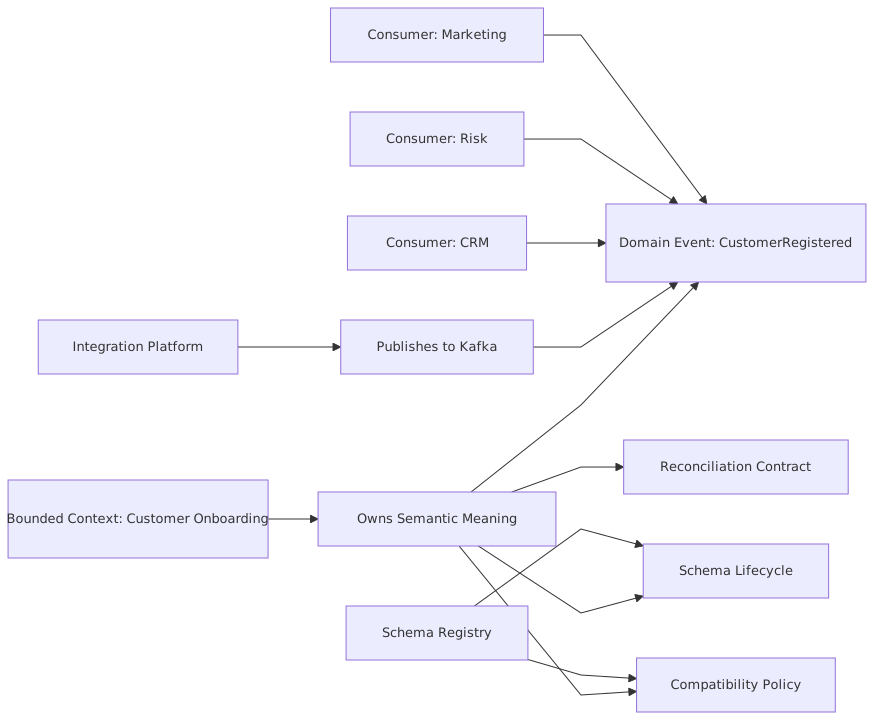
The key is that the platform does not own the schema. It hosts the mechanism. Ownership remains with the domain.
Architecture
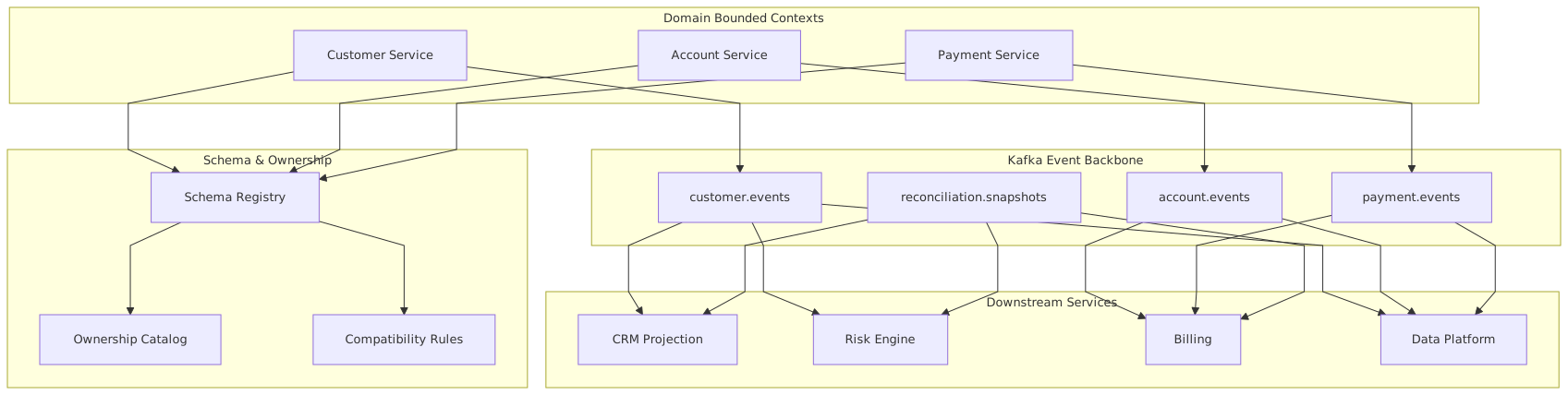
A workable architecture for event schema ownership in Kafka-based microservices usually has five layers. microservices architecture diagrams
1. Domain services within bounded contexts
These services own business capabilities and produce domain events from meaningful state transitions or completed business actions. They should publish events that correspond to domain language: CustomerRegistered, AccountActivated, PaymentSettled, ClaimRejected. Not CustomerTableRowChanged.
2. Event contract and schema management
A schema registry stores versioned schemas, but with ownership metadata attached: owning team, domain, change policy, classification, deprecation status, and links to domain documentation. This is where many enterprises stop at syntax validation. That is too shallow. The registry should answer not just “is this Avro valid?” but “who stands behind this meaning?”
3. Streaming backbone
Kafka topics carry the events. Topic design should align with ownership boundaries and event class. Topic names should reveal domain and semantic intent. Partitioning should be chosen for business ordering requirements, not merely throughput. If a consumer needs ordered account lifecycle events, partition by account identifier. If global ordering is not needed, do not pretend otherwise.
4. Consumer-owned materialization
Consumers should build their own read models or local projections from authoritative events. They should not redefine upstream semantics, but they may contextualize them. This is classic DDD and loose coupling: consume facts, own interpretations.
5. Reconciliation and audit capability
This is the layer too many teams bolt on after incidents. You need snapshot topics, replay procedures, dead-letter analysis, idempotency keys, lineage tracking, and periodic state verification between publishers and consumers. Event-driven architecture without reconciliation is like bookkeeping without a ledger review.
Reference architecture
Domain semantics discussion
This is where architecture earns its keep.
A domain event should answer three questions cleanly:
- What happened in the business?
- When did it become true?
- Who is authoritative for that fact?
If an event cannot answer these, it is likely either too technical or too vague.
Take CustomerUpdated. It sounds innocent. It is also semantically weak. Updated how? Legal name corrected? Segment recalculated? Consent withdrawn? Address standardized? A strong schema favors narrower, intention-revealing events or explicit state transitions. Coarse events are tempting because they look reusable. In practice, they force every consumer to reverse-engineer field-level meaning.
Another semantic trap is mixing commands, facts, and read models in one stream. A command asks for something to happen. An event records that something did happen. A snapshot describes current state. These are different beasts. If you put them in the same conceptual box, ownership becomes impossible to reason about.
Migration Strategy
Most enterprises do not get to start greenfield. They inherit ESBs, nightly batch feeds, database replication, brittle point-to-point interfaces, and systems that have never heard of bounded contexts. So ownership mapping must support migration without requiring a revolution.
The right approach is a progressive strangler migration.
Start by identifying high-value domains where event semantics matter most and where consumer sprawl is already causing pain. Customer, order, and payment are common candidates. Then create an ownership map for those domains before redesigning every integration. The map should identify:
- authoritative bounded context
- existing sources and consumers
- current event or feed types
- semantic conflicts
- candidate canonical domain events
- transitional integration events
- reconciliation path
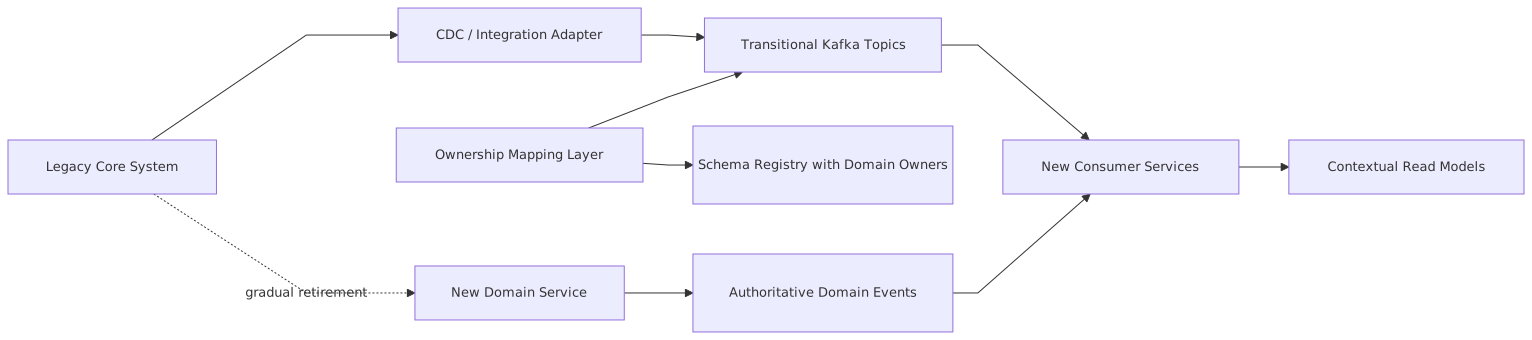
In early stages, you may publish events from anti-corruption layers or CDC pipelines while preserving domain ownership elsewhere. That is acceptable if the semantics are explicitly curated. What you must not do is mistake transitional publishers for long-term semantic owners.
Progressive strangler pattern for ownership migration
Migration steps
Step 1: Inventory semantics, not just interfaces
List existing feeds and events, but classify them by business meaning. Which are true domain facts? Which are technical deltas? Which are snapshots? Which are overloaded catch-all messages? This exercise reveals where ownership is already fractured.
Step 2: Define bounded contexts and authoritative facts
Work with domain teams to identify where facts originate. For example, account opening might be authoritative in core banking, but account servicing status may be authoritative in a servicing platform. Do not chase a mythical single source of truth for every attribute. Truth is often segmented by domain capability.
Step 3: Introduce ownership metadata in the schema registry
Even before changing payloads, add owner, domain, contact, version policy, and deprecation state. This starts building operational accountability.
Step 4: Create semantic facades over technical events
Where existing systems can only provide CDC or generic updates, publish curated integration events that restore business meaning. This can be done through stream processing or adapter services. These facades are a bridge, not the destination.
Step 5: Add reconciliation mechanisms early
Provide snapshot topics, replay windows, and state comparison jobs while migration is ongoing. Consumers will need repair paths as semantics improve.
Step 6: Shift publication to domain-native services
As new microservices take over capabilities from legacy systems, move event publication to the actual bounded context implementation. This is the real completion of ownership migration.
Step 7: Retire transitional topics deliberately
A surprising amount of enterprise complexity comes from “temporary” integration topics that survive for years. Set retirement dates, publish deprecation notices, and measure residual consumers.
Enterprise Example
Consider a global insurer modernizing its customer and policy estate.
The company had a 20-year-old policy administration platform, a separate CRM, a digital portal stack, a billing engine, and multiple regional data marts. Kafka was introduced to decouple channels and support near real-time operations. Within a year, there were dozens of topics with names like customer-update, policy-change, and party-sync. Consumer teams were writing increasingly elaborate transformation code to make sense of them.
The worst offender was customer data. The CRM team believed it owned customer events because it managed interactions. The policy platform team believed it owned customer events because policies required insured parties. The identity and access team believed it owned customer events because it handled login and profile registration. All three were right in part, and wrong in total.
The architecture team reframed the problem using bounded contexts.
- Party Identity owned legal identity and core party registration semantics.
- Customer Engagement owned communication preferences and channel profile semantics.
- Policy Administration owned insured-party relationships in the context of policies.
- Billing owned payer responsibility relationships.
Instead of chasing one universal CustomerUpdated event, they defined separate authoritative domain events:
PartyRegisteredPartyNameCorrectedCommunicationPreferenceChangedInsuredPartyAttachedToPolicyPayerResponsibilityAssigned
For broad consumers such as analytics and customer servicing dashboards, they introduced curated integration events and materialized “customer view” projections. These views were explicitly marked as derived, not authoritative.
The migration used a strangler pattern. Legacy policy data changes still arrived via CDC for some time, but an anti-corruption stream processor translated them into policy-context events with documented ownership. Meanwhile, the new party identity service began publishing authoritative identity events directly.
Reconciliation became crucial. Because legacy systems occasionally missed CDC records during maintenance windows, downstream projections compared event-derived state with nightly authoritative snapshots. This surfaced divergence early. More importantly, it normalized the idea that streaming and reconciliation are partners, not enemies.
The result was not purity. It was clarity. Teams stopped arguing about who owned “customer” in the abstract and started owning precise facts in bounded contexts. Consumer logic simplified. Topic sprawl reduced. Schema changes became discussable because ownership was visible.
That is what good architecture looks like in an enterprise: less mythology, more named responsibility.
Operational Considerations
Ownership mapping only works if operations reinforce it.
Schema governance without bureaucracy
A registry should enforce compatibility rules automatically where possible. Backward compatibility checks, required metadata validation, and deprecation workflows are useful. But avoid central architecture review for every field addition. The domain owner should be empowered to evolve within agreed rules.
Observability tied to ownership
Dashboards should show event throughput, lag, schema version adoption, dead-letter rates, replay usage, and reconciliation drift by owning team and domain. Incidents need names, not generic platform buckets.
Data quality and semantic SLAs
Some events are mission-critical. Others are best-effort. Ownership mapping should define expectations: timeliness, completeness, uniqueness, ordering assumptions, and replay support. An event without an SLA is a rumor with serialization.
Security and compliance
Ownership includes data classification. Teams must know whether a schema contains personal data, regulated attributes, or sensitive financial information. Kafka ACLs, encryption, retention, masking, and audit controls should align with ownership metadata.
Consumer onboarding
Make ownership discoverable. A developer should be able to find:
- what this event means
- who owns it
- example payloads
- compatibility guarantees
- reconciliation method
- known caveats
- replacement topics if deprecated
This sounds mundane. It is not. Many event-driven programs spend millions on infrastructure while leaving consumers to learn semantics through Slack archaeology.
Tradeoffs
No architecture decision gets out alive without tradeoffs.
More events, less ambiguity
A bounded-context approach often produces more specific events and more schemas. Some teams will complain this is harder to navigate than a few giant generic topics. They are half right. It is more to catalog. But it is vastly easier to reason about.
Strong ownership can reveal political fault lines
When you assign semantic ownership, you expose organizational ambiguity. Teams may resist because ownership implies accountability. This is not a technical downside so much as an organizational reality. Still, expect friction.
Integration events can become shadow canonicals
Creating consumer-friendly integration events is practical, but risky. If too many consumers rely on them, they can become de facto canonical representations and overshadow true domain events. Be explicit about which is authoritative.
Reconciliation adds complexity
Snapshot topics, replay jobs, and state comparison pipelines cost money and effort. But the alternative is silent divergence. In distributed systems, complexity does not disappear when ignored. It moves into outages.
Versioning strategy is never free
In-place evolution with backward compatibility is easier operationally, but can accumulate semantic baggage. New topic versions are cleaner semantically, but increase migration cost. There is no universal rule; use semantic gravity as your guide. If the meaning changes materially, a new event or topic is usually warranted.
Failure Modes
There are several classic ways this goes wrong.
The platform team becomes the semantic owner by accident
This happens when domain teams are not engaged, so the Kafka or integration team defines schemas centrally. The result is syntactically tidy but semantically shallow contracts. The platform becomes a translation bureau for concepts it does not own.
CDC is mistaken for event-driven design
CDC has its place. It is excellent for migration, replication, and some forms of integration. But raw row changes are not domain events. If consumers depend on them as if they were, they inherit source schema coupling and implementation leakage.
“Canonical” becomes a euphemism for compromise
The enterprise creates one master customer event to satisfy everyone. It ends up pleasing nobody. Canonical data models are useful for some integration and data platform needs, but a universal canonical event for rich operational domains is often a trap. enterprise architecture with ArchiMate
Consumers encode undocumented assumptions
They assume ordering across partitions, infer deletion from absence, treat optional fields as required, or expect a lookup table to be in sync. Then a schema evolves and the house shakes. This is why ownership must include explicit temporal and behavioral semantics, not just fields.
No reconciliation path
A consumer misses a week of messages due to a bug. There is no replay retention, no authoritative snapshot, and no comparison job. Recovery becomes a bespoke production incident. This is amateur hour in expensive clothes.
When Not To Use
Ownership mapping is valuable, but it is not a religion.
Do not over-engineer this pattern in small systems with a handful of tightly coordinated services, especially where one team owns the whole flow and semantics are obvious. A lightweight contract discipline may be enough.
Do not insist on rich domain-event ownership for purely analytical ingestion pipelines where the source is inherently tabular and consumers are using it as raw data rather than operational contract. In such cases, CDC plus lineage may be the right answer.
Do not create elaborate ownership catalogs if your primary integration mode is synchronous APIs and eventing is peripheral. Architecture should solve the problem you have, not the conference talk you enjoyed.
And do not apply bounded-context purity where the domain itself is immature. If the business has not stabilized its language, your schema taxonomy will thrash. Sometimes the honest move is to keep events narrower and more local until domain understanding improves.
Related Patterns
Several patterns sit close to schema ownership and are often confused with it.
Bounded Context
The foundational DDD pattern. Ownership mapping depends on bounded contexts because semantics live there. Without them, event ownership degrades into system ownership or database ownership.
Anti-Corruption Layer
Essential in migration. It translates legacy semantics into cleaner domain events and protects new services from old model pollution.
Outbox Pattern
Useful for reliable event publication from transactional services. It solves consistency between state change and event emission, but it does not solve semantic ownership by itself.
CDC
A pragmatic migration and replication tool. Powerful, but semantically low-level. Best used as a source for curated events, not as the final design for domain communication in most core business cases.
Event Sourcing
Related, but different. Event sourcing uses events as the source of truth for aggregate state. Schema ownership is still relevant there, but most enterprises are dealing with event integration, not full event-sourced domains.
Data Mesh Product Thinking
There is a useful parallel here. Treat an event stream as a data product with owner, quality expectations, discoverability, and lifecycle management. But operational event contracts are usually tighter and more behavior-sensitive than analytical data products.
Summary
Event schema ownership is not about who can edit an Avro file. It is about who owns the business meaning carried through an event-driven system.
In enterprises using Kafka and microservices, this is one of the decisive architecture choices. Get it wrong and the estate fills with generic events, semantic drift, hidden coupling, and integration folklore. Get it right and teams can publish facts with confidence, consumers can build local models safely, and migration from legacy systems becomes manageable rather than chaotic.
The practical recipe is clear:
- anchor ownership in bounded contexts
- distinguish domain events from integration and technical events
- make semantic ownership visible in the schema lifecycle
- use progressive strangler migration from legacy estates
- treat reconciliation as a first-class capability
- standardize mechanics, not domain meaning
- resist the lure of universal canonical mush
A good event contract is not a packet of fields. It is a promise about reality.
And in distributed systems, reality is the one dependency you cannot mock.
Frequently Asked Questions
What is enterprise architecture?
Enterprise architecture aligns strategy, business processes, applications, and technology in a coherent model. It enables impact analysis, portfolio rationalisation, governance, and transformation planning across the organisation.
How does ArchiMate support architecture practice?
ArchiMate provides a standard language connecting strategy, business operations, applications, and technology. It enables traceability from strategic goals through capabilities and services to infrastructure — making architecture decisions explicit and reviewable.
What tools support enterprise architecture modeling?
The main tools are Sparx Enterprise Architect (ArchiMate, UML, BPMN, SysML), Archi (free, ArchiMate-only), and BiZZdesign. Sparx EA is the most feature-rich, supporting concurrent repositories, automation, scripting, and Jira integration.