⏱ 20 min read
Distributed systems rarely fail with dignity.
They fail like airports in a thunderstorm. One delayed flight becomes five. Five become fifty. Gates clog, crews time out, baggage gets misplaced, and suddenly the original problem is no longer the weather. The problem is the system’s own response to stress. Message retry storms behave the same way. A small, ordinary fault—a slow downstream service, a transient database lock, a network partition—turns into a self-inflicted denial of service because every component, with the best of intentions, tries again. And again. And again.
This is one of the least glamorous but most expensive failure patterns in event-driven architecture. Teams talk about Kafka throughput, microservices autonomy, eventual consistency, and domain ownership. Then a payment adapter slows down for three minutes and the platform melts under a flood of retries. Consumer lag explodes. Dead-letter queues swell. Operators disable alerts just to think. Business stakeholders see duplicated emails, delayed orders, and phantom compensations. What began as resilience logic becomes systemic amplification.
The uncomfortable truth is simple: retries are not a resilience strategy on their own. Retries are control loops. Poorly designed control loops oscillate, amplify, and destabilize the whole machine.
A good architecture article should not pretend this is merely a technical tuning exercise. Retry storms are a design problem. They sit at the intersection of domain semantics, message delivery guarantees, operational feedback, and migration strategy. They reveal whether a team actually understands its bounded contexts, failure domains, and business tolerances—or whether it has simply scattered retry libraries across services and hoped for the best.
So let’s talk plainly. We’ll look at why retry storms happen, why “just increase backoff” is often inadequate, how to design event-driven systems that fail more gracefully, and when not to use these patterns at all. We’ll also look at how to migrate from naive retries to controlled recovery using a progressive strangler approach, because very few enterprises get to start clean.
Context
In a modern enterprise estate, event-driven systems are usually born from reasonable goals: decouple services, absorb spikes, support asynchronous workflows, and let domains evolve independently. Kafka often becomes the backbone because it handles scale, partitioned ordering, and replay well enough to feel like infrastructure you can trust. Microservices publish domain events, downstream consumers react, and over time a web of asynchronous dependencies emerges. event-driven architecture patterns
This is where things get interesting.
Most teams begin with a simple mental model: if processing a message fails, retry it. That sounds sensible because many failures are transient. A timeout to a pricing service may succeed on the second attempt. A database deadlock may clear. A dependency might recover in seconds. Frameworks encourage this optimism. Spring, Kafka consumers, cloud messaging SDKs, and workflow platforms all make retries easy to configure.
Easy is dangerous.
The hidden architectural question is not “can this message be retried?” but “what does retry mean in this domain?” That is a domain-driven design question, not a plumbing question. A PaymentAuthorizationRequested event is not the same kind of thing as CustomerProfileProjectionUpdated. One represents a business action with external side effects and financial semantics. The other may be a reconstructable projection update. Retrying one naively can double-charge a customer. Retrying the other may be harmless if idempotent. Lumping them together under a generic retry policy is how systems become operationally noisy and semantically wrong.
There is also a time dimension. In event-driven systems, correctness is often eventual rather than immediate. That means architecture has to distinguish between:
- transient technical failure
- persistent technical failure
- semantic rejection
- stale message handling
- poison messages
- dependency overload
- dependency unavailability due to maintenance or intentional shedding
A retry storm happens when these distinctions collapse and the platform responds to all of them the same way: with more attempts.
Problem
A retry storm is a positive feedback loop in which failed message processing triggers retries that increase load, contention, and latency, which in turn causes more failures and more retries.
That’s the mechanics. The lived experience is uglier.
A downstream service slows, so consumers stop committing offsets because processing is incomplete. Kafka lag rises. Consumer instances scale out automatically, increasing concurrent pressure on the same dependency. Retry middleware schedules immediate or near-immediate reprocessing. Thread pools saturate. Databases see hot-row contention. Circuit breakers flap because recovery windows are too short. Operators restart services, which causes consumers to rebalance, which briefly worsens throughput. Eventually someone pauses a topic, disables a consumer group, or routes traffic to a dead-letter topic just to stop the bleeding.
In diagrams, it looks obvious.
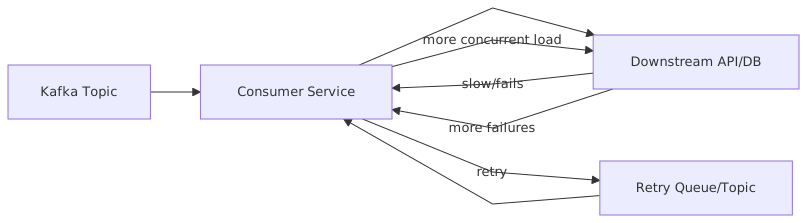
But the crucial point is that retry storms are rarely caused by retries alone. They emerge from the combination of at least four factors:
- Shared infrastructure limits
Connection pools, partition consumers, thread pools, rate limits, and storage IOPS all have ceilings.
- Unbounded optimism
Systems assume failure is transient and close to resolution.
- Weak domain semantics
The architecture doesn’t distinguish “must succeed eventually” from “safe to skip and reconcile later.”
- Tight temporal coupling hidden inside asynchronous designs
The system looks decoupled because it uses events, but business flow still depends on fast downstream responses.
That last one matters. Kafka can remove transport coupling while preserving business coupling. Many enterprises discover this only in production.
Forces
Retry storm design is a balancing act among competing forces. Any serious architecture has to name them.
Reliability versus load amplification
Retries improve success rates for transient faults. They also multiply work. A single message retried five times across three consumer instances is not one unit of work; it’s a traffic generator. At scale, resilience and load become enemies.
Throughput versus fairness
When a hot partition contains problematic messages, should consumers block to preserve order, skip ahead, or isolate failures? Preserving strict ordering may punish unrelated business events. Skipping may break domain invariants.
Business correctness versus operational simplicity
It is operationally simpler to dead-letter everything after N failures. It is business-correct to treat message classes differently. An inventory reservation, an anti-fraud check, and an email notification should not all share one failure path.
Local autonomy versus global stability
Microservice teams want local freedom. Platform teams want predictable system behavior. Retry policy is exactly where those two ambitions collide. Let every team choose independently and storms spread through the estate. Centralize too hard and you erase domain nuance.
Immediate recovery versus deferred reconciliation
A message that fails now may succeed later. But “later” might be better handled by reconciliation than by incessant retries. Reconciliation is not a consolation prize. In many domains it is the right recovery mechanism.
Delivery guarantees versus side effects
At-least-once delivery means duplicates are expected. That’s fine for idempotent state projection. It is not fine for partner integrations that trigger shipping, billing, or customer communication. Retries without idempotency keys are business bugs wearing infrastructure clothing.
Solution
The solution is not “remove retries.” It is to turn retries from a reflex into a governed recovery strategy.
A robust design usually combines six ideas:
- Classify failures by semantics, not by exception type alone
- Use bounded retries with jittered backoff
- Isolate retries from the hot path
- Apply idempotency and deduplication where side effects exist
- Prefer reconciliation for long-lived or ambiguous failures
- Protect downstream dependencies with admission control, circuit breakers, and rate limits
This is less a single pattern than an architecture stance.
1. Classify failures by semantics
Not all failures deserve retry. A malformed message, business rule rejection, unknown reference data code, or unsupported state transition is not transient. Those are poison messages or semantic failures. Retrying them is waste. Worse, it creates noise that hides real transient faults.
A useful classification model looks like this:
- Transient technical: timeout, temporary network issue, brief lock contention
Action: bounded retry with backoff
- Persistent technical: dependency down for extended period, repeated 5xx, exhausted quota
Action: isolate, defer, maybe park for later replay
- Semantic failure: invalid business state, schema mismatch at semantic level, unsupported event version
Action: reject, quarantine, raise domain alert
- External side-effect ambiguity: unknown whether external action succeeded due to timeout after request sent
Action: avoid blind retry; reconcile against source of truth
That last category causes real damage. If a payment gateway times out after authorization may have been accepted, the next step is not “retry immediately.” The next step is “check status with idempotency key or reconcile against provider state.”
2. Bound retries and add jitter
If you retry, do it with discipline. Immediate retries are often acceptable only for tiny transient blips and only a small number of times. Exponential backoff helps, but synchronized exponential backoff can still produce retry waves. Jitter matters. It breaks alignment.
The principle is simple: never allow all failed consumers to come back at the same moment like a cavalry charge into the same machine gun.
3. Isolate retries from the hot path
Do not let failed work compete directly with fresh work in the same execution lane if failure can persist. This is where retry topics, delay queues, parking lots, or workflow orchestrators earn their keep. Fresh events should continue flowing where possible. A subset of toxic messages should not hold the entire stream hostage.
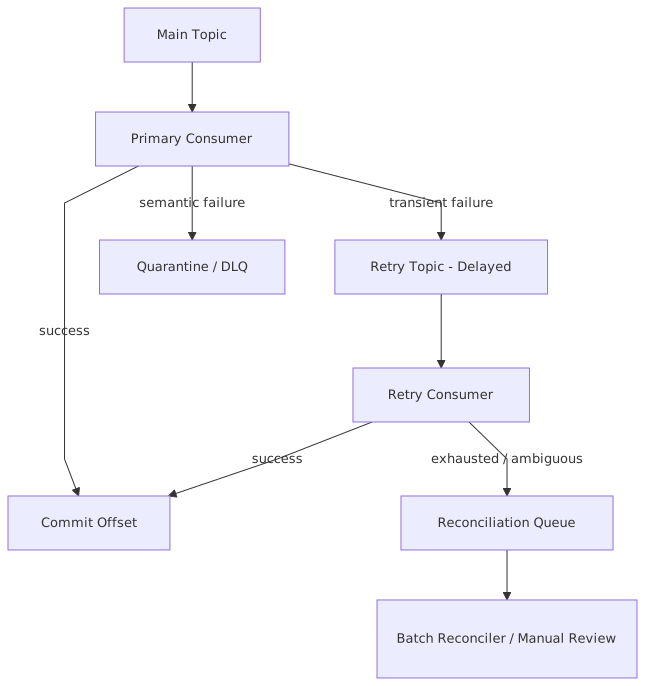
This design is not free. Separate retry channels add operational complexity and can blur ordering guarantees. But they stop one bad dependency day from becoming a platform-wide pileup.
4. Make side effects idempotent
If a message can trigger an externally visible action, retries require idempotency keys or deduplication records. There is no elegant alternative. “We think duplicates are rare” is not architecture; it is wishful thinking.
In domain terms, the command or event needs an identity that survives retries and replays. The receiving system must understand that identity. If the downstream partner does not support idempotency, your architecture must compensate with an outbox, a sent-record ledger, or a reconciliation process.
5. Reconcile instead of retrying forever
Reconciliation is the grown-up answer to uncertainty.
When an event fails due to prolonged outage, ambiguous side-effect outcome, or dependency contract drift, endless retries usually create more heat than light. Park the work. Later, compare the intended state with the actual state and close the gap. Reconciliation may query source systems, rebuild projections, reissue missing commands, or raise business exceptions for human intervention.
This is especially important in DDD terms. A bounded context should protect its own invariants. If another context is unavailable, that does not automatically mean the right behavior is to keep hammering it. Sometimes the right behavior is to capture intent, preserve auditability, and reconcile once truth is observable again.
6. Protect dependencies deliberately
Retries are only half the story. The other half is refusing to overload recovering components. Use:
- consumer concurrency limits
- token-bucket or leaky-bucket rate limiting
- circuit breakers with sane half-open behavior
- partition isolation for toxic workloads
- backpressure signals
- queue depth and age guards
- autoscaling policies that do not blindly amplify dependency pressure
Autoscaling without dependency-aware throttling is a classic storm accelerator. More consumers mean more requests. More requests mean slower dependency response. Slower responses mean more retries. This is how cloud-native systems spend more money while becoming less available. cloud architecture guide
Architecture
A practical architecture for avoiding retry storms in Kafka-centric microservices usually has five lanes of behavior. microservices architecture diagrams
Main processing lane
The consumer reads from the primary topic and processes messages under normal SLA expectations. It performs lightweight validation, applies local business logic, and calls downstream dependencies only within controlled budgets.
Fast retry lane
A very small number of immediate retries happen inline for truly transient failures: brief network glitches, connection resets, short lock waits. Think one or two attempts, not a spiritual commitment.
Delayed retry lane
Failures that may recover in minutes move to a delayed retry topic or scheduled queue. This decouples them from the main flow and smooths pressure on dependencies.
Quarantine lane
Messages with semantic problems, irrecoverable schema mismatches, or corrupted payloads go to quarantine, not to endless retry. Quarantine should preserve context: event key, headers, payload, processing history, and reason classification.
Reconciliation lane
Messages with ambiguous outcomes or long-lived failures move into a reconciliation process. This can be event-sourced, batch-driven, or workflow-based. The key is to make recovery explicit rather than accidental.
Here is the control model.

This architecture has a DDD flavor whether teams admit it or not. The validation and classification step is where ubiquitous language matters. A message is not merely “failed.” It is “payment already authorized,” “customer not yet replicated,” “policy lapsed,” “reference data unknown,” or “partner confirmation uncertain.” Those labels drive recovery behavior. Without them, the platform can only do blunt-force infrastructure moves.
Kafka-specific considerations
Kafka makes some choices sharp:
- Partition ordering means one poison message may block later records on the same partition if your consumer model commits in order.
- Consumer lag is both a metric and a trap. Reducing lag by raising concurrency may worsen the root cause.
- Replay is powerful but dangerous. Replaying into side-effectful consumers without idempotency is duplicate generation at scale.
- DLQ topics are useful but often abused as silent graveyards. If nobody owns triage and replay semantics, the DLQ is just deferred neglect.
For Kafka, a common enterprise move is to separate domain event topics from integration command topics. Domain events represent facts. Integration commands represent intent toward external systems. Retry policies differ. Facts should often be preserved and replayable. Commands need stronger idempotency and side-effect tracking.
Migration Strategy
Most enterprises do not redesign retry handling in one sweep. They inherit a mess: framework defaults, inconsistent backoff, per-service DLQs, and tribal knowledge embedded in runbooks. The right answer is a progressive strangler migration.
Start where pain is visible. Retry storms announce themselves.
Step 1: Observe before changing behavior
Instrument message age, retry count, failure classification, downstream latency, consumer lag, circuit breaker state, and duplicate side-effect detection. You cannot govern what you cannot see. Many teams discover they have three retry loops active at once: client library, consumer middleware, and broker redelivery. That insight alone can halve the chaos.
Step 2: Externalize retry policy
Pull retry behavior out of scattered code and into explicit policy by message class or topic class. Not necessarily centralized in one platform service, but governed and visible. “Five retries everywhere” is not a policy. It is a confession.
Step 3: Introduce classification and quarantine
Before building elaborate retry infrastructure, stop retrying known bad messages. Add semantic classification. Create a quarantine path with ownership and dashboards. This delivers quick wins because poison messages stop consuming capacity.
Step 4: Add delayed retry topics
Move medium-duration retries off the hot path. Start with the highest-volume failure modes. Keep ordering tradeoffs explicit. In some domains, preserving partition order matters. In others, freshness for unaffected messages matters more.
Step 5: Add reconciliation workflows
For side-effect ambiguity and prolonged outages, create a reconciliation capability. This often means introducing a state store, audit trail, or workflow engine. It sounds heavier than retries because it is. But it is also more honest about the business problem.
Step 6: Strangle old retry logic
As new lanes take over, disable inline or broker-level retries that now duplicate behavior. This is classic strangler fig work: route specific message classes through the new control plane while legacy handling still exists for the rest.
A migration view might look like this:
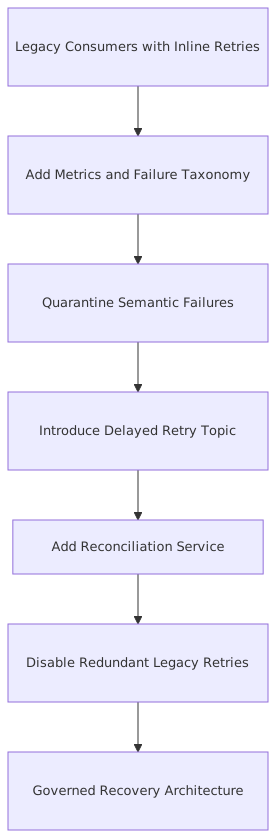
This progressive approach matters politically as much as technically. Enterprise platforms rarely get budget for “retry redesign.” They do get budget for reducing incidents, duplicate transactions, and pager fatigue. A strangler migration lets you tie architecture change to operational outcomes.
Enterprise Example
Consider a large insurer modernizing claims processing across multiple bounded contexts: Policy, Claims, Payments, Customer Communications, and Fraud. Kafka is the event backbone. Claims events trigger downstream actions such as reserve calculation, fraud scoring, payment initiation, and customer notifications.
At first, the design looked respectable. Each microservice consumed claim-related events and retried failed processing up to ten times with exponential backoff. Payment calls to a banking gateway had client-level retries. Kafka consumer error handlers also retried. Autoscaling was driven by consumer lag.
Then a banking partner introduced intermittent latency during a certificate rotation. Payment initiation slowed from 200 ms to 8 seconds, with frequent timeouts. The Payments service stopped keeping up. Consumer lag rose. Autoscaling doubled pods. That doubled concurrent payment attempts. Client retries multiplied request volume again. Some requests actually succeeded at the bank but timed out before acknowledgment, so duplicate payment risk emerged. Claims processing downstream began to stall because payment completion events were delayed. Communications retried “payment pending” notifications, sending customers conflicting updates. Fraud models received delayed state and produced noisy alerts.
Classic retry storm. But with domain consequences.
The recovery architecture changed in three important ways.
First, the insurer split payment intent from payment confirmation. ClaimPaymentRequested became an internal domain event recording business intent. Actual calls to the banking gateway were issued by an integration component using idempotency keys tied to payment instruction IDs. That meant a timeout no longer justified blind repeat submission.
Second, they introduced a delayed retry topic for technical payment failures and a reconciliation workflow for ambiguous outcomes. If the bank response was unknown, the system queried the bank using the instruction ID before any resubmission. That single move eliminated duplicate payment incidents.
Third, they reclassified notifications and projections as lower-criticality consumers. Those bounded contexts could tolerate lag and reconcile later. They were no longer allowed to compete aggressively with payment recovery during incidents.
The lesson is not “payments are special.” The lesson is that domain semantics define retry semantics. Financial actions, customer communications, and read-model updates do not fail in the same way and should not recover in the same way.
Operational Considerations
Architecture only counts if it survives Tuesday at 2:13 a.m.
Metrics that matter
Track more than success/failure rates:
- retry volume by classification
- message age, not just queue depth
- number of messages in quarantine and reconciliation
- duplicate side-effect detections
- downstream saturation indicators
- partition-level skew
- replay volume
- ratio of fresh processing to retry processing
Queue depth alone lies. A shallow queue of very old business-critical messages is worse than a deep queue of low-value projections.
Alerting
Alert on storm indicators, not just outages:
- retries exceed fresh throughput
- same dependency failure causing cross-service spikes
- circuit breaker flapping
- autoscaling events correlated with error rates
- DLQ growth without triage consumption
- reconciliation backlog breaching business SLA
Runbooks
Operators need authority and guidance to:
- pause specific consumers
- divert to delayed retry topics
- reduce concurrency
- disable nonessential consumers
- trigger targeted reconciliation
- replay safely with idempotency protections
Without runbooks, people improvise. Improvisation during a retry storm is how innocent restarts become cascading failures.
Ownership
Someone must own quarantine and reconciliation. A DLQ with no owner is just an abandonment queue. In DDD terms, ownership should align to the bounded context that understands the business meaning of failure, with platform support for the mechanics.
Tradeoffs
There is no free lunch here.
A governed retry architecture adds moving parts: retry topics, classifiers, idempotency stores, reconciliation services, dashboards, and policies. It increases operational sophistication and demands stronger collaboration between platform and domain teams.
It may also weaken simple ordering assumptions. Once failed messages leave the main flow, later messages may progress. In some domains this is acceptable. In others, such as ledger posting, it may be disastrous.
Reconciliation is powerful but not cheap. It introduces delayed resolution, batch complexity, and often human workflows. Some teams resist it because it feels less elegant than “automatic retry.” In truth, reconciliation is often more faithful to reality. The world does not always answer immediately.
There is also a cultural tradeoff. Teams must stop thinking of retries as harmless plumbing. That requires governance. Governance is often unpopular right up until the fourth major incident. EA governance checklist
Failure Modes
Even good retry architectures fail in specific ways.
Retry lanes become permanent backlogs
If delayed retries are easier than fixing root causes, they turn into slow-motion queues of shame.
Misclassification
A semantic failure marked as transient causes waste. A transient dependency issue marked as poison causes unnecessary manual work. Classification quality matters.
Idempotency gaps
One missing idempotency key in a side-effect path can invalidate the whole safety story.
Reconciliation drift
If reconciliation logic diverges from online processing logic, systems disagree about truth. This is subtle and dangerous.
Silent DLQ growth
Teams celebrate that the main flow is healthy while business-critical messages quietly accumulate in quarantine.
Hot partitions and ordering deadlocks
One partition with problematic keys can remain blocked while others drain normally, masking localized failure.
Governance bypass
A team under pressure adds “temporary” infinite retries in a client SDK. Temporary in enterprises often means until the next replatforming, which is to say forever.
When Not To Use
Not every system needs a full retry-control architecture.
Do not build all of this if:
- your workload is low volume and operationally simple
- failures are rare and side effects are trivial
- a synchronous request/response interaction is clearer and safer
- the domain can tolerate straightforward manual recovery
- event-driven decoupling is being used as fashion rather than necessity
Also, if your business process requires strict, immediate, transactional consistency across multiple steps, asynchronous retries may be the wrong model. An event log will not rescue a fundamentally synchronous domain requirement. Use event-driven approaches where temporal decoupling is real, not imagined.
And if your team lacks the discipline to own quarantine, reconciliation, and idempotency, then adding retry topics may just create a more complicated mess. Better a simpler design honestly operated than a sophisticated one nobody truly understands.
Related Patterns
Several patterns sit adjacent to retry storm control:
- Outbox pattern for reliable event publication from transactional boundaries
- Idempotent consumer for safe duplicate handling
- Dead-letter queue for irrecoverable or quarantined messages
- Circuit breaker to stop load amplification toward failing dependencies
- Bulkhead isolation to prevent one failure domain consuming all resources
- Saga for long-running cross-context business processes
- Competing consumers for scale, with caution around pressure multiplication
- Strangler fig pattern for progressive migration from naive retry logic
- Reconciliation jobs for eventual repair and truth alignment
The important thing is to combine them intentionally. Patterns are ingredients, not architecture.
Summary
Retry storms are what happen when a distributed system mistakes persistence for wisdom.
The root issue is rarely that teams retried. The issue is that they retried without understanding domain meaning, dependency limits, or recovery pathways. In event-driven systems—especially Kafka-backed microservices—retries can preserve availability for transient faults, but they can just as easily amplify instability into a platform incident.
The architecture answer is to classify failures semantically, bound and jitter retries, isolate failed work from hot paths, enforce idempotency for side effects, and lean on reconciliation when certainty is unavailable. Domain-driven design matters here because business meaning determines safe recovery. A payment is not a projection update. A customer notification is not a fraud decision. Treat them differently.
For enterprises, the practical path is not a grand rewrite. It is a progressive strangler migration: observe, classify, quarantine, isolate, reconcile, and then retire the old naive retry loops. Do that well, and your system will not become failure-proof. Nothing is. But it will fail with more grace, less noise, and far less collateral damage.
That is the real goal. Not a system that never stumbles, but one that does not kick itself down the stairs when it does.
Frequently Asked Questions
What is enterprise architecture?
Enterprise architecture aligns strategy, business processes, applications, and technology in a coherent model. It enables impact analysis, portfolio rationalisation, governance, and transformation planning across the organisation.
How does ArchiMate support architecture practice?
ArchiMate provides a standard language connecting strategy, business operations, applications, and technology. It enables traceability from strategic goals through capabilities and services to infrastructure — making architecture decisions explicit and reviewable.
What tools support enterprise architecture modeling?
The main tools are Sparx Enterprise Architect (ArchiMate, UML, BPMN, SysML), Archi (free, ArchiMate-only), and BiZZdesign. Sparx EA is the most feature-rich, supporting concurrent repositories, automation, scripting, and Jira integration.