⏱ 21 min read
Event-driven architecture often starts as a clean sketch on a whiteboard. A few services, a message broker, some well-named domain events, and a promise: systems that are decoupled, scalable, and responsive. It looks elegant because, at small scale, it is elegant.
Then the enterprise shows up.
A second team adds “just a few more events.” A third team publishes a notification stream that is half domain fact and half integration shortcut. Kafka topics multiply. Schemas drift. Consumers fork event meanings in private. Before long, what began as a disciplined language of business facts becomes confetti. Every bounded context is speaking, but fewer and fewer are saying anything precise. event-driven architecture patterns
This is the quiet tax of success in event-driven systems: domain event explosion. Not merely lots of events, but too many event types, too many weakly governed semantics, too many publication paths, and too many accidental consumers. The architecture still moves data. It may even move it fast. But it stops telling the truth clearly.
That distinction matters. In enterprise systems, an event is not just a packet on a wire. It is a claim about the business. “OrderPlaced” means something. “PaymentAuthorized” means something else. If those meanings blur, the entire architecture gets slippery. Teams can no longer reason locally. Integration becomes archaeology. Reconciliation becomes permanent. Governance arrives late, wearing a fluorescent jacket and waving documents no one wants to read. EA governance checklist
The answer is not to abandon event-driven architecture. That would be like banning roads because traffic exists. The answer is to restore discipline around domain semantics, ownership, and propagation. You need to treat events as part of the domain model, not as exhaust from service methods. You need migration strategies that reduce entropy without freezing delivery. And you need to know the tradeoffs, because there are good reasons why event landscapes become explosive in the first place.
This article is about that problem in the real world: Kafka, microservices, bounded contexts, legacy cores, strangler migration, reconciliation pipelines, consumer drift, and the operational gravity that accumulates around large enterprises. It is opinionated because this topic needs opinions. Without them, event-driven design degenerates into cargo-cult integration. microservices architecture diagrams
Good architecture is not the elimination of complexity. It is deciding where complexity is allowed to live. Domain event explosion is what happens when you let it live everywhere.
Context
Event-driven architecture is attractive because it promises loose coupling. A service emits an event. Other services react. Nobody blocks on synchronous calls unless they truly need to. Teams move faster. Systems absorb load better. New use cases appear by subscribing rather than modifying an existing application.
That story is broadly true. It is also incomplete.
In a typical enterprise, event-driven architecture sits on top of layered realities: legacy transaction systems, ERP platforms, CRM suites, cloud-native microservices, reporting pipelines, fraud engines, and a dozen integration standards accumulated over years. Kafka often becomes the center of gravity because it provides durable logs, high throughput, consumer isolation, and a practical backbone for both streaming and integration. That makes it useful. It also makes it dangerously easy to use for everything.
This is where domain-driven design matters. DDD gives us a way to think about events as expressions of a bounded context. A domain event should capture something meaningful that happened in the model of that context. Not a database mutation. Not an internal workflow hop. Not “we needed to notify downstream somehow.” A meaningful business fact.
That sounds obvious, but in practice many organizations produce events from technical boundaries rather than domain boundaries. They emit “CustomerTableUpdated,” “PolicyRecordChanged,” or “OrderServiceEventV7.” These are integration artifacts masquerading as business language. Once that habit spreads, event catalogs grow rapidly while semantic clarity collapses.
Enterprises then reach a familiar state:
- hundreds or thousands of event types
- overlapping topic taxonomies
- inconsistent schema evolution
- teams consuming events they do not really understand
- replay processes that break because semantics changed under the same name
- reconciliation jobs compensating for eventual consistency that was never actually designed
The issue is not event volume. Kafka can handle volume. The issue is semantic fragmentation.
Problem
Domain event explosion is the uncontrolled proliferation of events, event types, topics, and subscriptions such that the event landscape becomes difficult to understand, govern, evolve, or trust.
It usually presents in one or more forms:
- Event type sprawl
Too many fine-grained events with unclear boundaries: OrderCreated, OrderInitialized, OrderHeaderSaved, OrderPending, OrderLineAttached, OrderUpdatedAfterRules.
- Semantic duplication
Different teams publish different events for the same business occurrence: CustomerRegistered, UserCreated, AccountOpened, all referring to overlapping concepts.
- Leaky internal workflow events
Internal service steps are published as if they were domain events, forcing downstream consumers to learn implementation details.
- Topic explosion
Every team creates its own topic naming style and partitioning model. The broker becomes a filing cabinet with no index.
- Consumer-driven semantics
Consumers infer meaning from payload fields rather than event contracts. Two consumers use the same event differently, and both insist they are right.
- Schema drift under stable names
The event name remains constant while the business meaning changes. Replay and audit become suspect.
- Integration by broadcast
Instead of explicit context mapping, teams publish broad event streams and hope consumers self-select the right facts.
This is not just clutter. It has architectural consequences.
When event semantics become weak, bounded contexts stop being bounded. They start bleeding assumptions into one another. Teams become coupled through interpretation. And interpretation is worse than code coupling, because it is harder to see.
A broken API often fails loudly. A broken event meaning often fails late.
Forces
Several forces push organizations toward event explosion. Most of them are understandable. Some are even rational.
1. Local optimization by autonomous teams
Microservices encourage autonomy. That is good. But without a shared discipline for event modeling, each team names and emits events according to local convenience. The local optimum becomes global noise.
2. Confusion between domain events and integration events
A domain event expresses a business fact inside a bounded context. An integration event is what you choose to publish externally so other contexts can react safely. They are related, but they are not the same thing. Enterprises often collapse them into one.
That shortcut feels efficient. It rarely stays that way.
3. Legacy system strangulation
During modernization, organizations place a Kafka backbone around legacy platforms and start emitting events from change-data-capture, outbox patterns, or wrapper services. This creates movement quickly, but often before domain semantics have been cleaned up. The first event stream reflects legacy structures, not business language.
4. Feature pressure
Product teams need notifications, search indexing, recommendations, fraud checks, personalization, and analytics. Events seem like the easiest integration path. So more are added. Then more.
5. Fear of synchronous dependency
Many teams overcorrect from tightly coupled APIs and push everything asynchronous. They publish events for interactions that should remain synchronous commands or queries. Event counts rise because architectural boundaries are compensating for governance gaps. ArchiMate for governance
6. Compliance and audit requirements
Regulated enterprises need traceability. Teams start publishing extra events “for audit,” often duplicating existing facts with slightly different payloads. Audit becomes another source of event proliferation rather than a property of the core design.
7. Platform incentives
Kafka makes publishing cheap. Cheap things get overused. The platform is not the architecture. It is only the substrate.
The result looks something like this:

This is the event explosion diagram nobody puts in the architecture deck. Yet it is the one that explains why delivery velocity starts dropping after the first wave of event enthusiasm.
Solution
The cure is not fewer events in the abstract. The cure is better event boundaries.
At the center of the solution is a simple idea: model events from domain semantics outward, then shape integration intentionally.
1. Distinguish event classes clearly
Use at least three conceptual categories:
- Domain events: meaningful facts within a bounded context
- Integration events: externally published facts shaped for other contexts
- Technical events: operational signals, CDC notifications, retries, workflow markers
Do not pretend they are interchangeable. They serve different audiences and deserve different naming, governance, and retention rules.
2. Publish from aggregates, not table changes
A strong domain event usually corresponds to a meaningful state transition in an aggregate or process. If the event comes from a row update with no business framing, you are exporting persistence design, not domain knowledge.
3. Design event portfolios per bounded context
Each bounded context should have a curated set of events it is willing to publish. Not every internal fact should become public. This is where DDD earns its keep. A bounded context owns its language. It does not owe the enterprise its internals.
4. Introduce canonical semantics carefully
I am skeptical of giant enterprise canonical models. They tend to become committees in XML form. But there is a middle ground: canonical semantics for high-value business concepts, with local context-specific representations behind them. You do not need one universal customer model. You do need agreement on what “customer registered” means when used cross-context.
5. Use event envelopes and contracts
Separate metadata from business payload:
- event id
- event type
- aggregate or entity id
- schema version
- occurred-at
- producer context
- correlation id / causation id
- payload
This lets you evolve operations and tracing independently from business meaning.
6. Treat event schemas as products
Version them. Review them. Deprecate them. Document examples. Make ownership explicit. If nobody owns an event contract, consumers become owners by accident.
7. Build consumer isolation
Use anti-corruption layers or translation consumers where necessary. Do not let every consumer bind directly to raw upstream event structures. It creates semantic lock-in.
8. Reconcile by design, not as apology
In distributed event-driven systems, some divergence is normal. Reconciliation processes should compare authoritative state, detect missing or duplicated effects, and restore alignment. But if every integration depends on nightly reconciliation to work, you do not have eventual consistency. You have eventual hope.
A healthier target architecture looks like this:
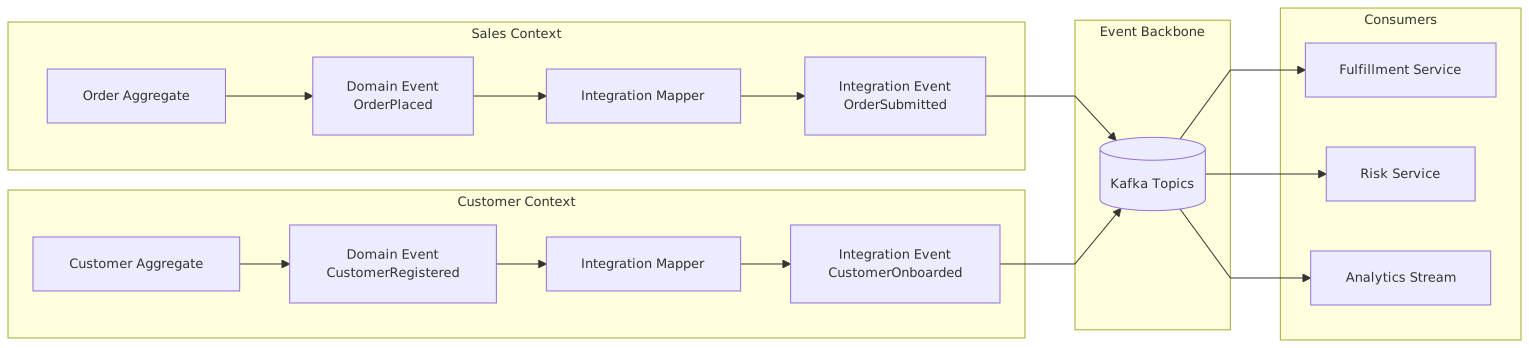
Notice the discipline: not every domain event leaks directly to Kafka. There is a shaping step. That step is not bureaucracy. It is architecture.
Architecture
A robust architecture for controlling domain event explosion usually has five elements.
Bounded context event catalogs
Each context maintains an explicit event catalog. This is not just a schema registry entry. It is a semantic registry:
- what the event means
- what business moment it represents
- what invariants must hold when it is published
- whether it is internal or external
- which consumers are expected
- which fields are stable contracts
This sounds heavier than it is. In practice, a small markdown spec with examples is enough. The key is that semantics are written down where engineers can find them.
Outbox and transactional publication
For services with their own data stores, the outbox pattern is still one of the safest ways to publish reliably. Commit business state and the event record atomically, then relay to Kafka. This avoids the classic failure mode where the database commits but the event is lost, or the event is sent but the database rolls back.
Schema governance with compatibility policy
Use Avro, Protobuf, or JSON Schema with explicit compatibility checks. More importantly, tie compatibility policy to semantics. A payload can be backward-compatible in structure and still backward-incompatible in meaning.
That is the trick many teams miss.
Event routing by business capability, not arbitrary team preference
Kafka topic design matters. Organize topics around stable business streams or capability domains, not per-sprint convenience. Avoid both extremes:
- one giant topic for everything
- one topic per tiny event variation
A practical approach is topic families per bounded context or domain capability, with event type in headers or envelope metadata. Partitioning should align with ordering requirements, usually around aggregate or entity keys.
Read models and reconciliation services
Downstream consumers should often project events into local read models rather than making assumptions from the raw stream every time. For critical flows, add reconciliation services that compare source-of-truth state with downstream projections or side effects.
This is especially important in financial, supply chain, and customer master domains where duplicate or missing events have real business consequences.
Here is a common enterprise pattern:
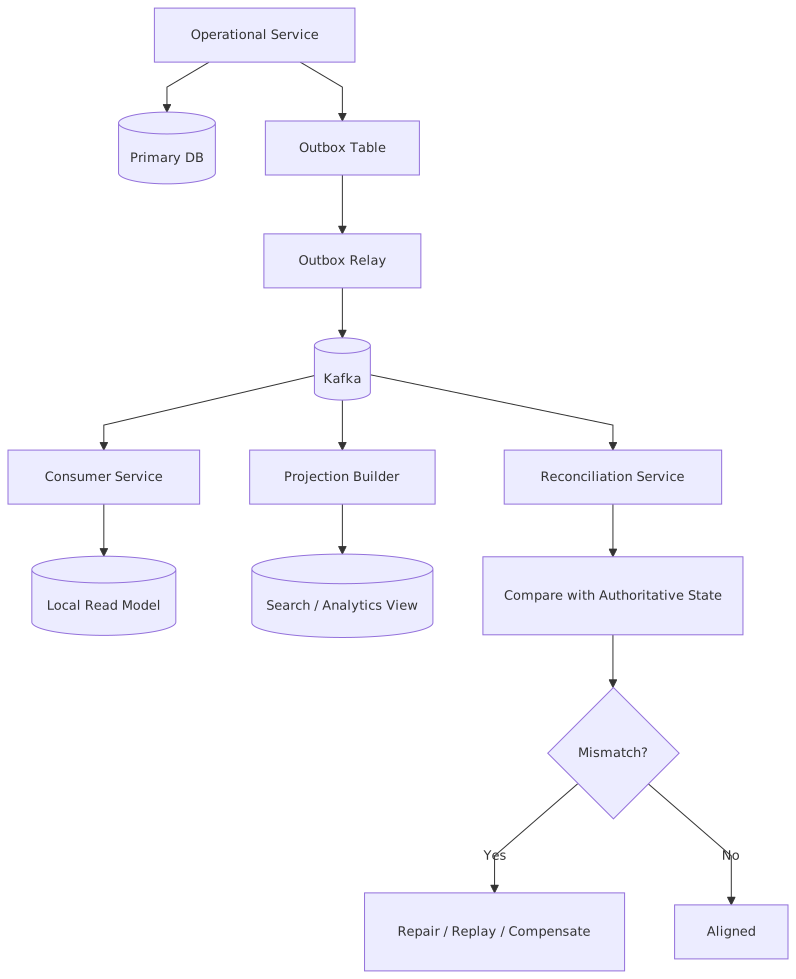
The important point here is not the mechanics. It is that reconciliation is a first-class architectural capability, not an improvised batch script created after the first audit finding.
Migration Strategy
This is where architecture stops being theory and starts dealing with scar tissue.
Most enterprises do not get to redesign their event landscape from scratch. They inherit a messy ecosystem: a few Kafka clusters, some CDC-based topics, a legacy ESB still carrying core integrations, and microservices already in production. The migration strategy must reduce event explosion progressively, not by decree.
The right approach is a strangler migration for semantics, not just services.
Phase 1: Inventory what actually exists
Catalog:
- topics
- event types
- producers
- consumers
- schemas and versions
- retention and replay use
- business owner, if any
- duplicate semantic events
This exercise is almost always sobering. You will find events with no known consumers and consumers depending on fields never documented. Good. Better to learn that now.
Phase 2: Identify authoritative contexts
For each major business concept—customer, order, payment, shipment, policy, claim, invoice—identify the bounded context that is authoritative for the business fact. Authority matters because event explosion often begins when several systems publish competing truths.
Phase 3: Introduce semantic gateways
Instead of letting all legacy or local events flow directly into the enterprise backbone, place translation layers that emit curated integration events. For legacy systems, this may sit atop CDC feeds. For microservices, it may be a mapper between domain events and public events.
Phase 4: Deprecate by replacement, not shutdown
Publish the new curated event alongside the old one. Let consumers migrate gradually. Measure adoption. Set dates. Provide field mappings and sample transformations. Then retire the old stream.
This is textbook strangler behavior: new semantics wrap and replace old ones over time.
Phase 5: Add reconciliation during transition
During migration, there will be overlap periods where old and new event models coexist. Reconciliation is essential here. Compare downstream effects from both paths. Detect lost publications, semantic mismatches, or timing gaps. Migration without reconciliation is wishful thinking in a distributed estate.
Phase 6: Tighten governance where it matters most
Do not start with a giant governance board reviewing every event. Start with critical domains and high fan-out streams. Payments, customer identity, inventory allocation, order lifecycle. Success there creates the discipline to expand elsewhere.
Phase 7: Retire accidental events
Some events should never have existed as enterprise contracts. Internal workflow notifications, ETL helper messages, retry markers, low-level status pings. Move them to internal topics or service-private channels.
This migration path is slower than “we’ll fix naming later.” It is also the only one that tends to survive contact with a real enterprise.
Enterprise Example
Consider a large retail bank modernizing its loan origination and servicing platforms.
The bank had:
- a mainframe-based customer master
- a loan origination suite
- a document management platform
- fraud and AML services
- digital channels built as microservices
- Kafka introduced as a strategic integration backbone
At first, the program looked healthy. Teams wrapped legacy systems, added CDC connectors, and began publishing streams. Within eighteen months, there were more than 400 event types related to customer onboarding and loans.
The problem was not just quantity. It was semantic overlap.
The digital onboarding team published ApplicantCreated.
The customer master wrapper published CustomerInserted.
The KYC service published IdentityProfileOpened.
The CRM adapter published PartyAdded.
The loan platform emitted BorrowerRegistered.
All of these sometimes referred to the same business milestone. Sometimes they did not. Different downstream systems—fraud, notifications, analytics, branch CRM—subscribed to different combinations and stitched their own understanding together. Duplicate customer records rose. Fraud checks ran twice for some applicants and not at all for others. Replays after outages created contradictory downstream states because event names had stayed stable while source semantics changed.
The bank did not solve this by deleting Kafka or centralizing all design in an architecture board. It solved it by applying DDD and a strangler migration.
First, the architecture team and domain leads defined authoritative bounded contexts:
- Party Management owned party identity
- Onboarding owned application intake
- Loan Origination owned credit application progression
- Servicing owned booked loan lifecycle
Then they identified the cross-context business facts worth publishing:
PartyRegisteredApplicationSubmittedIdentityVerifiedLoanApprovedLoanBooked
Notably absent were dozens of local workflow events. Those stayed internal.
A semantic gateway was placed between legacy and public streams. CDC still existed, but only a smaller set of curated integration events became enterprise contracts. Existing consumers were migrated topic by topic. During the migration, a reconciliation service compared booked loans, fraud case creation, and notification outputs between old event chains and new ones. This caught several hidden assumptions, including one branch channel process that relied on a field only present in a legacy wrapper event.
The result was not fewer messages overall. In fact, internal traffic increased. But enterprise event contracts became smaller, clearer, and more durable. Consumer onboarding improved. Audit confidence improved. Most importantly, teams regained the ability to discuss the system in business terms rather than topic archaeology.
That is the real value. Architecture should make the enterprise more legible.
Operational Considerations
Event explosion is often discovered operationally before it is acknowledged architecturally.
Observability
You need tracing that crosses asynchronous boundaries:
- correlation ids
- causation ids
- topic, partition, offset metadata
- event version
- producer and consumer identity
Without that, investigating fan-out failures is miserable.
Replay discipline
Replay is one of Kafka’s great strengths and one of the easiest ways to hurt yourself. Replaying an old topic into modern consumers only works if semantics and idempotency have been designed for it. Otherwise replay becomes historical fiction.
Idempotency
Consumers must tolerate duplicates. This is non-negotiable in event-driven systems with retries and reprocessing. Idempotent handlers, deduplication keys, and effect tracking are basic hygiene.
Retention and compaction
Retention policies should reflect event purpose. Audit-grade events may need long retention. Internal workflow events may not. Compacting topics by key can support current-state streams, but they are not a substitute for properly modeled business events.
Access control and data classification
An event stream is easy to subscribe to and hard to unshare. Be careful with personally identifiable information, payment data, health data, and regional data residency rules. Event explosion often becomes a security issue because uncontrolled publication creates uncontrolled exposure.
Consumer lifecycle management
Know who consumes what. Dead consumers and unknown consumers both create risk. If retiring an event might break somebody you cannot identify, the architecture is already in trouble.
Tradeoffs
There is no free lunch here. Containing domain event explosion introduces costs.
More design upfront
Modeling domain semantics carefully takes time. It slows the first release and speeds the next fifty. Some organizations are not patient enough for that arithmetic.
Additional mapping layers
Separating domain and integration events creates translation code and extra components. Purists may complain. They are wrong. Indirection is often cheaper than semantic leakage.
Governance friction
Schema reviews, event catalogs, ownership assignments—these feel like friction because they are friction. Productive friction. The goal is not to eliminate publishing effort. It is to make bad contracts slightly harder to create.
Potential loss of flexibility
If teams cannot publish any event they like onto shared backbones, they may feel constrained. Good. Shared integration surfaces should be constrained.
Reconciliation overhead
Reconciliation pipelines consume engineering and operational effort. But in critical domains, they are cheaper than silent divergence.
In short: the discipline that prevents event explosion is not free. It is simply less expensive than chaos.
Failure Modes
Even with a good approach, there are common ways to get this wrong.
Mistaking canonical for universal
A small set of shared semantics is useful. A giant enterprise-wide canonical data model is usually a swamp. Keep the common language narrow and valuable.
Publishing CRUD as domain truth
If every create, update, and delete becomes a public event, consumers inherit your internal model. That is not decoupling. It is outsourcing your refactoring cost.
Versioning structure but not meaning
Teams often think schema compatibility equals semantic compatibility. It does not. A field can remain in place while its interpretation changes completely.
Ignoring aggregate boundaries
If events are emitted from arbitrary service methods without aggregate consistency behind them, consumers will see half-facts and contradictory sequences.
No deprecation path
Old events linger forever because nobody knows how to retire them safely. Over time, every bad decision becomes permanent. This is how event graveyards form.
Reconciliation as afterthought
Once divergence is discovered in production, ad hoc repairs proliferate. That path leads to brittle scripts, manual runbooks, and no confidence in replay.
When Not To Use
Event-driven architecture is not a religion, and domain event-heavy integration is not always the right pattern.
Do not center your design on rich domain event publication when:
- the domain is simple CRUD with limited cross-context reactions
- consistency requirements are immediate and strict across participants
- there are very few consumers and synchronous APIs are sufficient
- teams do not have the maturity to manage contracts and ownership
- the event backbone is being used mainly to avoid hard conversations about bounded contexts
- the business process is better represented as commands and orchestrated workflows than as broad event dissemination
Likewise, if your architecture is still trying to discover the core domain language, emitting a large public event surface too early can lock confusion into contracts. Sometimes the right move is to keep events internal until the model stabilizes.
Not every change deserves a trumpet.
Related Patterns
Several patterns help contain or complement domain event explosion.
Outbox Pattern
Reliable event publication tied to local transaction commits.
Anti-Corruption Layer
Protects a bounded context from upstream event semantics it should not absorb directly.
Event Carried State Transfer
Useful for denormalized read models, but dangerous if overused as a substitute for proper context ownership.
CDC
Helpful in migration, especially around legacy systems, but should usually feed a translation layer rather than serve as the final enterprise contract.
Saga / Process Manager
Coordinates long-running workflows. Important when event chains need explicit business progression rather than passive fan-out.
CQRS
Supports read models built from events, but should not be used as an excuse to publish every internal mutation.
Strangler Fig Pattern
Essential for progressive migration from legacy events and interfaces to curated domain-aligned contracts.
Summary
Domain event explosion is what happens when event-driven architecture scales faster than domain language. Kafka can carry the load. Microservices can multiply the publishers. But neither can protect semantic integrity for you.
That job belongs to architecture.
The practical response is not to ban events or centralize every integration decision. It is to restore intentionality:
- define bounded contexts clearly
- distinguish domain, integration, and technical events
- publish business facts, not persistence artifacts
- use translation layers deliberately
- migrate with strangler patterns
- reconcile during and after transition
- govern the few event contracts that truly matter
- retire accidental contracts before they become institutional folklore
In a healthy enterprise event architecture, events are not noise. They are narrative. They tell you what the business believes has happened, who owns that truth, and how other parts of the organization may react without becoming entangled.
That is the standard worth aiming for.
Because once event streams stop meaning something precise, the architecture may still be distributed, scalable, and modern. It just won’t be trustworthy. And in the enterprise, trust is the one non-functional requirement you never get to downgrade.
Frequently Asked Questions
What is enterprise architecture?
Enterprise architecture aligns strategy, business processes, applications, and technology in a coherent model. It enables impact analysis, portfolio rationalisation, governance, and transformation planning across the organisation.
How does ArchiMate support architecture practice?
ArchiMate provides a standard language connecting strategy, business operations, applications, and technology. It enables traceability from strategic goals through capabilities and services to infrastructure — making architecture decisions explicit and reviewable.
What tools support enterprise architecture modeling?
The main tools are Sparx Enterprise Architect (ArchiMate, UML, BPMN, SysML), Archi (free, ArchiMate-only), and BiZZdesign. Sparx EA is the most feature-rich, supporting concurrent repositories, automation, scripting, and Jira integration.