⏱ 20 min read
Distributed systems lie. Not maliciously, not even unusually. They lie the way old buildings creak in winter: because stress reveals the structure. In event-driven architecture, one of the oldest lies is this: “each message will be processed once.”
It won’t.
Not reliably. Not under broker failover, network partitions, consumer restarts, offset rewinds, replay jobs, blue-green deployments, dead-letter redrives, or a tired operations engineer doing exactly the right thing at exactly the wrong layer. The brutal truth is that most enterprise event platforms are not “exactly once” machines. They are “at least once, and sometimes more than once when the business can least tolerate it” machines.
That’s why deduplication matters. Not as a neat implementation detail. As a first-class architectural concern.
The teams that get this right stop treating dedupe as a Kafka trick or a database constraint and start seeing it as a business semantic. A payment authorization repeated twice is not the same as a customer profile update repeated twice. A “ship order” command duplicated can create real-world damage. A “customer viewed page” event duplicated may simply distort analytics. The architecture has to reflect that difference. Domain-driven design helps here because it gives us the right lens: dedupe is not only about messages, it is about meaning.
This article takes a hard look at message deduplication patterns in event-driven systems, especially in Kafka-centric microservices estates. We’ll cover the underlying forces, practical architecture choices, migration strategy, operational consequences, and the situations where dedupe is overused or simply misplaced. We’ll also walk through a real enterprise example. Because this topic is never solved by one clever diagram and a slogan.
Context
Event-driven systems are attractive because they decouple time, teams, and technology. Producers emit facts or commands. Consumers react independently. Kafka, Pulsar, cloud event buses, and integration streams become the nervous system of the enterprise. event-driven architecture patterns
But asynchronous decoupling creates a different burden: delivery semantics move from obvious to slippery.
Most event brokers make one promise well: durability. Some also provide ordering within a partition, retention, replay, consumer groups, and transactional publication. All useful. None remove the need to think deeply about duplicates end to end.
Duplicates appear for ordinary reasons:
- A producer retries after timeout, but the first send actually succeeded.
- An outbox publisher crashes after publishing but before marking the row as sent.
- A Kafka consumer processes a message, commits side effects, then crashes before offset commit.
- A downstream system returns an ambiguous timeout, so the caller retries.
- A replay job intentionally republishes history.
- A dead-letter queue is reprocessed without regard for original business keys.
- Two upstream systems emit semantically identical events using different IDs.
The result is familiar: duplicate invoices, duplicate shipment labels, double booking, repeated notifications, inconsistent projections, and argument-filled incident calls where every individual component appears to be “working as designed.”
It usually is.
That is why message deduplication sits at the intersection of integration architecture, domain design, data consistency, and operations. It is not one pattern but a family of patterns. integration architecture guide
Problem
The technical problem sounds simple: prevent a consumer from applying the same logical event more than once.
The real problem is harder: determine what “the same logical event” means in a business context, then enforce that boundary with acceptable latency, cost, and operational complexity.
This is where many teams go wrong. They dedupe on transport identifiers alone and call it done. But transport identity and domain identity are not the same thing.
Consider these examples:
- Two
PaymentCapturedevents with different Kafka offsets but the same payment id may be duplicates. - Two
AddressChangedevents for the same customer may both be valid if they represent separate edits. - Two
OrderSubmittedcommands with the same client request id are probably duplicates. - Two inventory adjustment events with identical payloads may not be duplicates at all if they reflect two warehouse scans.
Dedupe that ignores domain semantics is blunt-force architecture. It may suppress legitimate work or allow harmful repeats. The right answer depends on the aggregate, the business invariant, and the cost of replay.
So the real problem has three layers:
- Detect transport or semantic duplicates.
- Prevent duplicate side effects.
- Allow safe replay and reconciliation without corrupting business state.
Those layers often need different mechanisms.
Forces
This space is ruled by tensions. There is no pattern without tradeoffs.
At-least-once delivery is common because it is practical
Enterprise messaging systems prefer durability over purity. Retrying is cheaper than losing a business event. So duplicates are an expected consequence of resilience.
Exactly-once guarantees are narrower than people think
Kafka’s exactly-once semantics help coordinate producer idempotence and transactional writes with Kafka consumers and topics. Useful, yes. But once you cross a database boundary, call an external payment gateway, send email, invoke a SaaS API, or update a warehouse system, you are back in the world of ambiguity. “Exactly once” usually stops at the edge of one platform’s trust boundary.
Business semantics matter more than message headers
A duplicate claim submission is a business issue. So is duplicate account opening. The architecture must be aligned with ubiquitous language: command id, payment id, settlement reference, shipment number, claim number, policy revision. These are not implementation trivia; they are the keys to correctness.
Throughput and latency fight against coordination
A shared dedupe store is simple to reason about but can become a hotspot. Partition-local dedupe is fast but constrained by routing discipline. Long dedupe retention improves safety but increases storage and lookup cost.
Replay is both a feature and a trap
One of the joys of event-driven systems is replay. One of the curses is replay. Reprocessing historical events through components that trigger side effects is a classic way to turn a recovery exercise into a customer incident. Dedupe must support controlled re-execution and reconciliation.
Microservice autonomy pushes decisions downstream
In federated enterprises, one team will not trust another team’s event identity forever. Consumers often need local dedupe logic because the producer’s guarantees are insufficient or inconsistent. This creates duplication of dedupe logic, which is ugly but sometimes necessary.
Solution
There isn’t a single deduplication pattern. There are several, and mature systems combine them.
The main patterns are:
- Idempotent consumer
- Processed-message store
- Business-key dedupe
- Natural idempotency by domain design
- Inbox pattern
- Partition-aware stateful stream dedupe
- Reconciliation-based correction
A good architecture starts by classifying events and commands into categories:
- Naturally idempotent
Reapplying the message leads to the same state. Example: SetCustomerMarketingPreference(false).
- Conditionally idempotent with key
Safe if processed under a stable idempotency key or business key. Example: CreatePayment with a client request id.
- Non-idempotent side-effecting operations
Dangerous to repeat. Example: charging a card, dispatching a parcel, issuing a refund.
- Analytical or eventually corrected flows
Duplicate tolerant if downstream reconciliation exists. Example: clickstream analytics, telemetry.
Architects should be opinionated here: not every flow deserves expensive dedupe. Reserve the strongest controls for side effects and business invariants. For low-risk event streams, reconciliation may be enough.
Pattern 1: Idempotent consumer with processed-message store
This is the workhorse. The consumer records a unique message identity before or with applying its side effects. If the identity already exists, the message is skipped.
The identity can be:
- event id
- command id
- client request id
- domain aggregate id plus version
- business transaction reference
The storage can be:
- relational table with unique constraint
- key-value store with TTL
- embedded state store in stream processor
- aggregate-local processed-command ledger
This is easy to explain and often hard to tune.

The crucial detail is transactionality. If you write business state and processed-message state separately, you have created another failure window. The strongest version stores both in the same database transaction. If that’s not possible, you need compensating logic or accept some duplicate risk.
Pattern 2: Business-key dedupe
Sometimes event IDs are useless because duplicates are created upstream with new transport IDs. In these cases, dedupe must be based on domain semantics.
Examples:
- one invoice per
orderId - one settlement per
paymentReference - one shipment label per
parcelId - one case creation per
claimNumber
This is a stronger and more business-aligned form of dedupe. It also requires harder conversations with domain experts. Good. Those conversations are where architecture becomes useful.
DDD helps frame the rule: ask what invariant the aggregate protects. If an Order may only transition to Shipped once, then the command side should enforce that transition idempotently regardless of message duplication.
Pattern 3: Inbox pattern
The inbox pattern is the consumer-side cousin of the outbox pattern. Messages are first durably stored in an inbox table or queue local to the consuming service, then processed in controlled fashion.
This helps when:
- consumption rate and business processing rate differ
- you need traceability of received messages
- you want retry workflows independent of broker offsets
- you need stronger audit and replay controls
Inbox plus business-key dedupe is a common enterprise combination for regulated domains.
Pattern 4: Stateful stream dedupe
In Kafka Streams, Flink, or similar platforms, dedupe may happen in the stream processor using keyed state and time windows. This is excellent for high-volume event streams, but only when duplication is defined within a time horizon and keying strategy is trustworthy.
For example, dedupe “same event id within 24 hours” can be implemented efficiently. But be honest: this is usually transport dedupe, not domain correctness. Don’t use a 24-hour stream window to guarantee you never charge a customer twice across replays and manual recovery operations. That way lies fantasy architecture.
Pattern 5: Reconciliation
Some duplicates cannot be fully prevented in real time, especially across organizational boundaries or legacy integration. Here, the right answer is not stronger online dedupe but robust reconciliation.
Reconciliation compares source-of-truth systems, identifies mismatches, and applies corrective actions. Payments, settlements, claims, and supply-chain events often need this anyway. Dedupe reduces incidents; reconciliation closes the books.
This matters in migration as well. During transition phases, parallel flows can produce ambiguity. Reconciliation is your safety net.
Architecture
A practical enterprise architecture for dedupe usually has three lines of defense.
- Producer discipline
- stable event IDs
- outbox pattern
- idempotent producer configuration where supported
- explicit business correlation keys
- Consumer-side protection
- processed-message store or inbox
- business-key uniqueness rules
- aggregate-level idempotent command handling
- Backstop correction
- replay-aware handlers
- reconciliation jobs
- observability and audit
Here’s a reference architecture for a Kafka-based microservice estate. microservices architecture diagrams
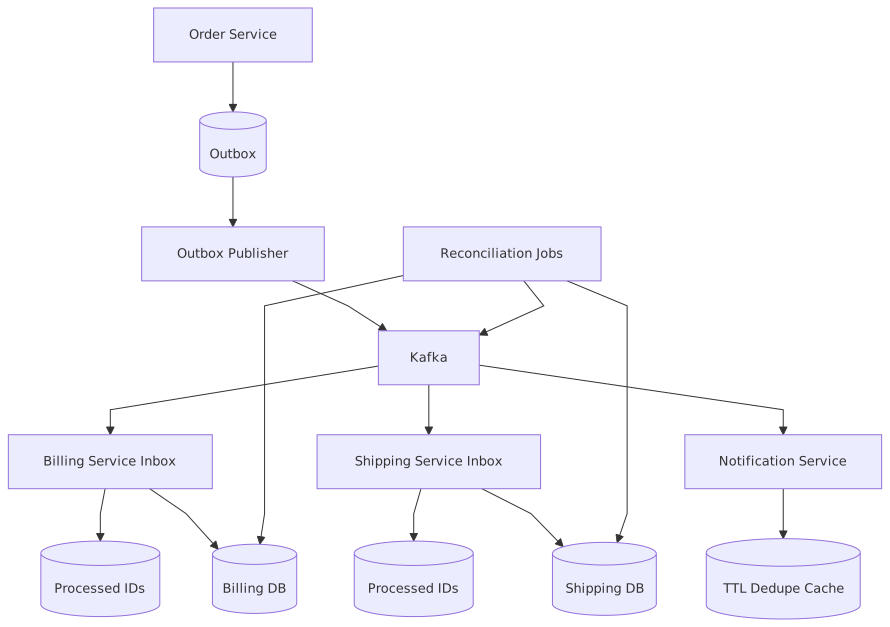
A few opinions worth stating plainly:
- The outbox pattern reduces lost-or-ghost messages but does not remove duplicates. It often creates duplicates during publisher recovery. That’s fine. Design for it.
- A TTL cache is not enough for high-value business operations. It is suitable for noisy notifications or telemetry, not financial posting.
- Dedupe belongs as close as possible to the side effect it protects.
- If the aggregate can enforce “this transition already happened,” do it there. Domain integrity beats plumbing cleverness.
Domain semantics and aggregate design
This is where DDD earns its keep. Suppose an Invoice aggregate enforces that a given shipmentId can produce one invoice only once. Then duplicate ShipmentCompleted events become less frightening. The aggregate decides whether the event advances state or is a no-op.
Likewise, a Payment aggregate should understand authorizationRequestId, captureReference, and refundReference. Those are not integration headers; they are business concepts.
A recurring smell is a consumer with a generic processed_messages table but no domain-level invariant. That setup can suppress transport duplicates, but it may still allow semantically duplicate operations coming through different message paths. Enterprises run many paths.
Migration Strategy
Most firms do not get to design a clean event-driven platform from scratch. They inherit batch integrations, shared databases, ESBs, nightly file drops, and APIs with mysterious retry behavior. Dedupe architecture must therefore be introduced progressively.
The right migration strategy is usually a strangler pattern, not a revolution.
Start by identifying duplicate-sensitive business flows:
- payments
- order fulfillment
- customer onboarding
- claims processing
- pricing updates
- notification dispatch
Then classify systems by control level:
- systems you own and can change
- systems you can wrap
- systems you can only observe and reconcile
A practical phased approach looks like this:
Phase 1: Make duplicates visible
You cannot govern what you cannot see. Introduce correlation IDs, command IDs, business transaction references, and broker metadata into logs and traces. Create dashboards for duplicate detections, replay rates, outbox retries, and offset rewinds.
This phase often reveals the embarrassing truth: duplicates are already happening more often than anyone thought.
Phase 2: Add consumer-side dedupe at the edges of harm
Target the services where duplicate side effects hurt most. Add processed-message tables or inboxes there first. Prefer local transactions with the service’s business database.
For legacy consumers that cannot be modified deeply, place a dedupe adapter in front of them. It is not elegant, but elegance is not the first duty during migration. Damage containment is.
Phase 3: Introduce business keys and domain rules
Once the technical dedupe net is in place, evolve APIs and events to carry stable domain identifiers. Refactor consumers to decide based on business semantics rather than only message UUIDs.
This is often where bounded contexts become clearer. Teams discover they have been emitting low-semantic events and pushing interpretation downstream. Dedupe pressure forces better contracts.
Phase 4: Add outbox and safer publication
Where producers currently emit directly after database commits or through ad hoc retry loops, introduce the outbox pattern. This improves consistency and gives you a single publication control point.
Phase 5: Strangle legacy flows with reconciliation
During coexistence, both old and new paths may create the same business action. Do not trust routing flags alone. Stand up reconciliation jobs to compare ledger entries, order statuses, or shipment records across the boundary.
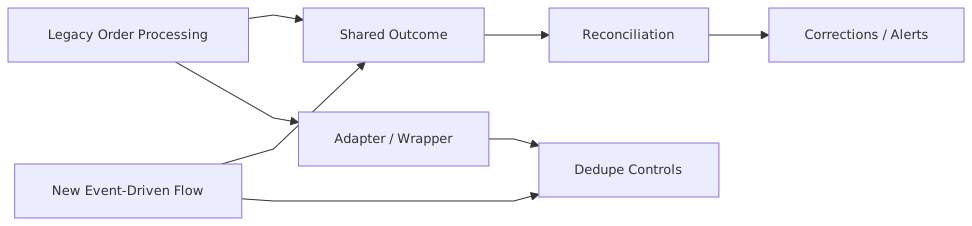
This phase is where many migration programs either become credible or collapse. If there is no reconciliation plan, there is no serious migration plan.
Enterprise Example
Consider a global retailer modernizing order fulfillment across e-commerce, stores, and third-party logistics providers.
The old estate had an ERP, a warehouse management system, a store order broker, and a central customer platform. Order events were increasingly sent through Kafka, but many flows still relied on REST callbacks and batch file feeds. During peak periods, duplicate ShipOrder and InvoiceOrder messages caused double labels, duplicate customer emails, and occasionally duplicate financial postings. Not frequent enough to halt the business, frequent enough to poison trust.
The initial reaction was technical: enable Kafka idempotent producers, tighten offset handling, and add retry backoff. Useful, but insufficient. The worst duplicates came from business process overlaps:
- a warehouse callback retried after timeout
- a replay job republished fulfillment events after a schema fix
- a manual recovery script regenerated “missed” invoices
- a store fulfillment path and distribution-center path emitted equivalent shipment completion events with different IDs
The architecture team reframed the issue in domain terms.
They identified three distinct semantic operations:
ShipmentRegisteredfor logistics trackingInvoiceIssuedfor financial postingCustomerNotifiedfor communications
Each had different duplicate tolerance.
For invoicing, the rule was strict: one invoice per fiscal shipment reference. The billing bounded context introduced a unique business key on fiscalShipmentReference and an inbox table for received events. The invoice aggregate treated repeated requests for the same reference as no-op returns of the existing invoice record.
For shipment notifications, the tolerance was looser. A Redis-based TTL dedupe cache keyed by customerId + shipmentId + notificationType suppressed obvious repeats within 48 hours. Any leak was acceptable because customer messaging already had complaint monitoring.
For warehouse updates, Kafka Streams performed short-window dedupe on event IDs to reduce processing noise before projection into operational dashboards. This was optimization, not correctness.
The migration was progressive. The retailer could not pause order flow to redesign everything. So they wrapped the old callback endpoint with an adapter that generated stable correlation metadata and wrote to Kafka. Legacy and new events ran in parallel for a quarter. During that period, a reconciliation job compared:
- shipment references
- invoice records
- label generation counts
- customer notification counts
Every mismatch produced an operational task. Painful, but clarifying.
The result was not duplicate-free perfection. It was better: duplicates became bounded, explainable, and mostly harmless. The billing domain was hardened. Logistics remained eventually consistent. Communications stayed cheap and elastic. That is what good enterprise architecture looks like—different controls for different risks.
Operational Considerations
Dedupe patterns die in operations long before they fail in diagrams.
Retention policy
How long should dedupe records be kept? The answer depends on replay horizon, legal risk, and business latency. A 24-hour TTL may work for API retry protection. It is absurdly short for month-end finance reprocessing.
Retention should be tied to:
- maximum replay window
- manual recovery windows
- audit requirements
- business cycle duration
Hot partitions and hotspots
If all dedupe checks hit one table or one partition key, throughput collapses. Use proper partitioning, sharding, or aggregate-local storage. Watch for “celebrity keys” such as one large customer or one high-volume merchant.
Poison message handling
A duplicate check that always fails due to malformed keys can lead to endless retries or false positives. Dedupe logic itself needs observability and dead-letter handling.
Schema evolution
When event contracts evolve, dedupe keys must remain stable or be version-aware. Teams often accidentally change the meaning of IDs during schema redesign. That breaks idempotency in subtle ways.
Replay modes
Your consumers should know whether they are in live mode or replay mode. In replay mode, side effects may need to be suppressed, redirected, or compared only against historical state. A single code path for both is elegant until it sends 800,000 duplicate emails.
Metrics that matter
Track:
- duplicate detection rate
- dedupe false positive rate
- processed-message store growth
- replay volume
- offset rewind incidents
- reconciliation mismatch count
- side-effect retries by downstream dependency
If you only track consumer lag, you’re measuring the wrong anxiety.
Tradeoffs
Every dedupe pattern pays in a different currency.
Processed-message table
- Pros: simple, reliable, auditable
- Cons: storage growth, write amplification, transactional coupling
Business-key uniqueness
- Pros: strongest semantic correctness
- Cons: requires domain clarity, can reject legitimate repeats if the model is naive
TTL cache dedupe
- Pros: fast, cheap, good for noisy event suppression
- Cons: weak guarantees, vulnerable to replay beyond TTL, not suitable for high-value invariants
Stream-window dedupe
- Pros: high throughput, good for event hygiene
- Cons: bounded horizon only, not enough for external side effects
Aggregate-level idempotency
- Pros: best alignment with DDD and business rules
- Cons: can be hard to retrofit into anemic or CRUD-heavy services
Reconciliation
- Pros: realistic across legacy boundaries
- Cons: delayed correction, operational overhead, can mask poor real-time controls if abused
A useful rule of thumb: use the cheapest mechanism that protects the business consequence, not the transport path.
Failure Modes
The most dangerous failures are not obvious outages. They are silent inconsistencies.
False sense of exactly-once safety
Teams rely on Kafka transactional semantics and assume duplicates are solved. Then a downstream database write or external API call repeats. Broker-level guarantees are valuable, but they are not business-level guarantees.
Dedupe key mismatch
A producer emits a new event ID on each retry while the consumer dedupes on event ID only. Duplicates sail through. Or worse, the consumer dedupes on too-broad a business key and suppresses valid operations.
Non-atomic side effects
The consumer writes business data, then fails before recording the processed message. On restart, it repeats the business write. Unless that write is itself idempotent, you have a duplicate.
Shared dedupe service dependency
Some organizations centralize dedupe in a platform service. It sounds attractive. It also creates latency, coupling, and a failure blast radius. If that service is slow or unavailable, everything waits. Central governance often becomes central fragility. EA governance checklist
Retention gaps
Dedupe records expire after seven days. A month-end replay republishes old events. Historic duplicates are processed as fresh work. This is common and very expensive.
Reconciliation drift
Reconciliation jobs become backlogged or ignored. The architecture assumes eventual correction, but operations no longer has the capacity to execute it. “Eventually” becomes “never”.
When Not To Use
Not every event flow deserves hard dedupe.
Do not reach for heavyweight processed-message infrastructure when:
- duplicates have no meaningful business consequence
- the target state is naturally idempotent
- downstream analytics already tolerate overcount and have periodic correction
- throughput demands make durable per-message tracking too expensive for the value at risk
- the true problem is poor domain modeling, not duplicate transport
Examples where lightweight handling or none at all may be better:
- telemetry ingestion
- user activity streams
- cache invalidation events
- search indexing refreshes
- low-value notification fan-out
There is a bad enterprise habit of taking one critical pattern from finance and imposing it on every stream in the platform. That produces expensive plumbing and little benefit. Architecture should be selective. Serious where the business is serious.
Related Patterns
Message deduplication rarely stands alone. It sits in a cluster of related patterns:
- Outbox pattern for reliable publication from transactional state
- Inbox pattern for durable consumer-side intake
- Idempotent receiver for safe repeated processing
- Saga orchestration or choreography where compensations may be needed if duplicates trigger partial workflows
- Event sourcing where event identity and versioning shape replay behavior
- CQRS projections which often need transport dedupe but can be rebuilt
- Reconciliation and ledger balancing for cross-system correctness
- Poison message quarantine / dead-letter handling to avoid endless retry loops
- Strangler fig migration to progressively replace legacy duplicate-prone flows
The point is not to memorize the pattern catalog. The point is to compose them intentionally. Outbox without inbox leaves consumer ambiguity. Dedupe without reconciliation leaves migration risk. Domain rules without observability leave blind spots.
Summary
Message deduplication in event-driven systems is not a narrow middleware concern. It is an architectural response to the reality that reliable delivery and reliable business outcomes are different things.
The strongest designs start with domain semantics. They ask: what exactly must happen once, what may happen more than once, and what can be corrected later? From there, they apply the right mechanism: processed-message stores, business-key uniqueness, aggregate idempotency, stream dedupe, or reconciliation.
Kafka helps. Microservices can help. Neither absolves us from thinking.
The practical enterprise answer is layered:
- producer discipline with outbox and stable identifiers
- consumer-side idempotency close to the side effect
- domain invariants inside aggregates
- reconciliation as a deliberate safety net
- progressive strangler migration rather than a heroic rewrite
And perhaps the most important lesson: duplicates are not a bug class to eliminate entirely. They are a condition to design for. Good architects stop promising impossible semantics and start building systems that remain honest under stress.
That is the real dedupe pattern. Not “process each message once.”
But: make repeated delivery ordinary, and repeated business harm rare.
The key is not replacing everything at once, but progressively earning trust while moving meaning, ownership, and behavior into the new platform.
Frequently Asked Questions
What is enterprise architecture?
Enterprise architecture aligns strategy, business processes, applications, and technology in a coherent model. It enables impact analysis, portfolio rationalisation, governance, and transformation planning across the organisation.
How does ArchiMate support architecture practice?
ArchiMate provides a standard language connecting strategy, business operations, applications, and technology. It enables traceability from strategic goals through capabilities and services to infrastructure — making architecture decisions explicit and reviewable.
What tools support enterprise architecture modeling?
The main tools are Sparx Enterprise Architect (ArchiMate, UML, BPMN, SysML), Archi (free, ArchiMate-only), and BiZZdesign. Sparx EA is the most feature-rich, supporting concurrent repositories, automation, scripting, and Jira integration.