⏱ 19 min read
Event-driven systems rarely fail with a bang. They fail like a city whose street names change one district at a time. The post still arrives, mostly. Taxis still move, mostly. But the wrong people show up at the wrong address, and everyone swears their map is correct.
That is version drift.
In an event-driven architecture, especially one built on Kafka and a thicket of microservices, the contract is the road system. We like to talk about brokers, throughput, partitions, schemas, registries, and consumer lag. Those matter. But the deeper truth is simpler: events are promises about domain meaning. Once many teams start evolving those promises independently, the system begins to drift. Not all at once. Not enough to trigger immediate panic. Just enough to create quiet corruption.
This is why data contract version drift is one of the most expensive forms of enterprise entropy. It sits between design and operations. Between domain language and technical integration. Between what a producer meant and what a consumer inferred. The dangerous part is that both sides can be “right” and the business still loses money.
The fix is not merely schema compatibility tooling. A schema registry helps. It is not the cure. Version drift is a domain problem wearing an infrastructure costume.
This article takes the issue seriously: what causes drift, how to design for it, how to migrate without setting fire to production, what reconciliation really looks like, where Kafka fits, where it does not, and when the whole approach is more trouble than it is worth. event-driven architecture patterns
Context
Event-driven systems gained their popularity for good reasons. They decouple services in time. They support scalability. They work well when business processes are distributed across multiple capabilities. They are natural for auditability, analytics, and asynchronous workflows.
In the enterprise, Kafka often becomes the spinal cord. Sales emits order events. Billing emits invoice events. Fulfillment emits shipment events. Identity emits customer updates. Then compliance, fraud, finance, customer support, and machine learning all subscribe and build their own interpretations of the truth.
That interpretation is where the trouble begins.
A producer publishes an event called CustomerUpdated. In year one, the payload contains customerId, email, and status. By year two, another team adds marketingPreferences, replaces status with lifecycleState, and starts masking email for privacy reasons in some environments. By year three, a regional business unit introduces legal distinctions between “prospect,” “account holder,” and “beneficial owner,” and those distinctions matter for onboarding.
The topic name remains the same. The broker remains healthy. Consumers continue to deserialize messages. Everyone says the system is backward compatible.
And yet the domain contract has changed.
This is the architectural sin people understate: compatibility at the wire level is not the same as compatibility at the business level. A field can remain optional and still destroy downstream meaning.
Domain-driven design gives us the right lens here. A data contract is not just structure. It is structure plus semantics within a bounded context. When an event crosses contexts, translation is needed even if the JSON or Avro still validates. Many organizations skip that translation step because the early demos worked fine. Then the enterprise scales, contexts diverge, and drift becomes operational debt.
Problem
Version drift happens when producers and consumers evolve a shared event contract at different speeds and with different assumptions, causing semantic mismatch over time.
It appears in several forms.
Structural drift
Fields are added, removed, renamed, widened, narrowed, or retyped. This is the obvious case. Most schema tooling is aimed here.
Semantic drift
The shape remains acceptable, but the meaning changes. status = active used to mean the customer could transact; now it only means the profile exists. orderTotal used to exclude tax; now it includes discounts and jurisdictional tax adjustments.
Temporal drift
Consumers process old and new versions out of order, or replay months of historical events through logic written for today’s domain understanding. Event sourcing teams know this pain intimately, but ordinary Kafka consumers hit it too during reprocessing.
Behavioral drift
A consumer relied on producer behavior never captured in the contract: one event per state change, monotonic version numbers, no duplicates, no tombstones, no redaction after publication. The producer later changes those behaviors. The consumer breaks while claiming the schema did not.
Context drift
Different bounded contexts use the same term for different business concepts. “Customer” in CRM is not “Customer” in billing. “Account” in retail banking is not “Account” in identity and access management. A shared topic with a shared contract becomes a semantic dumping ground.
Here is the pattern in visual form.
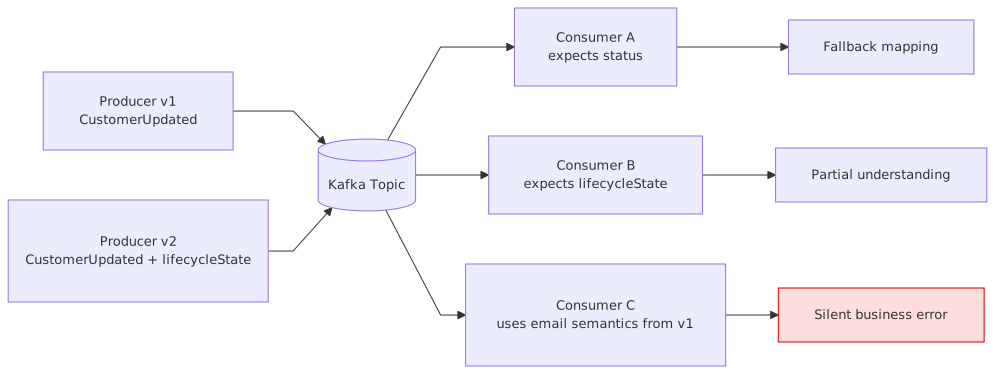
The worst failures are silent. If deserialization fails, at least alarms ring. If business meaning shifts gradually, dashboards may still look green while invoices, fraud models, and customer notifications become wrong in different ways.
This is why version drift is not merely an integration nuisance. It is a threat to business correctness.
Forces
Every architecture problem worth discussing is a conflict among legitimate forces. Version drift is no exception.
Team autonomy versus shared meaning
Microservices encourage independent delivery. Domain-driven design encourages bounded contexts. Both are healthy. But event streams create a social illusion of shared truth. Teams publish once and many others consume. The publishing team wants to evolve quickly. The consuming teams want stability. Neither is unreasonable.
Reuse versus coupling
A common enterprise instinct is to create a broadly useful “canonical event.” It sounds efficient. In practice it often becomes a lowest-common-denominator compromise that satisfies no one. The more consumers pile onto one topic, the harder it becomes to evolve. Reuse turns into semantic coupling.
Backward compatibility versus domain progress
Businesses change. Regulations appear. Products diversify. Acquisitions bring foreign vocabularies. Contracts must evolve. Freezing them forever is not realistic. But changing them too casually externalizes migration cost onto every downstream team.
Stream immutability versus correction
Kafka is excellent at durable ordered logs. Enterprises are not excellent at never making mistakes. Sometimes events must be corrected, compensated, redacted, or superseded. The platform says “append.” Legal and finance sometimes say “remove or fix.”
Historical replay versus current interpretation
One of the joys of event-driven systems is replay. One of the traps is replaying old events into new code without accounting for changed semantics. The machine obeys. The business reality does not.
Local optimization versus enterprise coherence
One team can optimize by emitting raw internal model changes. Another can optimize by directly consuming them. Across 50 teams, this creates a fragile graph of accidental dependencies. Enterprise architecture exists, at its best, to stop local cleverness from becoming systemic fragility.
Solution
The practical solution is to treat event contracts as explicit, versioned domain agreements with governed evolution paths, translation boundaries, and reconciliation mechanisms.
That sentence sounds tidy. The implementation is not. But it is manageable if you separate the problem into layers.
1. Version semantics, not just schema syntax
Use schema versioning, yes. Avro with Schema Registry is common in Kafka estates and works well. But add semantic version rules tied to business meaning.
A contract change is not “minor” because a field is optional. It is minor only if downstream business interpretation remains valid. That means contract reviews need domain input, not just API or platform sign-off.
A useful rule:
- Patch: metadata-only correction, no consumer behavior impact
- Minor: additive and semantically non-breaking for existing consumers
- Major: any meaning change, removal, reinterpretation, or lifecycle model change
This is not software package versioning. It is business-message versioning.
2. Publish domain events, not database change gossip
Many drift problems begin because teams emit low-level state changes from their service data model. That model was never intended as an enterprise contract. Publish events rooted in domain intent: OrderPlaced, InvoiceIssued, CustomerConsentWithdrawn. These are more stable than “row updated” messages because they reflect business language, not storage design.
3. Use bounded-context translation
Do not force all consumers to speak the producer’s language forever. Place an anti-corruption layer between contexts. If CRM emits CustomerProfileChanged, Billing may translate that into BillToPartyUpdated according to billing semantics. This is classic DDD and still underused in streaming systems.
4. Prefer explicit version channels over hidden polymorphism when semantics diverge
If a contract evolves structurally but preserves meaning, a single topic with compatible schemas may be fine. If meaning diverges, use a new event type or topic. Architects often resist this because “topic sprawl” looks messy. Semantic ambiguity is messier.
5. Build reconciliation as a first-class capability
No matter how disciplined you are, drift will happen. Systems need reconciliation: compare producer truth, consumer projections, and downstream operational records; detect mismatches; repair by replay, compensating event, or manual workflow.
6. Govern lifecycle and deprecation
Every event contract should have:
- owner
- purpose
- bounded context
- consumers
- semantic version history
- deprecation date if superseded
- migration guidance
If you cannot answer who owns an event, you do not have a contract. You have a rumor on a topic.
Architecture
A robust pattern for managing version drift in Kafka-based microservices usually contains six pieces: microservices architecture diagrams
- Producer service emits domain events
- Schema registry validates structural compatibility
- Contract catalog tracks semantic ownership and lifecycle
- Translation layer maps producer contracts into consumer-context contracts
- Consumer projections store local read models
- Reconciliation service checks divergence and initiates repair
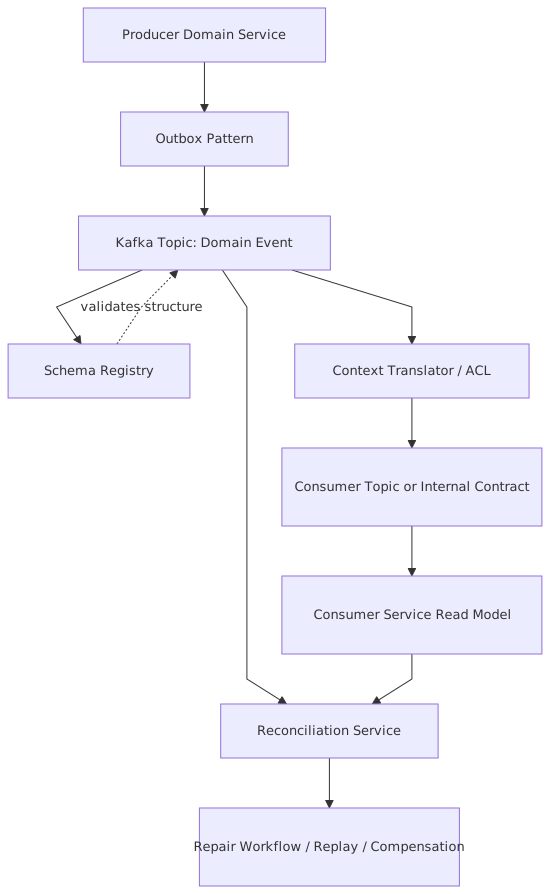
A few opinions here.
First, the outbox pattern matters. If events are published directly from application logic without transactional discipline, drift diagnosis becomes harder because you cannot trust event completeness. The contract may be fine; the emission may be inconsistent.
Second, translation belongs near the consumer context or in a dedicated mediation service, depending on organizational shape. If you centralize all translation in an enterprise integration team, you will create a ticket queue masquerading as architecture. If you push all translation to every consumer team, you get duplication and inconsistent semantics. There is no perfect placement. There is only the least harmful placement for your operating model.
Third, reconciliation is not a luxury. In financial services, insurance, healthcare, and supply chain, event-driven projections routinely need repair. The architecture should assume imperfect convergence and provide operational ways to detect and correct it.
Contract evolution path
A healthy evolution path looks like this:
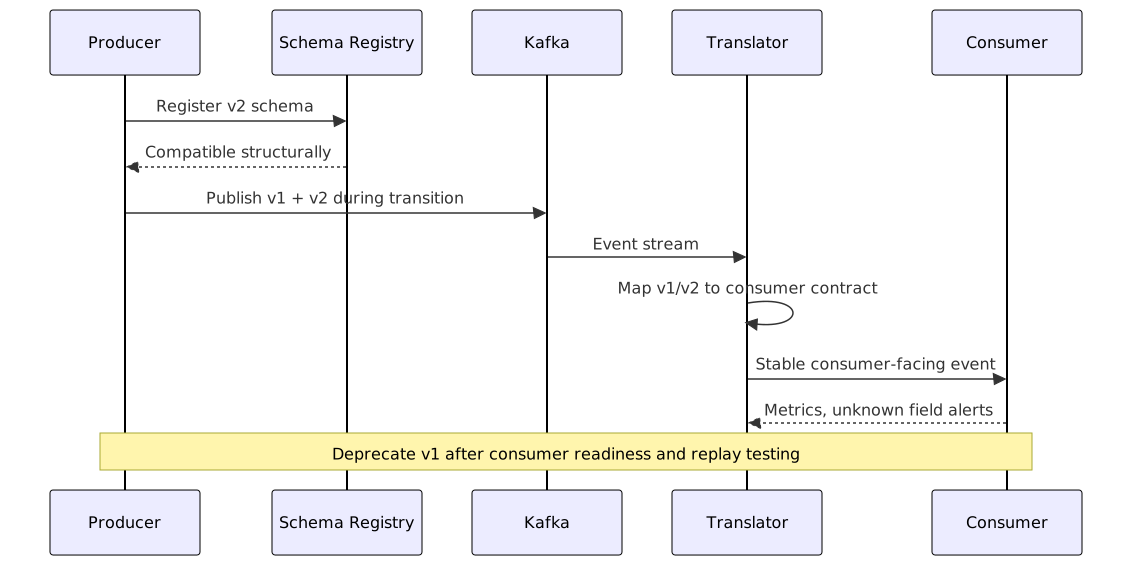
The key idea is stability at the consumer-facing boundary while upstream producers evolve. That stability can be provided by translation, by parallel topic publication, or by explicit major version topics.
Domain semantics discussion
Let’s make this concrete. Suppose an insurer publishes PolicyBound. In one context, that means “the customer accepted the quote.” In another, it means “legal coverage is active.” During a migration to real-time underwriting, the business changes the rule so there is a gap between acceptance and legal activation.
Structurally, the event may still look nearly identical. Semantically, it has split into two distinct moments. If you preserve the old event name and merely add an activationStatus field, downstream consumers will each invent their own interpretation. Claims may think coverage exists. Finance may defer revenue. Customer communication may congratulate the policyholder too early.
This is not a schema problem. This is a domain event taxonomy problem.
The right move is often to create two explicit domain events: PolicyAccepted and CoverageActivated, then migrate consumers context by context. Semantically clean. Operationally more work. Worth it.
Migration Strategy
Migration is where architects earn their keep. It is easy to declare a better contract. The hard part is moving a live enterprise there without breaking twenty dependent systems and three reporting chains.
The most reliable approach is a progressive strangler migration for event contracts.
Step 1: Inventory the blast radius
Before changing anything, identify:
- all producers
- all known consumers
- shadow consumers and data science jobs
- replay users
- regulatory exports
- dashboards and downstream data lake pipelines
In large enterprises, the undocumented consumers are the ones that bite. Someone built a nightly compliance extraction two years ago and forgot to mention it.
Step 2: Classify contract changes
Separate additive structural changes from semantic changes. Additive changes may survive in-place evolution. Semantic changes should trigger versioned events, translation, or parallel publication.
Step 3: Introduce a compatibility facade
Stand up a translator or compatibility service that can consume old and new producer forms and emit stable consumer-specific forms. This is the strangler vine. It does not replace the old world overnight; it wraps it and gradually redirects traffic.
Step 4: Dual publish or dual consume
For a period, either:
- producers emit both old and new contracts, or
- consumers handle both old and new through a translation layer
Dual publish is simpler for consumer teams but increases producer complexity and topic volume. Dual consume keeps producers cleaner but pushes migration burden downstream.
Step 5: Backfill and replay with semantic mapping
Historical data matters. When introducing new event semantics, replay old streams only through explicit mapping rules. Do not assume v1 can be naively transformed into v2. Some meaning may be unknowable from old data. Mark such cases as inferred or unresolved.
Step 6: Reconcile
Run old and new projections in parallel. Compare outputs. Measure divergence. Investigate discrepancies before cutover.
Step 7: Cut over by consumer cohort
Migrate low-risk consumers first, then internal operational systems, then financial and regulatory consumers, then external integrations. This is not glamourous. It is sane.
Step 8: Enforce deprecation
A migration without deprecation is just accumulation. Put deadlines on old contracts. Alert on continued usage. Eventually block new consumers from onboarding to deprecated versions.
Enterprise Example
Consider a global retailer with e-commerce, stores, loyalty, and financial services. Kafka is the event backbone. The customer domain has grown through acquisition: one CRM platform in Europe, another in North America, and a loyalty platform that predates both.
Initially, the enterprise standardizes on a shared event: CustomerUpdated.
Fields include:
customerIdnameemailstatusaddressloyaltyTier
It works well enough for a year. Then the business expands into regulated credit offerings. Suddenly “customer” is not enough. The credit business must distinguish applicant, account holder, guarantor, and beneficial owner. Consent management becomes regional. Privacy rules require data minimization for some consumers. Marketing wants household-level identity. Fraud wants device and risk signals.
The CRM team tries to evolve CustomerUpdated with optional fields:
partyRoleconsentFlagsidentityConfidencehouseholdIdregionalRestrictions
Schema Registry reports compatibility. Platform team congratulates itself. Then the real problems arrive.
Billing still interprets status=active as “can invoice.”
Marketing interprets active as “contact allowed.”
Fraud interprets active as “identity sufficiently verified.”
Credit operations infer account-holder eligibility where only applicant status exists.
No deserialization failures. Plenty of business failures.
The retailer eventually corrects course.
It splits the model into bounded-context events:
PartyProfileChangedin identity contextCustomerContactPreferencesChangedin consent contextLoyaltyMemberTierChangedin loyalty contextCreditApplicantStatusChangedin lending context
A translation service then emits consumer-facing contracts:
- Billing receives
BillablePartyUpdated - Marketing receives
ContactablePartyUpdated - Fraud receives
IdentityRiskProfileUpdated
They run parallel pipelines for three months. A reconciliation service compares:
- CRM source of record
- billing customer master
- campaign audience tables
- credit eligibility projections
They find thousands of records where old semantics had silently produced contradictory classifications. Some customers were contactable but not billable. Some were loyalty members without verified contact consent. A handful of credit notices had been sent to applicants before legal conversion to account holders.
The architectural lesson is blunt: a “unified customer event” gave the appearance of simplification while exporting semantic ambiguity across the enterprise. The fix was more events, clearer context boundaries, and explicit translation.
Sometimes the shortest contract is the longest incident.
Operational Considerations
Even good contract design dies without operational discipline.
Observability
Track:
- event version by topic and consumer
- unknown field frequency
- translation fallback usage
- deserialization errors
- semantic validation failures
- reconciliation mismatch rate
- replay-related divergence
The important metric is not only whether messages are flowing. It is whether consumers are interpreting them with confidence.
Consumer-driven contract testing
Producer teams should not ship contract changes based solely on schema compatibility. Use consumer contract tests or compatibility suites. If ten critical consumers rely on a subtle behavior, make that dependency visible before production.
Replay safety
Tag events with event-time, schema version, and producer version. Reprocessing pipelines should understand historical semantics. If replaying v1 events through v3 logic requires assumptions, surface those assumptions in reports.
Idempotency and deduplication
Version drift gets worse under duplicate delivery. A consumer trying to bridge old and new contracts can mistakenly apply both and double-count. Use event IDs, version markers, and idempotent projection logic.
Data governance and privacy
Contract evolution often collides with privacy rules. A producer adding PII to an event because “someone might need it” is a classic enterprise mistake. Keep contracts minimal and purpose-driven. Emit separate events for sensitive contexts if needed.
Topic retention and compaction
Kafka retention policies affect migration options. If old events are unavailable, backfill may require database extraction. If compacted topics overwrite state, historical semantic reconstruction can be impossible. Architects should align retention strategy with expected migration and audit needs.
Ownership
Every contract needs a named business owner and technical owner. Shared ownership usually means neglected ownership.
Tradeoffs
There is no free lunch here.
More explicit versioning means more artifacts
You get cleaner semantics but more topics, schemas, translators, and governance overhead. Some teams will call this bureaucracy. Sometimes they are right. Over-rotation creates architecture museums. EA governance checklist
Translation layers reduce consumer pain but can hide complexity
A good anti-corruption layer protects contexts. A bad one becomes a semantic landfill where every exception and one-off mapping accumulates.
Dual running increases confidence but costs money
Parallel pipelines, replay testing, and reconciliation consume infrastructure and people. For critical domains, this is the right cost. For low-value telemetry, it may not be.
Domain purity can slow delivery
DDD-minded event modeling produces better long-term contracts, but it requires thoughtful language, collaboration, and restraint. Organizations addicted to shipping database changes as events will find this uncomfortable.
Strong governance improves coherence but may reduce autonomy
The trick is to govern at the contract and domain level, not micromanage implementation details. Architecture should define guardrails, not become a customs checkpoint for every field addition.
Failure Modes
Here are the failure modes I see most often.
1. Backward compatible, business broken
Schema validators pass. Consumers keep running. Reports become wrong because a field’s meaning changed.
2. Shared canonical contract ossification
The enterprise standard event becomes impossible to evolve because too many consumers depend on it. Teams work around it with side channels and undocumented fields.
3. Translation layer as permanent crutch
A migration translator meant to last six months survives six years. Nobody knows the original semantics anymore. The strangler became a second legacy system.
4. Replay corruption
Historical events are replayed into new projection logic, silently generating a rewritten business past. The numbers reconcile nowhere.
5. Consumer inference addiction
Consumers rely on missing data defaults, event ordering assumptions, or producer timing behaviors not stated in the contract. Drift exposes the hidden dependency.
6. Unowned deprecation
Old event versions are never retired. Every producer change must maintain decades of compatibility. Delivery slows to a crawl.
7. Data lake amplification
A broken semantic contract enters the lakehouse, BI dashboards, ML features, and regulatory extracts. Drift at the event layer becomes enterprise-wide misinformation.
When Not To Use
Not every problem deserves contract-heavy event architecture.
Do not use this approach when:
- the domain is simple CRUD with limited integration value
- there are few consumers and low business criticality
- the events are purely technical telemetry, not business facts
- teams are too immature to own contracts and migration lifecycles
- reconciliation cost exceeds the business value of decoupling
- strict request-response with strong consistency is the real need
A synchronous API can be the better design. So can batch integration. Architects do not prove sophistication by choosing Kafka. They prove judgment by knowing when not to.
If your organization cannot identify event owners, bounded contexts, and migration funding, then adding semantic version governance will likely create ceremony without reliability. Better to simplify. ArchiMate for governance
Related Patterns
Several patterns sit adjacent to version drift management.
Outbox Pattern
Ensures events are emitted reliably from transactional state changes. Essential where missed or duplicated events would confuse version migration.
Anti-Corruption Layer
Classic DDD pattern. Translates one bounded context’s model into another’s. In event-driven systems, this is one of the best defenses against semantic drift.
Event Carried State Transfer
Useful, but dangerous when overused. Rich payloads reduce chattiness but increase semantic coupling and drift blast radius.
Event Notification
Thin events with identifiers only. Better for decoupling semantics, but increases lookup chatter and can reintroduce synchronous coupling.
CQRS Projections
Consumers maintain read models from events. Drift must be handled explicitly in projection code, especially during replay.
Strangler Fig Pattern
Perfect for progressive migration from old contracts to new ones, using translation and phased cutover.
Schema Registry Governance
Necessary but insufficient. It solves the syntax half of the problem, not the meaning half.
Summary
Data contract version drift is what happens when enterprises treat events as serialized objects instead of domain commitments.
The symptoms show up in Kafka topics and consumer code, but the disease is deeper. It lives in mismatched semantics, unmanaged context boundaries, hidden assumptions, and migrations done with optimism instead of design. Structural compatibility helps. It does not save you from semantic divergence.
The durable approach is straightforward, if not easy:
- model events around domain intent
- respect bounded contexts
- version for meaning, not just syntax
- use translation where contexts differ
- migrate progressively with a strangler strategy
- reconcile relentlessly
- deprecate old contracts with discipline
A good event contract should age like a legal agreement, not like a casual chat message. Clear parties. Clear meaning. Clear change process. Clear consequences.
Because in the end, event-driven architecture is not about moving messages. It is about moving understanding across time, teams, and systems without letting it rot on the journey.
Frequently Asked Questions
What is enterprise architecture?
Enterprise architecture aligns strategy, business processes, applications, and technology in a coherent model. It enables impact analysis, portfolio rationalisation, governance, and transformation planning across the organisation.
How does ArchiMate support architecture practice?
ArchiMate provides a standard language connecting strategy, business operations, applications, and technology. It enables traceability from strategic goals through capabilities and services to infrastructure — making architecture decisions explicit and reviewable.
What tools support enterprise architecture modeling?
The main tools are Sparx Enterprise Architect (ArchiMate, UML, BPMN, SysML), Archi (free, ArchiMate-only), and BiZZdesign. Sparx EA is the most feature-rich, supporting concurrent repositories, automation, scripting, and Jira integration.