⏱ 20 min read
There is a moment in almost every serious Kafka estate when the partitioning strategy that once looked clean and obvious begins to betray the team. event-driven architecture patterns
It starts quietly. A few hot partitions. A lagging consumer group during month-end processing. A join that was easy when all customer events shared a key, but now fails because new workflows need ordering by account, contract, or region instead. Then the platform team says the line every architect eventually hears: “We need to change the partition key.”
That sentence sounds operational. It is not. It is domain design wearing infrastructure clothes.
Partitioning in Kafka is one of those architectural decisions that people pretend is technical until the business changes. Then everyone rediscovers that a partition key is really an encoded statement about what must stay together, what must stay in order, and what the business considers the unit of consistency. Change that, and you are not merely tuning throughput. You are redrawing the fault lines of the domain.
This is why event partition evolution deserves more respect than it usually gets. Too many teams treat it like a reconfiguration task. It is closer to city planning while the traffic is still moving.
In this article, I’ll walk through how partition evolution works in Kafka architectures, why it becomes necessary, how to migrate safely, where the traps are, and when you should refuse the whole idea. We’ll look at domain-driven design concerns, progressive strangler migration, reconciliation, failure modes, and the real compromises that appear in enterprise systems—not toy diagrams, not conference-demo purity.
Context
Kafka gives you scale, replayability, and loose coupling. But it also asks you to be precise about ordering and distribution. A topic is not just a log. In practice, it is a set of ordered logs, one per partition. The partition key determines where events land, which means it determines where ordering exists and where it does not.
That matters because most business processes are not uniformly distributed streams of facts. They are clustered around domain aggregates, customer journeys, product lifecycles, claims, shipments, trades, invoices. If the partitioning strategy aligns with the aggregate that needs sequential handling, life is good. A single consumer instance can process events for one business entity in order, while the group scales horizontally across many entities.
But domains evolve.
A retail bank might begin with customerId as the event key because the first use cases are profile updates, KYC checks, and communication preferences. Later, loan servicing arrives and now the real consistency boundary is the loanAccountId. Then collections joins the party and wants ordering by caseId. Fraud wants region-aware sharding. Data science wants denormalized streams partitioned by product line for batch-ish downstream jobs. Suddenly the original partitioning choice is no longer wrong in the abstract; it is wrong for the current shape of the business.
Kafka does not let you casually mutate history. Existing records stay in their partitions. Existing consumers may rely on that ordering. Topic partition count changes do not magically rehash old messages into a new shape. This is why partition evolution is less like changing an index and more like changing the street grid of a city after the buildings are already occupied.
Problem
The central problem is simple to describe and awkward to solve:
How do you evolve Kafka partitioning semantics without breaking ordering guarantees, consumer assumptions, replay behavior, and business correctness?
Several variants show up in the real world:
- You need a new partition key because the old one no longer reflects the aggregate that must be processed in order.
- You need more partitions to scale throughput, but key distribution is poor and simply increasing the count creates skew or breaks downstream expectations.
- You need to split one event stream into multiple bounded contexts, each with different partition semantics.
- You need to migrate from integration-topic chaos to domain-aligned event streams.
- You need to repair a design where partitioning was chosen for infrastructure convenience rather than domain behavior.
The hard part is not moving bytes. Kafka is very good at moving bytes. The hard part is preserving the business meaning of event order during transition.
And order in Kafka is always local. Teams forget this constantly. Kafka does not provide global order across a topic; it gives order within a partition. So when you alter partitioning, you are altering where order exists. That means you are altering process behavior, concurrency, and sometimes correctness.
This is where architecture should get opinionated: if you cannot explain what business invariant your partition key protects, you are not ready to operate Kafka at enterprise scale.
Forces
Partition evolution is driven by a handful of forces, and architecture is the art of not pretending those forces are compatible when they are not.
1. Domain semantics versus operational scale
A good partition key usually follows a domain aggregate: orderId, accountId, claimId. That keeps causally related events together.
A good scaling strategy, on the other hand, wants high cardinality and even distribution. Those goals overlap sometimes, but not always. countryCode might be meaningful to the business and disastrous for load distribution.
This is the first tradeoff: semantic purity versus throughput symmetry.
2. Existing consumer contracts
Consumers often build hidden assumptions around partitioning:
- all events for one entity arrive in order
- no concurrent processing occurs for the same key
- replay reproduces historical behavior
- state stores align with event key
- exactly-once flows depend on key stability
These assumptions are rarely documented. They live in code and incident retrospectives.
3. Backward compatibility of history
New events can be republished under a new key. Old events cannot be wished into that shape without backfill, replay, or dual-stream complexity. Historical continuity is expensive.
4. Migration risk under live traffic
Partition evolution almost never happens in a quiet system. It happens when growth, latency, or a new business initiative forces the issue. You are changing the aircraft wing while it is carrying passengers.
5. Multiple bounded contexts, different truths
A domain event useful in one bounded context may need one partitioning strategy, while a derived event in another context needs a different one. Trying to make one canonical stream satisfy everyone usually produces a stream that satisfies nobody.
This is where domain-driven design is practical, not fashionable. Bounded contexts are often a better answer than endlessly “fixing” one giant topic.
Solution
The robust solution is usually progressive partition evolution through new streams, not in-place mutation.
That means:
- Treat partitioning as part of the event contract.
- Introduce a new topic or stream version with the new partitioning semantics.
- Dual-publish or derive the new stream from the old one for a transition period.
- Migrate consumers progressively using a strangler approach.
- Reconcile outputs and state until confidence is established.
- Retire the old stream only when business invariants hold, not when the infrastructure change is technically complete.
The key insight is that partition evolution is almost always a semantic migration, not a broker change.
If the old stream was keyed by customerId and the new stream must be keyed by accountId, do not pretend they are the same thing because the payload looks similar. They support different processing models. Give them different names, different contracts, and often different ownership boundaries.
Here is the common evolution shape:
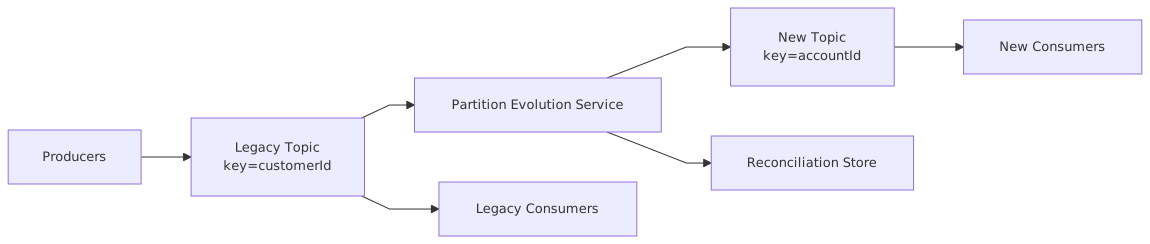
This pattern has a few virtues.
First, it makes the change explicit. Teams can see that customer-activity-events and account-activity-events are related but not interchangeable.
Second, it allows migration by consumer cohort. Some services move early. Others stay on the legacy topic until they are ready.
Third, it creates room for reconciliation, which is the part most teams skip until a regulator, auditor, or finance department asks awkward questions.
Architecture
A mature partition evolution architecture usually contains six moving parts.
1. Domain event source
The source is the system of record or source bounded context. It should emit facts in language the business recognizes. If your event names sound like database triggers, your architecture is already drifting.
Example:
CustomerAddressChangedLoanPaymentAppliedClaimOpened
The source stream’s partitioning should follow the aggregate of the source context, not the convenience of downstream analytics.
2. Evolution or translation service
This service reads the legacy stream, resolves any additional reference data needed for re-keying, and emits a new stream with partitioning aligned to the target context.
This is not merely format translation. It often performs semantic projection:
- one source event may map to several target events
- one target event may require enrichment
- target keys may require a lookup from source identity to target aggregate identity
For example, a CustomerAddressChanged event keyed by customerId may need to be translated into multiple AccountContactDetailsUpdated events keyed by accountId for every active account held by that customer.
That is not infrastructure plumbing. That is domain logic.
3. New topic version or derivative stream
The new topic should be named and governed as a deliberate contract. Avoid the lazy pattern of keeping the same topic name while silently changing the partition key. That kind of cleverness is how enterprises buy outages.
Versioning options include:
account-activity-events-v2account-activity-eventscustomer-events-derived-for-accounting
I prefer names that reflect business semantics over technical version numbers where possible. Versions are inevitable, but semantics are more useful than chronology.
4. Consumer strangler layer
Consumers migrate gradually. Some teams create a compatibility adapter so a service can read from either old or new topics behind one internal interface.
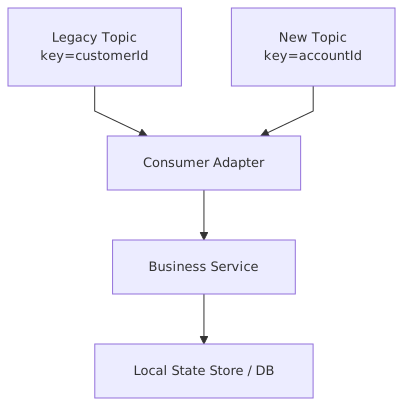
This is a classic strangler move. Instead of big-bang replacement, the business service slowly shifts its dependency from old semantics to new semantics. The adapter can support feature flags, cohort rollout, and shadow processing.
5. Reconciliation capability
If you are changing partition semantics in a regulated or financially material workflow, reconciliation is not optional.
You need the ability to answer:
- did every relevant legacy event produce the correct new event?
- did downstream state converge?
- were any entities processed twice?
- did ordering-sensitive outcomes diverge?
Reconciliation can be implemented through:
- side-by-side output comparison
- counts by aggregate and time window
- state snapshots compared across old and new flows
- deterministic recomputation for sample cohorts
- audit tables keyed by source event id and target event ids
This is where many “stream-first” architectures suddenly rediscover old-school controls. Good. Enterprises need both speed and accounting.
6. Cutover governance
At some point, you stop pretending the migration is temporary. Cutover requires explicit criteria:
- all critical consumers migrated
- lag stable under peak load
- reconciliation error rate below threshold
- incident runbooks updated
- replay procedure tested
- ownership of old and new topics clarified
No cutover should happen because the project Gantt chart says so. Cutover happens when the system’s behavior says so.
Migration Strategy
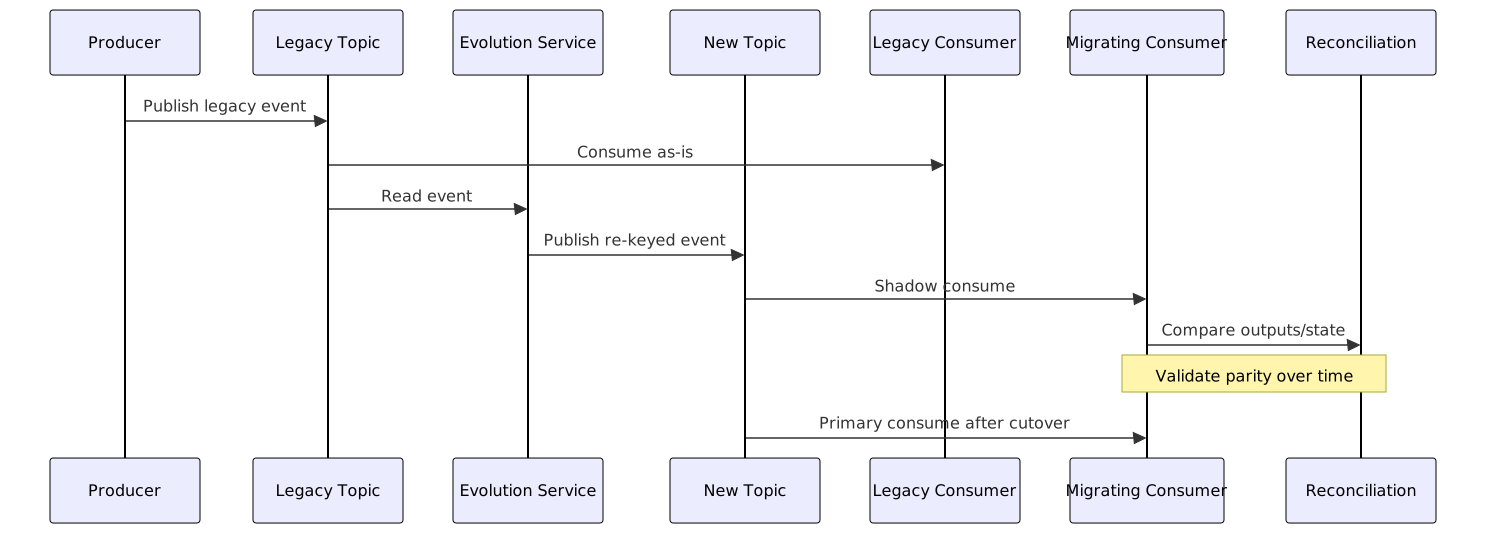
A safe migration follows a progressive strangler path. There are many variants, but the pattern below is common and reliable.
Step 1: Make semantics explicit
Start by documenting the current and desired partition semantics in domain language.
Not:
- “current topic uses 24 partitions”
- “new topic uses Murmur hash with a different key field”
But:
- “legacy stream preserves order per customer”
- “target stream must preserve order per account for payment allocation”
- “cross-account order is irrelevant”
- “customer-level projections may now require joining multiple account streams”
This exercise usually surfaces hidden assumptions that have been breaking in production for months.
Step 2: Identify invariants
List the business invariants that rely on stream order:
- no payment applied twice to the same loan account
- status transitions processed sequentially per claim
- inventory reservation cannot over-allocate a SKU-location pair
- one customer communication preference update supersedes the prior value
You cannot migrate safely without knowing what you are protecting.
Step 3: Build the derivative stream
Create a new topic with the new partition key and explicit schema contract.
Sometimes producers can dual-publish directly. That is cleaner when the producer knows both domain identities and can emit both streams honestly.
Often, though, a translation service is better because:
- the producer should not absorb downstream bounded-context concerns
- lookups are required
- not all source events map one-to-one
- migration can proceed without changing the system of record
Step 4: Shadow consumers
Move target consumers into shadow mode. They consume the new topic, execute logic, and write to non-authoritative outputs or comparison stores.
This phase is where architecture earns its salary. Shadow mode reveals all the things slides omit:
- missing reference data during translation
- timing differences that change materialized views
- assumptions about global order that never really held
- side effects triggered accidentally in shadow runs
- key skew in the new partitioning model
Step 5: Reconciliation and drift analysis
Reconciliation should be relentless and boring. Boring is good.
Typical checks:
- event counts by day, partition, aggregate type
- state equality for migrated entities
- temporal divergence windows
- duplicate processing rates
- unmatched source events
- dead-letter trends by error cause
You want to know whether drift is structural or incidental. One mismatch due to a malformed source event is not the same as a systemic ordering problem.
Step 6: Cohort cutover
Cut over by consumer cohort, business unit, geography, or entity range. Avoid all-at-once if you can.
Feature flags help, but use them sparingly. A feature flag should control a business routing decision, not become a permanent architecture layer no one dares remove.
Step 7: Freeze and retire
Eventually, freeze onboarding to the old topic. Then retire it when:
- no critical consumers remain
- replay obligations are satisfied
- compliance retention is handled
- support teams know the old path is dead
Retiring late is usually safer than retiring early. But retiring never is how estates become archaeological digs.
Enterprise Example
Consider a global insurer processing claims across policy administration, fraud, finance, and customer service.
Originally, the insurer used a topic called customer-events, keyed by customerId. It worked for CRM updates, document preferences, and contact changes. Later, claims processing subscribed to the same ecosystem because it was “already there.” A claim opening event, claim note, fraud flag, reserve adjustment, and payout event all ended up derived from customer-centric streams.
Then reality arrived.
One customer can have multiple claims. Multiple adjusters can act on separate claims concurrently. Financial reserve logic requires strict in-order processing per claimId, not per customer. During storms and catastrophe events, a small number of customers with many related claim activities created hot partitions. Consumer lag spiked. Reserve calculations replayed out of practical SLA. Finance lost confidence in event-driven postings and demanded batch reconciliation extracts every night.
This is a familiar smell: the partitioning matched the old center of gravity of the domain, not the current one.
The architecture team introduced a new stream, claim-ledger-events, keyed by claimId. They did not ask the policy administration system to dual-publish immediately because the producer only knew customer-centric lifecycle events and lacked some claim mappings at source. Instead, they built a claims evolution service that:
- consumed customer and claims-related legacy topics
- resolved customer-to-claim associations
- emitted claim-scoped financial and status events
- attached source event ids for audit traceability
Claims finance and fraud moved first. Customer service stayed on the legacy flows longer because their read models were customer-centric and did not require strict claim ordering.
Reconciliation was the decisive control. For three months, reserve balances and payout ledger entries were computed both ways for a selected portfolio. Differences were categorized:
- expected due to historical data quality issues
- timing-only differences that converged within minutes
- true semantic mismatches caused by missing claim associations
- duplicates from retried source events without stable idempotency keys
The migration revealed an uncomfortable truth: the old customer-partitioned model had already been producing occasional mis-ordering effects during catastrophe spikes. The new design did not create operational complexity; it exposed pre-existing domain inconsistency.
That is one of the deepest lessons in partition evolution. Migration often does not introduce mess. It reveals where the old architecture had been cheating.
After cutover, the insurer kept both streams because they served different bounded contexts:
customer-eventsfor CRM and communication journeysclaim-ledger-eventsfor financial and operational claim processing
That is a healthy outcome. One domain fact can feed multiple context-aligned streams. The mistake is insisting there must be one perfect universal topic.
Operational Considerations
Once you move beyond diagrams, partition evolution becomes an operational discipline.
Topic sizing and skew
Changing the partition key can improve or worsen distribution. Test with production-like cardinality and burst patterns, not averages. A key that looks fine in a sample may produce severe skew during quarter close, catastrophe intake, or campaign peaks.
Idempotency
Re-keying often involves republishing, and republishing invites duplicates. Ensure stable event identifiers and idempotent consumer behavior. “Exactly once” features help in narrow technical paths, but business idempotency is still your real defense.
Replay strategy
Can you rebuild the new stream from retained legacy history? If yes, how long will it take? If no, are you comfortable that the derivative stream is now a system of record for downstream behavior? Enterprises often avoid answering this question until disaster recovery testing becomes political.
Schema governance
Partition evolution often travels with schema evolution. Keep them distinct. A new schema does not always require a new partition key, and a new partition key does not always require a payload change. Tie them together only when domain semantics justify it.
Observability
At minimum, instrument:
- producer and consumer lag
- partition hot spots
- re-key translation failures
- reconciliation mismatch counts
- end-to-end latency by event type
- dead-letter volume and reasons
- consumer rebalance frequency during migration
Data lineage
If auditors or support teams cannot trace a source event to its transformed equivalents, your migration will become a human problem. Persist correlation identifiers and lineage metadata.
Tradeoffs
There is no free partition evolution.
New streams increase clarity, but also proliferation
Creating a new topic preserves contracts and makes semantics explicit. It also increases catalog size, governance burden, and support overhead. That is usually worth it. Usually. EA governance checklist
Translation services preserve producer simplicity, but create another moving part
A dedicated evolution service is often the right decoupling move. It also introduces lag, lookup dependencies, and another failure surface.
Reconciliation provides safety, but slows migration
Good reconciliation feels expensive because it is. The alternative is discovering divergence in production accounting, which is more expensive in every way that matters.
Domain-aligned partitioning improves correctness, but may reduce infrastructure neatness
You may choose a key that reflects the business aggregate even if it is slightly less balanced than a purely synthetic sharding key. That is often the right call. Perfectly balanced nonsense is still nonsense.
Dual-running reduces risk, but raises cost and complexity
For a while, you will pay for both paths. This is normal. Architects who promise zero-overhead migration are usually just moving cost into a later outage.
Failure Modes
This subject gets dangerous when teams underestimate how many ways it can go wrong.
Silent semantic breakage
The worst failure is not a crashed consumer. It is a consumer that keeps running while business invariants quietly break because ordering shifted under its feet.
Hidden dependency on legacy order
A downstream service may rely on accidental ordering that was never guaranteed. Migration breaks it, and everyone blames Kafka instead of the bad assumption.
Incomplete identity mapping
Re-keying often depends on lookups: customer to account, policy to claim, order to fulfillment unit. Missing or stale mappings create dropped, delayed, or misrouted events.
Duplicate side effects during shadow mode
A shadow consumer accidentally triggers emails, payments, case updates, or API calls because someone forgot to neutralize side effects. This is more common than people admit.
Replay divergence
Historical replay into the new stream may not produce the same outcome as live migration because reference data has changed, enrichment services are time-sensitive, or old malformed events now fail stricter validation.
Partition hot spots move rather than disappear
You solve skew on customerId and recreate it on regionId or merchantId. Architects should be suspicious of any migration whose scale story relies only on “more partitions.”
When Not To Use
Sometimes the right answer is not to evolve Kafka partitioning at all.
Do not use this approach when:
The real need is a read model, not a new event contract
If one downstream team wants different grouping for analytics or search, Kafka partition evolution may be overkill. A dedicated projection or materialized view may be enough.
Ordering is not actually required
Many teams overestimate their need for strict order. If the process is commutative or can be made idempotent and version-tolerant, changing partition strategy may not be worth the migration complexity.
The domain boundary is still unstable
If the business has not settled on whether the core aggregate is customer, account, subscription, or case, do not lock in a new partition contract yet. You will just create tomorrow’s migration today.
Retention or replay constraints make safe migration impossible
If you do not retain enough history to rebuild, and dual-running cannot establish confidence, a partition evolution may create more risk than benefit.
A monolithic consistency model is still needed
If the real process demands multi-entity transactional consistency, Kafka partitioning tricks will not save you. This may be a sign the workflow still belongs inside one transactional boundary, or at least behind an orchestrated process manager.
Related Patterns
Partition evolution sits near several other useful patterns.
Strangler Fig Migration
Move consumers and business capability progressively from old streams to new ones. This is the core migration style here.
Outbox Pattern
If dual-publishing from a source service is required, the outbox pattern can provide reliable event emission while preserving transactional integrity with the source database.
Change Data Capture
CDC can bootstrap derivative streams, but be careful: database change order is not always the same as domain event order. CDC is a tool, not a semantic guarantee.
Event Versioning
Schema versioning helps consumers adapt to payload evolution. It is related, but not the same as partition evolution. Many teams confuse the two.
Process Manager / Saga
When changing partition boundaries creates multi-stream coordination needs, sagas or process managers can help manage the resulting workflow state.
Materialized View / CQRS Projection
Sometimes the need is not a re-keyed operational stream but a different read-optimized projection. Choose the smaller solution if it works.
Summary
Partition evolution in Kafka is not a broker tuning exercise. It is a domain migration disguised as infrastructure work.
The partition key says what belongs together. It says where order matters. It says what the system treats as the unit of sequential truth. When that choice no longer matches the business, the answer is rarely an in-place tweak. The answer is usually to introduce a new stream with explicit semantics, migrate progressively, reconcile relentlessly, and retire the old path with discipline.
Be clear-eyed about the tradeoffs. New streams create overhead. Translation services add moving parts. Reconciliation costs time. Dual-running is expensive.
Do it anyway when the domain requires it.
Because the alternative is worse: a Kafka platform that scales beautifully while processing the business incorrectly.
And in enterprise architecture, that is the cardinal sin. Fast wrong is still wrong.
Frequently Asked Questions
What is event-driven architecture?
Event-driven architecture (EDA) decouples services by having producers publish events to a broker like Kafka, while consumers subscribe independently. This reduces direct coupling, improves resilience, and allows new consumers to be added without modifying producers.
When should you use Kafka vs a message queue?
Use Kafka when you need event replay, high throughput, long retention, or multiple independent consumers reading the same stream. Use a traditional message queue (RabbitMQ, SQS) when you need simple point-to-point delivery, low latency, or complex routing logic per message.
How do you model event-driven architecture in ArchiMate?
In ArchiMate, the Kafka broker is a Technology Service or Application Component. Topics are Data Objects or Application Services. Producer/consumer services are Application Components connected via Flow relationships. This makes the event topology explicit and queryable.