⏱ 21 min read
Most teams meet schema registries the way people meet plumbing: late, under stress, and only after the floor is already wet.
At first, event streaming looks gloriously simple. A producer writes JSON to Kafka. A consumer reads it. Another team joins, then another. Someone adds a field. Someone else renames one. A payments service interprets amount as gross, the ledger service treats it as net, and the data platform quietly copies both into a lake where analysts build dashboards with the confidence of people standing on thin ice. Everything still “works” for a while. Then it doesn’t.
This is the moment where many architects make a small but expensive mistake: they treat schema registry as a serialization utility. A place to store Avro or Protobuf definitions. Useful, yes. Important, maybe. Architectural, not really.
That view is too small.
A schema registry is not just a catalog of message shapes. In an event-driven estate, it becomes the treaty system between bounded contexts. It defines who is allowed to say what, how evolution happens without breaking yesterday’s consumers, and where semantics stop being tribal knowledge hidden in code and become explicit enough to govern. If Kafka is the nervous system, the registry is the part that stops the body from hallucinating. event-driven architecture patterns
That is why “schema registry flow” matters. Not as a narrow integration concern, but as architecture. The flow of schema creation, registration, validation, compatibility checking, promotion, and consumption is one of the few practical ways to make event streaming survivable at enterprise scale.
This article takes the opinionated view that schema registry should be treated as a first-class architectural mechanism. Not optional infrastructure. Not a developer convenience. A mechanism for managing domain semantics, controlling migration, containing failure, and enabling change across microservices without turning the platform into a distributed misunderstanding. microservices architecture diagrams
Context
Enterprise event streaming usually begins with an honest ambition: decouple systems, reduce latency, support real-time reactions, and expose business events as reusable facts. Kafka becomes the backbone because it is durable, scalable, and operationally mature. Microservices adopt publish/subscribe patterns because point-to-point integration has already made everyone miserable at least once.
Then reality arrives.
Different teams own different services. They move at different speeds. They use different languages and frameworks. One team prefers JSON because it is easy to debug; another mandates Avro for performance and compatibility; a third uses Protobuf because their gRPC tooling already exists. Meanwhile, the business vocabulary itself is unstable. “Customer” means prospect in sales, policy holder in insurance, account owner in banking, and legal entity in risk systems. Events cross these lines every day.
This is where domain-driven design earns its keep. In a healthy event architecture, events are not generic data packets. They are statements made by a bounded context in its own language. OrderPlaced is not just a payload. It is a published fact from the Order domain. CreditReserved belongs to Credit. ShipmentDispatched belongs to Fulfillment. These facts need contracts, and those contracts must evolve without forcing lockstep deployment across the estate.
Without a schema discipline, teams end up passing around structurally valid but semantically slippery events. The platform becomes loosely coupled in transport and tightly coupled in confusion.
A schema registry provides the missing center of gravity.
Problem
The raw problem sounds technical: how do we manage message schemas in an event streaming platform?
The real problem is architectural drift under asynchronous change.
In synchronous APIs, contract mismatches fail fast. A request comes in; the endpoint rejects it. In event streaming, failure is often deferred. A producer emits a new field or changes a meaning. Existing consumers may continue to deserialize the message while quietly doing the wrong thing. Data lakes preserve the mistake forever. Replay spreads it wider. Async systems are merciless that way: they preserve history, including your misunderstandings.
A few specific problems appear repeatedly:
- Schema evolution without coordination: producers change faster than consumers.
- Semantic ambiguity: fields are present, but their meaning is unclear or changes over time.
- Polyglot consumption: Java, .NET, Python, and SQL-based consumers must agree on contracts.
- Data product reuse: topics intended for one use case are consumed by many unplanned consumers.
- Regulated traceability: auditors want to know what an event meant at a given point in time.
- Migration pressure: legacy systems still publish batch extracts or ad hoc payloads during transition.
- Replay risk: old events must remain readable after schema changes.
Put simply: the organization wants independence of delivery and stability of meaning at the same time. Those two goals are natural enemies unless you give them rules.
Forces
Good architecture is never about purity. It is about balancing unpleasant truths.
1. Autonomy vs control
Teams want freedom to evolve their services. The enterprise wants consistency, traceability, and low breakage. A schema registry can become a good boundary or a bureaucratic weapon. The difference lies in whether it encodes useful policy or merely slows down work.
2. Domain language vs enterprise standardization
DDD teaches us to respect bounded contexts. That means not forcing a universal canonical schema for everything. At the same time, large organizations need some consistency in identifiers, timestamps, privacy classifications, and event metadata. The trick is to standardize the envelope and govern the semantics, not flatten every domain into a single corporate Esperanto.
3. Backward compatibility vs business change
Compatibility rules protect consumers. But not every business change is backward-compatible. Sometimes the meaning really changes. Pretending otherwise by keeping the same event name and mutating semantics is worse than a breaking change. Good schema architecture creates room for deliberate versioned evolution.
4. Performance vs readability
Text formats are easy to inspect but inefficient. Binary formats are compact and safer for typed evolution but harder to debug. In practice, mature Kafka platforms use Avro or Protobuf with a registry because they trade a little ergonomics for a lot of operational discipline.
5. Decoupling vs hidden coupling
Teams often claim event streaming creates loose coupling. It does not. It changes the type of coupling. You become less coupled in time and invocation, more coupled in schema, semantics, and operational assumptions. A registry makes that coupling visible.
6. Central governance vs local ownership
The registry is shared infrastructure, but schemas should still be owned by the producing domain. If platform teams own all schemas, domain knowledge gets separated from domain responsibility. That is a recipe for elegant nonsense.
Solution
Treat schema registry as a core architectural service in the event streaming platform.
Not a sidecar. Not just a serializer plugin. A governed control point for message contracts and evolution.
At minimum, the registry should provide:
- central storage of versioned schemas
- compatibility policy enforcement
- producer-side registration and serialization
- consumer-side schema resolution and deserialization
- metadata for ownership, classification, lifecycle, and domain context
- promotion workflows across environments
- integration with CI/CD to validate changes before deployment
But the architecture is not in the feature list. It is in the flow.
A healthy schema registry flow looks like this:
- A domain team designs an event based on a domain concept within a bounded context.
- The schema is defined with meaningful names, field intent, optionality rules, and metadata.
- Automated checks validate style, ownership, and compatibility.
- The schema is registered under a subject strategy that reflects lifecycle and topic governance.
- Producers publish messages using a serializer that embeds schema identity.
- Consumers resolve the schema and deserialize safely.
- Observability tracks schema versions in use across topics and services.
- Deprecation and migration processes remove old versions gradually.
- Reconciliation routines compare event-driven projections against source systems where needed.
That flow turns contract evolution into an explicit architectural process rather than an informal act of hope.
Domain semantics matter more than field lists
This is the point too many teams miss.
A registry cannot rescue poor domain modeling. If an event called CustomerUpdated contains twenty unrelated fields from five subdomains, no compatibility rule will save you. If status means workflow state in one release and commercial eligibility in the next, serializing it with Avro only makes the confusion more efficient.
Schema governance must therefore include semantic discipline:
- Events should describe domain facts, not CRUD noise where possible.
- Field names should reflect business meaning, not UI labels or database column names.
- Optionality should be intentional; rampant nullable fields often signal mixed responsibilities.
- Event boundaries should align to bounded contexts.
- Metadata should capture ownership and stewardship.
A good registry stores shape. A good architecture stores meaning through conventions, docs, review practices, and ownership models around that shape.
Architecture
Here is the basic reference model.
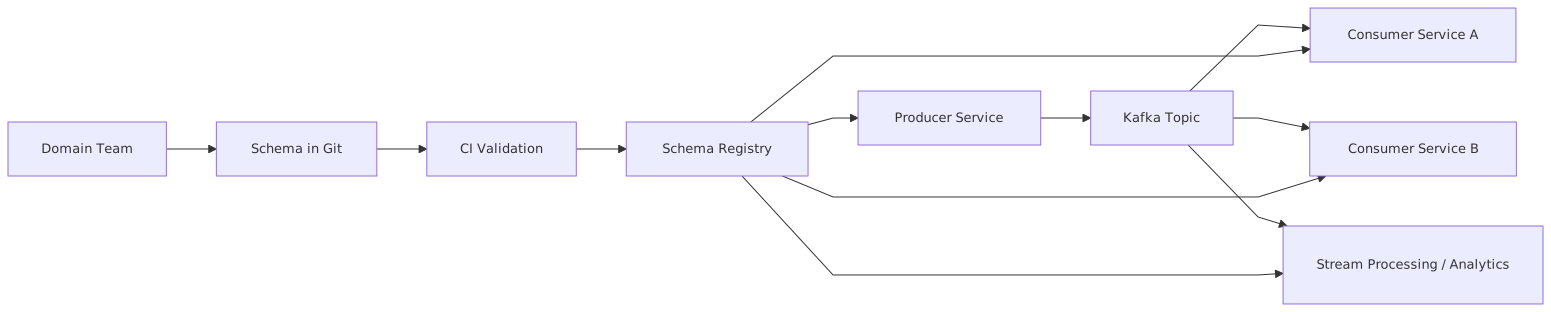
The picture is simple. The implications are not.
Core components
Producer services publish domain events. They should not handcraft payload strings. They should use standard serialization libraries integrated with the registry.
Kafka topics carry events. Topic design and schema design are related but not identical. A topic may hold one event family or several related event types depending on governance and throughput needs. In enterprises, the safest default is narrower topics with clear ownership.
Schema registry stores versioned schemas and compatibility policies. It resolves schema IDs at runtime and acts as the control plane for event contracts.
Consumer services deserialize using registry-managed schemas. They should be written defensively, especially around optional fields and version drift.
CI/CD pipeline validates schema changes before they enter shared environments. Runtime validation is too late to be your main line of defense.
Subject strategy is architecture
How schemas are named and grouped in the registry matters. Subject naming often feels like a technical detail. It is not. It determines how compatibility is enforced and across what boundary.
Common approaches include topic-based, record-based, or topic-record hybrid naming. The right choice depends on how strictly topics map to event families and whether multiple event types share a topic.
My bias: choose a strategy that mirrors business ownership and evolution boundaries. If one domain owns a topic and its event family, topic-scoped compatibility works well. If multiple event types evolve independently, record-level strategies are often cleaner. What matters is not fashion. What matters is whether the compatibility boundary reflects the real change boundary.
Compatibility modes are policy, not defaults
Backward compatibility is often the enterprise default because it lets old consumers keep working when producers add fields with defaults. But there is no universally correct mode.
- Backward protects existing consumers.
- Forward protects future consumers reading older data patterns.
- Full is stricter but can slow change.
- None is acceptable only in constrained cases, usually internal or ephemeral flows where breakage risk is deliberately tolerated.
Set compatibility by business criticality, consumer diversity, and replay needs. A high-value shared event stream used by many downstream systems should be governed differently from an internal processing topic within one team.
Envelope and payload
One practical pattern is to standardize the event envelope while letting domains own payload schemas.
For example, enforce enterprise-wide metadata such as:
- event ID
- event type
- occurred timestamp
- producer service
- schema version
- tenant or jurisdiction markers
- privacy classification
Then let the payload remain domain-specific.
This avoids the old canonical-model trap while preserving enough consistency for tooling, observability, and compliance.
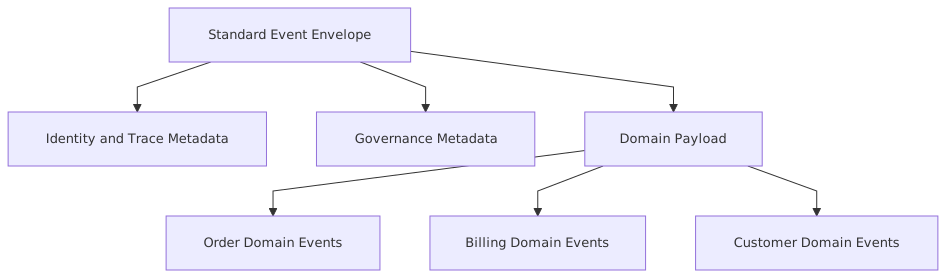
The envelope gives the enterprise a common spine. The payload preserves bounded context language. That is a sensible compromise. And enterprise architecture, done properly, is usually the art of sensible compromises.
Migration Strategy
No serious enterprise starts with a blank sheet. You inherit legacy publishers, file-based integrations, ad hoc JSON topics, and downstream consumers no one can confidently count. So the question is not whether to migrate. It is how to migrate without blowing up the estate.
The right answer is usually a progressive strangler migration.
Start by introducing the registry into new event flows and high-value existing streams. Do not try to retrofit the entire platform in one campaign. That is how architecture turns into theater.
Progressive strangler pattern for schema-managed streaming
- Identify candidate streams
Choose topics with high reuse, frequent breakage, regulatory significance, or ongoing change. These produce the best return.
- Introduce a governed schema for new versions
Keep legacy payloads flowing, but publish equivalent domain events on new schema-managed topics or under new event types.
- Bridge legacy producers
Use adapters or sidecar publishers to transform old formats into registered schemas. This lets downstream consumers move first.
- Dual run and reconcile
Run old and new flows in parallel. Compare counts, key business values, and outcome projections. Reconciliation is not bureaucracy here; it is the evidence that migration preserved business truth.
- Move consumers gradually
Prioritize consumers by business criticality and ease of change. Some can switch directly. Others may need anti-corruption layers.
- Deprecate with deadlines
Mark old schemas and topics as deprecated. Publish retirement plans. If you do not set dates, “temporary dual run” becomes a permanent operating model.
Why reconciliation matters
Event migration is not just contract migration. It is state migration in motion.
Suppose a legacy order system emits nightly batch files, while the new order service emits real-time OrderPlaced, OrderConfirmed, and OrderCancelled events. During migration, downstream finance views may receive both old and new representations. You must reconcile them:
- Are all business events represented?
- Are totals consistent?
- Are ordering guarantees adequate for downstream calculations?
- Are duplicate suppression rules correct?
- Are corrections represented explicitly?
This matters because event streaming often creates derived read models, caches, and analytical projections. A schema registry ensures messages can be read. Reconciliation ensures the business can trust what those messages say.
Here is a typical strangler migration path.

Versioning strategy during migration
Be blunt here: if semantics change, use a new event or a new major lineage. Do not sneak semantic changes through additive fields and call it compatibility.
Examples:
- Adding
discountCodetoOrderPlaced: likely compatible. - Changing
amountfrom gross to net: not compatible in any meaningful sense. - Splitting
CustomerUpdatedintoCustomerContactChangedandCustomerStatusChanged: probably a new event model, not a version bump.
Migration is where weak semantic discipline causes lasting damage. Old consumers often survive much longer than you expect. Design as if your least favorite integration will still exist in five years. Because it may.
Enterprise Example
Consider a large insurer modernizing its policy administration landscape.
The company has:
- a legacy policy core on the mainframe
- a claims platform built over many years
- a growing set of microservices on Kafka
- a central data platform consuming almost everything
- regulatory reporting that depends on historical correctness
Initially, teams publish JSON to Kafka topics with loose conventions. The policy team emits policy_event messages containing many shapes. Claims consumes some. Billing consumes others. The data platform consumes all of them because, of course it does. A year later, there are more than forty consumers, many undocumented.
Problems begin to pile up:
- fields appear and disappear without notice
- dates use different formats
- policy status codes are repurposed during a product launch
- replaying old events breaks new consumers
- auditors ask what an event looked like when a pricing dispute occurred six months earlier
The insurer introduces a schema registry, but crucially, not as a standalone platform upgrade. It ties the registry to a domain event program.
The policy domain defines explicit event families:
PolicyIssuedPolicyEndorsedPolicyCancelledPremiumInvoiced
Each schema includes business identifiers, occurrence timestamps, jurisdiction metadata, and PII classification tags in the envelope. The payload remains domain-owned. Compatibility is enforced per event family. New schemas must pass CI validation, stewardship review, and semantic checks.
Legacy policy_event publishing continues for a time, but an anti-corruption layer maps old payloads to the new event families. Downstream consumers are migrated incrementally. A reconciliation service compares premium totals, cancellation counts, and policy state transitions between the old integration outputs and the new streams.
What changes is not just serialization. Governance changes too: EA governance checklist
- Every event has an owning team.
- Every schema has lifecycle state.
- Every breaking semantic change requires a new event contract.
- Data platform consumers are treated as real consumers, not afterthoughts.
- Replay is tested against historical schema versions before promotion.
The outcome is not perfection. Some old integrations remain awkward. Some domains still over-publish generic updates. But breakage drops sharply, auditability improves, and teams can evolve contracts without summoning a cross-enterprise war room every sprint.
That is what architecture should do. Not eliminate complexity. Put it where it can be managed.
Operational Considerations
A schema registry is operationally critical infrastructure once enough streams depend on it. Treat it accordingly.
Availability and caching
Producer and consumer libraries often cache schema metadata, which reduces runtime dependency on the registry after startup or first use. That helps, but do not use caching as an excuse for weak availability design. Outages still affect deployments, new schema fetches, and recovery scenarios.
Run the registry with appropriate HA, backup, and disaster recovery. Know exactly what happens if the registry is unavailable during:
- new producer startup
- consumer scale-out
- partition rebalance
- replay of old topics
- cross-region failover
CI/CD integration
Schema checks belong in the pipeline:
- syntax validation
- compatibility verification
- naming and metadata rules
- ownership checks
- deprecation policy enforcement
If the first time you discover a contract problem is when a consumer crashes in production, the architecture has already failed.
Observability
Track:
- schema versions registered per subject
- active versions in use by producers and consumers
- deserialization errors
- unknown schema IDs
- deprecated schema usage
- message rejection rates
- replay success by version range
This gives you the basic visibility to manage evolution rather than merely endure it.
Security and governance
Not everyone should be able to register or evolve schemas. Separate:
- who can create subjects
- who can publish new versions
- who can change compatibility modes
- who can approve deprecations
In regulated environments, schema definitions may themselves reveal sensitive fields. Treat metadata and access with care.
Documentation and discovery
A registry is not a substitute for discoverability. It tells systems how to read bytes. Humans still need to know why an event exists, who owns it, what guarantees it offers, and when not to use it.
The best enterprise setups pair schema registry with an event catalog or developer portal.
Tradeoffs
There is no free lunch here.
What you gain
- safer schema evolution
- reduced consumer breakage
- clearer contract ownership
- better replay and historical readability
- stronger support for polyglot consumers
- governance that scales beyond tribal memory
What you pay
- more process around event changes
- tooling complexity
- stricter discipline on teams used to informal messaging
- migration overhead for existing topics
- occasional friction when semantic changes do not fit compatibility rules
The largest tradeoff is cultural. A schema registry formalizes change. Teams that are used to “just adding a field” may experience this as bureaucracy. Sometimes they are right: poorly designed governance can suffocate useful work. But in most large enterprises, the bigger danger is not too much discipline. It is pretending asynchronous integration can remain informal after dozens of consumers depend on it. ArchiMate for governance
You can have speed, or you can have silent cross-system breakage. Pick one.
Failure Modes
Schema registries do not remove failure. They change failure from invisible to visible. That is usually progress, but only if you understand the common traps.
1. Shape without semantics
The payload validates. The business meaning is wrong. This is the classic failure where status, amount, or customerType shifts meaning but remains technically compatible. The registry cannot solve this alone. Domain review and event stewardship must.
2. Shared topic chaos
Multiple unrelated event types share one topic with weak governance. Compatibility becomes awkward, consumers become broad and brittle, and ownership blurs. Eventually the topic turns into a junk drawer.
3. Compatibility theater
Teams set compatibility to NONE because migration is hard, then declare victory because they are “using schema registry.” That is like installing seatbelts and cutting them off because they wrinkle your shirt.
4. Platform ownership detached from domain ownership
The central platform team manages schemas, while domain teams treat contracts as someone else’s problem. This creates elegant technical contracts with poor business fidelity.
5. Version sprawl
Every small change becomes a new version with no retirement discipline. Consumers lag indefinitely. Replay support becomes uncertain. The registry fills with historical clutter and no one knows which versions actually matter.
6. Replay blindness
Teams evolve schemas but never test replay from old offsets or archived topics. Then a recovery event requires historical reprocessing and consumers fail on old versions.
7. Registry as single point of organizational failure
Not technical failure. Organizational failure. Every schema change requires a central review board that meets once a fortnight and asks irrelevant questions. Teams route around the system with side channels and raw payloads. Governance dies by overreach.
When Not To Use
Schema registry is not mandatory for every event flow.
Do not over-architect small, contained, single-team pipelines where:
- producer and consumers are deployed together
- event lifetimes are short
- replay is irrelevant
- schema evolution is tightly coordinated
- the flow is operationally local and not reused
Likewise, if the “events” are really transient internal messages inside one service boundary, a full registry may be more ceremony than value.
And if your organization is nowhere near capable of basic event ownership, introducing registry first may be premature. Sometimes the first step is not tooling. It is identifying domains, owners, and event purpose. A schema registry on top of conceptual chaos just gives you well-indexed chaos.
That said, once a stream becomes shared, durable, replayable, or business-critical, informal schema management stops being brave and starts being reckless.
Related Patterns
Several patterns complement schema registry architecture.
Event storming and DDD modeling
Use event storming to discover real domain events and bounded contexts before you design schemas. Registry governance works best when event models reflect business language.
Anti-corruption layer
Critical in migration. It isolates legacy semantics and prevents them from contaminating the new domain event model.
Outbox pattern
Useful when publishing events from transactional systems. It ensures reliable event emission while still using registered schemas for downstream safety.
Consumer-driven contracts
Helpful, but use carefully in event streaming. Producers should not be wholly dictated by every consumer whim. Domain ownership still matters.
Data mesh and data products
Schema registry supports data product discipline by making contracts explicit and reusable. But data products still need semantic ownership and service levels.
Canonical envelope, non-canonical payload
One of the most practical enterprise patterns. Standardize metadata; allow domain-specific payloads.
Summary
Schema registry is often introduced as a technical utility and then discovered, slowly and painfully, to be an architectural necessity.
That is because event streaming changes where coupling lives. Services may stop calling each other directly, but they remain bound by the facts they publish, the meaning of the fields they carry, and the historical record they leave behind. Kafka gives you durable distribution. A schema registry gives you governed evolution. Together, they create the possibility of a platform that can change without forgetting what it meant yesterday.
The important phrase is not schema registry. It is schema registry flow.
The architecture lies in the flow from domain event design to validation, registration, publication, consumption, migration, reconciliation, and retirement. Done well, this creates a contract system aligned to bounded contexts, resilient to asynchronous change, and suitable for enterprise scale. Done badly, it becomes either empty ceremony or a glorified file cabinet.
Be opinionated about semantics. Be pragmatic about migration. Use progressive strangler patterns rather than heroic rewrites. Reconcile old and new flows until you trust them. Govern compatibility where streams are shared and valuable. And never confuse a technically valid message with a meaningful business event.
In event streaming, the bytes are rarely the problem. The meaning is. A schema registry, treated properly, is one of the few tools that lets architecture speak before production starts screaming.
Frequently Asked Questions
What is event-driven architecture?
Event-driven architecture (EDA) decouples services by having producers publish events to a broker like Kafka, while consumers subscribe independently. This reduces direct coupling, improves resilience, and allows new consumers to be added without modifying producers.
When should you use Kafka vs a message queue?
Use Kafka when you need event replay, high throughput, long retention, or multiple independent consumers reading the same stream. Use a traditional message queue (RabbitMQ, SQS) when you need simple point-to-point delivery, low latency, or complex routing logic per message.
How do you model event-driven architecture in ArchiMate?
In ArchiMate, the Kafka broker is a Technology Service or Application Component. Topics are Data Objects or Application Services. Producer/consumer services are Application Components connected via Flow relationships. This makes the event topology explicit and queryable.