⏱ 7 min read
Recommended Reading
Assumptions / unspecified constraints: No specific Kafka distribution, cloud provider, or schema format is assumed; the governance patterns cover contract ownership and compatibility controls that generalize across deployments.
Executive summary
Kafka governance is ultimately contract governance: events (schemas), topics, and consumer expectations become enterprise-wide dependencies. Kafka’s documentation introduces core concepts like topics and partitioning (data distributed across brokers), which implies that topic design and retention become architectural decisions with operational consequences.
Most governance breakdowns in Kafka programs come from unclear ownership boundaries and unmanaged schema evolution. Confluent’s Schema Registry documentation formalizes schema evolution and compatibility, noting that the default compatibility type is BACKWARD and describing different compatibility modes. ArchiMate for architecture governance
In regulated settings, additional governance is required around auditability and lineage. W3C PROV defines provenance as information about entities, activities, and people involved in producing data, while OpenLineage defines an open standard to record lineage metadata for datasets, jobs, and runs. Together, these standards provide conceptual and practical foundations for proving “where data came from and where it went,” which is often essential in audits and incident investigations. ArchiMate modeling standards
A mature Kafka governance model therefore includes: domain ownership of event contracts, platform ownership of infrastructure guardrails, defined schema compatibility and deprecation policies, ARB-style review for high-impact changes, and lineage metadata capture that supports compliance and operational resilience.
Background and context
Kafka adoption changes integration economics. Instead of point-to-point APIs, you gain an event log and a fan-out model—but you also gain a new shared surface: topics, schemas, retention policies, and replay semantics. Kafka’s documentation highlights that topics are partitioned and distributed across brokers, which underlines why operational governance (availability, replication, partition strategy, retention) becomes enterprise-critical. integration architecture diagram

Governance must answer predictable enterprise questions:
- Who is allowed to create topics and define schemas?
- How do schema changes get reviewed and approved?
- How do we ensure consumers do not break?
- How do we investigate incidents and prove lineage?
The moment multiple domains publish events consumed by multiple teams, governance becomes non-optional.
Design patterns and reference architectures
Pattern: domain-owned contracts, platform-owned guardrails
- Domains own: event meaning, schema evolution decisions, deprecation timelines.
- Platform team owns: cluster operations, access control patterns, quotas, monitoring, and default compatibility policy.
This aligns accountability: domains bear responsibility for contract stability; platform bears responsibility for reliable service.
Pattern: compatibility defaults by event class
Use a classification scheme:
- Enterprise-shared canonical events: strict compatibility requirements (often backward).
- Domain-private events: more flexibility (but still governed).
- Ephemeral notification events: lowest retention and weaker replay guarantees, but still contract-defined.
Confluent documents compatibility types and the default of BACKWARD, providing a baseline for governance policy design.
Pattern: lineage as a first-class governance deliverable
OpenLineage defines a generic model for dataset/job/run entities and supports extensibility via facets, explicitly encouraging familiarity with the core model. This enables consistent lineage collection across tools and jobs.
W3C PROV provides a broader provenance model vocabulary, useful for reasoning about data trust and accountability.
Implementation playbook
Step one: establish an event taxonomy and naming standard
Define which domains exist and what qualifies as a “domain event” vs “integration event” vs “system event.” Document topic naming conventions aligned to domain boundaries. modeling integration architecture with ArchiMate
Step two: define schema governance and compatibility policy
At minimum:
- Required schema registry usage (or equivalent).
- Compatibility modes by event class.
- Versioning and deprecation timelines.
- “Breaking change = new event type or new topic” rules.
Confluent’s schema evolution guidance provides explicit compatibility categories and describes the default compatibility type as BACKWARD.
Step three: define approval workflows for high-impact changes
Use a lightweight ARB-style process (or architecture board) for:
- Enterprise-shared event changes
- Sensitive data classification changes
- Retention/replay policy changes
- New cross-domain topic introductions
ARB guidance emphasizes multi-disciplinary composition and reducing project recycle by including stakeholders early, which maps directly to event governance decisions (security, operations, architecture).
Step four: implement lineage capture and discoverability
- Align lineage to governance reporting needs (owners, classifications, data categories).
- Use PROV-style reasoning for provenance completeness in audits.
Governance, checklists, and controls
Kafka governance checklist
- Every topic has an owner, classification, retention, and consumer list.
- Every published event has a schema, compatibility mode, and versioning policy.
- Breaking changes follow explicit rules (new topic or new event type).
- High-impact changes are reviewed and have recorded decisions.
- Lineage metadata is collected for major pipelines.
Schema compatibility comparison table
| Compatibility mode | Core idea | Governance implication | Typical best use |
|---|---|---|---|
| BACKWARD | New readers can read old data | Enables safe evolution for consumers + replay | Shared enterprise topics |
| FORWARD | Old readers can read new data | Harder in practice; constrains writer changes | Legacy consumers you can’t update quickly |
| FULL | Both directions | Strongest constraints; slower evolution | High-assurance canonical schemas |
Pitfalls and anti-patterns
Anti-pattern: “topics as shared dumping grounds.” This destroys ownership and forces coupling.
Anti-pattern: “schema evolution without compatibility enforcement.” Consumers break silently; incident response becomes reactive rather than governed.
Anti-pattern: “lineage as an afterthought.” Without lineage standards, audits and incident investigations require manual reconstruction; OpenLineage exists specifically to standardize lineage metadata capture.
Examples and case scenarios
Example: introducing a new canonical customer event
- Domain “Customer” publishes CustomerCreated event.
- Schema compatibility set to BACKWARD.
- Topic is classified as enterprise-shared; changes require exception-path ARB review.
Key takeaways
Kafka governance is effective when it treats events as enterprise contracts: domains own meaning and evolution; platform teams own guardrails; compatibility policies are explicit and enforced; and lineage is captured using standards (OpenLineage/PROV concepts) so compliance and incident response are evidence-driven.
- ARB multi-disciplinary governance framing (AWS).
Three layers of EDA governance
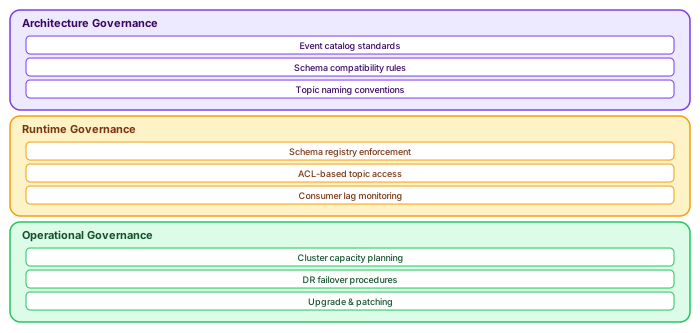
Governing event-driven architecture requires three distinct governance layers, each operating at a different level of abstraction and cadence. application cooperation diagram
Architecture governance defines the rules before events flow: the event catalog standard (what metadata every event must carry), schema compatibility rules (backward, forward, or full compatibility per topic), and topic naming conventions (domain.entity.action pattern). These are defined by the architecture team and enforced at design time.
Runtime governance enforces rules while events flow: the Schema Registry rejects incompatible schema changes, ACLs restrict which services can produce to or consume from which topics, and consumer lag monitoring detects processing bottlenecks before they become outages.
Operational governance manages the platform itself: cluster capacity planning (ensuring partitions and brokers scale with growth), disaster recovery procedures (cross-region replication with tested failover), and upgrade cadence (keeping Kafka versions current without disrupting production).
If you’d like hands-on training tailored to your team — Sparx Enterprise Architect, BPMN, SysML, Apache Kafka or the Archi tool — or modelling coaching in ArchiMate and TOGAF-aligned governance, you can reach us via our contact page.
Frequently Asked Questions
What is architecture governance in enterprise architecture?
Architecture governance is the set of practices, processes, and standards that ensure architecture decisions are consistent, traceable, and aligned to organisational strategy. It typically includes an Architecture Review Board (ARB), architecture principles, modeling standards, and compliance checking.
How does ArchiMate support architecture governance?
ArchiMate supports governance by providing a standard language that makes architecture proposals comparable and reviewable. Governance decisions, architecture principles, and compliance requirements can be modeled as Motivation layer elements and traced to the architectural elements they constrain.
What are architecture principles and how are they modeled?
Architecture principles are fundamental rules that guide architecture decisions. In ArchiMate, they are modeled in the Motivation layer as Principle elements, often linked to Goals and Drivers that justify them, and connected via Influence relationships to the constraints they impose on design decisions.