⏱ 21 min read
Most modernization programs don’t fail because the technology is weak. They fail because the migration story is fiction.
Someone draws a neat target architecture with Kafka in the middle, microservices around the edges, and arrows that suggest inevitability. “We’ll move from the monolith to event-driven services in phases,” they say. The slide looks clean. The enterprise does not. event-driven architecture patterns
Reality is less generous. You have a core system that still matters, reporting logic nobody fully trusts, teams with uneven skills, and a business that expects no interruption while you change the engine mid-flight. The hard part is not inventing the final architecture. The hard part is adopting events incrementally without corrupting domain semantics, breaking operational accountability, or creating a distributed mess that nobody can reason about.
That is where incremental event adoption matters. Not as a slogan, but as an architectural discipline.
The central idea is simple: don’t “switch to event-driven.” Introduce events where they carry real business meaning, use them to peel capabilities away from existing systems, and build a migration path that tolerates coexistence for longer than anyone wants. This is progressive strangler migration with domain-driven design at the center, not integration fashion. Events are not just transport. They are a bet about how the business speaks.
And if you get that bet wrong, the platform will amplify your confusion at machine speed.
This article walks through how to adopt event-driven architecture incrementally in enterprise migration: the forces at play, the architecture that tends to work, the migration strategy, the operational realities, and the sharp edges. We’ll look at Kafka and microservices where they help, but the real focus is on migration reasoning, domain semantics, reconciliation, and the tradeoffs that separate a useful event platform from an expensive rumor mill. microservices architecture diagrams
Context
Many enterprises sit on a familiar landscape: a large transactional core, several integration hubs, a data warehouse, and a growing set of digital channels demanding faster change than the core can safely provide. The pressure comes from everywhere at once. Product teams want autonomy. Data teams want fresher signals. Operations wants decoupling. Executives want “real-time.” Architecture gets told to make it happen without increasing risk.
So the organization reaches for event-driven architecture.
That instinct is not wrong. Events can reduce coupling, improve responsiveness, and create a cleaner integration model than point-to-point APIs and nightly batch jobs. Kafka, in particular, is attractive because it offers durable logs, scalable fan-out, replay, and a practical substrate for enterprise integration. Properly used, it becomes a backbone for publishing business facts and feeding downstream services, analytics, and operational workflows.
But there is a trap here. Enterprises often adopt event infrastructure before they adopt event thinking. They install Kafka, define topics around systems rather than domains, emit low-level change notifications rather than meaningful business events, and call the result modernization. It isn’t. It is just asynchronous legacy.
Domain-driven design helps here because it forces the obvious question that architecture decks often dodge: what happened in the business? Not “which table changed?” Not “which service wrote a message?” But what occurred in the domain that another bounded context can legitimately care about?
That question changes the migration.
Instead of trying to decompose the estate all at once, you identify bounded contexts with independent business value, publish domain events from the current core or its edges, and use those events to feed new services. Over time, command ownership shifts. Read models move first. Then downstream decisions. Then parts of transaction initiation. Finally, the old core shrinks to the parts it still truly owns.
This is not glamorous. It is a long negotiation between old truth and new truth. But it works.
Problem
The core problem is coexistence.
During migration, the legacy system still owns critical business processes, while new services need timely, trustworthy information to operate independently. If you wait until the old system is entirely decomposed, you get no modernization value for years. If you move too quickly, you create split brain ownership, inconsistent business rules, and operational chaos.
Event-driven migration promises a middle path: publish events from existing systems, let new services subscribe, build new capabilities around those events, and progressively redirect responsibilities. But doing this incrementally introduces several hard questions:
- Which events are truly domain events versus technical notifications?
- How do you preserve domain semantics when legacy systems were never designed to emit them?
- How do you manage dual writes, eventual consistency, and replay?
- How do you reconcile divergent state across old and new systems?
- How do you know when a bounded context is ready to take ownership?
- How do you avoid turning Kafka into a giant integration bypass where every team publishes whatever they like?
These are not implementation details. They are architecture decisions with long half-lives.
The biggest mistake is assuming events remove complexity. They don’t. They relocate it from call chains into time, ordering, contracts, and operational visibility. Synchronous integration fails loudly. Event-driven integration can fail politely for days.
That is often worse.
Forces
A useful architecture article should name the forces, because systems are usually the visible residue of unresolved tensions.
1. Business continuity versus structural change
The business wants uninterrupted operations while architecture wants to restructure responsibilities. This creates pressure for low-risk, reversible steps. Big-bang migration is politically attractive and operationally reckless.
2. Domain truth versus system truth
Legacy systems often encode business behavior in tangled ways: triggers, status fields, batch updates, side effects, and operator workarounds. What a system stores is not always what the domain means. Event adoption must preserve business semantics, not just data movement.
3. Autonomy versus consistency
Microservices gain value from bounded autonomy. Enterprises still need coherent outcomes: fulfilled orders, accurate balances, compliant processes. Incremental event adoption must accept eventual consistency without becoming semantically inconsistent.
4. Speed of delivery versus contract stability
During migration, event contracts evolve. Teams want to move fast; downstream consumers need trust. This pushes you toward versioned schemas, compatibility discipline, and explicit event governance. EA governance checklist
5. Replayability versus correctness
Kafka invites replay. Replaying technical events is easy. Replaying events into a changed business model is not. Historical events can be structurally valid and semantically wrong for the current world.
6. Local optimization versus enterprise coherence
A team can publish events that make perfect sense inside its service and still damage the broader enterprise. Event naming, ownership, topic design, and data classification need cross-team discipline. Without it, “event-driven” becomes a distributed source of accidental coupling.
7. Incremental migration versus duplicated logic
For a while, old and new worlds overlap. Some logic must be duplicated or shadowed. This is expensive and error-prone, but often unavoidable. The question is not whether duplication exists, but whether it is deliberate, temporary, and visible.
Solution
The effective pattern is incremental event adoption through domain-aligned event publication, selective downstream materialization, and progressive transfer of responsibility. In plain language: start by publishing trustworthy business events from the existing core, let new services consume them to build read models and supporting capabilities, then gradually move decision-making and command ownership into those services as the surrounding domain becomes stable enough.
Not every system should emit events first-hand. Legacy platforms often cannot produce useful domain events without contamination. In those cases, place an anti-corruption or translation layer near the source. Its job is not merely protocol conversion. Its job is semantic conversion: turning system changes into domain facts.
This is where domain-driven design earns its keep. You identify bounded contexts and define event streams around domain concepts such as OrderPlaced, PaymentAuthorized, ShipmentDispatched, PolicyBound, or ClaimRegistered. These events are meaningful to other contexts because they describe business occurrences, not implementation leakage.
The migration usually proceeds in three broad stages:
- Observe and publish
Legacy remains system of record. Events are introduced as published facts. New services consume them to build projections, notifications, analytics, or low-risk side capabilities.
- Augment and decide
New services begin making local decisions based on event streams and their own state. Some workflows become choreography or saga-based rather than centralized in the monolith.
- Own and command
Selected bounded contexts take command ownership. APIs or channels route commands to new services first. Legacy becomes a subscriber, an adapter, or is bypassed entirely for those contexts.
The key principle is this: read models move before write authority. Enterprises that ignore this usually discover too late that they have moved a user interface, not a business capability.
Here is the high-level shape.
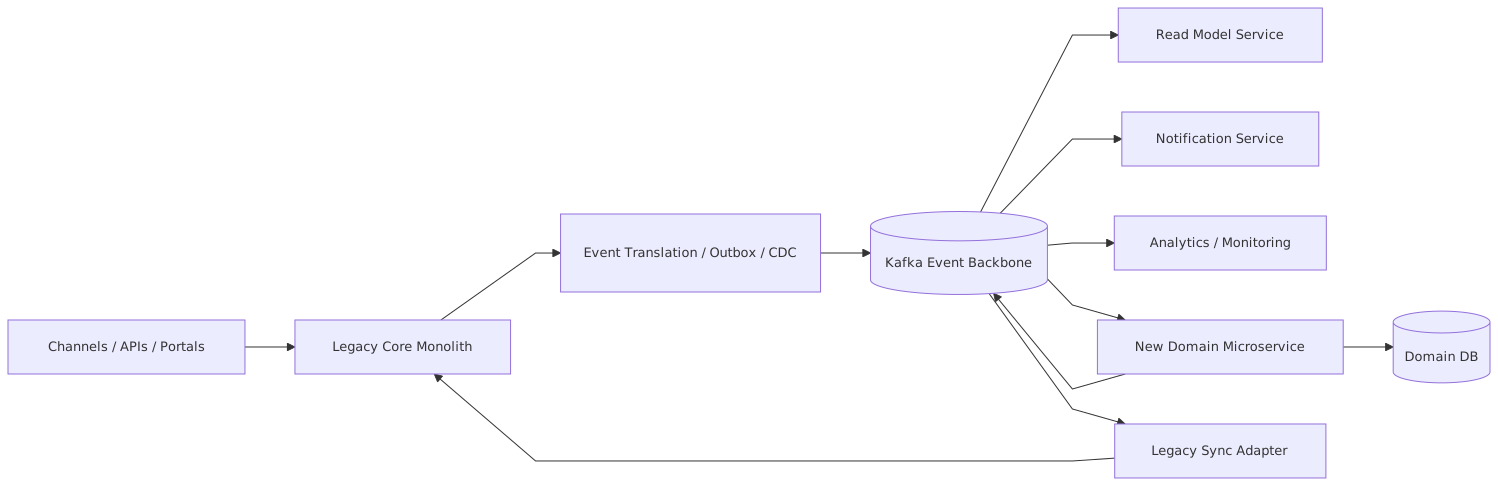
This architecture makes one crucial move: it treats the event backbone as a migration seam, not just a messaging system. The seam lets old and new coexist without pretending they are the same thing.
Architecture
Let’s make the architecture more concrete.
Event sources
You generally have three options for sourcing events from a legacy system:
- Application outbox: preferred when you can change the application. Business transaction commits data and an outbox record atomically. A relay publishes to Kafka.
- Change Data Capture (CDC): useful when direct code change is hard. Database changes are captured and translated into events. Strong for feasibility, weak if used without semantic translation.
- Process interception / façade: place an API layer or orchestration point in front of the legacy system and emit events based on known business operations.
My opinion: if you can only do raw CDC, do not pretend you have domain events. You have database change signals. That can still be useful, but call things by their proper names. Architecture gets expensive when language gets sloppy.
Event design
Good enterprise events have a few traits:
- They reflect domain facts, not CRUD actions.
- They include stable business identifiers.
- They separate metadata from payload.
- They are immutable.
- They are versioned.
- They carry enough context for downstream use without cloning the source database into every event.
For example, CustomerAddressUpdated may be a fine event in a customer context. CUSTOMER_TBL_ROW_CHANGED is not. One is about the business. The other is about implementation regret.
Topic and ownership design
Kafka topics should generally align with domain streams or event classes that reflect bounded context ownership. The owner of a topic is accountable for semantic quality, schema compatibility, and publication behavior.
Do not create a topic taxonomy entirely around technical environments or individual applications. You will lock system structure into the platform and make later decomposition harder.
Consumers and projections
Incremental event adoption shines when consumers build materialized views and domain-specific projections. This lets new services become useful without owning writes yet.
Examples:
- A fulfillment service subscribes to
OrderPlacedandPaymentAuthorizedto prepare shipping readiness. - A customer communications service subscribes to lifecycle events to trigger notifications.
- A fraud service subscribes to policy or payment events to score risk asynchronously.
These are often the first migration wins because they reduce direct dependency on the monolith while not challenging transaction ownership too early.
Command boundary migration
Eventually, some bounded contexts become capable of accepting commands directly. At that point, command routing changes. The new service processes the command, writes its own state, and publishes events. Legacy may still subscribe for reconciliation or downstream updates.
That is the real migration step. It is where architecture moves from “listen” to “own.”
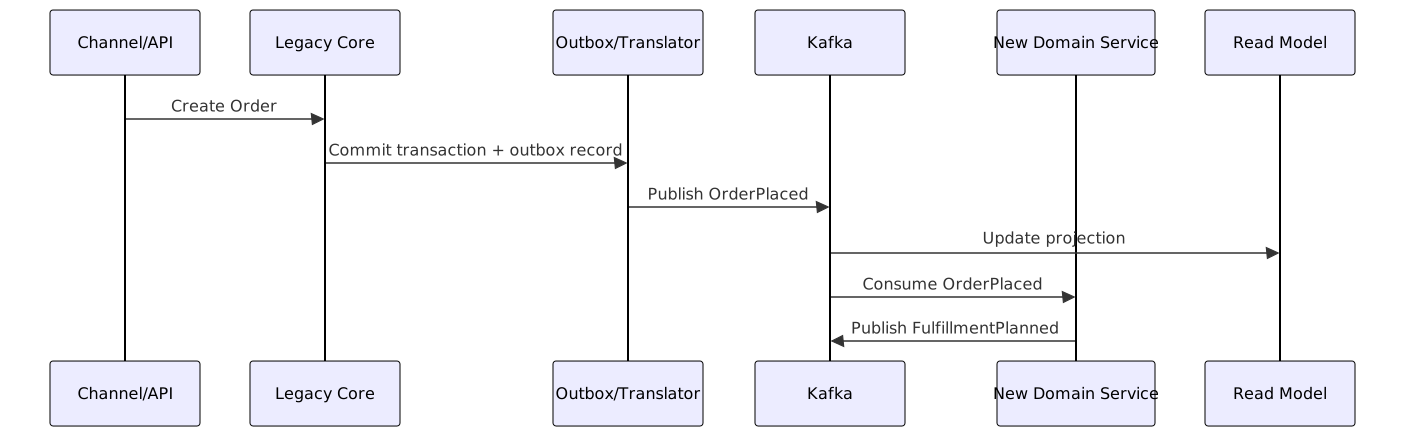
Later in migration:
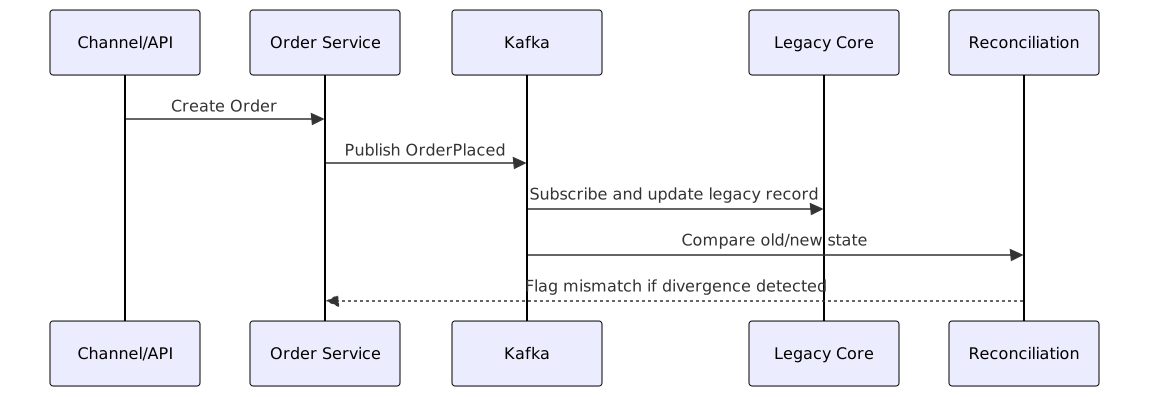
This shift from legacy-first to service-first is where many programs wobble. The event model might remain similar; the ownership model changes dramatically.
Migration Strategy
A sensible migration strategy is progressive strangler migration driven by bounded contexts, not by technical layers alone.
Step 1: Find the domain seams
Start with event storming, domain mapping, and ugly but honest conversations with business operators. You are looking for bounded contexts where:
- business language is stable enough,
- integration dependencies are manageable,
- value can be delivered before full ownership transfer,
- and existing legacy behavior can be observed with acceptable fidelity.
Candidate contexts often include notifications, customer profile, catalog, fulfillment, case handling, document generation, or fraud assessment. General ledger and deeply entangled pricing engines usually come later for good reason.
Step 2: Publish first-class business events
Introduce event publication at the edges of the current truth. Prefer outbox where feasible. Use CDC carefully, with translation into domain terms. Establish schema governance early. If teams say governance will slow them down, they are usually underestimating how much cleanup unguided publishing creates. ArchiMate for governance
Step 3: Build projections and side capabilities
Use events to power read models, workflows, and side services. This phase proves that event contracts are useful and lets teams develop operational discipline around lag, retries, idempotency, and replay. It also exposes semantic gaps while the legacy system still owns writes.
Step 4: Shadow decision logic
Before moving write ownership, run new decision logic in shadow mode. Compare outcomes against legacy behavior. This is where reconciliation becomes a first-class architectural concern, not a cleanup script.
Reconciliation should compare both data and business outcomes:
- Did both systems agree on order eligibility?
- Did both compute the same premium or discount?
- Did both transition to the same lifecycle state?
- If not, is the difference acceptable, understood, and intentional?
Step 5: Redirect commands selectively
Move a narrow slice of command ownership into the new service. Keep blast radius small. Use feature flags, tenant-based routing, product-line segmentation, or region-by-region rollout. A migration step that cannot be reversed is not a migration step. It is a deployment gamble.
Step 6: Retire legacy responsibilities
Once command ownership is proven and reconciliation stabilizes, remove the corresponding logic from the legacy flow. This is the part organizations postpone too long. If you never subtract, you haven’t migrated. You have only accumulated architecture.
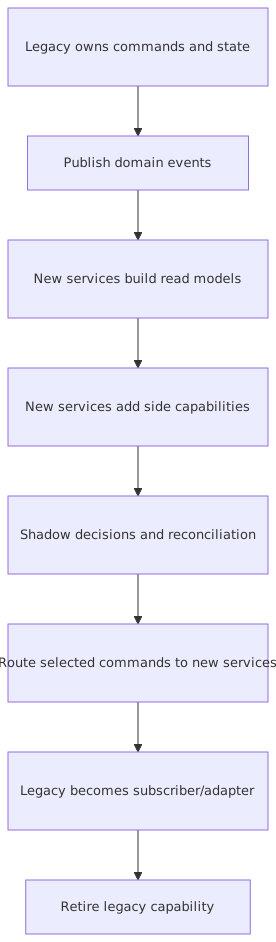
Here is the migration shape:
Reconciliation deserves its own budget
In event-driven migration, reconciliation is not a sign of failure. It is a design necessity.
You will have periods where old and new systems process the same business facts differently. Reasons include:
- timing differences,
- ordering differences,
- hidden legacy rules,
- historical data anomalies,
- event loss or duplication handling,
- and plain misunderstandings of the domain.
A mature reconciliation approach includes:
- canonical business keys,
- deterministic comparison points,
- exception queues,
- replay and repair tooling,
- ownership of discrepancy investigation,
- and clear tolerances for temporary divergence.
Without reconciliation, teams argue from dashboards and anecdotes. With reconciliation, they argue from evidence. That is progress.
Enterprise Example
Consider a large insurer modernizing its policy administration platform.
The insurer has a thirty-year-old core system handling policy creation, endorsements, renewals, and billing interactions. Every channel—agent portal, call center, partner API—depends on it. Batch jobs feed reporting. Document generation is tightly coupled. Change is slow and dangerous.
The business wants faster product rollout and better customer servicing. Architecture proposes microservices and Kafka. Good instinct, dangerous simplification.
A domain-driven assessment identifies several bounded contexts:
- Policy Administration
- Billing
- Customer Profile
- Document Communications
- Claims
- Underwriting Rules
Policy Administration remains deeply entangled and stays in the legacy core initially. But Customer Profile and Document Communications are less coupled and are good early candidates. The team introduces an outbox pattern in the policy platform for major lifecycle events:
PolicyQuotedPolicyBoundPolicyRenewedEndorsementRequestedCustomerContactChanged
Kafka becomes the event backbone. New services subscribe.
The Document Communications service consumes lifecycle events and generates customer communications independently. This removes brittle direct calls from the core. The Customer Profile service builds a current customer view from multiple event streams and becomes the source for digital channels. This gives a visible business benefit early: call center and self-service screens get a cleaner, faster customer timeline.
Then the insurer tackles Underwriting Rules. A new underwriting service consumes quote and policy events, runs risk scoring in shadow mode, and compares outputs against legacy underwriting decisions. For three months, discrepancies are logged and reviewed. The team finds what always happens in real enterprises: there are “rules” in the old platform that nobody documented because they were encoded as combinations of status flags and operator overrides.
This is exactly why shadowing and reconciliation exist.
After the discrepancy rate drops to an acceptable threshold, new business lines in one region are routed to the underwriting service first. It publishes RiskAssessed and QuoteApproved events. Legacy still receives updates for reporting and continuity. Over time, command ownership for underwriting shifts fully. Policy Administration remains in legacy for issuance and endorsements, but one bounded context has genuinely moved.
That is a real migration. Not because the target slide changed, but because business authority moved.
The insurer does not decompose the whole core at once. It uses events to create a progressive strangler path:
- first communications,
- then customer profile,
- then underwriting,
- later selected quote flows,
- and much later pieces of policy servicing.
Could they have gone faster with a clean-sheet rebuild? On slides, yes. In enterprise reality, no.
Operational Considerations
Event-driven migration is won or lost in operations.
Idempotency
Consumers must tolerate duplicates. Kafka gives at-least-once delivery characteristics in many practical setups, and retries are normal. Every consumer that mutates state needs idempotent handling keyed by event identity or business identity plus version.
Ordering
Do not assume global ordering. Even per-key ordering can be disrupted by bad partitioning or replay patterns. Design consumers around domain invariants and sequence expectations that are explicit and testable.
Schema evolution
Use a schema registry. Enforce compatibility rules. Version payloads with intention. The cost of schema discipline is tiny compared to the cost of downstream breakage in a large enterprise estate.
Observability
You need more than broker metrics. Track:
- publication lag,
- consumer lag,
- dead-letter volume,
- replay counts,
- reconciliation mismatches,
- end-to-end business latency,
- and event contract usage.
A healthy cluster can still carry unhealthy business flow.
Security and data classification
Events spread quickly. That is their superpower and their risk. PII, financial data, regulatory classifications, retention obligations, and regional residency rules must be built into event design and topic governance. “We’ll clean that up later” is how sensitive data ends up everywhere.
Replay and repair
Replay is not a magic undo button. You need clear procedures:
- when replay is allowed,
- from which offsets or time windows,
- into which consumer versions,
- with what side effects suppressed,
- and how repaired state is verified.
A replay strategy without business guardrails is just a very efficient way to repeat mistakes.
Tradeoffs
There is no free lunch here. Incremental event adoption trades one set of problems for another.
What you gain
- Lower runtime coupling
- Better scalability for downstream consumers
- Faster introduction of new services
- Clearer domain seams when done well
- More flexible integration patterns
- Strong support for progressive strangler migration
What you pay
- More operational complexity
- Eventual consistency
- Harder debugging across time and services
- Contract governance overhead
- Reconciliation workload
- Risk of semantic drift between producer intent and consumer interpretation
A common tradeoff appears around event payload richness. Fat events reduce consumer lookup chatter but risk over-coupling and data sprawl. Thin events preserve producer boundaries but can force chatty enrichment calls and undermine autonomy. The right answer depends on the domain and migration phase. During migration, I often favor moderately rich events with stable business context because they help consumers become useful sooner. Later, payloads can be tightened where needed.
Another tradeoff is choreography versus orchestration. Choreography feels elegant until nobody can explain why a business process stalled. Orchestration adds central control but can recreate old coupling if overused. In migrations, a pragmatic mix usually wins: use events for decoupled state propagation, and orchestrate where business accountability demands a visible owner.
Failure Modes
Architectures fail in recognizable ways. Event-driven migration is no exception.
1. Publishing technical noise instead of domain events
If your topics are mostly CRUD deltas and table mutations, consumers will reverse-engineer meaning and couple themselves to legacy structure. You haven’t created a domain event backbone. You’ve exported implementation debt.
2. Dual-write inconsistency
A service writes to its database and publishes separately without transactional safety. Sooner or later, one succeeds and the other fails. The estate diverges quietly. Use outbox or equivalent reliability patterns.
3. Shared event ownership
Multiple teams treat the same topic as communal property. Semantics blur. Contract changes become political. Nobody owns quality. Every enterprise says they value ownership until a shared topic appears.
4. Hidden synchronous dependency under asynchronous branding
A service consumes an event but immediately calls back into the source synchronously for essential context. Now the system is both asynchronous and tightly coupled. The worst of both worlds.
5. No reconciliation discipline
Teams assume eventual consistency will “sort itself out.” It won’t. Divergence becomes institutionalized, and trust in the migration collapses.
6. Premature command migration
New services take write ownership before event semantics, projections, and shadow logic are proven. The architecture looks modern right up to the outage review.
7. Kafka as a dumping ground
Without domain governance, every team publishes every state change “just in case.” Topic sprawl grows, data quality drops, and the platform becomes expensive plumbing with no coherent information model.
When Not To Use
Incremental event adoption is powerful, but it is not universal.
Do not use it when:
- the domain is simple and a modular monolith would solve the real problem;
- the organization lacks basic operational maturity for distributed systems;
- your main issue is poor internal design, not integration coupling;
- strict synchronous consistency is non-negotiable and cannot be isolated;
- the system has such low change pressure that migration cost outweighs flexibility benefit;
- or the enterprise cannot commit to domain ownership and contract governance.
I’ll be blunt: some organizations should not adopt event-driven migration yet. If teams cannot define bounded contexts, cannot own schemas, cannot monitor consumer lag, and cannot investigate reconciliation mismatches, then Kafka will not make them modern. It will simply make them asynchronous.
There is also a class of domains where event-driven migration is overkill. If a capability has few integrations, modest throughput, and a small team, a well-structured service or even a modular monolith behind clear APIs may be the better answer. Not every problem deserves a log.
Related Patterns
Incremental event adoption often works alongside several related patterns:
- Strangler Fig Pattern
The broader migration approach: gradually replacing legacy functionality behind stable interfaces and routing controls.
- Anti-Corruption Layer
Essential when translating legacy data or operations into proper domain semantics.
- Transactional Outbox
The workhorse for reliable event publication from transactional systems.
- Change Data Capture
Useful as a pragmatic bridge, especially where source code changes are difficult.
- CQRS
Often helpful because read models move earlier than writes in migration.
- Saga / Process Manager
Important when cross-service coordination grows and business processes need explicit state handling.
- Event Sourcing
Sometimes adjacent, often confused with simple event-driven integration. It is a very different commitment. Do not adopt event sourcing just because you adopted Kafka.
That last point matters. Event-driven migration does not require event sourcing. Publishing domain events is about integration and business signaling. Event sourcing is about persistence and state derivation. They can work together, but they are not the same bet.
Summary
Incremental event adoption is the grown-up way to do event-driven migration.
It accepts that enterprises do not leap from monolith to microservices in one move. They coexist. They disagree. They overlap. The architecture has to manage that ambiguity without losing domain meaning or operational control.
The pattern works when you start with bounded contexts, publish real business events, use those events to build read models and side capabilities, and only then move command ownership. It works when reconciliation is treated as a first-class concern. It works when Kafka is a disciplined event backbone, not a generic integration landfill. And it works when teams understand that events are part of the domain language, not just a transport choice.
The memorable line here is simple: migrate authority, not just software.
That is the point of incremental event adoption. Not to produce more messages. Not to check the “event-driven” box. But to move business capability, step by reversible step, from brittle legacy control into bounded, observable, domain-aligned services.
Do that, and event-driven migration becomes an architecture strategy.
Skip it, and you will still have the same legacy estate—just with more topics.
Frequently Asked Questions
What is enterprise architecture?
Enterprise architecture aligns strategy, business processes, applications, and technology in a coherent model. It enables impact analysis, portfolio rationalisation, governance, and transformation planning across the organisation.
How does ArchiMate support architecture practice?
ArchiMate provides a standard language connecting strategy, business operations, applications, and technology. It enables traceability from strategic goals through capabilities and services to infrastructure — making architecture decisions explicit and reviewable.
What tools support enterprise architecture modeling?
The main tools are Sparx Enterprise Architect (ArchiMate, UML, BPMN, SysML), Archi (free, ArchiMate-only), and BiZZdesign. Sparx EA is the most feature-rich, supporting concurrent repositories, automation, scripting, and Jira integration.