⏱ 19 min read
Event-driven architecture likes to market itself as freedom. No direct calls. No waiting. No tight runtime dependency. Teams publish facts, other teams subscribe, and everyone moves faster.
That story is true right up to the moment it isn’t.
Because in most enterprises, the real coupling in microservices does not live in HTTP clients or service meshes. It lives in the event stream, in the shape of payloads, in the meaning of fields, in timing assumptions nobody wrote down, and in that quietly dangerous sentence: “Consumers can just ignore unknown fields.” The wire may be asynchronous, but the dependency is still there. It’s just hidden better.
This is the problem with implicit contracts in event streams. A producer thinks it is publishing an event. In reality, it is publishing an agreement. Sometimes several agreements. One consumer reads the event as a business fact. Another reads it as a trigger. A third uses it as a materialized view feed. A fourth reverse-engineers missing semantics from historical behavior. Soon the stream becomes less like a log of domain facts and more like a crowded train station where everyone is using the same announcements for different reasons.
And then someone changes a field.
Not the schema, necessarily. The meaning. The timing. The cardinality. The lifecycle. The assumption that “created” always comes before “approved.” The assumption that “customer status” only moves forward. The assumption that duplicates are rare. The assumption that an event means something happened, not merely that some table changed. These are the real contracts. They are not explicit, rarely versioned, and almost never owned properly.
Architecturally, this matters because hidden coupling is the tax that event-driven systems charge later. You avoid the upfront pain of tightly designed APIs and pay instead in operational ambiguity, migration drag, reconciliation work, and brittle downstream behavior. This does not mean event streaming is wrong. It means that a Kafka topic is not a magical decoupling machine. It is shared language in motion. Shared language is useful, but it is also dangerous when no one curates the vocabulary. event-driven architecture patterns
A good architect learns to see these hidden dependencies as a graph, not a list. Producer to topic to consumer is the cartoon. Real life is producer to semantic contract to multiple consumer interpretations to derived stores to operational runbooks to compliance evidence. Once you see that graph, the conversation changes. You stop asking “can we add a field?” and start asking “who has made business meaning out of this event, and what happens when that meaning moves?”
That is the work.
Context
Microservices and Kafka often arrive together in large organizations for understandable reasons. The enterprise wants autonomous teams, scalable data movement, real-time integration, and less brittle request/response choreography. The platform team offers an event backbone. Domain teams publish events from order management, billing, inventory, payments, customer onboarding, logistics, and fraud. Analytics teams subscribe. So do operational systems. So do half a dozen integration services built under deadline pressure.
At first, this feels cleaner than service-to-service API sprawl. A producer emits OrderPlaced, and many consumers benefit. A payment service reserves funds. Inventory allocates stock. Notifications send a confirmation. Data science captures behavioral signals. Everyone wins.
But after a year or two, the stream starts to accumulate accidental semantics.
A field called status begins as an internal state marker, then becomes the basis of downstream decisioning. A nullable field is treated by one consumer as “not yet known” and by another as “not applicable.” A CDC-derived event is mistaken for a domain event. A partition key choice creates ordering guarantees some consumers silently rely on. Retention settings become part of a recovery strategy nobody documented. Consumer lag changes the business meaning of “near real time.”
This is where domain-driven design becomes more than a design workshop exercise. Event streams are not technical plumbing. They are a boundary artifact between bounded contexts. If the language in the stream is weak, overloaded, or leaked from internal models, the hidden coupling becomes inevitable. Consumers fill in the semantic gaps themselves. And when consumers invent meaning, producers lose control of their own evolution.
In enterprise environments, this is amplified by organizational reality. Teams change. Vendors own some consumers. Regulations require lineage. Auditors ask why a decision was made. Support teams need to replay events. Acquisitions bring in parallel platforms. Legacy systems emit table changes disguised as business events. There is no greenfield purity. There is only the stream you have and the contracts people believe exist.
Problem
The central problem is simple to state and hard to fix: event-driven systems often contain implicit producer-consumer contracts that are stronger than the explicit schema and weaker than a properly governed domain interface.
That awkward middle ground is where architectures decay.
A schema registry helps, but only with structural compatibility. It does not protect you from semantic drift. You can preserve backward compatibility at the Avro or Protobuf level while still breaking consumers badly. Add a new enum value, and old logic may route it to a default branch with terrible consequences. Reinterpret a timestamp from “business effective time” to “processing time,” and reconciliation starts lying. Change event granularity from one-per-order to one-per-line-item, and downstream SLAs explode. None of these are schema violations. All are contract violations.
The hidden coupling graph usually forms through a few common patterns:
- State-leak events: producers emit internal persistence changes rather than meaningful domain events.
- Trigger abuse: consumers use events as commands in disguise.
- Read-model parasitism: downstream teams reconstruct producer state because asking for a proper API or published view felt slower.
- Ordering dependence: consumers assume an order that only sometimes exists.
- Completeness assumptions: consumers treat one stream as the entire truth when it was only intended as a partial signal.
- Temporal overreach: consumers assume low latency is guaranteed and make business decisions based on “fresh enough” data that is not actually governed.
A hidden contract is particularly nasty because neither side fully owns it. The producer didn’t mean to offer it. The consumer cannot safely operate without it. Governance discovers it only during outages or migrations. EA governance checklist
Here is the shape of the problem in practice.
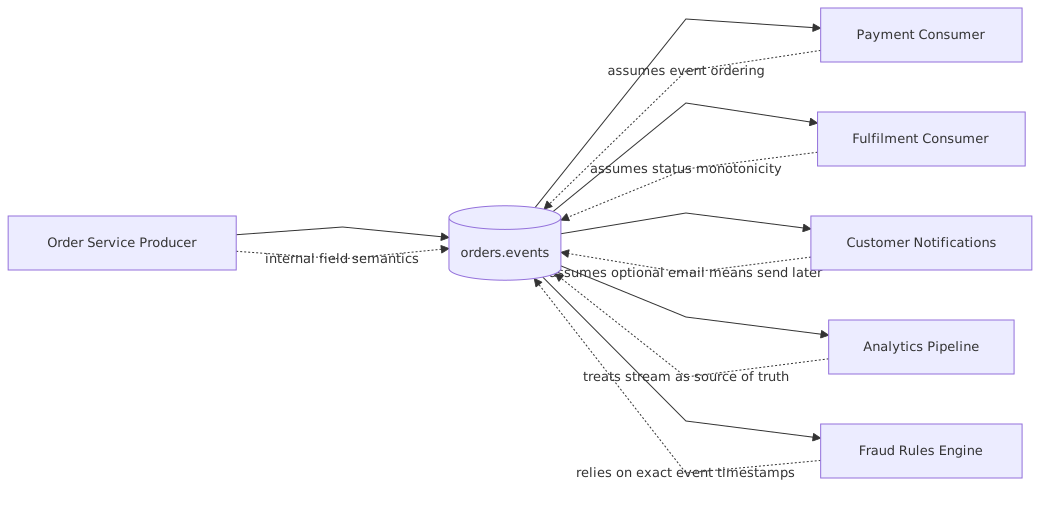
That dotted line is where the architecture really lives.
Forces
Several forces pull architects toward implicit contracts even when they know better.
Speed over explicitness. Publishing an event is often politically easier than negotiating an API or a shared domain model. Teams optimize for local delivery. The stream becomes a convenience layer.
Asynchrony creates false confidence. Because services are not directly calling one another, people assume they are decoupled. Runtime decoupling is mistaken for semantic decoupling. They are not the same thing.
Schema tooling solves the wrong half. Compatibility checks are valuable, but they can encourage a dangerous belief that the contract is under control. Syntax is visible. Semantics are not.
Consumers are rewarded for opportunism. If a stream contains useful data, downstream teams will use it. In the enterprise, “temporary” subscriber logic has a habit of surviving for years.
Bounded contexts blur under delivery pressure. DDD tells us to model domain events around meaningful business facts within a bounded context. The enterprise often ships integration events, state-change events, and CDC feed events on the same backbone without strong distinction. Consumers then infer meaning from naming and behavior.
Migration makes streams sticky. Once a stream becomes the integration seam for a strangler migration, every attribute looks too dangerous to change. The stream hardens around historical accidents.
Operations need recoverability. Replays, backfills, and reconciliation encourage consumers to depend on retention periods, event completeness, and idempotency behavior. These become part of the practical contract.
All of this creates the producer/consumer hidden coupling graph: a network of semantic dependence that is wider and deeper than any topic diagram suggests.
Solution
The solution is not “stop using events.” That would be an overreaction. Nor is it “just govern schemas harder.” That is necessary but inadequate.
The solution is to treat event streams as explicit domain contracts and to manage the hidden coupling graph as a first-class architectural artifact.
Three moves matter.
1. Distinguish event types by intent
Too many platforms mix these without discipline:
- Domain events: meaningful facts in the language of the bounded context, such as
OrderPlaced,PaymentAuthorized,ShipmentDispatched. - Integration events: curated events intended for other contexts, often translated and stabilized.
- CDC or change events: low-level data mutations from persistence technology.
These are not interchangeable. A CDC event is not a domain event with bad manners; it is a different thing. If you publish table-level mutations and let consumers build business processes on top, you have outsourced your domain model to whoever happens to subscribe first.
My advice is blunt: use domain or integration events for cross-context contracts; use CDC sparingly, and name it as such when you do.
2. Make semantic contracts explicit
An event contract needs more than a schema. It needs declared meaning.
At minimum, each published event should document:
- business meaning and bounded context
- event intent: fact, notification, snapshot delta, or process signal
- identity semantics
- ordering expectations, if any
- duplication expectations
- completeness limits
- temporal semantics: event time, processing time, effective time
- field invariants and lifecycle rules
- deprecation and version strategy
- known downstream use classes
This is not bureaucracy. It is architectural oxygen.
3. Model and govern the coupling graph
You need a view of which consumers depend on which semantics, not just which topics they read. That can start as a lightweight architecture catalog and evolve into lineage tooling, consumer registration, and compatibility review gates. The point is not perfect documentation. The point is to reveal hidden dependencies early enough to manage them.
Here is a more realistic architecture view.
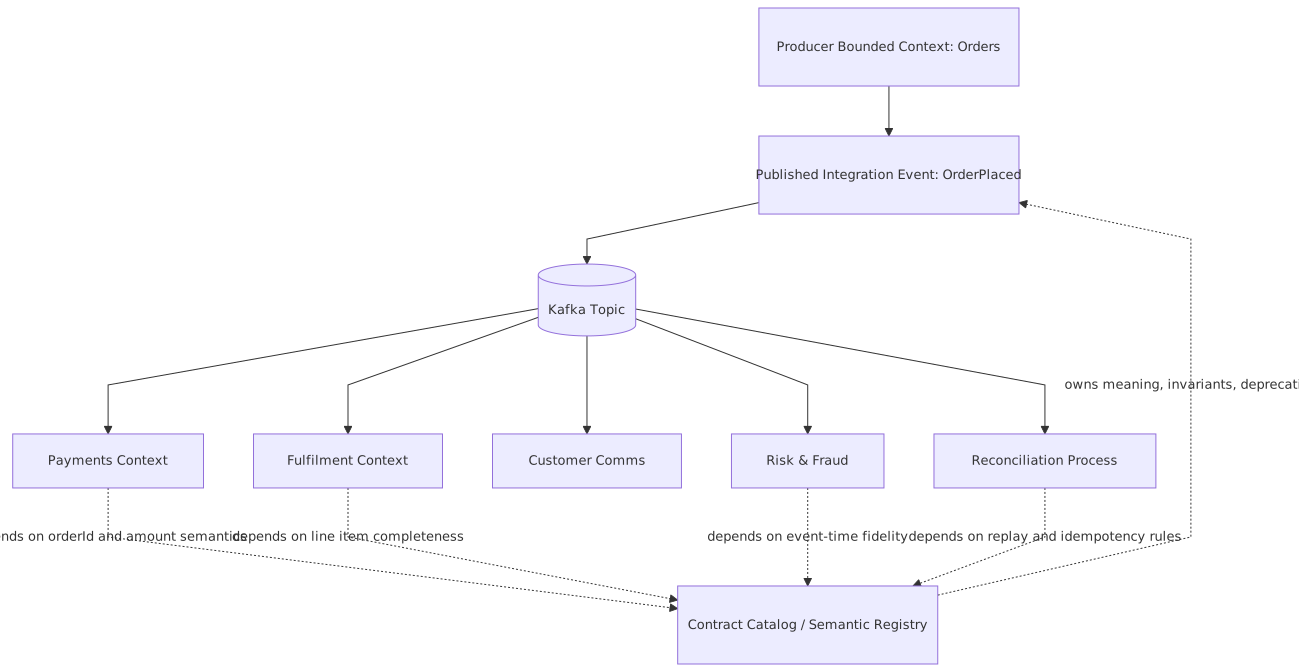
Once you have this, governance stops being generic and starts becoming domain-specific. ArchiMate for governance
Architecture
A healthy event architecture in microservices has a few recognizable traits. microservices architecture diagrams
First, events are anchored in domain semantics, not storage mechanics. In DDD terms, the event should belong to the ubiquitous language of the bounded context. OrderPlaced is stronger than OrderRowInserted. AddressValidated is stronger than CustomerTableUpdated. The stream should tell a business story, not expose a table diary.
Second, producers separate internal evolution from external publication. This often means an anti-corruption layer in reverse: a publication layer that translates internal state transitions into stable integration events. If your internal aggregate changes, you do not force all consumers to absorb that turbulence.
Third, consumers are categorized. Some consumers use events for process orchestration. Others for projections. Others for analytics. Others for integration. Their tolerance for change differs. A projection consumer may survive additive fields easily. A process consumer depending on state transitions may not survive semantic drift at all.
Fourth, the architecture includes reconciliation. This is the part event-driven enthusiasts often skip. In enterprise systems, streams are not enough by themselves. There must be a way to compare expected business truth with observed derived state, to detect gaps, duplicates, poison messages, and semantic mismatches. Reconciliation is not a patch for bad design; it is how mature organizations operate asynchronous systems with confidence.
A practical architecture often looks like this:
- Domain service raises internal domain events.
- Outbox pattern persists those events transactionally with business state.
- Publication component translates them into external integration events.
- Kafka distributes events with clear topic ownership and retention policies.
- Consumers build local models or initiate bounded workflows.
- Reconciliation jobs compare source-of-truth data and downstream projections.
- A contract catalog records semantics and subscriber dependencies.
This is not glamorous. It is dependable.
Migration Strategy
The hardest time to tackle implicit contracts is after the stream already has many consumers. Unfortunately, that is also the normal time.
So the migration strategy must be progressive, not revolutionary. This is where the strangler pattern earns its keep.
Do not try to “fix all event contracts” in one rewrite. You will freeze delivery and still miss hidden dependencies. Instead, strangler the semantic surface area.
Step 1: Inventory consumers and inferred semantics
Start by mapping subscribers, but don’t stop at topic names. Interview teams. Read code. Look at dashboards and replay scripts. Ask what assumptions each consumer makes: ordering, status transitions, field nullability, uniqueness, lateness, retention, backfill behavior.
This exercise is usually humbling. That’s good. Architects should be humbled by reality before they redesign it.
Step 2: Classify current streams
For each topic, decide whether it is:
- domain event stream
- integration event stream
- CDC stream
- mixed or ambiguous
Mixed streams are the danger zone. They need priority treatment because they invite consumers to manufacture semantics.
Step 3: Introduce curated integration events
Rather than forcing all consumers to adapt at once, create a publication layer that emits a better event model alongside the legacy one. Keep both streams for a time. The new stream should carry explicit semantic documentation and tighter ownership.
Step 4: Move consumers incrementally
Migrate consumers by value and by risk. Start with internal consumers you control. Then move high-risk process consumers. Leave analytics consumers later if needed, but give them a transition plan.
Step 5: Add reconciliation and dual-run comparison
For a period, run both old and new contract paths. Compare outputs. This is where reconciliation is essential. If a new integration event omits a nuance that some hidden consumer depended on, dual-run will expose it before cutover.
Step 6: Deprecate with evidence
Only deprecate legacy streams when you have subscriber registration, observed inactivity, and business sign-off. In large enterprises, “we think no one uses it” is the prelude to a major incident.
The migration flow often looks like this:

This is classic strangler thinking applied to event semantics rather than HTTP endpoints. The old thing remains, but the center of gravity shifts.
Enterprise Example
Consider a large retailer modernizing its order management platform.
The company had a monolithic order system feeding downstream capabilities through nightly batch files and, later, Kafka topics generated from database change data capture. Teams celebrated the move to streaming. Payment risk got near-real-time signals. Warehouse systems reacted faster. Customer communications improved.
Then problems started.
The orders_cdc topic became the unofficial integration backbone. Its payload mirrored relational tables. Downstream teams learned to combine changes from order_header, order_line, payment, and shipment records to infer business events. One consumer treated a status=ALLOCATED update as permission to print pick lists. Another assumed line-item changes always arrived after header creation. Fraud systems used update timestamps as if they represented customer action time. Analytics treated the stream as complete business truth despite certain in-store transactions bypassing the database path entirely.
Nobody intended this. Everyone depended on it.
When the retailer began carving the monolith into microservices, the hidden coupling graph became visible through pain. The new Order Service had a richer domain model and different persistence. There was no longer a one-to-one mapping to legacy tables. Simply reproducing old CDC events would have cemented the wrong model forever. But changing them would break dozens of consumers.
The migration team did three sensible things.
First, they identified a bounded context boundary around Order Management and defined a small set of integration events: OrderPlaced, OrderAmended, OrderCancelled, OrderReadyForFulfilment. These were not just renamed table updates. They carried explicit business semantics, event time, causation metadata, and completeness rules.
Second, they introduced an outbox-based publication service from the new order domain. The old CDC topic continued for legacy consumers, but the curated integration topic became the target for migrated subscribers.
Third, they built reconciliation between the old inferred downstream outcomes and the new event-driven outcomes. Warehouse allocations, customer notifications, and finance settlements were compared daily and during cutover windows. This surfaced subtle issues: split shipments had different granularity, amendments after payment authorization needed revised semantics, and some store-originated orders had to be represented through a separate integration path.
The most important lesson was not technical. It was domain-oriented. The migration succeeded because the retailer stopped asking, “How do we preserve the topic?” and started asking, “What business facts does the Order context truly owe to other contexts?” That is DDD doing real work in the enterprise. Not sticky notes. Contract design.
Operational Considerations
If hidden contracts are where architectures break, operations is where they confess.
A few operational disciplines matter enormously.
Consumer registration. Know who is reading what. Anonymous consumption is architectural debt with a cheerful interface.
Semantic observability. Monitor more than throughput and lag. Track event cardinality shifts, new enum values, missing correlated events, duplicate rates, lateness distributions, and reconciliation variance. Many contract violations first appear as weird business metrics, not broken infrastructure.
Replay strategy. Reprocessing is one of Kafka’s superpowers, but replaying events into consumers that were built with undocumented assumptions can amplify errors quickly. Replays need contract-aware runbooks.
Retention and recovery alignment. If downstream recovery depends on replay, topic retention is not just a platform setting. It is part of the business recovery contract.
Idempotency and deduplication. In event-driven systems, duplicates are not edge cases. They are weather. Consumers must be built accordingly, and producers should document delivery semantics honestly.
Reconciliation pipelines. Reconciliation should be designed in from the beginning for material business flows: order-to-payment, payment-to-ledger, shipment-to-invoice. Enterprises that skip this end up debugging finance discrepancies by archaeology.
Contract review process. Changes to event meaning deserve lightweight architectural review, especially across bounded contexts. You do not need a committee for every field addition, but you do need visible ownership for semantic shifts.
Tradeoffs
There is no free architecture, only chosen pain.
Making event contracts explicit introduces overhead. Documentation, consumer catalogs, publication layers, and semantic reviews all cost time. Teams used to dumping payloads onto Kafka will complain that this slows them down. They are partly right. It does slow down thoughtless publishing. Good.
Curated integration events can feel like duplication when internal models already exist. They are. But duplication at the boundary is often cheaper than accidental coupling everywhere else.
Reconciliation adds operational complexity and storage cost. Also true. But if the business process matters, the alternative is blind faith in asynchronous correctness. Blind faith is not an enterprise control framework.
Versioning contracts carefully may extend migration windows and require dual publishing. Again yes. But hard cutovers on shared event streams tend to fail in expensive, public ways.
There is also a strategic tradeoff between broad generic events and narrow purpose-built ones. Broad events maximize reuse but invite semantic overloading. Narrow events reduce ambiguity but can proliferate. My bias is to prefer semantically clear integration events over overly generic “entity changed” streams. Reuse is valuable; ambiguity is costly.
Failure Modes
Some failure modes show up repeatedly.
Schema-compatible, semantically breaking change. The classic. Everything validates, yet consumers misbehave because meaning shifted.
Event storms from model refactoring. Internal domain changes produce a new pattern of publication volume or granularity, overwhelming downstream consumers that had hidden cardinality assumptions.
Out-of-order business interpretation. Kafka preserves order only within partitions, and only according to the chosen key. Consumers often rely on stronger ordering than the platform actually provides.
Phantom completeness. A topic is treated as a full ledger of business facts when it is only a partial feed. Reconciliation drifts silently until audits or customers complain.
Poison replay. Historical events are replayed through logic built for current semantics, causing duplicate side effects or corrupted projections.
Leaky bounded contexts. Producers publish internal concepts that bleed implementation details. Consumers adopt them. Later, the producer cannot evolve without a multi-team negotiation.
Zombie consumers. Deprecated streams remain in use by forgotten jobs, spreadsheets, vendor adapters, and shadow analytics. Shutdown reveals them with theatrical timing.
These are not theoretical. They are the normal ways event-driven estates accumulate scar tissue.
When Not To Use
Not every integration problem deserves an event stream.
Do not use event streaming as the primary contract when consumers need synchronous validation, immediate consistency, or a precise query answer from the current source of truth. An event is a fact that happened, not a substitute for a read API.
Do not publish low-level change streams as enterprise contracts if the domain semantics are unstable or unclear. You will be exporting confusion at scale.
Do not lean on asynchronous events for highly regulated decision points without robust lineage, reconciliation, and operational controls. Regulators are unimpressed by “the topic lagged.”
Do not use broad shared event streams as a shortcut around bounded context design. If teams have not agreed on language and ownership, the stream will become a semantic landfill.
And if your organization lacks the discipline to register consumers, govern meaning, and fund reconciliation, then a simpler API-based integration may be the wiser choice. Event-driven architecture is powerful, but it is not forgiving.
Related Patterns
A few patterns sit close to this problem.
Outbox Pattern. Critical for reliable publication from transactional state changes. It helps with consistency, though not with semantic quality by itself.
Strangler Fig Pattern. Ideal for progressive migration from legacy events or CDC feeds toward curated integration contracts.
Anti-Corruption Layer. Useful both on the consuming side, to protect a bounded context from upstream semantics, and on the producing side, to translate internal models into stable external events.
Event Sourcing. Related but often confused here. Event sourcing stores domain events as the source of truth for an aggregate. That does not mean every stored event should be published as an enterprise integration contract.
CQRS and materialized views. Consumers frequently build projections from streams. This is fine, but projection feeds need clear semantics around completeness, ordering, and replay.
Data Mesh and data products. The same lesson applies: a data product with fuzzy semantics is not a product. It is a file with ambition.
Summary
Implicit contracts in event streams are one of the quietest causes of hidden coupling in microservices. They emerge because asynchronous systems make dependency less visible, not because dependency has vanished. Schema compatibility catches structural drift; it does not catch meaning drift. And in enterprise architecture, meaning is where the money is.
The remedy is not to retreat from Kafka or from event-driven design. It is to treat streams as domain contracts, shaped by bounded contexts, published with explicit semantics, migrated progressively, and backed by reconciliation. The hidden coupling graph must be made visible enough to govern.
The memorable line is this: an event is never just data in motion; it is business meaning on loan. If you do not manage the loan terms, consumers will write them for you.
That is the real contract.
Frequently Asked Questions
What is a service mesh?
A service mesh is an infrastructure layer managing service-to-service communication. It provides mutual TLS, load balancing, circuit breaking, retries, and observability without each service implementing these capabilities. Istio and Linkerd are common implementations.
How do you document microservices architecture for governance?
Use ArchiMate Application Cooperation diagrams for the service landscape, UML Component diagrams for internal structure, UML Sequence diagrams for key flows, and UML Deployment diagrams for Kubernetes topology. All views can coexist in Sparx EA with full traceability.
What is the difference between choreography and orchestration in microservices?
Choreography has services react to events independently — no central coordinator. Orchestration uses a central workflow engine that calls services in sequence. Choreography scales better but is harder to debug; orchestration is easier to reason about but creates a central coupling point.