⏱ 19 min read
Event streams are unforgiving historians. They remember everything, including the bad ideas.
That is the first thing teams learn once they move beyond slideware and build real event-driven systems. In a request-response world, an API mistake can often be patched, versioned, hidden behind a gateway, or quietly retired. In event streaming, especially with Kafka and a long-lived set of consumers, your past keeps showing up in production. The contract you published six months ago is still being replayed by a reconciliation job. The message shape you thought was “internal only” is now embedded in three downstream services, a risk engine, and a finance data lake. You do not merely deploy schemas. You accumulate commitments.
This is why a schema compatibility matrix matters. Not as bureaucracy. Not as another architecture artifact nobody reads. But as a practical compatibility grid that tells you, with brutal honesty, which producers and consumers can coexist, which migrations are safe, which changes are reversible, and where your event model is lying about the business.
Done well, a compatibility matrix becomes a living map between domain semantics and technical evolution. Done badly, it becomes theater: green cells on a spreadsheet while consumers silently deserialize nulls and make the wrong decisions.
The heart of the matter is simple. Event streaming systems evolve at different speeds. Producers change because the business changes. Consumers lag because teams have backlogs, dependencies, release windows, audit constraints, and fear. Kafka makes loose coupling possible, but not free. Schema registries help, but they do not rescue a weak domain model. Compatibility is not just about whether bytes can be read. It is about whether meaning survives the trip. event-driven architecture patterns
This article takes the problem seriously. We will look at the forces that make schema evolution difficult, the role of domain-driven design in defining event meaning, how to design a compatibility matrix that is actually useful, how to migrate progressively with a strangler approach, and where the pattern fails. Along the way, we will deal with tradeoffs, reconciliation, enterprise operations, and the awkward fact that technical compatibility can still produce business corruption.
Context
Most enterprises adopt event streaming for sensible reasons: asynchronous integration, decoupled microservices, auditability, scalability, and the ability to react in near real time. Kafka is often the backbone because it is operationally proven and because its append-only log fits the enterprise instinct for durable records. microservices architecture diagrams
Then reality arrives.
A customer domain publishes CustomerCreated. Later, marketing wants preferences. Then compliance needs consent provenance. Then legal requires retention classification. Then the CRM migration introduces external identifiers. Now half a dozen consumers rely on a record that began life as “just enough fields to get started.” The schema evolves because the domain evolves. That is healthy. The trouble starts when teams confuse field-level changes with business-safe changes.
In domain-driven design terms, events are not generic data envelopes. They are statements about something that happened in a bounded context. A schema is not merely a serialization concern; it is the visible edge of a domain model. If PolicyQuoted, PolicyIssued, and PolicyBound get flattened into one shape because “the fields are mostly the same,” the system may still compile. It will also eventually misprice risk, send the wrong documents, or misstate a financial position.
Enter the compatibility grid.
A compatibility matrix is a structured way to describe which schema versions are valid with which consumers, producers, and processing paths. It normally captures technical compatibility modes such as backward, forward, and full compatibility. But mature teams go further. They annotate semantic shifts, deprecated fields, transformation rules, replay constraints, and whether reconciliation is needed. In other words, the matrix becomes both a technical and domain governance tool. EA governance checklist
This is particularly important in event streaming because unlike APIs, events are often replayed. The backlog is part of the system. The past must remain interpretable.
Problem
Teams usually discover the need for a compatibility matrix after one of three incidents.
First, a producer adds a field and assumes the default value will protect older consumers. It does not. One consumer treats missing and unknown as equivalent; another treats them differently and triggers a fraud review. The schema change is technically backward compatible but semantically disruptive.
Second, a producer renames or repurposes a field. The registry might reject the change, or it might not, depending on the serialization format and rules. Either way, downstream processors with brittle mappings break or, worse, continue with corrupted meaning.
Third, a migration introduces a new topic or event version, but not all downstream consumers move in lockstep. Now the enterprise runs dual streams, dual semantics, and dual operational dashboards without a clean statement of what is compatible with what.
The core problem is not merely schema drift. It is uncontrolled semantic drift across independently deployed systems.
A compatibility grid addresses this by making evolution explicit:
- Which producer versions can publish to which topic contract?
- Which consumer versions can safely read which schema versions?
- Which changes require translation?
- Which changes require replay?
- Which changes require reconciliation against source-of-truth systems?
- Which changes are forbidden because they break domain meaning?
Without that grid, architecture reviews devolve into folklore. One team says “Avro handles that.” Another says “the registry will block it.” A third says “we can map it in the consumer.” All three may be partially right, and collectively dangerous.
Forces
A good architecture article should admit the forces, because the design lives in the tension between them.
Independent team cadence
Microservices promise autonomous delivery. Producers and consumers deploy separately. That independence is valuable, but schema evolution now stretches across organizational boundaries. One team’s “minor update” is another team’s weekend incident.
Long-lived event retention and replay
Kafka’s retention and replay capabilities are strengths. They are also obligations. If you can replay a year of events, you must be able to interpret a year of schemas. Reprocessing pipelines, audit jobs, and new downstream consumers all turn historical compatibility into a first-class concern.
Domain semantics over field shape
Two schemas can be structurally compatible while semantically incompatible. Adding a nullable field may be technically safe, yet changing the interpretation of status=ACTIVE can break billing, servicing, and reporting. Domain-driven design reminds us that meaning lives in the ubiquitous language, invariants, and bounded contexts, not just in field lists.
Legacy coexistence
Enterprises rarely start greenfield. They carry mainframes, package applications, ETL jobs, and reporting estates. During migration, event streams often mirror or bridge legacy models. This creates translation layers and eventual reconciliation needs.
Governance versus speed
Heavy central governance slows teams down. No governance creates entropy. A compatibility matrix works only if it is light enough to be used and strong enough to matter. ArchiMate for governance
Operational complexity
Supporting multiple schema versions increases test combinations, observability needs, and recovery scenarios. Every extra version is not just a code path. It is another branch in your incident tree.
Solution
The practical solution is to establish a schema compatibility matrix as a managed architecture artifact tied to your event contracts, schema registry rules, and migration playbooks.
At minimum, the matrix should track:
- Event name and bounded context
- Schema version
- Producer versions allowed
- Consumer versions known compatible
- Compatibility mode: backward, forward, full, none
- Semantic notes: new meaning, deprecated meaning, replacement event
- Required transforms or adapters
- Replay safety
- Reconciliation requirement
- Sunset date for old versions
This is not busywork. It is the difference between deliberate evolution and accidental coupling.
A useful compatibility grid usually operates at three levels.
1. Structural compatibility
This is the familiar registry-level question: can an old consumer parse a new message, or can a new consumer parse an old message? Avro, Protobuf, and JSON Schema each behave differently here. Kafka Schema Registry can enforce modes like backward or full compatibility.
This layer matters. It catches obvious breakage. But it is table stakes.
2. Semantic compatibility
This is where architects earn their keep. You document whether the event still means the same thing. For example:
- Adding
middleNametoCustomerRegistered: usually semantically compatible. - Changing
amountfrom gross to net while keeping the same field name: semantically incompatible. - Splitting
OrderSubmittedintoOrderPlacedandOrderValidated: structurally manageable, semantically significant.
Semantic compatibility belongs to domain owners, not just platform engineers. This is deeply DDD territory. Events should reflect domain facts in the bounded context’s language. If the language changes, the matrix must say so.
3. Operational compatibility
Can the ecosystem survive the change under replay, dual-write, failure recovery, and lagging consumers? A schema can be structurally and semantically valid yet operationally unsafe if, say, replaying historical events through a new projection causes duplicate side effects.
That is why the compatibility matrix should explicitly include replay and reconciliation guidance.
Here is a simple conceptual view.
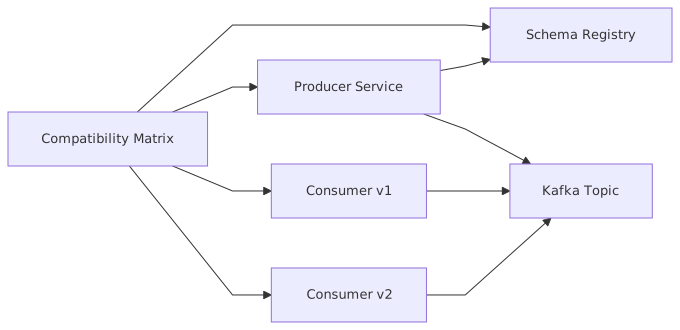
The matrix is not separate from delivery. It informs build checks, deployment gates, migration decisions, and operational runbooks.
Architecture
A robust enterprise architecture for schema compatibility in event streaming usually includes five moving parts.
Contract-first event design
Define event contracts deliberately. Use schemas stored with code. Tie them to bounded contexts and domain owners. Avoid creating “enterprise canonical events” too early; they often become bloated compromise artifacts with weak meaning. Better to have context-specific events with explicit published language.
Schema registry enforcement
Use registry compatibility modes as guardrails, not as the complete strategy. Backward compatibility is often the minimum sensible default in Kafka ecosystems because it allows old consumers to read new messages if optional additions are made carefully. But some domains need stricter controls, and some transitions need temporary exceptions.
Consumer tolerance patterns
Consumers should ignore unknown fields, use defaults carefully, and externalize mapping logic when semantics are in transition. They should also emit metrics on schema version consumption. If you cannot see who is still reading v3, you cannot retire v3 safely.
Translation and anti-corruption layers
When domain semantics genuinely change, do not hide it with field acrobatics. Introduce translation services, stream processors, or anti-corruption layers. Preserve old meaning for old consumers while publishing new meaning to new consumers.
Version-aware observability
Track event versions, transform rates, deserialization failures, semantic validation failures, and replay outcomes. A compatibility matrix without observability is just a polite fiction.
A more realistic architecture looks like this.
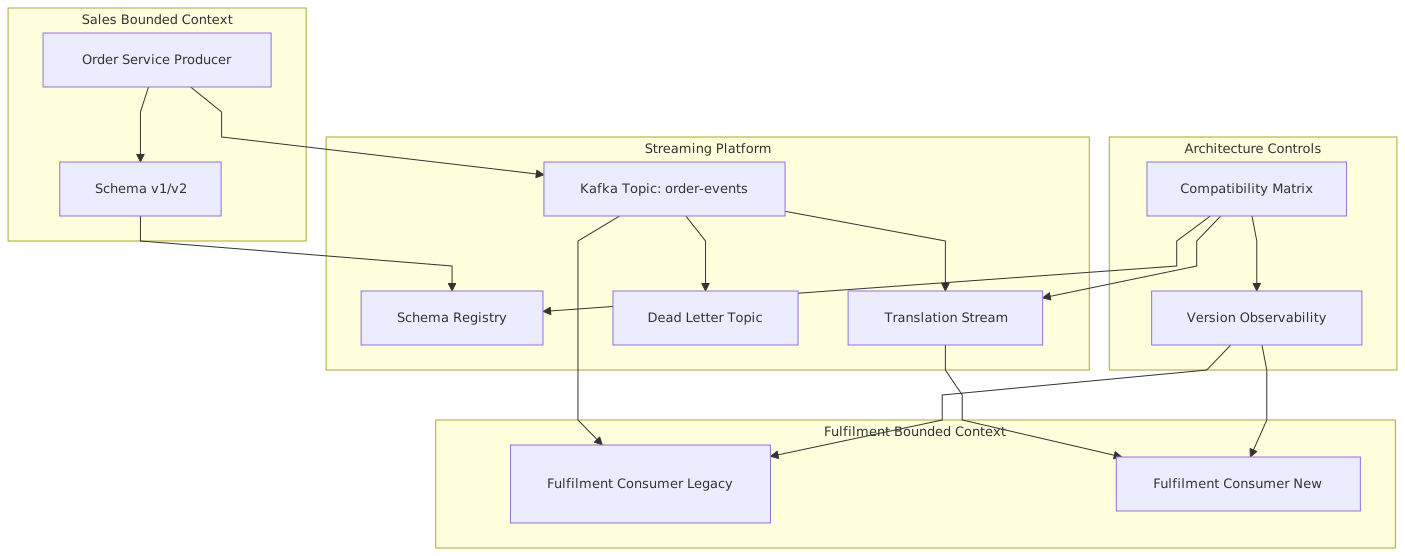
Notice the translation stream. This is where many migrations either become manageable or become a swamp. The trick is to use translation as a temporary anti-corruption measure, not as a permanent graveyard for unresolved semantics.
Migration Strategy
Most enterprises do not need a grand schema revolution. They need a migration path that does not blow up quarter-end reporting.
The right migration strategy is usually progressive strangler migration applied to event contracts.
You do not replace every producer and consumer at once. You introduce new event versions or new topics incrementally, route some traffic through translation, keep old consumers alive until they are retired, and measure who has actually moved. This is one of the few sane ways to evolve event streaming in a large organization.
A typical sequence looks like this:
- Baseline the current estate
Inventory producers, consumers, schema versions, replay jobs, and batch exports. Most enterprises are surprised by how many hidden consumers exist.
- Classify compatibility risks
Separate additive structural changes from semantic changes. Not every new field needs migration theatre. But every semantic shift deserves explicit treatment.
- Introduce a compatibility matrix
Start small. One domain, one topic family, real owners, explicit states. Do not attempt to model the whole enterprise in a spreadsheet cathedral.
- Publish new contract alongside old contract
This can be a new version in the same topic when safe, or a new topic when semantics materially diverge.
- Use translators for lagging consumers
Stream processors or adapter services can reshape new events into old forms, or vice versa, during transition.
- Run reconciliation
Compare outcomes across old and new paths. This is crucial when new events alter business interpretation, not just field shape.
- Retire old consumers and old contracts deliberately
Use observability and cutoff dates. “We think nobody uses it” is not a retirement strategy.
Here is the migration pattern in one picture.
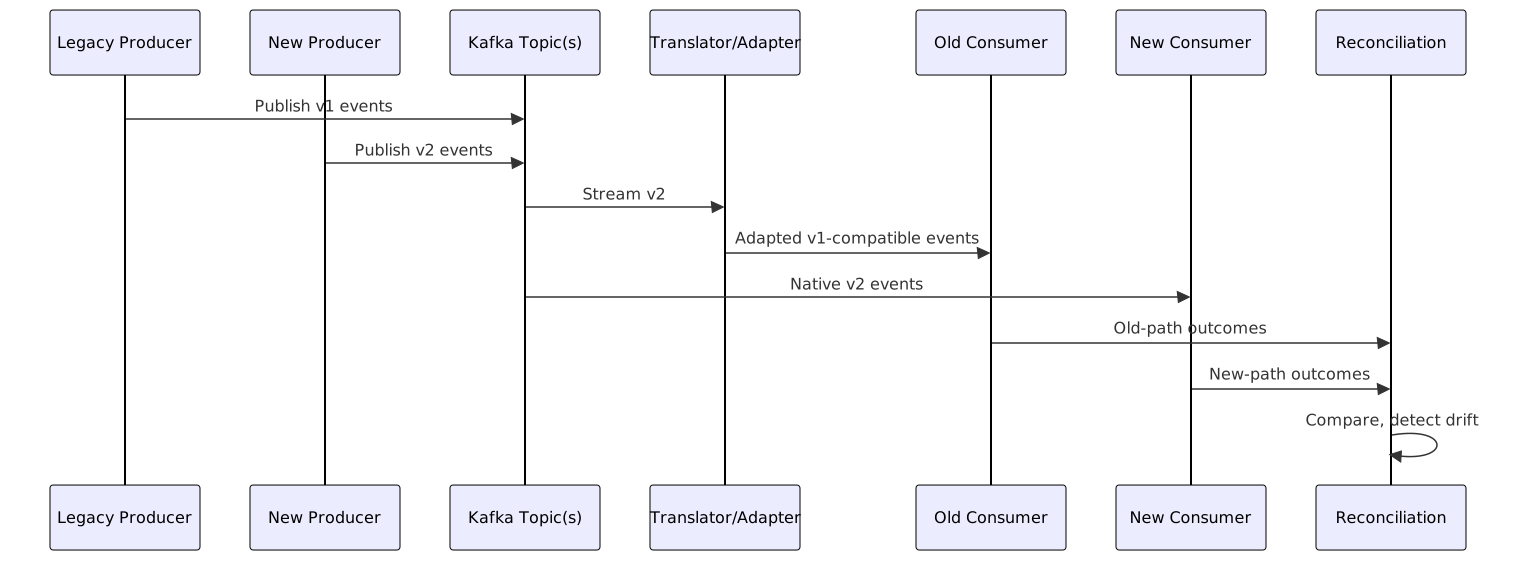
Progressive strangler in practice
The strangler pattern is often discussed for APIs, but it is equally relevant for event streams. You slowly encircle the old model with a new one. New consumers read the new event. Old consumers survive behind a translator. Over time, old paths are cut away.
This works best when you are honest about what is changing:
- If the event means the same thing and only shape changes, version within the same logical contract.
- If the business fact changes, introduce a new event name or topic. Renaming a field is cheaper than admitting a domain change, but the bill always arrives later.
Reconciliation is non-negotiable
Reconciliation is the grown-up part of migration. During coexistence, compare outcomes from old and new processing. Not just payloads. Business outcomes.
For example, in claims processing, a new event version may carry more granular status reasons. Structurally harmless. But if old consumers collapse those reasons into a generic “rejected” while new consumers route some to manual review, downstream operational counts will diverge. Reconciliation catches this before the CFO asks why reports disagree.
Reconciliation can be:
- record-by-record,
- aggregate-based,
- ledger-style balancing,
- or exception-driven for high-value domains.
It is expensive. It is still cheaper than silent corruption.
Enterprise Example
Consider a global insurer modernizing its policy administration estate.
The legacy core system emits nightly extracts. A new digital platform introduces Kafka for real-time policy events consumed by pricing, document generation, billing, and customer servicing microservices. The initial event contract for PolicyIssued is simple: policy ID, customer ID, product code, premium, effective date.
Then the business evolves.
The insurer launches multi-vehicle products, broker channels, installment billing, and regional compliance rules. The policy domain team realizes one event no longer carries enough meaning. They introduce richer attributes: rating basis, tax breakdown, payment plan, intermediary details, jurisdiction codes, and issuance source.
So far, this is ordinary evolution.
The trouble starts because downstream systems interpret premium differently. Billing wants gross premium including taxes and fees. Pricing wants technical premium before taxes. Finance wants earned premium logic based on accrual rules. The old event collapsed all of this into one field because the original team was moving fast and “everyone knows what premium means.”
Everyone did not.
The insurer implements a compatibility matrix across policy events:
PolicyIssued v1remains supported for servicing and document consumers for six months.PolicyIssued v2adds explicitgrossPremium,netPremium,taxAmount, andfeeAmount.- Semantic note: field
premiumin v1 maps togrossPremiumonly for retail products in regions A and B; elsewhere translation requires product rules. - Legacy billing remains incompatible with
v2and consumes translatedv1-compatibleevents. - Replay note: historical
v1events cannot be losslessly upgraded for older products because tax detail was absent; finance projections must derive values from source systems, not replay alone. - Reconciliation requirement: compare billed totals and issued-policy counts between old nightly extract path and new event path during migration.
This single example captures why compatibility matrices are enterprise architecture tools, not just developer documentation. They expose semantic ambiguity. They force migration reasoning. They make failure visible before production does.
The strangler migration proceeds in waves:
- Digital channels publish native
v2. - A stream adapter derives
v1-compatibleevents for old consumers. - New billing services consume
v2. - Nightly batch remains the source of truth for finance for one quarter while reconciliation runs.
- Once variances are within tolerance and exceptions are understood, finance switches to the event-driven feed.
- Old
v1consumers are retired and the translation path is shut down.
This is slow by startup standards. It is fast by enterprise standards. More importantly, it is survivable.
Operational Considerations
Compatibility strategy fails in operations long before it fails in architecture diagrams.
Version telemetry
Every consumer should report which schema versions it processes successfully, which versions trigger fallback logic, and which versions fail semantic validation. If you only monitor broker lag and throughput, you are blind to contract drift.
Contract testing
Schema registry checks are necessary but inadequate. Add consumer-driven contract tests and replay tests with representative historical data. Event evolution breaks assumptions hidden in transformation code, not just serializers.
Replay safety
Mark which consumers are replay-safe. Some consumers build projections and can replay freely. Others trigger emails, payments, or external calls and need idempotency or side-effect suppression. The compatibility matrix should point to replay rules.
Dead-letter strategy
Deserialization failures and semantic validation failures are different beasts. Put them in different buckets. A consumer that cannot parse bytes has a technical incompatibility. A consumer that parses successfully but rejects a business invariant has a semantic incompatibility. The incident response differs.
Governance cadence
Review compatibility matrices as part of domain change governance, not as an afterthought in platform operations. Event contracts belong with domain evolution discussions.
Data retention and legal constraints
Long retention helps replay and audit but lengthens compatibility obligations. In regulated sectors, retention may be mandated while schemas still evolve. Plan for long-tail support or archival conversion.
Tradeoffs
There is no free lunch here. There is barely a discounted sandwich.
Benefit: safer independent evolution
A compatibility matrix allows teams to move without pretending everyone deploys together.
Cost: more governance
Someone must own the matrix, validate semantics, and enforce retirement. This introduces process. Good. Some process is cheaper than production archaeology.
Benefit: better migration planning
You know which transitions need adapters, dual-run, or reconciliation.
Cost: more moving parts
Translators, dual topics, multi-version consumers, and reconciliation jobs add complexity. Temporary migration logic has a nasty habit of becoming permanent if not aggressively retired.
Benefit: domain clarity
Semantic incompatibilities get surfaced early. Teams are forced to admit when an event name no longer reflects the business fact.
Cost: uncomfortable conversations
The matrix often reveals that “shared enterprise event models” are vague compromises. Some organizations resist this because ambiguity is politically convenient.
A practical rule: prefer localized complexity during migration over diffuse ambiguity forever.
Failure Modes
Compatibility work tends to fail in depressingly familiar ways.
Treating compatibility as serialization only
This is the classic mistake. The schema registry says the change is valid, so the team ships. Weeks later, downstream decisions are wrong because a field’s business meaning shifted. The bytes were compatible. The business was not.
Keeping one event name for multiple meanings
When an event becomes semantically overloaded, every consumer starts carrying product logic, regional rules, and historical exceptions. This is not loose coupling. It is distributed confusion.
Permanent adapters
Adapters are excellent migration tools and terrible permanent architecture. Left too long, they become shadow domains where no one understands the transformation rules.
Hidden consumers
Analytics jobs, ad hoc exports, partner integrations, and notebook-based consumers often escape formal inventory. Then a “safe” change breaks a supposedly nonexistent dependency.
No reconciliation during cutover
Teams compare message counts and declare success. Meanwhile old and new paths compute different business outcomes. By the time this is noticed, the audit trail is murky and trust is gone.
Version explosion
If every minor change becomes a new event version without retirement discipline, the matrix becomes unreadable and support costs climb. Not every variation deserves long-term support.
When Not To Use
A schema compatibility matrix is valuable, but not universal.
Do not overengineer this pattern when:
- You have a small system with a single producer and single consumer deployed together.
- Event retention is short and replay is not a core concern.
- Contracts are internal implementation details with tightly coordinated teams.
- The domain is simple and changes are rare.
- You are still discovering the domain and should avoid premature formalization.
Even then, some lightweight version discipline is wise. But a full compatibility grid with semantic governance, adapters, and reconciliation may be excessive.
Also, do not use a compatibility matrix as a substitute for fixing a broken domain model. If your events are vague snapshots emitted from CRUD tables, the matrix will document the mess, not cure it. Domain-driven design still matters. The best compatibility strategy begins with events that express genuine domain facts.
Related Patterns
Several related patterns often travel with schema compatibility management.
Consumer-driven contracts
Useful for understanding actual downstream expectations, especially where consumers are diverse. Best used alongside producer-owned domain contracts, not instead of them.
Anti-corruption layer
Essential when legacy semantics and new domain semantics differ. The ACL protects the new model from old distortions.
Strangler fig pattern
The right migration posture for most enterprises. Replace incrementally, measure continuously, retire ruthlessly.
Event versioning
Necessary but blunt. Versioning alone does not solve semantic ambiguity.
Upcasting and downcasting
Helpful for read-time translation, especially in event sourcing or replay-heavy systems. Dangerous if they become magical semantics laundering.
Outbox pattern
Relevant when producers need reliable event publication from transactional systems. It stabilizes publication, though not semantics.
Canonical data model
Sometimes useful for enterprise reporting or integration hubs. Often overused. In event streaming, canonical models can flatten bounded-context meaning into generic mush. Use sparingly.
Summary
A schema compatibility matrix is one of those architectural tools that looks dull until you need it, and then it becomes the difference between controlled evolution and institutional panic.
In event streaming systems, especially Kafka-based microservices estates, compatibility is not just about reading bytes. It is about preserving meaning across time, teams, and migrations. Structural compatibility matters. Semantic compatibility matters more. Operational compatibility is where the pain shows up.
The strongest approach ties schema evolution to domain-driven design. Events belong to bounded contexts. Their names and fields should reflect business facts, not incidental database structure. When the domain meaning changes, admit it. Publish a new contract. Use translators during migration. Reconcile outcomes. Retire old paths deliberately.
That is the point of the compatibility grid. It gives architecture a memory and migration a plan.
The enterprise lesson is simple: every event contract is a promise made to the future. A compatibility matrix is how you keep that promise without freezing the business in place.
Frequently Asked Questions
What is event-driven architecture?
Event-driven architecture (EDA) decouples services by having producers publish events to a broker like Kafka, while consumers subscribe independently. This reduces direct coupling, improves resilience, and allows new consumers to be added without modifying producers.
When should you use Kafka vs a message queue?
Use Kafka when you need event replay, high throughput, long retention, or multiple independent consumers reading the same stream. Use a traditional message queue (RabbitMQ, SQS) when you need simple point-to-point delivery, low latency, or complex routing logic per message.
How do you model event-driven architecture in ArchiMate?
In ArchiMate, the Kafka broker is a Technology Service or Application Component. Topics are Data Objects or Application Services. Producer/consumer services are Application Components connected via Flow relationships. This makes the event topology explicit and queryable.