⏱ 20 min read
Most enterprise systems do not fail because they lack validation. They fail because validation is scattered like broken glass across controllers, message consumers, UI forms, database constraints, and tribal memory. Everyone “checks” something, yet nobody can tell you where the business actually decides what is allowed.
That is the quiet tax of many CQRS systems.
Teams adopt Command Query Responsibility Segregation because they want clearer models, independent read optimization, and better handling of change. They usually get those benefits. But then a more subtle problem appears: where should command validation live? In the API? In the application service? In the aggregate? In a workflow? In Kafka consumers? Everywhere? The honest answer is yes, but not in the same way. event-driven architecture patterns
This is where architecture matters. Validation is not a single concern. It is a stack of concerns with different timing, different semantics, and different failure consequences. Treating all validation as one thing is how we end up with anemic domain models, duplicated rules, brittle integrations, and impossible migrations.
The useful move is to think in layers. Not because layers are fashionable, but because different questions deserve different homes. “Is the JSON well formed?” is not the same question as “Does this customer still have credit?” and neither is the same as “Did another bounded context reserve the inventory five seconds ago?” If you place these in the same bucket, the bucket leaks.
In a CQRS architecture, command validation layers create a disciplined path from intent to decision. They help separate transport correctness from domain invariants, local consistency from cross-service policy, and immediate rejection from eventual reconciliation. Done well, they make systems easier to reason about, easier to migrate, and far more honest about where truth actually lives.
Context
CQRS changes the shape of a system by splitting write intent from read optimization. Commands express what a user or upstream system wants to do. Queries answer what the world currently appears to be. The write side protects business rules and state transitions. The read side serves projections tailored for use cases.
This sounds straightforward until the system grows teeth.
A command rarely travels alone. It arrives through an API gateway, or a UI backed by BFF services, or a Kafka topic, or a batch import, or a partner integration. It is authenticated, authorized, deserialized, enriched, routed, retried, audited, and sometimes translated between models. Along that path, many actors are tempted to “just validate it here.” Sensible in isolation, disastrous in aggregate.
Domain-driven design gives us the right lens. Validation is meaningful only in relation to a model. And enterprises do not have one model; they have many bounded contexts. A Sales context may allow an order to be accepted before inventory is physically reserved. A Fulfillment context may reject shipment creation without a valid warehouse assignment. A Finance context may block invoice issuance if tax registration is missing. Those are not duplicate validations. They are different semantic decisions in different domains.
That distinction matters in CQRS because command handling is where business intent meets business truth.
Problem
The usual anti-pattern appears early: all validation gets shoved to the edges.
Frontend teams add form rules. API teams add request validators. Integration teams add schema contracts. Data teams add database constraints. Workflow teams add BPM checks. Event consumers reject messages that “don’t make sense.” Eventually somebody notices that a supposedly invalid operation succeeded through one channel but failed through another.
Now the conversation gets painful.
Was the order invalid because quantity was negative? That is trivial and should have been rejected immediately. Was it invalid because the customer exceeded credit? That depends on live business state. Was it invalid because the product was discontinued in the catalog but still sellable under an exception contract? That depends on domain semantics. Was it invalid because another microservice had not yet processed a prior event? That may not be invalid at all; it may be temporarily undecidable. microservices architecture diagrams
Without explicit validation layers, teams conflate four different categories:
- Input validation: shape, type, required fields, basic format.
- Application validation: permissions, command completeness, routing preconditions, idempotency checks.
- Domain validation: invariants and state transition rules inside the domain model.
- Distributed validation: policies that depend on data or decisions outside the local transactional boundary.
That conflation creates three recurring enterprise problems.
First, domain rules drift into edge services and are duplicated across channels. The API says one thing. The Kafka consumer says another. The batch importer has its own shortcuts.
Second, systems become migration-hostile. If validation is baked into every caller, moving from a monolith to services becomes a archaeology project.
Third, teams promise synchronous certainty where the architecture can only offer eventual certainty. That usually ends with reconciliation jobs and apology emails.
Forces
There is no clean answer without acknowledging the forces pulling in different directions.
Fast rejection versus correct rejection
Rejecting bad commands early saves money, CPU, and user frustration. Nobody wants to load an aggregate just to discover the quantity field is missing.
But the closer a rule is to the edge, the more likely it is to become a lie. Edge layers rarely have full domain context, complete policy history, or current state across bounded contexts.
Reuse versus ownership
Centralizing validation sounds efficient. One shared validation library, one set of annotations, one dream. Then the Sales team changes semantics for “preferred customer,” while Finance keeps the old definition for credit policy. Shared validators become shared coupling.
DDD teaches the opposite instinct: rules belong with the model that owns the meaning.
Strong consistency versus availability
Inside a single aggregate or transactional boundary, command validation can be decisive. Across microservices, decisive validation often requires distributed locking, synchronous orchestration, or brittle chains of remote calls. Enterprises talk a good game about autonomy until quarter-end traffic arrives and the synchronous validation mesh starts timing out.
User experience versus system truth
A UI wants immediate answers. A distributed system often cannot provide them honestly. Architects need to choose where to return “accepted,” where to return “rejected,” and where to return “pending decision.”
Migration safety versus architectural purity
In a legacy estate, the existing monolith may still hold part of the truth. A progressive strangler migration means validation responsibilities cannot move all at once. During transition, some rules remain in the old core while new command handlers emerge around it. That awkwardness is not failure. It is the price of not betting the company on a weekend rewrite.
Solution
The practical solution is to model validation as explicit layers along the command path. Each layer has a purpose, a scope, and a rule about what kinds of decisions it may make.
A good rule of thumb is simple:
Validate as early as possible, but decide as late as necessary.
That line tends to survive architecture reviews.
Here is the layered approach I recommend.
1. Transport and contract validation
At the boundary, validate the message envelope, schema, syntax, required fields, primitive ranges, and serialization assumptions. This is where you reject malformed JSON, invalid enum values, missing IDs, malformed dates, oversized payloads, and schema version incompatibilities.
These checks are not business rules. They are admission control.
If a Kafka consumer receives a command event with no tenant identifier, it should fail before domain code ever runs. If an HTTP request includes a string where a decimal is required, reject it immediately.
This layer should be deterministic, cheap, and context-light.
2. Application validation
Next comes validation owned by the application service or command handler pipeline. This is where we check authorization, idempotency keys, anti-replay tokens, feature toggles, tenant scoping, command completeness, and whether the target aggregate or workflow is addressable.
This layer answers questions like:
- Is the caller allowed to issue this command?
- Has this exact command already been processed?
- Does the tenant exist and is it active?
- Can this request be routed to the proper bounded context?
- Does the command include correlation metadata required for downstream tracing?
These are operationally important, but they are still not domain invariants.
3. Domain validation
This is the center of gravity.
Domain validation lives in the aggregate, domain service, policy object, or invariant-rich model that owns the business meaning. This is where the system decides whether the requested state transition is allowed according to domain semantics.
Examples:
- An order cannot be confirmed if it has no line items.
- A shipment cannot be dispatched if already delivered.
- A policy cannot be renewed after legal termination.
- A customer cannot move to Platinum tier unless eligibility criteria are met.
This layer must be authoritative for local business truth. If a rule defines legal state transitions for an aggregate, do not leave it in controllers or orchestration code.
4. Cross-context and distributed policy validation
Some commands depend on information outside the local consistency boundary. Credit checks, inventory reservations, sanctions screening, fraud scoring, pricing approvals, and legal holds often sit here.
This is where naïve architectures fall apart. Teams try to turn distributed policy into synchronous validation by making a chain of remote calls before accepting a command. It works in slide decks and fails under latency, partial outages, and semantic drift.
A better approach is to distinguish between:
- Must-decide-before-acceptance policies
- Can-decide-after-acceptance policies
If inventory reservation is mandatory before order acceptance, then either inventory belongs inside the same consistency boundary or the command should enter a pending process managed by saga/process manager semantics.
If fraud review can happen after payment authorization, then the command may be accepted provisionally, with follow-up compensations or holds.
5. Reconciliation validation
This is the layer teams pretend they do not need until production teaches them otherwise.
In distributed CQRS systems, some decisions are made with stale reads, delayed events, or partial information. Reconciliation is the discipline of detecting and resolving divergence later. It is not a bug fix. It is part of the architecture.
Reconciliation checks answer:
- Did the read model mislead a command path?
- Did an external service respond “approved” and then issue a later reversal?
- Did duplicate or out-of-order Kafka events create inconsistent downstream state?
- Did a temporary exception allow a command that now violates policy?
You should design for this layer from the start, especially in microservices using asynchronous messaging.
Architecture
A layered validation architecture in CQRS typically looks like this.

The point is not to create bureaucracy. The point is to stop asking the wrong layer to make the wrong decision.
A practical implementation often uses a command pipeline with decorators or middleware:
- schema validator
- auth validator
- idempotency validator
- command enricher
- handler invocation
- event publication
- post-commit policy orchestration
This keeps edge concerns out of domain code while preserving a single path for command processing.
The domain model itself should remain explicit. If a command asks to ApproveLoan, the aggregate should expose behavior that reflects domain language, not generic setters. Invariants belong there. DDD is not window dressing here. It is the difference between a system that speaks the business language and one that merely stores records.
Here is a more domain-centric view.
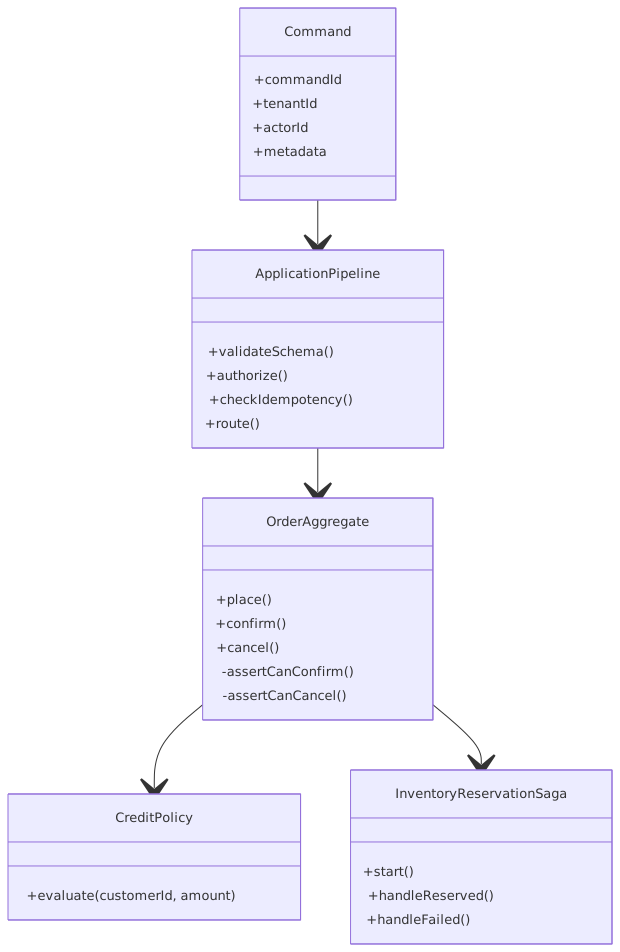
Notice the separation. The aggregate enforces its own rules. The policy object or saga coordinates what cannot be decided purely inside the aggregate. That line is the heart of sane CQRS validation.
Domain semantics matter more than code location
One of the worst enterprise habits is discussing validation only as placement. “Should this go in the controller or service?” That is a code-organization question pretending to be architecture.
The real question is semantic ownership.
Suppose we have a SubmitInsuranceClaim command. Consider these checks:
- Claim amount must be a positive monetary value.
- Policy number must exist.
- Submission must come from an authenticated claimant or agent.
- A terminated policy cannot accept new claims after termination date.
- Claims over a threshold need fraud screening.
- Duplicate claims from the same source in a ten-minute window should be ignored.
- Claims from embargoed jurisdictions require legal review.
These rules belong in different places because they mean different things. Positive amount is transport/application hygiene. Authentication is application validation. “Terminated policy cannot accept new claims” is a domain invariant. Fraud screening and legal review are cross-context policies. Duplicate suppression is idempotency and operational safety.
When architects fail to make these semantic distinctions, teams either over-centralize or over-scatter. Both are expensive.
Migration Strategy
In greenfield work, layered validation is straightforward. In enterprises, almost nobody gets greenfield. You inherit a monolith, several integration hubs, a brittle ESB nobody wants to admit still matters, and a read estate assembled over ten years of reporting requests.
So migration must be progressive. Strangler fig, not chainsaw.
Start by identifying command types with high business value and manageable consistency boundaries. Do not begin with the hardest cross-domain transaction in the company. Begin where one bounded context can own a meaningful slice of command authority.
The migration path usually unfolds like this:
Step 1: Catalog existing validations
Before moving any command, inventory where validations currently live:
- UI and mobile clients
- API gateways
- monolith controllers/services
- stored procedures and triggers
- integration middleware
- batch jobs
- downstream consumers
This exercise is ugly and necessary. It exposes duplication, contradictions, and shadow policies.
Step 2: Separate hard invariants from convenience checks
Hard invariants must move with the domain authority. Convenience checks can remain at the edge temporarily. If the monolith still owns credit policy, do not fake ownership in the new service.
Step 3: Introduce a command façade
Create a new command endpoint or Kafka ingress that applies transport and application validation consistently. Even if the command still delegates to the monolith for domain decision, you have begun standardizing the outer layers.
Step 4: Strangle domain validation incrementally
Move one invariant cluster at a time into the new bounded context. Keep old and new paths observable. During transition, the old system may still be the system of record while the new service acts as a validation façade and event publisher.
Step 5: Add reconciliation before cutting over
This is the step teams skip because deadlines win. Add reconciliation before full autonomy. When old and new systems overlap, mismatches will happen. Reconciliation reports, dead-letter handling, and discrepancy workflows are your airbag.
Step 6: Shift distributed policies toward asynchronous coordination
As command ownership moves out of the monolith, distributed policy checks often need to become sagas, asynchronous approvals, or provisional acceptance flows rather than synchronous RPC chains.
A migration view looks like this:
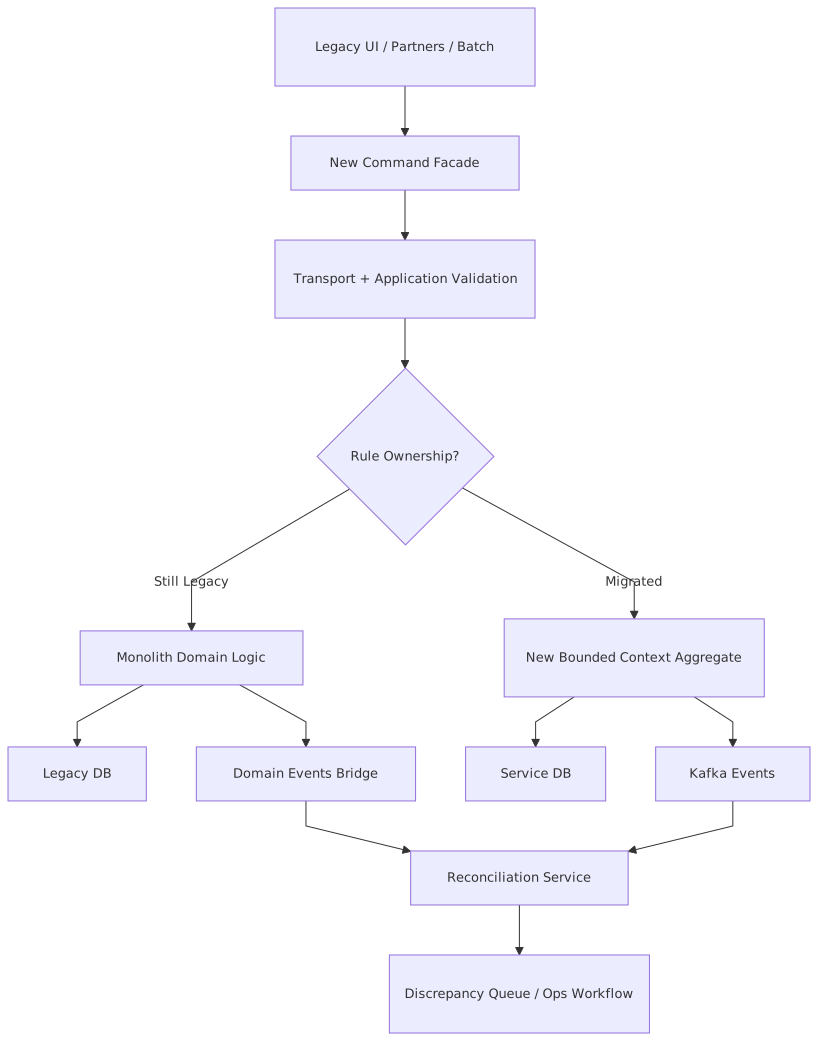
This pattern is not glamorous, but it is how large companies survive migration without pausing the business.
Enterprise Example
Consider a global wholesale distributor migrating order management from a monolithic ERP customization into a CQRS and Kafka-based architecture. The company sells industrial equipment across 40 countries. Orders touch Sales, Pricing, Inventory, Credit, Logistics, and Compliance. Nobody truly “owns” the entire process, which is exactly why validation became a mess.
Originally, orders entered through web portals, call-center tools, EDI feeds, and partner APIs. Each channel had its own checks. The ERP still held authoritative inventory allocation and customer credit. A separate compliance platform screened export restrictions nightly. Pricing exceptions were managed in another system entirely.
The symptoms were classic:
- Web orders could be submitted that EDI orders would reject.
- Credit overruns happened because one path cached stale balances.
- Inventory was oversold during peak demand because read replicas lagged.
- Compliance holds were discovered after shipment creation.
- Support teams spent hours reconciling “accepted” orders later cancelled by back-office processes.
The migration strategy did not try to solve everything at once.
First, the architecture team established an Order Capture bounded context. Its job was not to own all policies immediately. Its job was to own command intake and the semantic lifecycle of an order submission.
They defined validation layers clearly:
Transport/contract
JSON/EDI schema, product code format, mandatory purchase order fields, tenant and source metadata.
Application
Authentication, channel authorization, duplicate command suppression, partner entitlement checks, route-to-market restrictions.
Domain
An order submission must contain at least one orderable line, currency must align with customer contract, discontinued products may only be sold under override rules, and orders cannot be amended after release.
Distributed policy
Credit approval, inventory reservation, export compliance, and pricing exception authorization.
This changed behavior dramatically.
Instead of trying to synchronously validate every external dependency before accepting an order, the new service accepted SubmitOrder into a domain state of PendingValidation when distributed policies were unresolved. Domain events were emitted to Kafka. Credit, inventory, and compliance services responded asynchronously. A process manager advanced the order to Validated, Held, or Rejected.
Purists complained this was not “real-time enough.” Operations loved it because it was honest. The UI could show an order as pending. Support could explain where it sat. The system no longer pretended certainty it did not possess.
Reconciliation became essential. Inventory events occasionally arrived out of order during regional failovers. Credit limits changed while a command was in flight. Compliance decisions sometimes reversed after updated sanctions lists. Rather than bury these as exceptions, the architecture introduced a reconciliation service that compared order state, policy outcomes, and downstream shipment status. Mismatches created operational tasks with domain-specific reason codes.
This is the part many articles omit: reconciliation was not a side utility. It was a first-class validation layer for distributed truth.
Within 18 months, order acceptance defects fell sharply, partner onboarding improved because ingress rules were clear, and the ERP could be progressively strangled without freezing all business change. Not because CQRS is magic. Because validation responsibility was made explicit.
Operational Considerations
Validation layers shape operations as much as design.
Idempotency
Command handlers, especially behind Kafka or retried HTTP calls, must be idempotent. Duplicate detection belongs in the application layer, close to command processing. Without it, retries mutate business state unpredictably and create phantom validation failures.
Observability
Every rejection or hold should produce structured reason codes. “Validation failed” is useless. “CreditPolicy.PendingExternalResponse” tells operations what to do next.
Trace command progression across layers. A good distributed trace should reveal whether a command was rejected at schema validation, denied in authorization, blocked by an aggregate invariant, or sent to pending due to cross-context dependency.
Dead-letter and poison message handling
Malformed commands belong in dead-letter queues with enough metadata for diagnosis. But be careful: business-invalid commands are not poison messages. They are expected outcomes and should be modeled as domain rejections, not transport failures.
Versioning
As command contracts evolve, transport validation must support version compatibility strategies. Domain semantics may also evolve independently. Keep wire contract changes separate from business rule changes when possible.
Read model staleness
Never pretend read models are perfect authorities for command validation unless your consistency model really supports it. Read models can guide UX pre-checks, but authoritative domain validation should happen against the write model or owned transactional state.
Tradeoffs
No architecture gets a free lunch.
Layered validation adds ceremony. More components, more explicit rule placement, more design conversations. Small teams working on simple CRUD systems may not need this machinery.
Asynchronous distributed validation improves resilience and decoupling, but complicates user experience. “Pending” is operationally honest but commercially awkward if stakeholders expect immediate yes/no answers.
Keeping domain invariants inside aggregates strengthens correctness, but can make some bulk-processing scenarios slower or harder to optimize. Sometimes you need specialized command batching or domain services for throughput-heavy cases.
Reconciliation is necessary in distributed systems, but it creates operational burden. Somebody owns discrepancy queues. Somebody decides compensations. Somebody explains to the business why “accepted” did not always mean “final.”
These are real costs. Worth paying only when the business complexity is real.
Failure Modes
There are a few predictable ways this architecture goes wrong.
Edge validation becomes shadow domain logic
Teams duplicate business rules in APIs and UIs “for performance.” Months later, behavior diverges by channel.
Aggregates become anemic
All rules move into handlers, validators, and orchestrators. The aggregate turns into a persistence shell. This is CQRS in costume, not in substance.
Distributed checks become synchronous dependency chains
One command triggers five remote calls. Latency spikes. Circuit breakers open. Retries multiply. Users receive inconsistent answers.
Reconciliation is treated as exception handling
If reconciliation is only a cleanup script written after production incidents, the system is under-architected.
Reason codes are not modeled
Without precise rejection semantics, support teams cannot distinguish malformed requests from policy holds from invariant violations.
Migration duplicates authority
During strangler migration, old and new systems both think they own a rule. Contradictions follow. Temporary dual validation is fine; dual authority is not.
When Not To Use
Do not build a full validation-layered CQRS architecture for a simple line-of-business app that mostly does CRUD on a single database with low business criticality. You will spend more energy explaining the architecture than benefiting from it.
Do not force asynchronous distributed validation where the business truly requires immediate atomic consistency and the bounded context can be kept cohesive in one service or one transactional store. Sometimes the right answer is a well-structured modular monolith.
Do not model every field constraint as domain logic. If a field must be a valid email format, that is not a strategic domain insight. Save the domain model for decisions that matter.
And do not use CQRS as an excuse to ignore transaction boundaries. If two concepts truly form one consistency boundary, splitting them into separate services and “solving” it with Kafka is not architecture. It is outsourcing your design mistake to operations.
Related Patterns
Several patterns sit naturally beside validation layers in CQRS:
- Aggregate invariants for local business rule enforcement
- Specification pattern for reusable domain predicates, used carefully
- Policy objects for business decision encapsulation
- Saga/process manager for cross-context validation and coordination
- Outbox pattern for reliable event publication after command success
- Idempotent consumer for Kafka and retried message handling
- Anti-corruption layer during monolith or ERP strangler migration
- Reconciliation workflows for eventual consistency correction
- BFF and UX pre-validation for user guidance without claiming authority
These are not random accessories. They are the supporting cast for making command validation trustworthy in a distributed enterprise estate.
Summary
Validation in CQRS is not one thing. It is a sequence of different decisions made for different reasons under different levels of certainty.
The architecture works when each layer knows its job:
- the boundary checks message correctness
- the application layer checks access, idempotency, and routing
- the domain model enforces invariants and legal state transitions
- distributed policies coordinate what lives beyond local consistency
- reconciliation repairs the truth gap that distributed systems inevitably create
That layered view aligns well with domain-driven design because it respects semantic ownership. It also aligns with real migration work because enterprises rarely move validation in one clean cut. Progressive strangler migration demands temporary delegation, explicit authority boundaries, and a serious reconciliation story.
If there is one memorable line to keep, let it be this:
A command is not valid because many places checked it. A command is valid when the right model made the right decision at the right time.
That is the difference between software that merely rejects bad input and architecture that protects business truth.
Frequently Asked Questions
What is CQRS?
Command Query Responsibility Segregation separates read and write models. Commands mutate state; queries read from a separate optimised read model. This enables independent scaling of reads and writes and allows different consistency models for each side.
What is the Saga pattern?
A Saga manages long-running transactions across multiple services without distributed ACID transactions. Each step publishes an event; if a step fails, compensating transactions roll back previous steps. Choreography-based sagas use events; orchestration-based sagas use a central coordinator.
What is the outbox pattern?
The transactional outbox pattern solves dual-write problems — ensuring a database update and a message publication happen atomically. The service writes both to its database and an outbox table in one transaction; a relay process reads the outbox and publishes to the message broker.