⏱ 19 min read
Order is one of those things architects overpay for because humans find disorder emotionally offensive.
We like to believe business happens in a neat line: customer places order, payment clears, inventory reserves, shipment leaves the warehouse, refund happens if needed. It reads well in a PowerPoint. It comforts program managers. It makes audit teams smile. But distributed systems do not care about our need for a tidy narrative. They operate through retries, partitions, lag, duplicate delivery, concurrent updates, and independent services moving at different speeds. In the real world, events arrive late, arrive twice, or arrive in the “wrong” sequence. Then the business asks a dangerous question: “Can we guarantee ordering?”
That question sounds technical. It isn’t. It is a domain question wearing infrastructure clothing.
The central mistake in many event-driven programs is trying to answer ordering entirely at the messaging layer. Teams argue about Kafka partitions, FIFO queues, single-threaded consumers, and broker semantics before they’ve asked the more useful question: what exactly must be ordered, for whom, and what happens if it isn’t? In domain-driven design terms, ordering is not a platform requirement. It is a business invariant. And like every invariant, it belongs inside a bounded context, expressed in the language of the domain, with explicit consequences when violated.
This is where mature architecture begins. Not with “ordered vs unordered queues” as a product feature comparison, but with the idea that some business facts are causally dependent and others merely correlated. Payment events for the same account may require serialization. Product view events for analytics almost certainly do not. A shipment event may need to occur after a reservation event from the perspective of fulfillment, while the customer-notification context can tolerate eventual consistency and even transient reordering. Treat all events as requiring total order and you will build a fragile, expensive bottleneck. Treat all events as unordered and you will create hidden data corruption that only shows up in quarter-end reconciliation.
There is no universal answer. There is only disciplined design.
Context
Event-driven architecture became popular because enterprises got tired of systems that only worked if everything was up at the same time. Synchronous orchestration scales poorly across business boundaries. It creates temporal coupling, and temporal coupling is the silent tax on every large platform. Events offered an escape: services publish facts, other services react independently, and the enterprise becomes more resilient.
Then reality arrives. As soon as separate services maintain their own state, questions of consistency, causality, and sequencing come to the surface. A customer changes address, then cancels an order, then reopens it. Which state wins? A bank account gets debited, then credited, but the credit arrives first at a downstream fraud engine. Does it flag the customer? A retail platform publishes inventory adjustments from stores around the globe. Can the planning engine safely process these out of order?
Most teams discover that “eventual consistency” is not a design, just a promise to have hard conversations later.
Kafka, Pulsar, RabbitMQ, SQS, Azure Service Bus, and cloud-native event platforms all expose different ordering behaviors. Kafka gives per-partition order, not global order. FIFO queues can preserve order but often at a steep throughput cost and with subtle limits around message groups. Standard queues maximize scale but make no useful promise beyond best-effort delivery. The platform matters, but the business semantics matter more.
Ordering guarantees are therefore an architecture decision at the intersection of domain design, messaging topology, service boundaries, and operational discipline.
Problem
The problem is simple to state and deceptively hard to solve:
How do we preserve the event order that matters to the business without paying the cost of ordering where it does not?
That breaks into several practical concerns:
- Some events must be processed in sequence for the same business entity.
- Some consumers need ordered processing while others do not.
- Different bounded contexts may care about different notions of “correct order.”
- Distributed brokers generally provide limited ordering scopes.
- Failures, retries, parallelism, and reprocessing routinely disturb observed order.
- Legacy systems often assume a total ordered world and react badly when migrated into asynchronous ecosystems.
The word “order” itself is overloaded. It can mean at least four different things:
- Publication order: the order in which a producer emits events.
- Broker order: the order in which the messaging platform stores or delivers them.
- Consumption order: the order in which a consumer processes them.
- Business causal order: the order implied by domain rules.
These are not the same. Architects who blur them tend to create systems that appear correct in testing and fail under production load.
A queue can preserve publication order and still violate business causality if two producers emit conflicting events from stale state. A consumer can process messages sequentially and still compute the wrong result if a retry reintroduces an older event after a newer state transition. And a broker can provide no ordering guarantee at all while the business remains perfectly safe because the consumer uses commutative updates or version checks.
The right design starts by discovering the minimum ordering guarantee necessary for the domain.
Forces
There are competing forces here, and they are not minor.
Business invariants vs throughput
The stronger the ordering guarantee, the more you constrain concurrency. Total order is expensive because it usually implies serialization. Serialization is the enemy of throughput.
If every customer event must flow through one ordered stream, your customer platform becomes a single-file line at airport security. Safe, maybe. Fast, never.
Local correctness vs global scalability
Per-aggregate ordering is often enough. That aligns well with domain-driven design, where aggregates define consistency boundaries. But many enterprise teams ask for global order because it is easier to reason about. Easier for people, worse for systems.
Availability vs strict sequencing
During partitions or consumer failures, systems with strict ordering often stop progress to preserve sequence. Systems with weaker guarantees keep moving and reconcile later. This is a business choice, not merely a technical one.
Simplicity now vs flexibility later
Single consumer, ordered queue, done. That works surprisingly well for narrow workloads. It breaks when the business wants ten times the volume, parallel consumers, replay, or region-level scaling.
Consumer autonomy vs shared constraints
In event-driven architecture, different consumers should evolve independently. But if ordering is enforced centrally for all consumers, you may end up imposing expensive constraints on analytics, notifications, search indexing, and machine learning pipelines that do not need them.
Semantics vs mechanics
The domain may care about “latest approved credit limit” rather than every intermediate event. In that case, sequence matters less than monotonic versioning. Too many teams solve semantic problems with infrastructure mechanics.
Solution
Here is the opinionated answer: default to unordered delivery, then design explicit ordering where the domain demands it. Not the other way around.
Ordered messaging should be treated like a precision instrument. Use it on the small surfaces where the business would genuinely break without it. Everywhere else, embrace idempotency, version-aware consumers, and reconciliation.
This leads to a layered approach.
1. Define the ordering scope in domain terms
Do not ask “Do we need ordered queues?” Ask:
- Ordered for which business entity?
- Ordered within which bounded context?
- Ordered across which state transitions?
- Ordered from whose point of view?
- Ordered for processing or only for final persisted state?
In DDD language, ordering often belongs at the aggregate level. For example:
- Bank account transactions: order per account.
- Customer profile changes: order per customer.
- Warehouse stock reservations: order per SKU-location pair.
- Shipment tracking updates: order per shipment.
That is a much smaller scope than global order across the entire enterprise.
2. Use partitioned ordering where possible
Kafka’s great trick is not ordering. It is scoped ordering. Events in the same partition are ordered; events across partitions are not. If the partition key aligns with the aggregate identity, you get the useful kind of order without global serialization.
This is often the sweet spot for microservices. Partition by account ID, order ID, customer ID, or another stable business key. Then ensure the producer emits events consistently for that key. microservices architecture diagrams
3. Make consumers version-aware
Even with partitioned streams, consumers should not blindly assume arrival order is always correct. Add version numbers, sequence numbers, or event timestamps with domain meaning. Consumers can then detect:
- stale events
- gaps in sequence
- duplicates
- impossible transitions
This is more robust than faith in the broker.
4. Separate command consistency from event observation
Commands usually require stronger consistency than events. If a domain invariant must hold at write time, enforce it inside the aggregate or transactional boundary. Events then become a propagation mechanism, not the sole guardian of truth.
That distinction saves teams from trying to make asynchronous messaging do the work of transactional consistency.
5. Reconcile where order cannot be guaranteed economically
Some workflows will be partly unordered by design. Good. Build reconciliation into the model. Periodic repair jobs, compensating events, read-model rebuilds, and exception queues are signs of maturity, not defeat.
A distributed enterprise without reconciliation is just denial with dashboards.
Architecture
A practical architecture usually combines ordered and unordered channels, each chosen for a reason.
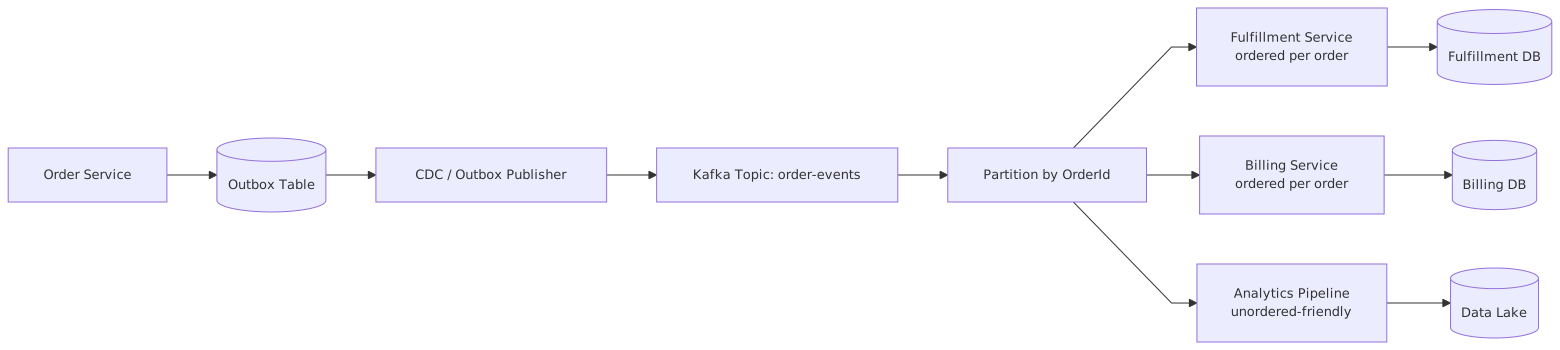
In this pattern:
- The producer writes state and event intent atomically using the outbox pattern.
- CDC or an outbox publisher emits events to Kafka.
- The topic is partitioned by
OrderId. - Fulfillment and billing care about per-order sequence.
- Analytics does not need strict ordering and can process with looser semantics.
This is not just a messaging design. It is domain-informed architecture. Different consumers get different correctness models from the same event stream.
Ordered queues
Ordered queues or FIFO queues are useful when:
- the workload is naturally serialized
- contention is low
- the business invariant is strict
- throughput is modest
- the operational team values predictability over scale
But they come with costs:
- lower parallelism
- head-of-line blocking
- poison message amplification
- reduced elasticity
- awkward hot-key behavior
If one customer or one account becomes extremely active, that ordered lane becomes a traffic jam.
Unordered queues
Unordered or standard queues maximize throughput and resilience to bursts. They fit workloads where:
- operations are commutative
- consumers are idempotent
- stale updates can be ignored using version checks
- reconciliation is acceptable
- consumers are mostly asynchronous projections
This is the right default for notifications, search indexing, clickstreams, telemetry, cache invalidation, and many integration flows.
Hybrid pattern: ordered islands in an unordered sea
This is often the enterprise answer. Use unordered events broadly, and introduce ordered handling only where aggregate-level business invariants demand it.
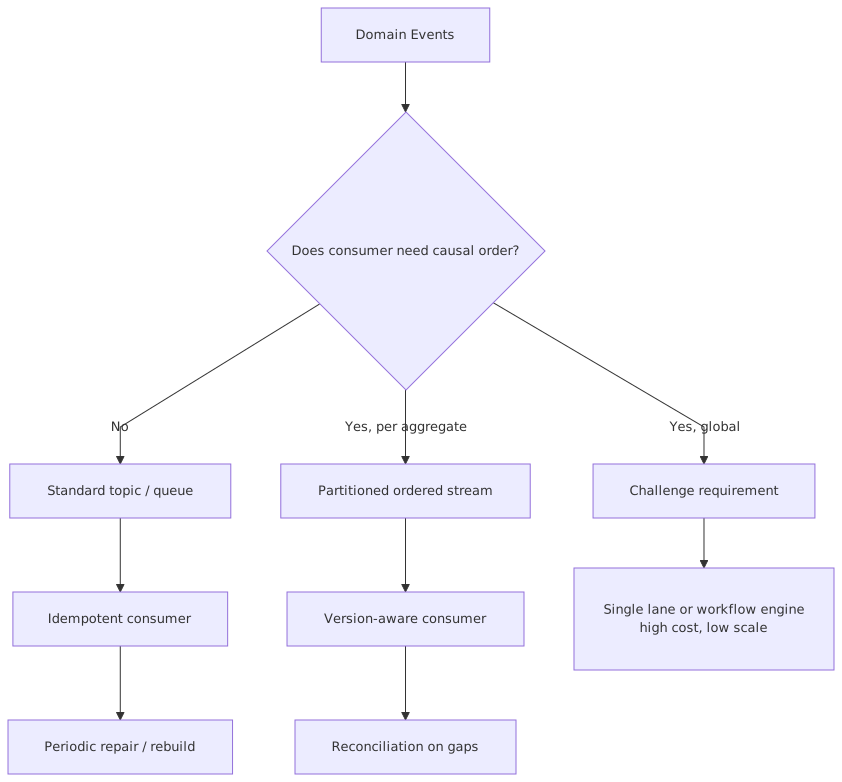
Notice the “Challenge requirement” box. That is deliberate. Global order requests deserve skepticism. Many of them are really requests for easier mental models, not true business necessity.
Migration Strategy
Most enterprises do not start on a clean slate. They inherit batch systems, ESBs, shared databases, and transaction-heavy monoliths that quietly depend on implicit ordering. The migration path matters more than the target architecture.
This is where the progressive strangler approach earns its keep.
You do not rip out a legacy order management platform and replace it with “event-driven microservices.” That is architecture fan fiction. You carve along domain seams, introduce event publication beside existing transaction paths, and move consumers one bounded context at a time.
Step 1: Identify order-sensitive business capabilities
Map capabilities and classify them:
- strict sequence required per entity
- monotonic latest-state required
- no meaningful order dependency
- unknown, needs discovery
This should be done with domain experts, not just middleware specialists.
Step 2: Publish canonical domain events from the legacy core
Use outbox or change data capture from the monolith or packaged application. Do not start by letting downstream teams scrape tables or infer state transitions from CRUD deltas. Publish explicit business events where possible: PaymentAuthorized, InventoryReserved, ShipmentDispatched.
Step 3: Introduce consumers that tolerate disorder
Early in migration, event quality will be uneven. Build new consumers with idempotency, version checks, and dead-letter handling from day one. Assume messages will be late, duplicated, or occasionally malformed.
Step 4: Move order-sensitive logic behind aggregate boundaries
Where strict ordering matters, migrate that logic into a service boundary aligned to the aggregate. Partition streams accordingly. Resist the urge to preserve monolithic global transaction semantics across all services.
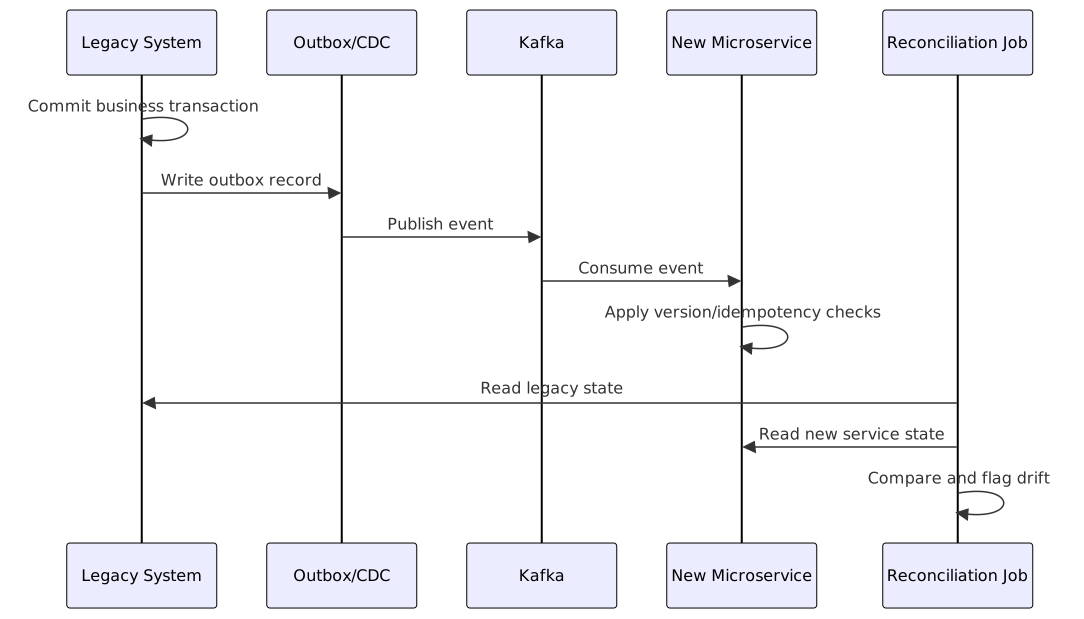
Step 5: Add reconciliation before cutover
This is where many migrations fail. Teams trust the event path too early. Run old and new paths in parallel. Compare balances, statuses, reservations, and ledger totals. Build daily or hourly reconciliation reports. Find drift before the auditors do.
Step 6: Cut over by bounded context, not by technical layer
Do not migrate “all messaging” first or “all consumers” first. Cut over capabilities with clear business ownership. For example, move shipment notifications to events early; keep inventory reservation in the monolith until the aggregate and partitioning model are proven.
Reconciliation as a first-class migration mechanism
Reconciliation deserves special emphasis. In enterprises, the migration succeeds not when every event is perfectly ordered, but when the business can prove state converges correctly. That means:
- snapshot comparison
- sequence gap detection
- duplicate event tracking
- repair workflows
- replay from durable logs
- business exception handling
Reconciliation is the bridge between “theory of events” and “actual financial close.”
Enterprise Example
Consider a global retail enterprise modernizing its order-to-fulfillment platform.
The legacy estate includes:
- a central ERP handling inventory and purchasing
- a monolithic order management system
- regional warehouse systems
- separate customer notification services
- a Kafka backbone introduced for modernization
The first instinct from leadership is predictable: “Put all order events on Kafka and guarantee order.” That sounds reasonable until you inspect the domain. event-driven architecture patterns
The business actually has several different order concepts:
- Customer order lifecycle: created, paid, packed, shipped, canceled
- Inventory reservation lifecycle: reserve, release, adjust
- Payment lifecycle: authorize, capture, refund, reverse
- Customer communication lifecycle: email, SMS, push notifications
These are related, but not the same bounded context.
For fulfillment, order matters per OrderId. A Shipped event before Packed is nonsense. For payment, order matters per PaymentId or AccountId, depending on the process. For notifications, order is looser: if “Your package shipped” arrives before “Your order is packed,” that is not ideal, but it is not a financial breach.
So the architecture team does three things.
First, they partition Kafka topics by business key:
- order events by
OrderId - payment events by
PaymentId - inventory adjustments by
SkuLocationId
Second, they require version numbers on all domain events emitted from newly carved microservices.
Third, they let low-risk consumers such as search indexing and analytics subscribe without ordered processing constraints.
The hard part arrives with inventory. The ERP emits stock updates in bulk, sometimes late, sometimes corrected retroactively. There is no practical way to force perfect event order across stores, warehouses, and supplier returns. So the team adopts a reconciliation model:
- event-driven projections update near-real-time availability
- nightly and intra-day reconciliation compare projected stock with authoritative ERP snapshots
- discrepancies trigger repair events or manual review
This is not a compromise. It is the architecture acknowledging reality.
The result is an enterprise platform with:
- strict ordering where reservation semantics demand it
- version-aware consumers across the board
- replayable Kafka logs for recovery
- reconciliation for noisy legacy interactions
- no expensive global ordered queue throttling the entire business
That is the difference between architecture and wishful thinking.
Operational Considerations
Ordering guarantees are not merely designed. They are operated.
Hot partitions and skew
If one aggregate key dominates traffic, a partitioned ordered stream can become imbalanced. Celebrity customers, flash-sale SKUs, and high-volume merchant accounts create hot spots. You need monitoring on partition lag, throughput skew, and consumer saturation.
Poison messages
In ordered processing, one bad message can block everything behind it for that partition or queue. This is head-of-line blocking in its nastiest form. You need policies for:
- retry limits
- parking queues
- operator intervention
- compensating actions
- selective skip with audit trail
Replays
Replaying events is easy to say and hard to survive. If consumers depend on wall-clock assumptions or non-idempotent side effects, replay can create chaos. Ordered systems should be tested for reprocessing from offset zero or from checkpoint rollback.
Schema evolution
Ordering semantics often fail during event contract changes. A new event version may alter sequence interpretation, omit a previous field, or split one lifecycle event into several finer-grained ones. Versioning strategy must include semantic compatibility, not just schema compatibility.
Clock misuse
Timestamps are seductive and often wrong. Cross-system clocks drift. Event-time and processing-time are not the same. If sequence truly matters, prefer explicit domain versions or sequence numbers over raw timestamps.
Observability
You need traceability at the event and aggregate level:
- partition key
- sequence/version
- consumer lag
- deduplication decisions
- stale-event rejections
- reconciliation drift metrics
Without these, ordering failures turn into archaeology.
Tradeoffs
There is no free lunch here, only different bills.
Ordered processing gives:
- easier reasoning for strict workflows
- deterministic replay per key
- simpler state transition validation
- stronger fit for aggregate-centric domains
Ordered processing costs:
- reduced concurrency
- throughput ceilings
- hot-key bottlenecks
- more severe poison message impact
- more difficult scaling
Unordered processing gives:
- high throughput
- better parallelism
- easier horizontal scaling
- lower broker constraints
- more consumer independence
Unordered processing costs:
- more complex consumer logic
- explicit idempotency requirements
- need for version-aware state handling
- greater dependence on reconciliation
- hidden correctness bugs if domain semantics are misunderstood
The tradeoff is not “simple vs complex.” It is “where do you want the complexity to live?” In the broker, in the consumer, in the domain model, or in operations.
My bias is clear: put complexity where the business can justify it, and nowhere else.
Failure Modes
The ugly failures are rarely dramatic. They are subtle.
False confidence in broker ordering
Teams assume Kafka means ordered processing. It does not. It means ordered records within a partition. If your keying strategy is wrong, your correctness model is fiction.
Multiple producers for one aggregate
If several services emit state-changing events for the same entity without a clear ownership model, publication order becomes meaningless. This is a bounded context problem disguised as middleware.
Consumer-side race conditions
A consumer may fetch additional state, call another service, and update a database asynchronously. Even if messages arrive ordered, the internal handling may complete out of order.
Gaps and missing events
A consumer that expects strict sequences can stall forever on a missing event. You need timeout rules and reconciliation paths, not just perfect-world assumptions.
Duplicate plus reorder
This pair is deadly. An old duplicate arriving after a new state transition can overwrite correct state unless version checks are enforced.
Legacy backfill corruption
During migration, historical backfills can interleave with live streams and scramble downstream projections. Always isolate replay and live processing semantics.
When Not To Use
Do not pay for ordered queues when the business does not need them.
Avoid strict ordering for:
- analytics and BI ingestion
- clickstream or telemetry pipelines
- search indexing
- notification fan-out
- cache invalidation
- machine learning feature feeds
- loosely coupled integrations with independent convergence
Also avoid it when:
- your partition key would be highly skewed
- your throughput requirements are extreme
- consumers already use commutative or snapshot-based updates
- the authoritative state is periodically synchronized anyway
- “must be ordered” is really shorthand for “we haven’t modeled the domain yet”
And be very cautious about global ordering requirements in multi-region architectures. They are usually a recipe for latency, fragility, and political arguments dressed up as consistency concerns.
Related Patterns
A few patterns commonly sit beside ordering decisions.
- Outbox pattern: atomic state change plus event publication intent.
- Idempotent consumer: tolerate duplicate delivery safely.
- Saga: coordinate long-running workflows without distributed transactions.
- Event sourcing: naturally sequence events per aggregate, but still demands careful partitioning and replay strategy.
- CQRS: lets read models tolerate asynchronous propagation and occasional reordering.
- Dead-letter queue / parking lot: isolate poison messages.
- Reconciliation process: compare projections to source of truth and repair drift.
- Strangler fig migration: progressively replace legacy capabilities without big-bang cutover.
These patterns are most effective when guided by domain semantics, not copied as infrastructure rituals.
Summary
Ordering guarantees in event-driven architecture are not a binary choice between “ordered queues” and “unordered queues.” They are a design exercise in discovering where sequence is a true business invariant and where it is merely a human preference for tidy stories.
That distinction changes everything.
Use domain-driven design to identify the real ordering boundary, usually at the aggregate or bounded context level. Prefer partitioned ordering over global serialization. Make consumers idempotent and version-aware. Build reconciliation into the architecture, especially during migration. Use the progressive strangler approach to move legacy systems toward event-driven models without pretending the old world was cleaner than it really was.
Kafka and similar platforms are powerful here, but they are not magic. They can preserve scoped order, support replay, and decouple services. They cannot rescue a muddled domain model or a careless ownership design.
The memorable line is this: order is expensive, and the business should have to earn it.
When you reserve strict ordering for the places where the domain truly needs causality, and embrace unordered, scalable flows everywhere else, you get an architecture that is both honest and effective. That is the real goal. Not perfect sequence. Reliable business outcomes.
Frequently Asked Questions
What is enterprise architecture?
Enterprise architecture aligns strategy, business processes, applications, and technology in a coherent model. It enables impact analysis, portfolio rationalisation, governance, and transformation planning across the organisation.
How does ArchiMate support architecture practice?
ArchiMate provides a standard language connecting strategy, business operations, applications, and technology. It enables traceability from strategic goals through capabilities and services to infrastructure — making architecture decisions explicit and reviewable.
What tools support enterprise architecture modeling?
The main tools are Sparx Enterprise Architect (ArchiMate, UML, BPMN, SysML), Archi (free, ArchiMate-only), and BiZZdesign. Sparx EA is the most feature-rich, supporting concurrent repositories, automation, scripting, and Jira integration.