⏱ 20 min read
There is a particular kind of outage that never looks dramatic in the beginning. No database catches fire. No cluster goes red. No pager screams in the first five minutes.
Instead, one team ships a harmless-looking event change on Tuesday. Another team, working three time zones away, deploys a consumer on Wednesday. By Thursday, finance notices numbers don’t reconcile, customer service sees ghost orders, and nobody can answer the simplest question in distributed systems: what exactly happened?
That is the quiet violence of schema drift in event-driven systems.
In a monolith, schema evolution is often a gated act. One team changes the model, one deployment carries the blast radius, one database reveals the truth. In an event-driven architecture—especially one built on Kafka, stream processors, microservices, and an expanding estate of downstream consumers—the schema is no longer an implementation detail. It is part contract, part language, part organizational treaty. When it changes carelessly, the business feels it. event-driven architecture patterns
This is where schema freeze windows become useful. Not fashionable. Not elegant. Useful.
A schema freeze window is a bounded period in which event contract changes are restricted, coordinated, or delayed so multiple producers, consumers, and migration activities can line up safely. It is not a substitute for backward compatibility. It is not an excuse for poor consumer design. It is a pragmatic control for moments when a distributed estate needs to move together without pretending that every participant can evolve independently forever.
Used well, schema freeze windows help enterprises migrate event contracts, replace legacy payloads, run dual-publish transitions, and reconcile downstream state without betting the quarter on perfect coordination. Used badly, they become bureaucratic theater that compensates for weak ownership and vague domain boundaries.
The interesting question is not whether freeze windows are “good practice.” The interesting question is what problem they solve, what cost they impose, and when they are the least bad option.
Context
Event-driven systems age differently from request-response systems.
At first, events feel liberating. A producer emits OrderPlaced, several services subscribe, analytics gets data “for free,” and new use cases arrive without touching the source application. The architecture looks loose, scalable, modern.
Then time passes.
Topics multiply. Payloads become denser. A single event starts serving fulfillment, fraud, billing, notifications, customer 360, machine learning features, and regulatory reporting. Teams arrive years apart with different assumptions about optional fields, null semantics, ordering guarantees, replay safety, and whether a string called status is code, label, lifecycle state, or just wishful thinking.
Now the event isn’t merely data on a wire. It is a shared semantic surface across dozens of bounded contexts.
That is the point many organizations discover a harsh truth: schemas are social systems disguised as technical artifacts. Avro, Protobuf, JSON Schema, a schema registry, compatibility rules—these all help. But they do not remove the fundamental coordination problem when domain meaning changes and multiple independent systems must absorb it safely.
This matters most in enterprises with Kafka-centric integration platforms. Kafka encourages durable event streams, replay, fan-out, and long-lived contracts. Those are strengths. They are also commitments. Once an event is consumed by twenty services, three stream-processing jobs, a data lake pipeline, and a regulatory archive, changing it becomes less like refactoring a class and more like changing a public road in a capital city. You can do it. But not casually.
Schema freeze windows sit in that reality. They acknowledge that while continuous delivery is a fine aspiration, some changes in distributed systems require a shared pause, or at least a shared corridor of controlled movement.
Problem
The problem is not simply “schema evolution is hard.” That is too soft to be useful.
The real problem is this:
In event-driven systems, some schema changes are technically compatible but operationally unsafe, and some are operationally manageable only if multiple teams coordinate around domain semantics, deployment timing, and reconciliation strategy.
That sentence hides a lot of pain.
A producer may add a field that is backward-compatible according to the registry. Fine. But if that field changes the interpretation of an amount, identity, lifecycle state, or business effective date, then a consumer that ignores it may still be “compatible” and still be wrong.
Likewise, a producer may deprecate a field over months, yet downstream consumers continue republishing old semantics into derivative streams, materialized views, and operational dashboards. By the time the producer removes the field, the organization has forgotten where the semantic dependency lives.
Schema freeze windows address moments where contract change must be treated as a business migration, not a mere code change.
Typical triggers include:
- replacing one canonical identifier with another
- splitting a composite event into distinct domain events
- reinterpreting timestamps from technical event time to business effective time
- moving from denormalized payloads to reference-based enrichment
- changing enum values that drive downstream workflows
- introducing mandatory fields that represent new domain invariants
- migrating from legacy topics to domain-aligned streams
- moving from “fat integration event” designs toward bounded-context events
The core difficulty is not syntax. It is semantics plus timing.
Forces
Architecture gets interesting when good ideas collide. Schema freeze windows exist because several valid forces pull in opposite directions.
1. Independent deployability vs coordinated correctness
Microservices promised teams could deploy independently. That promise matters. But event contracts are shared assets. Independence weakens when producers and consumers jointly define business meaning.
A hard lesson: independent deployment does not imply independent evolution.
2. Backward compatibility vs semantic drift
Schema registries can enforce backward, forward, or full compatibility. Useful guardrails. Yet they mostly judge shape, not meaning.
You can preserve binary compatibility and still break finance.
3. Domain autonomy vs enterprise integration
Domain-driven design tells us bounded contexts should own their language. Correct. But large enterprises also have cross-cutting consumers—reporting, risk, compliance, customer support, search, AI pipelines—that consume events from many domains. These consumers often amplify the cost of change because they depend on consistency more than purity.
4. Continuous delivery vs reconciliation cost
Fast change is only admirable if the organization can reconcile the resulting state. If a schema migration creates divergence between old and new topics, old and new read models, or ledger and operational views, then someone will pay for reconciliation. Usually late, and under pressure.
5. Simplicity for producers vs survivability for consumers
Producers often prefer to “just publish the new shape.” Consumers prefer long deprecation timelines, dual fields, aliases, and migration notes. Both are rational. Neither is free.
6. Local optimization vs platform discipline
One team can make a schema change quickly. An enterprise platform has to think about replay behavior, lineage, retention, dead-letter handling, compaction, data contracts, and recovery. What looks fast locally often creates platform drag globally.
These are not signs of failure. They are the normal forces of event-driven enterprise systems.
Solution
A schema freeze window is a planned governance and delivery mechanism for high-impact event contract changes. During the window, teams limit certain kinds of schema changes, focus on a specific migration path, align producer and consumer deployments, and run explicit reconciliation before closing the transition.
The key phrase is specific migration path.
This is not a broad “nobody touch anything” release freeze. That is lazy operations masquerading as architecture. A good freeze window is narrow, purposeful, and tied to a domain transition.
A practical pattern looks like this:
- Classify the schema change
- additive and safe
- compatible but semantically risky
- breaking shape
- breaking meaning
- Decide whether a freeze is needed
- if impact is local and consumers are version-tolerant, skip it
- if multiple bounded contexts, critical workflows, or ledger/reporting pipelines are involved, consider it
- Establish a migration window
- define producer cutover date
- define dual-publish period
- define consumer upgrade deadline
- define reconciliation period
- define removal date for deprecated fields/topic
- Lock non-essential schema changes
- pause unrelated schema changes on affected topics
- avoid stacking migrations on top of each other
- Run dual-read or dual-publish
- publish old and new events
- or map old to new and compare derived state
- or maintain translation adapters at topic boundaries
- Reconcile
- compare counts, keys, aggregates, business invariants
- reprocess gaps from retained Kafka history where possible
- identify semantic mismatches before decommissioning old contracts
- Close the freeze
- retire old schemas and code paths
- update ownership docs, data contracts, and lineage
- remove temporary adapters before they fossilize
A schema freeze window is therefore not really about “freezing schemas.” It is about creating a temporary zone of reduced change so the organization can move a shared contract safely.
Architecture
The architecture behind freeze windows should reflect a sober view of event contracts: they are domain interfaces with operational consequences.
The first architectural move is to recognize that not all events deserve the same treatment.
- Domain events represent meaningful business facts within a bounded context.
- Integration events are tailored for cross-context consumption.
- Derived analytics streams should not drive operational semantics back into the core.
If your enterprise uses one overloaded event for all three purposes, freeze windows will become frequent and painful. That is not because freeze windows are bad; it is because the event model has collapsed multiple concerns into one stream.
A stronger architecture separates these concerns and uses versioned contracts plus translation boundaries.
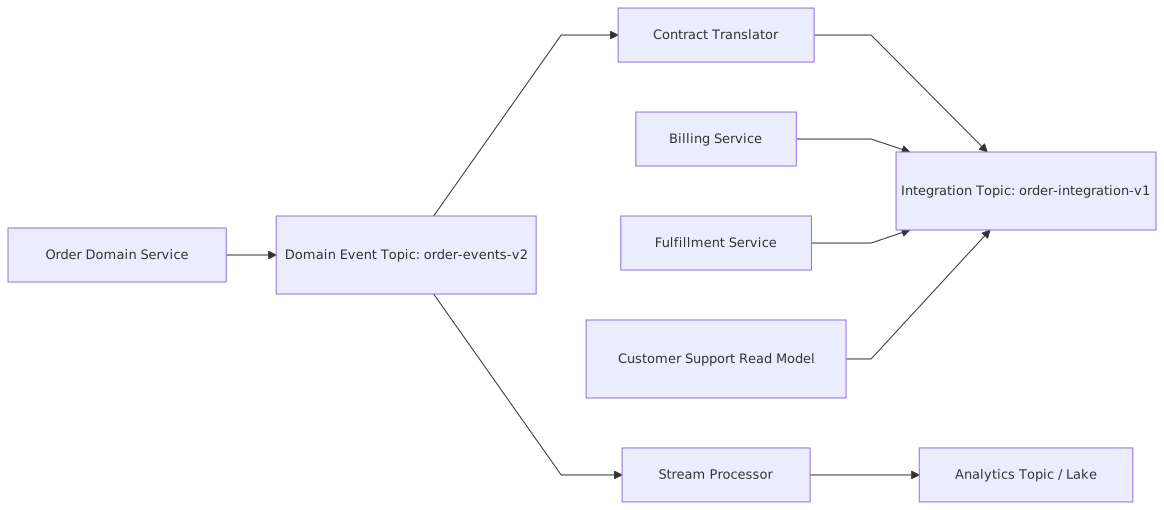
This arrangement gives the domain team room to evolve internal eventing while stabilizing external integration contracts. It does not remove the need for migration windows, but it narrows where they matter.
Freeze timeline as an architectural control
A freeze window is best treated as a timeline with explicit phases and entry/exit criteria.
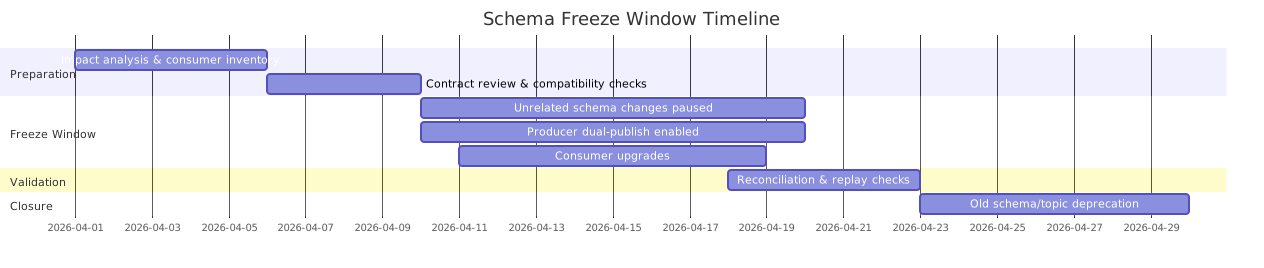
Notice what matters here: not the dates, but the fact that the architecture includes consumer inventory, dual-publish, and reconciliation as first-class design elements.
That is architecture. Not just boxes and arrows, but the choreography of change.
Domain semantics are the heart of the issue
Suppose an OrderShipped event once contained status = SHIPPED and later introduces shipmentState = IN_TRANSIT | DELIVERED | FAILED. A schema registry may happily allow additive change. But the domain semantics have changed. SHIPPED may have been interpreted downstream as “carrier accepted” by one consumer and “delivered to customer” by another. The system was already inconsistent; the schema change merely reveals it.
This is why domain-driven design matters. Events must be named and shaped around explicit business facts inside a bounded context. Freeze windows are often necessary precisely when prior event design was too vague. They are a corrective mechanism for semantic debt.
Control points that matter
In Kafka-based systems, architecture during a freeze should include:
- schema registry compatibility checks
- topic-level ownership and approval paths
- consumer inventory with criticality ratings
- replay capability from retained topics
- observability on lag, deserialization failures, and null/default field behavior
- materialized view comparison for old vs new processing paths
- dead-letter strategy that preserves recoverability rather than hiding breakage
- translation adapters with expiry dates
Without these, a freeze window becomes ceremony without leverage.
Migration Strategy
The right migration strategy is almost always progressive strangler migration, not big bang replacement.
That phrase matters. We are not merely changing schemas. We are strangling old contract usage while allowing the new model to prove itself in production.
A practical sequence looks like this:
1. Inventory consumers and classify dependency depth
Find every direct and indirect consumer:
- operational microservices
- stream processors
- CDC sinks
- search indexers
- BI pipelines
- fraud/risk engines
- compliance archives
- partner integrations
Then classify them:
- shape dependent
- semantic dependent
- replay dependent
- low criticality / high criticality
This step is often skipped because it is tedious. It is also where hidden blast radius lives.
2. Introduce a translation boundary
Create a translator that maps old events to new contracts or vice versa. This can sit:
- in the producer
- in Kafka Streams
- in an integration service
- at the API gateway of event ingress/egress for external partners
Translation is a temporary tax. Pay it consciously.
3. Dual-publish or dual-read
If the producer can afford it, dual-publish both old and new topics. If not, consumers can dual-read with a translation layer. Producer-led dual-publish is usually easier to govern because source semantics remain explicit.
4. Reconcile continuously, not just at the end
Compare:
- event counts by business key
- monetary totals
- state transition counts
- missing/duplicate IDs
- late-arriving event behavior
- compacted topic materializations
- downstream read model parity
Reconciliation should answer “are these two representations functionally equivalent for the business?”, not merely “did messages flow?”
5. Cut over consumer groups in waves
Move low-risk consumers first, then medium-risk, then regulated or customer-impacting services. Keep rollback paths explicit.
6. Freeze removal only after semantic confidence
Do not close the migration because all consumers compiled. Close it when reconciled outcomes match agreed tolerances.
Here is the migration flow in simple form:
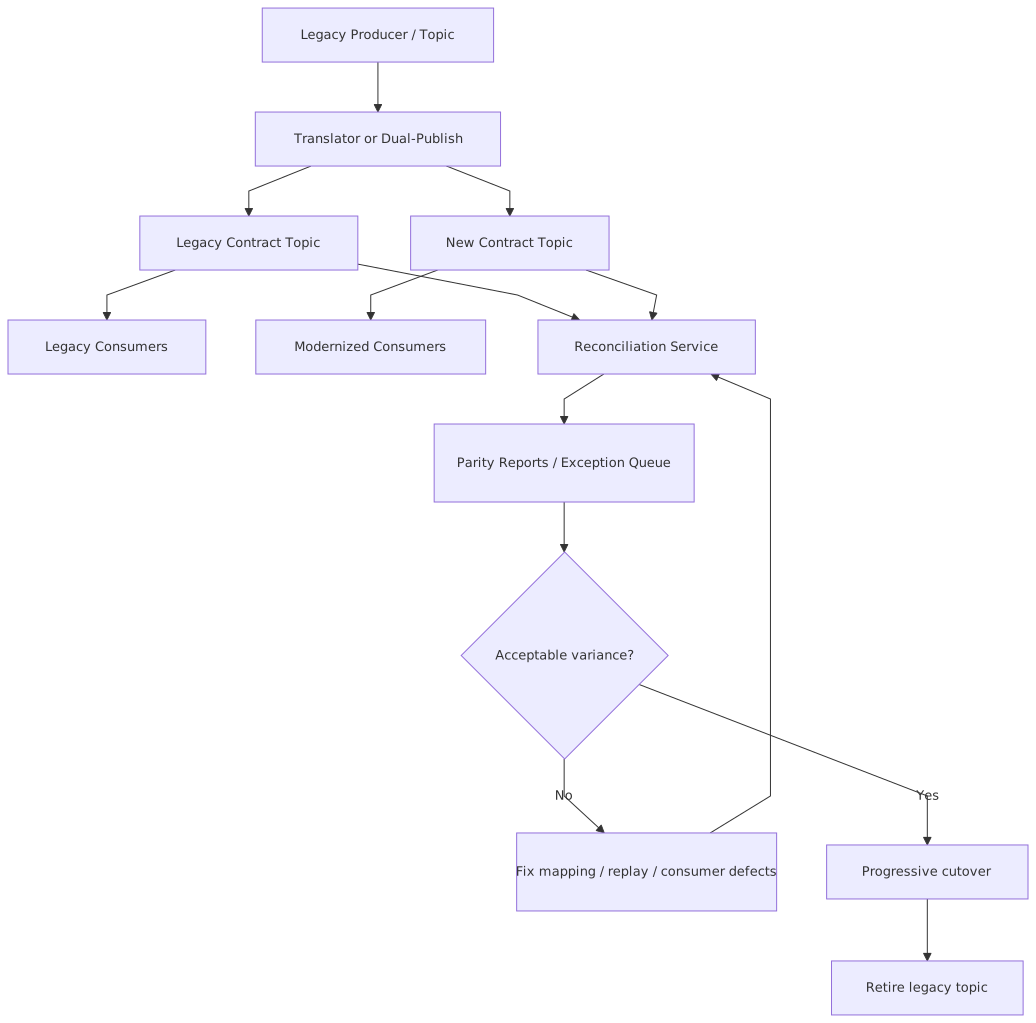
Progressive strangler migration in practice
The strangler pattern works well because it acknowledges that old and new contracts may need to coexist for a while. In enterprises, coexistence is not failure. It is often the only responsible route.
The trick is to make coexistence temporary and measurable.
That means:
- clear target state
- finite deprecation schedule
- active monitoring of legacy traffic
- ownership for every remaining legacy consumer
- executive air cover when laggards threaten the migration
Otherwise, the legacy topic becomes immortal. Enterprises are full of immortal temporary interfaces.
Enterprise Example
Consider a global retailer modernizing its order platform.
The company has:
- a central Kafka backbone
- order, payment, fulfillment, customer service, loyalty, fraud, and finance microservices
- regional data platforms consuming order streams for tax, VAT, and revenue recognition
- a legacy OMS still emitting broad integration events
For years, the main event was OrderUpdated. It contained status, payment summary, shipment summary, discounts, addresses, and several loosely defined timestamps. Every team used it differently. Customer service loved the convenience. Finance tolerated it. Fulfillment quietly built side logic to infer shipment transitions. Data engineering exploded it into warehouse models nightly.
Then the retailer decided to move to domain-aligned events:
OrderPlacedPaymentAuthorizedShipmentDispatchedOrderCancelledRefundIssued
This was the right model. It was also a dangerous migration.
Why? Because OrderUpdated had become an accidental enterprise API.
The architecture team introduced a schema freeze window around order-event modernization. They did not freeze all Kafka work. They froze schema changes to order-related integration topics for three weeks.
The plan looked like this:
- Build a new order event stream from the modern order service.
- Create a translator that could derive old
OrderUpdatedpayloads from the new domain events. - Dual-publish:
- Reconcile:
- Migrate consumers in waves.
- Decommission legacy topic after 95 days.
- new domain topics for modern consumers
- legacy OrderUpdated for lagging consumers
- order counts by region
- shipment lifecycle counts
- payment/refund net totals
- customer service read model parity
- finance daily revenue extracts
The interesting part was not the code. It was the semantics.
Finance had long interpreted updatedAt as the effective accounting timestamp. The modern domain model distinguished:
- event emission time
- aggregate update time
- business effective time
Those are not the same thing. The old event had hidden this ambiguity. The freeze window forced the organization to settle domain meaning before migration. That single semantic decision prevented months of downstream reporting defects.
Another surprise came from fraud. Their models had depended on full shipping address snapshots inside OrderUpdated. The new events emitted references and normalized changes separately. Technically cleaner. Operationally inconvenient. During the freeze window, the team added a temporary enrichment stream for fraud so model quality did not collapse during the transition.
This is enterprise architecture in the real world: not purity, but controlled compromise.
The migration succeeded because the company treated schema change as a business capability migration with reconciliation, not as a developer convenience refactor.
Operational Considerations
A freeze window lives or dies in operations.
Consumer observability
You need to know:
- who is consuming what
- which consumer groups are active
- deserialization failure rates
- schema version adoption
- lag profiles during cutover
- replay success metrics
- dropped/defaulted field frequencies
Without this, the migration is guesswork.
Reconciliation as an operational product
Reconciliation should be automated and visible. Treat it as a product, not a spreadsheet ritual.
Useful checks include:
- record count parity by partition key and business date
- aggregate balances by region/currency
- state transition monotonicity
- duplicate key detection
- nullability drift after schema changes
- old vs new materialized view comparisons
- exception queues with business-readable reasons
Retention and replay
Kafka gives you one of the best migration tools in distributed systems: replay. But only if retention policies and topic compaction strategies preserve what you need.
Many enterprises discover too late that retention was tuned for cost, not migration. Then reconciliation becomes forensic archaeology.
Governance without paralysis
A schema freeze window needs lightweight but serious governance: EA governance checklist
- named owner
- explicit scope
- approved migration decision record
- consumer sign-off criteria
- rollback plan
- freeze end conditions
Do not route this through six committees. The point is coordinated safety, not institutional theater.
Temporary code must expire
Dual-publishers, translators, enrichers, fallback consumers—these are useful. They are also dangerous if left in place. Every temporary component should have:
- an owner
- a removal date
- a usage metric
- a decommission checklist
Temporary architecture is where complexity goes to retire.
Tradeoffs
Schema freeze windows are not free. If they were, every team would use them all the time.
Benefits
- reduce semantic breakage during high-impact migrations
- make cross-team dependencies visible
- create room for reconciliation and replay
- lower risk for regulated and financially sensitive workflows
- support progressive strangler migration
- prevent overlapping changes from obscuring root causes
Costs
- slow delivery for affected domains
- introduce coordination overhead
- tempt teams into broad freezes instead of precise migration design
- create temporary duplication in topics and consumers
- increase platform load during dual-publish and replay
- risk normalizing governance where better contract design would suffice
My view is simple: freeze windows are a precision tool, not a default operating model.
If your architecture needs constant schema freezes, the problem is probably not change management. It is poor event boundaries, overloaded contracts, missing ownership, or weak compatibility discipline.
Failure Modes
This pattern has several predictable ways to go wrong.
1. Freezing shape, ignoring meaning
Teams focus on field additions/removals and never clarify business semantics. The migration “passes” technically and fails in reporting or operations.
2. No complete consumer inventory
A hidden downstream consumer surfaces after cutover. Usually in finance, analytics, or a vendor integration nobody knew still existed.
3. Dual-publish without parity checks
Both streams run, everyone feels safe, but no one compares outcomes. Divergence accumulates quietly.
4. Freeze window too short
Teams cannot actually upgrade, test, and reconcile within the window. The result is rushed exceptions and manual workarounds.
5. Freeze window too broad
Everything stops for too long. Teams work around governance, confidence drops, and the organization starts seeing architecture as bureaucracy. ArchiMate for governance
6. Translation logic becomes permanent
Temporary adapters remain because one long-tail consumer never migrates. Now your enterprise carries semantic debt forever.
7. Replay assumptions are wrong
A consumer may not be idempotent. Event ordering may differ. Enrichment dependencies may have changed. Reprocessing then produces different outcomes than original processing.
8. Ownership is blurred
Platform thinks domain owns semantics. Domain thinks platform owns migration. Operations gets caught in the middle. Nobody can decide when to cut over.
These are not edge cases. They are the common traps.
When Not To Use
Schema freeze windows are not needed for every event evolution.
Do not use them when:
- the change is truly additive and semantically irrelevant to existing consumers
- the topic has few consumers with clear ownership and proven tolerance
- you already have robust contract versioning and independent consumer upgrade paths
- the event is internal to a single bounded context
- the migration can be hidden entirely behind a stable integration contract
- the organizational cost of coordination outweighs the business risk
Also, do not use a schema freeze to compensate for weak engineering basics.
If consumers cannot handle optional fields, if nobody knows who owns the topic, if there is no replay path, if event names are vague to begin with—a freeze window may reduce immediate risk, but it will not cure the underlying design illness.
Sometimes the right answer is to stop pretending an event is a reusable enterprise contract and instead publish a new topic with a cleaner bounded-context meaning. Version by replacement. Migrate consumers. Kill the old one. That can be simpler than trying to preserve universal compatibility.
Related Patterns
Schema freeze windows sit beside several related patterns.
Consumer-driven contracts
Useful for understanding downstream expectations. Limited when semantic interpretation differs across consumers.
Schema registry compatibility enforcement
Essential baseline. Necessary, not sufficient.
Event versioning
Helpful for shape evolution. Dangerous if overused inside a single overloaded topic instead of introducing new event types where meaning changes.
Strangler fig migration
The most important companion pattern here. Gradually shift consumers and capabilities to new contracts while retaining control of risk.
Anti-corruption layer
Particularly useful when translating between a legacy event model and a cleaner domain model.
Outbox pattern
Improves producer reliability and consistency. Does not solve contract semantics by itself.
CQRS and materialized views
Relevant because many consumer breakages surface in read models. During migration, comparing old/new views is often the best reconciliation strategy.
Data reconciliation pipelines
An undervalued pattern. In large migrations, reconciliation deserves architecture status equal to event publication itself.
Summary
Schema freeze windows are a pragmatic response to an inconvenient truth of event-driven systems: contracts may be distributed, but meaning is shared. And when shared meaning changes, the organization sometimes needs a controlled pause to move safely.
The best use of a freeze window is narrow, intentional, and migration-driven. It protects high-impact schema evolution by combining contract discipline, bounded-context thinking, progressive strangler migration, dual-publish or translation strategies, and explicit reconciliation. In Kafka-heavy enterprises, that combination is often the difference between a clean modernization and a slow-motion integrity failure.
The deeper lesson is not about freezing.
It is about respecting domain semantics.
A field is never just a field when it decides revenue recognition, customer promises, shipment state, or regulatory reporting. A topic is never just a topic when half the enterprise reads from it. And a “compatible” schema is never truly compatible if downstream business meaning silently changes.
Use schema freeze windows when the contract has become important enough that change must be choreographed. Avoid them when better event boundaries, versioning discipline, and bounded context separation can preserve autonomy. And above all, do not treat reconciliation as an afterthought. In distributed systems, reconciliation is how architecture tells the truth after migration.
That is the real value of a freeze window. Not that it stops change, but that it gives change enough structure to survive contact with the enterprise.
Frequently Asked Questions
What is enterprise architecture?
Enterprise architecture aligns strategy, business processes, applications, and technology in a coherent model. It enables impact analysis, portfolio rationalisation, governance, and transformation planning across the organisation.
How does ArchiMate support architecture practice?
ArchiMate provides a standard language connecting strategy, business operations, applications, and technology. It enables traceability from strategic goals through capabilities and services to infrastructure — making architecture decisions explicit and reviewable.
What tools support enterprise architecture modeling?
The main tools are Sparx Enterprise Architect (ArchiMate, UML, BPMN, SysML), Archi (free, ArchiMate-only), and BiZZdesign. Sparx EA is the most feature-rich, supporting concurrent repositories, automation, scripting, and Jira integration.