⏱ 20 min read
Most enterprise architecture diagrams about data are useless by the second workshop.
That sounds harsh. It is harsh. But it is also true.
Teams spend weeks drawing “data flows,” “platform views,” and “target states,” and somehow still cannot answer basic questions like:
- Which business capability actually depends on this Kafka topic?
- Where is the system of record?
- Who is allowed to publish customer-risk events?
- What breaks if the IAM token service is down?
- Is this “event-driven architecture” actually decoupled, or did we just move our spaghetti into Kafka?
This is where ArchiMate can be either extremely valuable or a complete waste of time.
Used well, ArchiMate gives you a disciplined way to connect business intent, applications, data, technology, security, and operational reality. Used badly, it becomes a sterile modeling exercise full of perfect boxes and zero decisions. And in data architecture, especially around Kafka-based systems, that difference matters. A lot.
So let’s say it simply up front, for the SEO crowd and for the people who just need the straight answer:
ArchiMate is useful for data architecture and Kafka-based systems because it helps architects model how business processes, applications, data objects, events, integration services, infrastructure, and governance relate to each other. It is not a Kafka design tool. It is not a schema registry. It is not observability. But it is a strong enterprise modeling language for showing how Kafka fits into an enterprise, why it exists, and what depends on it.
That’s the short version.
The more important version is this: if you are using Kafka in a bank, insurer, retailer, or public cloud-heavy enterprise, and you are not modeling ownership, trust boundaries, identity dependencies, and data semantics, then your architecture is probably more fragile than your slide deck admits. ArchiMate in TOGAF ADM
Why ArchiMate matters for data architecture
Data architecture has a bad habit of becoming abstract too quickly.
People talk about “domains,” “data products,” “event streams,” “golden records,” and “federated governance” as if saying the words solves the design problem. It doesn’t. Enterprises do not fail because they lacked vocabulary. They fail because nobody connected the vocabulary to real systems, real controls, and real operational consequences. ArchiMate for governance
ArchiMate helps because it forces relationships into the conversation.
At a practical level, data architecture usually needs to answer five things:
ArchiMate is strong precisely because it spans those concerns without forcing everything into one technical lens.
For data architecture, the useful ArchiMate elements are usually not the entire framework. You do not need to model every possible concept just because the notation allows it. That is another common architecture disease: notation greed.
In most Kafka-centered enterprise work, the most useful ArchiMate layers are: ArchiMate modeling guide
- Business layer: business services, processes, actors, capabilities
- Application layer: application components, application services, data objects
- Technology layer: nodes, system software, technology services, communication paths
- Motivation/strategy elements: drivers, goals, requirements, constraints
- Implementation/migration elements when planning transition states
That mix is enough to model most of what matters.
A simple way to explain ArchiMate in Kafka terms
Here is the easiest explanation I use with delivery teams:
- The business layer explains why the data matters.
- The application layer explains which systems create, consume, or transform it.
- The technology layer explains where Kafka and cloud infrastructure actually run.
- The motivation layer explains why security, compliance, latency, resilience, and auditability are non-negotiable.
If that sounds obvious, good. Architecture should become clearer when explained, not more mystical.
Now let’s map this into a Kafka-based enterprise setup.
Imagine a bank. Retail onboarding creates customer profiles. Fraud systems score transactions. IAM controls service identities. Core banking publishes account events. Analytics consumes streams into a cloud lakehouse. Notifications subscribe to customer preference changes. Compliance wants lineage. Operations wants resilience. Security wants encryption, topic access control, and audit. Every one of those concerns belongs in the architecture.
Kafka is not the architecture. Kafka is one critical part of the application and technology architecture.
That distinction matters because many architects accidentally model Kafka as the center of the universe. It isn’t. In a good enterprise model, Kafka is an integration backbone or event streaming platform supporting business and application services. It enables data movement and event propagation. It does not define business meaning by itself.
That is a contrarian point for some event-driven purists, but I stand by it. If your enterprise architecture starts with “we have Kafka,” instead of “we need reliable, governed, low-latency business event distribution for these capabilities,” you are already designing backwards.
What to model in ArchiMate for Kafka-based data architecture
Let’s get practical.
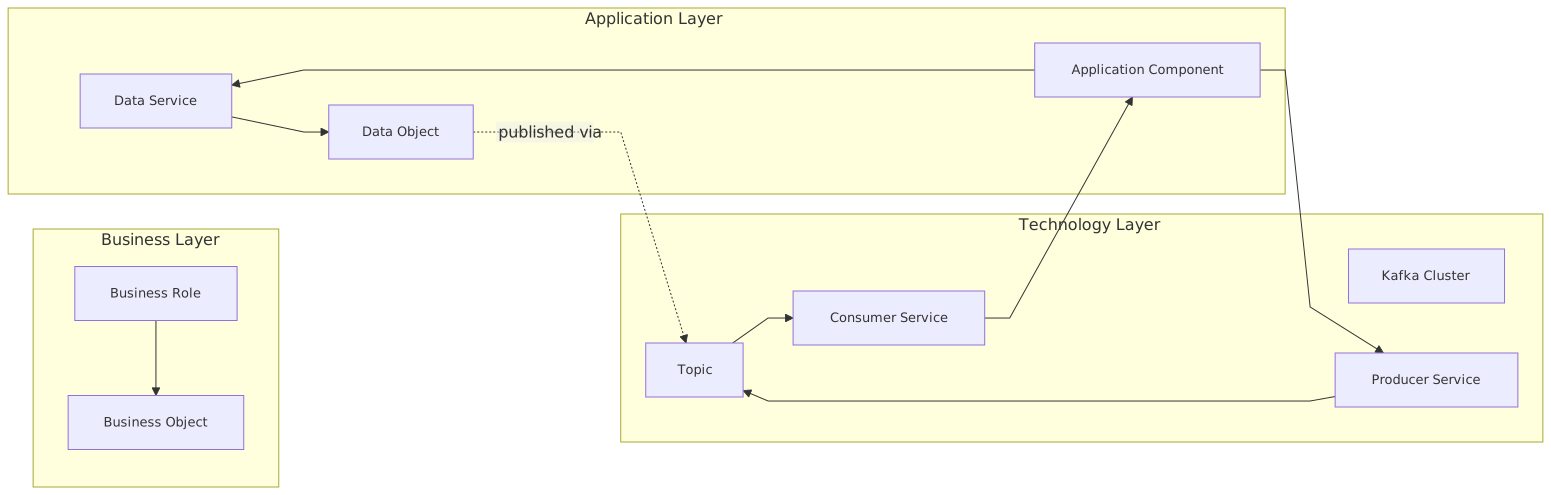
When I model Kafka in ArchiMate for real enterprise work, I usually want to represent these things: ArchiMate tutorial
1. Business capabilities and processes that depend on event data
Examples:
- Customer onboarding
- Payment processing
- Fraud detection
- Account servicing
- Regulatory reporting
These are not decorative. They justify the event architecture.
If “Transaction Monitoring” depends on near-real-time payment events, then the architecture must show that dependency. Otherwise Kafka just looks like a generic plumbing choice.
2. Application components that publish and consume events
Examples:
- Core Banking Platform
- Payments Hub
- Fraud Scoring Engine
- CRM
- Notification Service
- Data Lake Ingestion Service
In ArchiMate, these are usually application components exposing or consuming application services, with data objects and event flows represented between them.
3. Data objects and event semantics
This is where many ArchiMate models get weak.
Architects draw arrows labeled “events” and think the job is done. It isn’t. The real question is: what business fact is being communicated?
Examples:
- CustomerCreated
- AccountOpened
- PaymentInitiated
- PaymentSettled
- LoginRiskEvaluated
- ConsentUpdated
These are not just topic payloads. They are data objects with business meaning. If you do not model them as such, you lose semantic clarity fast.
4. Kafka platform services and infrastructure
At the technology layer, model:
- Kafka cluster(s)
- Schema registry
- Connect infrastructure
- Stream processing runtime
- Kubernetes or VM platform
- Cloud network zones
- Managed IAM integrations
- Secrets management
- Monitoring/logging stack
This is where the architecture becomes real instead of aspirational.
5. IAM and security dependencies
This deserves its own section, because event platforms without identity architecture are a governance mess waiting to happen.
In a modern cloud bank, a producer does not just “connect to Kafka.” It authenticates using a service principal, workload identity, certificate, or token flow. Authorization may be topic-based, namespace-based, or policy-based. Encryption may be in transit and at rest. Access may differ by environment and data classification.
If your ArchiMate model does not show the identity service and trust relationship, then your data architecture is incomplete.
That is not a nice-to-have. That is basic enterprise design.
The architecture mistake almost everyone makes with Kafka
The most common mistake is modeling Kafka as a transport line between systems and stopping there.
That is integration thinking from 2012 wearing modern clothes.
A proper enterprise architecture for Kafka-based systems must address at least these dimensions:
- Business meaning: why the event exists
- Ownership: who publishes and owns the event contract
- Consumption model: who is allowed to consume, and for what purpose
- Security model: how identities authenticate and authorize
- Operational model: latency, retention, replay, resilience, observability
- Data governance model: schema evolution, lineage, classification, quality
- Platform model: tenancy, cloud deployment, regional topology, DR
A line on a diagram does not tell me any of that.
Another mistake: architects use ArchiMate to show static data lineage but not dynamic event dependency. That is a problem in Kafka systems because event streams are temporal and subscription-driven. A static source-to-target picture is not enough. You need to show that a consumer depends on a stream service, not just a database copy.
And then there is the favorite mistake of all: pretending topics are business architecture.
They are not.
A topic name is an implementation artifact. Sometimes an important one, yes. But if your enterprise model is built around topic names rather than business events and application services, you are modeling too low too early.
A practical modeling approach that actually works
Here is the approach I have found most useful in real architecture work.
View 1: Capability-to-data view
Start with business capabilities and the critical data or events they use.
For a bank, that might look like:
- Customer Management uses customer profile events
- Payments Processing uses payment lifecycle events
- Fraud Management uses transaction and login events
- Compliance Reporting uses account, payment, and consent data
This view is for executives, domain leads, and risk stakeholders. Keep it clean.
View 2: Application cooperation view
Then show the systems that publish, transform, and consume data.
Example:
- Core Banking publishes AccountOpened and BalanceChanged
- Payments Hub publishes PaymentInitiated and PaymentSettled
- IAM platform publishes IdentityVerified or AccessPolicyChanged where relevant
- Fraud Engine consumes payment and login streams, produces RiskAlert
- CRM consumes customer and consent events
- Lakehouse ingestion consumes approved enterprise topics
This is where ownership starts becoming visible.
View 3: Technology/platform view
Now show:
- Kafka cluster by environment or region
- Schema registry
- Kafka Connect
- Kubernetes platform
- Cloud VPC/VNet segmentation
- IAM provider
- KMS/HSM
- Observability services
- DR topology
This is the view operations and platform teams need.
View 4: Security and trust view
This one is often missing and should not be.
Show:
- Producer identities
- Consumer identities
- IAM token or certificate service
- Authorization policies
- Sensitive topic zones
- Cross-account or cross-subscription trust boundaries
- Audit logging dependencies
Without this view, your architecture is pretending security is a footnote.
View 5: Transition architecture
If you are migrating from batch ETL or point-to-point integration to Kafka, show baseline, transition, and target states.
This is where ArchiMate is very useful. It handles change better than many teams realize.
You can show:
- Existing nightly batch feeds
- Intermediate dual-publish phase
- Target event-native consumption
- Legacy system retirement dependencies
That is actual architecture work. Not just drawing the final fantasy picture.
Real enterprise example: a bank modernizing customer and payment data
Let’s make this concrete.
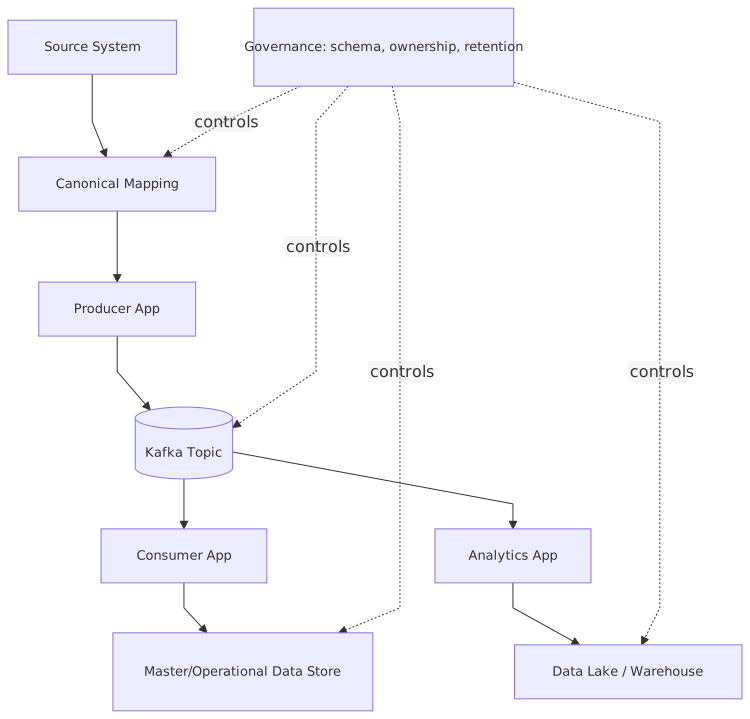
A regional bank I’ll describe in generic terms had the classic mess:
- Core banking on-prem
- CRM in SaaS
- Fraud tools in a private cloud
- Data warehouse fed by nightly ETL
- IAM split across legacy LDAP, cloud identity, and custom service credentials
- Dozens of brittle integrations
- No consistent data ownership model
- “Real-time” used in PowerPoint, but not in production
The bank wanted to modernize customer onboarding, payment processing, fraud analytics, and regulatory reporting. Kafka was selected as the event backbone, deployed in cloud-managed infrastructure with hybrid connectivity back to on-prem systems.
At first, the program architecture was awful.
The initial diagrams showed:
- Kafka in the middle
- arrows from everything to everything
- “customer events”
- “payment events”
- “fraud events”
- no business capability mapping
- no IAM dependency model
- no distinction between source-of-truth and derived events
- no separation between operational and analytical consumption
Honestly, it looked modern. It was also dangerously vague.
So we reworked it using ArchiMate.
Step 1: Tie events to business capabilities
We mapped business capabilities first:
- Customer Onboarding
- Identity Verification
- Account Management
- Payment Execution
- Fraud Detection
- Regulatory Compliance
Then we linked each capability to the business services and key data objects it depended on.
This changed the conversation immediately. Suddenly “CustomerUpdated” was not just a stream. It supported onboarding, servicing, compliance screening, and CRM synchronization. That meant ownership, quality, and schema control had to be stronger.
Step 2: Identify application ownership
We modeled:
- Core Customer Platform as owner of customer master events
- Payments Hub as owner of payment lifecycle events
- IAM/Identity Verification platform as owner of identity verification outcomes
- Fraud Engine as consumer of payment and identity signals, and producer of risk assessment events
- Compliance Reporting platform as consumer, not owner, of most business events
Again, obvious in hindsight. But this was exactly what the teams had not made explicit.
Step 3: Model Kafka as platform service, not business owner
In ArchiMate, Kafka was represented as a technology service enabling event distribution, replay, and decoupled consumption. It was not modeled as the source of business truth.
That sounds like a small notation choice. It is not. It prevents a lot of bad governance decisions.
Because once Kafka gets treated as “the source,” teams stop caring who actually owns the event semantics. Then every topic becomes a soft contract and every consumer interprets payloads differently. Welcome to enterprise entropy.
Step 4: Add IAM and access control architecture
This was the critical piece.
The bank was moving to cloud-managed Kafka. Producers and consumers across multiple platforms needed authenticated and authorized access. Sensitive data included PII, account status, fraud indicators, and consent changes.
We modeled:
- cloud IAM as the identity authority for workload identities
- secret/certificate management for legacy producers
- token-based auth for modern services
- authorization policies by topic namespace and environment
- audit logging as a security service dependency
- network segmentation between sensitive and general integration zones
This exposed two major architectural issues:
- some legacy applications could not support the required auth model without a proxy
- fraud and compliance teams wanted broad topic access that violated least privilege
Both problems were hidden until the architecture made them visible.
Step 5: Separate operational eventing from analytics ingestion
Another common mistake is pretending one event stream serves every purpose equally well.
In reality, the bank needed:
- operational event streams for business process coordination
- curated ingestion into the cloud lakehouse for analytics and reporting
Those are related, but not the same. Different latency, quality, retention, and change-control expectations apply.
We used ArchiMate to show the distinction:
- operational systems consumed business event streams directly
- data engineering services consumed approved topics and transformed them into analytical data products
- governance controls applied differently across the two paths
That stopped a lot of unproductive debate. The architecture made it clear that not every Kafka topic is a reusable enterprise data product.
A very unfashionable opinion, by the way: not all events deserve enterprise-wide reuse. Some are local integration artifacts. Architects should say that more often.
How this applies in real architecture work
This is the part many articles skip. They tell you what ArchiMate can do in theory, then disappear before the governance board starts asking questions.
In real work, ArchiMate for Kafka-based data architecture is useful in five very practical situations.
1. Platform investment decisions
When leadership asks, “Why do we need a managed Kafka platform, schema registry, and IAM integration instead of just using APIs and batch?” you need more than technical preference.
An ArchiMate model can show:
- business capabilities requiring event-driven responsiveness
- systems that need asynchronous decoupling
- resilience and replay requirements
- security and compliance dependencies
- reduction in point-to-point integration complexity
That is how you justify architecture, not by saying event-driven is trendy.
2. Data governance and ownership workshops
Kafka creates a false sense of shared data abundance. Suddenly everyone wants access to everything.
Architecture has to push back.
ArchiMate helps structure ownership discussions:
- who owns the event
- what business object it represents
- who can consume it
- what service exposes it
- what policy constrains it
Without this, governance turns into endless arguments over topic ACLs with no business context.
3. Migration planning
Most enterprises are not greenfield. They have ETL, ESB, APIs, MQ, batch files, and old systems that still matter.
ArchiMate is strong for transition planning because you can show:
- current-state integration dependencies
- transition-state coexistence
- target-state event backbone
- retirement of old interfaces
That matters especially in banking, where you cannot just switch off core integrations because the architecture team discovered streaming.
4. Security and risk reviews
Security teams often distrust event architectures because they see broad data distribution and weak accountability.
Fair enough. In many organizations, they are right.
A proper ArchiMate view showing IAM, trust boundaries, encryption, logging, and authorization policy dependencies can turn a vague “Kafka is risky” discussion into a solvable design review.
5. Operating model alignment
This is the one architects underestimate.
A Kafka-based architecture only works if platform teams, domain teams, security, and data governance all understand their roles.
ArchiMate can help show:
- platform team owns streaming infrastructure service
- domain application teams own event production contracts
- security owns identity and policy guardrails
- data governance owns classification and standards
- operations owns monitoring, incident handling, and resilience controls
If you do not model the operating model somehow, your “target architecture” is just a technical aspiration.
Common mistakes architects make
Let’s be blunt.
Mistake 1: Modeling only technology, not meaning
A Kafka cluster, some consumers, some producers. Fine. But what is the business object? Who owns the fact? What process depends on it?
If that is missing, your architecture is incomplete.
Mistake 2: Confusing topics with data products
A topic is not automatically a governed, reusable enterprise data asset. Sometimes it is just a transport mechanism for one bounded context.
That is okay. Stop pretending every event is strategic.
Mistake 3: Ignoring IAM until late design
This is one of the biggest failures in cloud event architectures.
Authentication, authorization, service identity, secret rotation, and audit are not implementation details. They shape the architecture from the start.
Mistake 4: No distinction between source events and derived events
A source system publishing PaymentSettled is not the same as an analytics service publishing DailyPaymentSummary. One is an operational business event. The other is derived information.
Architects should model that distinction clearly.
Mistake 5: Trying to make one view do everything
A single diagram cannot satisfy executives, engineers, security reviewers, and operations leads. Stop trying.
Use multiple ArchiMate views with clear intent.
Mistake 6: Over-modeling
This is the opposite problem. Some architects create fifty diagrams nobody can read. They model every broker, every connector, every artifact, every flow.
If the model cannot support a decision, it is decoration.
Mistake 7: Pretending event-driven means decoupled by default
It does not.
If every consumer depends on a brittle shared payload, if schemas are unmanaged, if ordering assumptions are hidden, if retries cause duplicate business actions, then congratulations, you built tightly coupled asynchronous architecture.
It is still coupling. Just harder to debug.
A practical ArchiMate mapping for Kafka environments
Here is a useful shorthand table.
This is not the only way to model it, but it is a practical one.
My opinionated guidance for architects
A few strong opinions, since the industry has enough neutral content already.
First: ArchiMate is not too abstract for data architecture. Bad architects are too abstract for data architecture. The notation is fine. The problem is usually the user.
Second: if your Kafka architecture has no explicit IAM model, it is not enterprise architecture. It is a prototype with funding.
Third: not every system should publish events directly to the enterprise backbone. Some systems need mediation, policy enforcement, schema validation, or even to stay on batch for a while. Purity is overrated.
Fourth: event-driven architecture in banking should be conservative where money and identity are involved. Strong contracts, strong ownership, strong audit. Move fast is for marketing sites, not payment settlement.
Fifth: architects need to spend less time arguing API versus events in absolute terms. Enterprises need both. The question is dependency style, business timing, control, and operational fit.
Final thought
ArchiMate will not magically fix a bad data architecture. Kafka will not magically modernize an enterprise. Cloud will not magically simplify governance. IAM will not magically become someone else’s problem.
But if you use ArchiMate properly, it gives you a way to describe the enterprise reality that actually exists: business capabilities depending on data, applications producing and consuming events, cloud platforms enabling scale, IAM enforcing trust, and governance trying to keep the whole thing from turning into distributed chaos.
That is the real value.
Not prettier diagrams. Better decisions.
And in Kafka-based systems, especially in banking and other regulated environments, that difference is everything.
FAQ
1. Is ArchiMate good for modeling Kafka itself, or just the surrounding enterprise architecture?
Mostly the surrounding architecture. You can represent Kafka clusters, services, and flows, but ArchiMate is strongest when showing how Kafka supports business capabilities, applications, security, and platform design. It is not a broker-level engineering tool.
2. How detailed should ArchiMate models be for data architecture?
Detailed enough to support decisions, not detailed enough to replace implementation docs. Show ownership, key data objects, major flows, IAM dependencies, and platform services. Do not try to model every topic partition or connector setting.
3. How do you represent IAM in a Kafka-based ArchiMate model?
Model IAM as application or technology services that provide authentication, authorization, and policy enforcement. Then show producer and consumer components depending on those services, plus constraints for least privilege, audit, and encryption.
4. What is the biggest mistake in enterprise Kafka architecture?
Treating Kafka as the architecture instead of as one platform capability within the architecture. That usually leads to weak ownership, vague semantics, poor access control, and too much faith in topic sprawl.
5. Can ArchiMate help with migration from batch to event-driven architecture?
Yes, very much. It is one of the better uses of the language. You can model current-state batch interfaces, transition phases, dual-run periods, target event services, and legacy retirement dependencies in a way business and technology stakeholders can both understand.
Frequently Asked Questions
How is Kafka modeled in enterprise architecture?
Kafka is modeled in ArchiMate as a Technology Service (the broker) or Application Component in the Application layer. Topics are modeled as Application Services or Data Objects. Producer and consumer applications connect to the Kafka component via Serving relationships, enabling dependency analysis and impact assessment.
What is event-driven architecture?
Event-driven architecture (EDA) is an integration pattern where components communicate by publishing and subscribing to events rather than calling each other directly. Producers emit events (e.g. OrderPlaced) to a broker like Kafka; consumers subscribe independently. This decoupling improves resilience, scalability, and the ability to add new consumers without changing producers.
How do you document event-driven architecture?
Document EDA using UML sequence diagrams for event flow scenarios, ArchiMate application cooperation diagrams for producer-consumer topology, and data object models for event schemas. In Sparx EA, Kafka topics can be modeled as named data objects with tagged values for retention, partitioning, schema version, and owning team.