⏱ 19 min read
Partition keys look innocent. They are not.
In Kafka architectures, the partition key is one of those choices teams make on a Tuesday afternoon and spend the next three years explaining in incident reviews. It sits in a producer config, often wrapped in a utility library, and because it feels low-level, it gets delegated. But the partition key is not a plumbing detail. It is a statement about business identity, ordering, load distribution, failure blast radius, and what the enterprise believes a “thing” is.
That is why partition key design belongs in architecture, not just implementation.
In distributed systems, every simplification is a bet. A Kafka topic with ten partitions looks simple enough. Add a key, get ordering, scale consumers, move on. Except the key decides which messages must stay together, which can be processed independently, which customer gets delayed because another one is noisy, and whether downstream materialized views can ever be reconciled without pain. A poor key can turn a clean event stream into a queue with hotspots. A good one can make a sprawling microservices estate feel coherent. microservices architecture diagrams
This article takes a hard look at event partition key design in Kafka-based systems through an enterprise architecture lens: domain-driven design, migration strategy, operational realities, and the tradeoffs that never fit on a standards slide. event-driven architecture patterns
Context
Kafka gives us a simple but powerful guarantee: records with the same key are routed to the same partition, and within that partition their order is preserved. That guarantee is the foundation for many event-driven designs. It is also where many designs go wrong.
In a small system, teams often key by whatever identifier is nearest at hand: customerId, orderId, accountId, perhaps no key at all. At first, everything works. Throughput is acceptable. Consumers are easy to scale. Then the estate grows. More domains publish events. More teams consume them. New services need to reconstruct aggregates, derive state, and perform compensations. Rebalancing events begin to hurt. A handful of partitions become hotspots. A “simple” repartitioning turns into a six-month migration. Architecture starts discovering a truth the business already knew: identity is contextual.
That last point matters.
Domain-driven design teaches us that identifiers are not universal truths. They are local to bounded contexts. A customer in CRM is not necessarily the same entity as a party in master data, a subscriber in billing, or a patient in healthcare. The partition key therefore should not be picked by convenience alone. It should reflect the semantics of the stream and the consistency boundary the stream is trying to preserve.
Put bluntly: if you do not know what must be ordered together, you do not know your partition key.
Problem
Most partition key problems show up as one of four architectural smells.
First, semantic mismatch. Events are keyed by an identifier that is easy for the producer but wrong for the business process. For example, an OrderPlaced event may be keyed by customerId because customer data is available everywhere. But fulfillment, invoicing, and returns all really care about order lifecycle ordering, not customer-wide ordering. The result is accidental coupling and unnecessary serialization.
Second, hot partitions. Real business traffic is rarely uniform. A few merchants, regions, SKUs, or enterprise customers generate a disproportionate share of events. If the chosen key aligns with an imbalanced business dimension, one or two partitions become overloaded while others sit idle. Kafka remains healthy on paper. The application does not.
Third, broken reconstruction. Consumers often need to build projections or maintain aggregate state. If related events are spread across partitions without a strategy for correlation, consumers need cross-partition joins, external locking, or eventual reconciliation processes. None of these are free.
Fourth, migration paralysis. Once many producers and consumers depend on a topic and its keying semantics, changing the partition key becomes difficult. Strictly speaking, you are not “reconfiguring Kafka”; you are changing the topology of business meaning in motion. Enterprises underestimate this all the time.
The ugly part is that these problems interact. A team trying to fix hotspots by changing from customerId to orderId may improve parallelism while breaking a fraud service that depended on customer-level ordering. A data platform team may introduce a repartitioned topic for analytics, only to create duplicate streams with unclear lineage. Good intentions. Expensive consequences.
Forces
This is not a problem with one right answer. It is a problem shaped by competing forces.
Ordering versus parallelism
The more events you force onto the same key, the stronger your local ordering and the lower your parallelism. Key by tenantId, and each tenant gets consistent sequencing but large tenants may bottleneck. Key by transactionId, and throughput improves, but any consumer wanting account-level sequence must now reconstruct it.
You are deciding where to pay.
Business identity versus technical convenience
The easiest key is often the identifier already present in the producer’s local model. But business flows cross services, and producers do not own the whole truth. If the key does not reflect a domain concept meaningful across producer and key consumers, it becomes accidental infrastructure design.
DDD helps here. Ask: what aggregate or business entity needs serialized change? That question is more useful than “what ID do we have?”
Throughput skew
Some keys are “whales.” A marketplace may have a few giant sellers. A bank may have payroll batches that dwarf consumer traffic. A telecom may have one region generating evening spikes. Hashing a skewed domain distribution still gives you skewed runtime behavior. A mathematically even partition function cannot rescue a semantically uneven domain.
Evolution and contract stability
Topics live longer than services. Once a stream is shared across bounded contexts, key semantics become part of the integration contract even if nobody documented them as such. Consumers may rely on same-key ordering, local state stores, or partition-affine processing. Changing keys safely requires coexistence, lineage, and reconciliation.
Operational simplicity versus correctness
An architect can always say, “Just create another topic with the right key.” In an enterprise, that means ACLs, schemas, consumer rewrites, monitoring, retention policy review, replay plans, lineage updates, support runbooks, and often a governance board. Simplicity matters. But not as much as hidden inconsistency. EA governance checklist
Solution
The practical solution is to treat partition key design as domain modeling for event flow, not as Kafka tuning.
A good partition key is chosen by answering five questions.
1. What business entity requires ordered change?
This is the core question. If events represent state changes to an aggregate, key by aggregate identity. Orders usually want orderId. Bank accounts often want accountId. Shipment tracking may want shipmentId. The point is not technical purity; it is preserving the minimal ordering boundary needed by the domain.
If no business entity needs ordering, that is important too. You may not need a key at all, or you may use a load-spreading key and let consumers perform idempotent processing.
2. Which bounded contexts consume the stream, and what do they assume?
A stream is rarely “owned” in isolation. Billing, customer care, analytics, risk, and operations may each infer different semantics from the same topic. Before selecting a key, identify the critical consumers and ask what they need to process safely. This is where enterprise architecture earns its keep. Not by centralizing control, but by exposing assumptions before they turn into outages.
3. What is the cardinality and skew of the candidate key?
A conceptually correct key can still be operationally disastrous if its distribution is too uneven. You need to look at actual domain data. How many active keys exist? What is the event volume per key? What are the peak patterns? This is architecture meeting production math.
In some cases, the answer is a composite or derived key. But be careful. Composite keys can preserve both context and spread only if consumers truly understand them.
4. What reconciliation path exists if ordering is incomplete?
Kafka gives partition ordering, not global ordering. Consumers that derive global views must tolerate partial sequence and eventual convergence. Good architecture includes a reconciliation loop: snapshots, compacted topics, correction events, or periodic rebuilds. If your design assumes no drift will ever happen, it is already broken.
5. How will this evolve?
Partition keys are one of the places where future migration cost should influence present design. A key that is “good enough” but impossible to evolve may be worse than a slightly more complex design with a clear migration path.
Here is the basic decision shape.
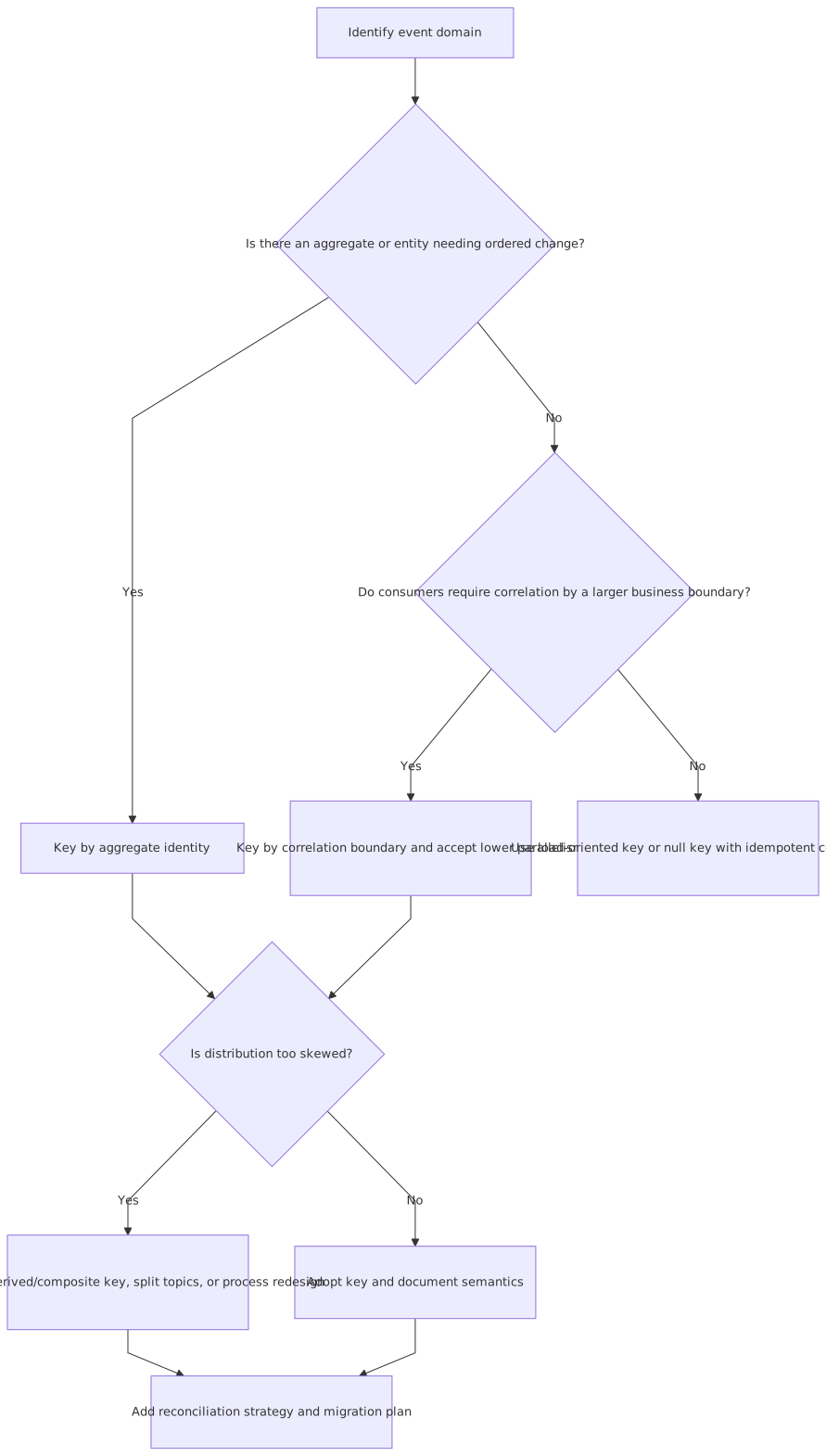
Notice what is not in that diagram: “Use the primary key from the database.” That shortcut is how systems inherit yesterday’s persistence model as tomorrow’s integration contract.
Architecture
A robust Kafka architecture makes partition semantics explicit. It usually has four layers of concern.
Producer semantics
Producers must emit keys based on domain identity, not merely local storage identity. This often means the producer needs access to canonical identifiers or a mapping service. That can feel inconvenient. It is still the right move when the stream is meant to serve multiple bounded contexts.
Producers should also emit event metadata that helps consumers survive evolution: event type, schema version, causation ID, correlation ID, source context, and business timestamp. The partition key is not enough by itself.
Topic topology
Not every use case should share the same topic. There is a difference between a domain event stream and a derived integration stream. A domain topic might be keyed by orderId to preserve order lifecycle semantics. A separate customer-activity topic may be derived and keyed by customerId for CRM and personalization use cases. Trying to satisfy all consumers with one key usually produces a lowest-common-denominator stream that satisfies nobody well.
This is one of those architectural truths people resist because it creates more topics. But extra topics are cheaper than semantic confusion.
Consumer state and reconciliation
Consumers should be designed with the expectation that local state may drift. Replays happen. Duplicates happen. Partial outages happen. If a consumer materializes account balance, inventory position, or customer status, it should have one of the following:
- an idempotent update model
- a compacted changelog or source of truth topic
- a replay strategy
- a periodic reconciliation job against an authoritative store
- correction events for detected divergence
Reconciliation is not a sign of failure. In enterprise event-driven systems, it is the adult supervision.
Governance of event semantics
I do not mean a committee approving every field name. I mean lightweight but explicit documentation of what the key means, what ordering is guaranteed, and what is not. Teams often document schemas and forget key semantics. Then months later a new consumer assumes “all account events are ordered,” while the producer had quietly keyed by payment batch.
That gap causes expensive bugs because both teams are technically correct from their own vantage point.
The following diagram shows a common enterprise shape with domain topics and derived streams.
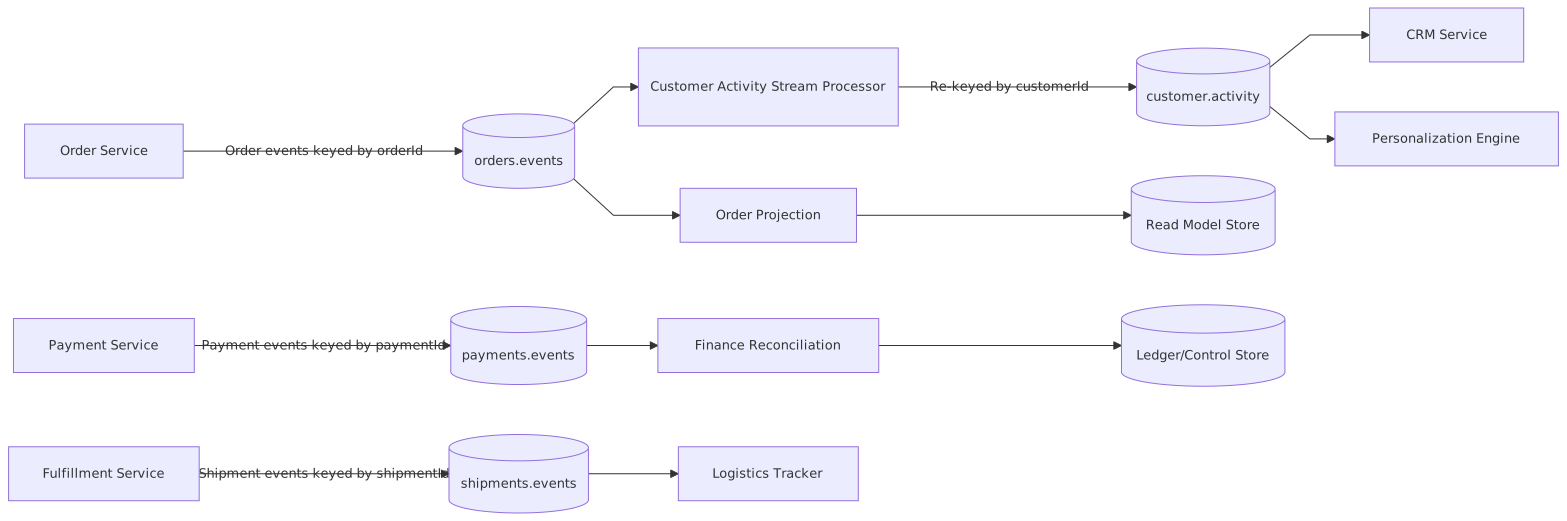
The important point is that re-keyed or derived topics are legitimate architectural tools. They let each stream carry the semantics its consumers actually need. But they must be named and governed as derived artifacts, not mistaken for the source domain truth.
Migration Strategy
Changing a partition key in a live enterprise system is not a refactor. It is a migration.
The safe pattern is progressive strangler migration: introduce a new stream with the new key semantics, run both in parallel, validate outcomes, move consumers incrementally, then retire the old path. This is slower than a flag day. It is also how you avoid inventing your own outage.
A practical migration sequence looks like this:
- Identify the semantic defect
Be precise. “We need more throughput” is not enough. State the actual problem: hotspot on top 2% of tenantId keys, or inability to reconstruct order lifecycle because events are keyed by customer.
- Define the target stream contract
New topic name, key semantics, schema compatibility stance, retention, and consumer expectations. Explicitly write down ordering guarantees and non-guarantees.
- Build translation or re-keying pipeline
Depending on data available, this may be done by producer dual-write, stream processing, or outbox-based republishing. Stream processing is common, but beware: if the source stream lacks the target key data, you may need enrichment.
- Run dual streams in parallel
Keep old consumers on the old topic while selected consumers adopt the new one. During this phase, reconciliation is mandatory.
- Validate with control reports and drift detection
Compare aggregate counts, balances, statuses, or lifecycle states between old and new processing paths. Do not rely on “consumer lag looks fine.”
- Cut over bounded contexts gradually
Migrate the consumers that benefit most or have the lowest dependency complexity first. High-risk consumers, especially those with financial or regulatory effects, should move only after evidence is stable.
- Freeze and retire old path
Once all dependent contexts have moved and retention windows are satisfied, decommission the old stream. Keep lineage and migration documentation. Somebody will ask six months later.
Here is the migration pattern in picture form.
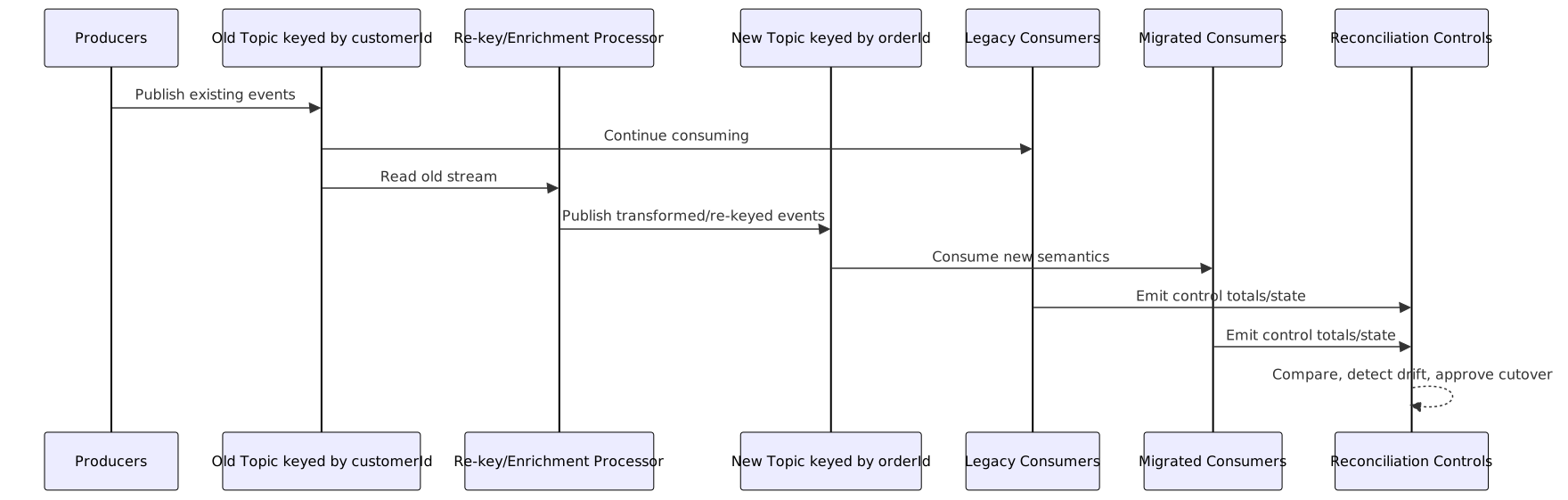
A word on dual-write. It is tempting to modify producers to publish both old and new keys directly. Sometimes that is the right move, especially when producers have the target business identity available and stream processing enrichment would be brittle. But dual-write introduces coordination and testing complexity across many services. In large estates, an intermediary re-keying pipeline is often easier to govern during transition.
Still, there is no free lunch. Re-keying introduces its own failure modes: stale reference data, incorrect joins, duplicate emissions, and timing gaps. That is why reconciliation matters.
Enterprise Example
Consider a global insurer modernizing claims processing.
The legacy estate had a central claims platform publishing Kafka events keyed by policyId. That made sense to the original team because policy was the top-level customer contract and many reporting processes were policy-centric. Over time, however, claims handling split into multiple microservices: intake, fraud, assessment, payments, recovery, and customer communication. Those services increasingly operated on claimId, not policy. A single policy might have multiple active claims, and catastrophe events caused huge bursts on a few policy-heavy regions.
The symptoms were classic:
- fraud and assessment consumers experienced backlogs because large commercial policies serialized too much traffic on a single partition
- claim lifecycle projections were hard to maintain because events for one claim were interleaved with unrelated claims under the same policy key
- customer service timelines became inconsistent because communication events and assessment events did not line up cleanly at claim granularity
- one region’s catastrophe traffic caused hot partitions and delayed unrelated workloads
The architecture team resisted the predictable answer of “just add more partitions.” That would reduce per-partition pressure but would not fix the semantic mismatch. Ordering was still too broad.
Instead, they reframed the problem using domain-driven design. In the claims bounded context, the aggregate of interest was claimId. Policy remained important, but it was a correlation dimension, not the primary ordering boundary for operational claim handling. So the target architecture introduced a new domain topic keyed by claimId for claim lifecycle events, while retaining policy-oriented derived streams for reporting and customer engagement.
Migration followed a strangler approach:
- existing policy-keyed topic remained live
- a stream processor enriched and republished claim lifecycle events keyed by
claimId - fraud, assessment, and payments services moved first because they benefited most from claim-level ordering
- reporting and customer experience stayed temporarily on policy-oriented streams
- nightly reconciliation compared claim status, payment totals, and open exposure between old and new processing paths
- after three months of stable controls, new producers emitted claim-keyed events natively from the outbox of modernized services
The result was not magical perfection. Some policy-wide analytics still needed separate aggregation pipelines. A few customer timeline views became eventually consistent across claim and policy streams. But operational throughput improved sharply, hotspot behavior reduced, and claim handling logic became comprehensible again.
That is the sort of tradeoff mature architecture makes: optimize the core domain flow first, then derive other views deliberately.
Operational Considerations
Partition key design is architectural, but its consequences are operational.
Partition count is not a cure-all
More partitions can increase throughput and consumer parallelism, but they do not solve semantic over-grouping. If one giant tenant or account dominates traffic, that key still lands on one partition. Kafka cannot shard a single key across partitions while preserving order. If your business has elephants, architecture must account for elephants.
Observe key distribution
Most teams monitor broker health, consumer lag, and throughput. Fewer monitor per-key skew. You should. Sample key cardinality, top-N key volume, partition imbalance, and processing latency by key category. Without this, hotspots look random until they do not.
Idempotency matters more than optimism
Even with a well-chosen key, duplicates and retries will occur. Consumers should be idempotent where possible. Exactly-once semantics can help in some pipelines, but enterprise systems still need pragmatic duplicate handling at the business operation level.
Retention and replay strategy
If consumers need to rebuild state, retention policies must support that need or there must be a compacted changelog or durable source store. Teams often discover too late that a topic retained only seven days of data, while the operational recovery process needs thirty.
Schema and key evolution must be linked
Changing fields while keeping the same key can still alter consumer behavior. More importantly, changing key semantics while preserving event names is dangerous because it looks backward compatible when it is not. Treat key changes as contract changes.
Tradeoffs
There is no perfect partition key, only an informed compromise.
Key by the narrowest aggregate identity and you maximize parallelism, but some consumers needing broader ordering will have to correlate externally.
Key by a broader business boundary and you simplify those consumers, but you create hotspots and reduce throughput.
Create multiple derived topics and you improve semantic fit, but you increase topology complexity, governance burden, and lineage management. ArchiMate for governance
Migrate slowly with dual streams and reconciliation and you reduce risk, but you spend more time and money in transition. Migrate fast and you shorten overlap, but increase outage potential.
My bias is clear: favor semantic correctness in the core domain stream, then derive alternate views where needed. Enterprises usually regret under-modeling business meaning more than they regret a few extra topics.
Failure Modes
Partition key mistakes fail in very recognizable ways.
Hot key collapse
A small number of keys generate most traffic. One consumer instance burns, lag grows, SLAs slip, and horizontal scaling appears ineffective because the workload is serialized by the key. Teams often misdiagnose this as “Kafka is slow.” It is usually key skew.
False ordering assumptions
A downstream service assumes all events for a business entity arrive in sequence, but the chosen key only preserves order for a different entity. The service builds invalid state, often subtly. These are nasty defects because no component appears broken in isolation.
Re-keying drift
A migration pipeline enriches old events with reference data to derive a new key, but the reference data changes over time. The same historical event may be assigned differently if replayed later. That breaks reproducibility. The cure is to use event-carried identity where possible, or versioned lookup rules.
Fan-out topic sprawl
To satisfy every consumer, teams create many derived topics without ownership or lifecycle management. Soon nobody knows which stream is authoritative, which is temporary, or which can be retired. The architecture decays into a streaming junk drawer.
Repartitioning by hope
A team changes partition counts or keying strategy assuming consumers are stateless. They are not. Local state stores, caches, and partition-affine processing break or produce duplicates. This is a fine way to turn a maintenance release into a weekend.
When Not To Use
There are cases where sophisticated partition key design is unnecessary or even counterproductive.
Do not over-engineer keys when the workload is low-volume, consumers are simple, and no meaningful ordering is required. A straightforward topic with idempotent consumers may be enough.
Do not force Kafka into being a transactional sequencer for workflows that need strict global ordering or synchronous consistency. If the business process truly requires one-at-a-time coordination across many entities, a partition key will not save you. Use a different pattern.
Do not create re-keyed operational topics casually for every reporting need. If the need is analytical and tolerant of delay, a lakehouse, warehouse, or batch-derived dataset may be a better fit than proliferating streaming contracts.
And do not use partition keys as a substitute for domain design. If your team cannot explain what business identity the key represents, stop. The stream is not ready.
Related Patterns
Several related patterns often appear around partition key design.
Transactional Outbox helps producers publish events with stable domain identifiers derived from the same transaction that changed state.
CQRS separates command-side operational streams from query-side derived projections, which often allows different key strategies.
Strangler Fig Migration is the right mindset for changing stream contracts in running systems: coexist, redirect, retire.
Saga orchestration or choreography influences key choice because long-running business processes may need correlation IDs distinct from aggregate IDs.
Compacted topics support reconciliation and current-state recovery when consumers need to rebuild views after failures.
The common thread is this: partition key design is not isolated from architecture patterns. It sits among them, shaping and being shaped by them.
Summary
The partition key in Kafka is not a hash input. It is a business decision wearing infrastructure clothing.
Design it from domain semantics first. Ask what entity needs ordered change. Understand bounded contexts and consumer assumptions. Measure key skew in the real business, not in the whiteboard fantasy. Accept that some consumers need derived streams with different keys. Build reconciliation into the architecture because distributed truth drifts. And if you must change keys, migrate with a progressive strangler approach rather than theatrical bravery.
A memorable rule is this: the right partition key is the smallest business identity that must fail, recover, and make sense together.
Get that right, and Kafka becomes an enabling backbone for microservices and event-driven architecture. Get it wrong, and the partitions may be balanced while the business is not.
Frequently Asked Questions
What is event-driven architecture?
Event-driven architecture (EDA) decouples services by having producers publish events to a broker like Kafka, while consumers subscribe independently. This reduces direct coupling, improves resilience, and allows new consumers to be added without modifying producers.
When should you use Kafka vs a message queue?
Use Kafka when you need event replay, high throughput, long retention, or multiple independent consumers reading the same stream. Use a traditional message queue (RabbitMQ, SQS) when you need simple point-to-point delivery, low latency, or complex routing logic per message.
How do you model event-driven architecture in ArchiMate?
In ArchiMate, the Kafka broker is a Technology Service or Application Component. Topics are Data Objects or Application Services. Producer/consumer services are Application Components connected via Flow relationships. This makes the event topology explicit and queryable.