⏱ 6 min read
Recommended Reading
Executive summary
Kafka adoption changes enterprise architecture from “application integration” to “event fabric governance.” Kafka’s core concepts (topics, partitioned logs) become architectural primitives that affect how domains share data and how changes ripple across the organization. Sparx EA training
Schema compatibility and evolution become enterprise governance matters, with Confluent’s Schema Registry documentation providing concrete compatibility modes and default policy guidance.
Lineage and auditability expectations also rise: OpenLineage and W3C PROV provide standards and vocabulary for tracking data movement and provenance—key for compliance and incident response.

Before and after Kafka: the architecture transformation
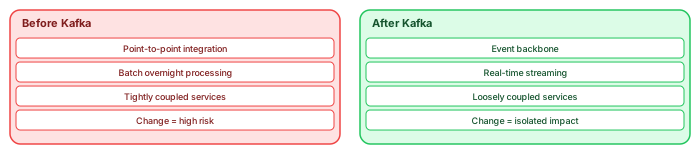
Kafka adoption is not a technology decision — it is an architecture decision that reshapes how systems communicate, how data flows, and how teams organize. Enterprise architects must understand the second-order effects before recommending Kafka. Sparx EA best practices
Integration topology changes. Before Kafka: N systems connected via N×(N-1)/2 point-to-point integrations, each with its own protocol, format, and error handling. After Kafka: N systems publish to and consume from shared topics, reducing integration complexity to 2N connections. This sounds simple, but it requires rethinking how every integration works — from synchronous request-reply to asynchronous event-driven.
Data flow visibility changes. Point-to-point integrations are invisible to enterprise architecture — they exist in configuration files, not in the architecture model. Kafka topics are visible, nameable, and governable. Every data flow becomes a topic with a schema, an owner, and consumers. This is a governance opportunity: the architecture team can finally see and manage how data moves across the enterprise.
Team structure changes. Kafka requires a dedicated platform team that owns the cluster, monitors health, manages upgrades, and provides self-service tooling. Domain teams own their topics, schemas, and producers/consumers. This maps to the "platform + domain" model that scales better than centralized integration teams.
Failure model changes. Synchronous systems fail fast — the caller gets an error immediately. Asynchronous systems fail slow — messages queue up, consumers fall behind, and problems surface hours later through consumer lag alerts. Enterprise architects must ensure the monitoring and alerting infrastructure is in place before the first event flows.
The organizational transformation Kafka requires
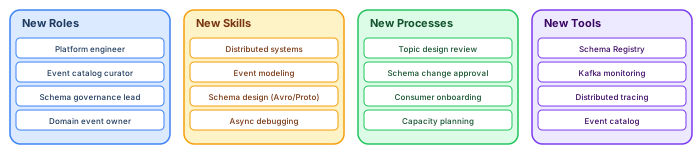
Kafka adoption triggers organizational change that goes far beyond installing a cluster. The enterprise architecture team must anticipate and plan for new roles, skills, processes, and tools. free Sparx EA maturity assessment
New roles. Platform engineers who operate and tune the Kafka cluster (distinct from application developers who produce and consume). An event catalog curator who maintains the authoritative inventory of all domain events, schemas, and ownership. A schema governance lead who reviews schema changes for compatibility and quality. Domain event owners — the team members accountable for each topic's data quality, documentation, and SLA.
New skills. Application developers must learn distributed systems concepts: eventual consistency, idempotency, at-least-once delivery semantics, and consumer offset management. Architects must learn event modeling — designing systems around events rather than API calls. Schema designers must master Avro or Protobuf schema design, including evolution strategies that maintain backward compatibility. Operations teams must learn to debug asynchronous systems where a single business transaction spans multiple topics and services.
New processes. Topic design review before creation (naming, partitioning, retention). Schema change approval before registration (compatibility, quality, documentation). Consumer onboarding workflow for new teams subscribing to existing topics. Capacity planning cadence for the Kafka platform (storage growth, throughput trends, partition rebalancing).
New tools. Schema Registry for contract governance. Kafka monitoring (Confluent Control Center, Conduktor, or Prometheus + Grafana with JMX exporters). Distributed tracing (OpenTelemetry with Jaeger or Zipkin) for debugging cross-topic transaction flows. Event catalog (internal wiki, AsyncAPI specification, or dedicated tooling like EventCatalog) for discoverability.
Planning the adoption roadmap
Kafka adoption follows a predictable maturity curve. Phase 1 (months 1-3): deploy a cluster, migrate one high-value integration, build the platform team. Phase 2 (months 4-9): migrate 5-10 integrations, establish topic governance, deploy Schema Registry. Phase 3 (months 10-18): adopt event-driven patterns for new services, build the event catalog, implement automated governance. Phase 4 (18+ months): event-driven is the default pattern, the event catalog is the authoritative integration map, governance is fully automated. integration architecture diagram
The enterprise architecture team's role is to ensure each phase delivers measurable value while building toward the next phase. Model the adoption roadmap as an ArchiMate Migration view with explicit plateaus — each plateau is a stable, viable state that the organization can operate in indefinitely if the next phase is delayed. ArchiMate layers explained
Measuring Kafka adoption success
Define success metrics before adoption begins. Track quarterly and report to architecture leadership.
Integration migration rate: Percentage of identified integration candidates migrated to Kafka. Target: 30% in year 1, 60% in year 2. Measure progress toward the target integration landscape.
Point-to-point reduction: Count of active point-to-point integrations before and after Kafka adoption. Each migration to Kafka should retire one or more point-to-point connections. Track the N×(N-1)/2 reduction toward the 2N target topology.
Event catalog coverage: Percentage of Kafka topics documented in the event catalog with schema, owner, and consumer registry. Target: 100% — undocumented topics are ungoverned topics.
Platform reliability: Kafka cluster uptime, message delivery latency (p99), and unplanned downtime incidents. These metrics justify continued investment in the platform team and infrastructure.
Developer satisfaction: Quarterly survey of development teams on ease of producing/consuming events, quality of documentation, and governance process efficiency. Architecture programs that ignore developer experience build technically sound platforms that nobody uses.
Governance model changes
Kafka adoption requires extending the architecture governance model. Add three new governance artifacts to the architecture repository. Event catalog: the authoritative list of all domain events with schema, owner, consumers, and SLA. Topic governance dashboard: real-time metrics on topic count, partition utilization, consumer lag, and naming compliance. Schema compatibility report: weekly report showing all schema changes, compatibility mode per topic, and any rejected changes. These artifacts join the existing portfolio views, capability maps, and compliance dashboards in the governance toolkit presented to the architecture board.
If you’d like hands-on training tailored to your team — Sparx Enterprise Architect, BPMN, SysML, Apache Kafka or the Archi tool — or modelling coaching in ArchiMate and TOGAF-aligned governance, you can reach us via our contact page.
Frequently Asked Questions
What is enterprise architecture?
Enterprise architecture is a discipline that aligns an organisation's strategy, business operations, information systems, and technology infrastructure. It provides a structured framework for understanding how an enterprise works today, where it needs to go, and how to manage the transition.
How is ArchiMate used in enterprise architecture practice?
ArchiMate is used as the standard modeling language in enterprise architecture practice. It enables architects to create consistent, layered models covering business capabilities, application services, data flows, and technology infrastructure — all traceable from strategic goals to implementation.
What tools are used for enterprise architecture modeling?
Common enterprise architecture modeling tools include Sparx Enterprise Architect (Sparx EA), Archi, BiZZdesign Enterprise Studio, LeanIX, and Orbus iServer. Sparx EA is widely used for its ArchiMate, UML, BPMN and SysML support combined with powerful automation and scripting capabilities.