⏱ 20 min read
Event replay looks innocent on the whiteboard.
A team discovers event sourcing, sees the neatness of immutable facts, and quickly lands on the seductive promise: if every change is an event, we can always rebuild anything. It sounds like operational immortality. Broken projection? Replay. New reporting model? Replay. Audit question from compliance? Replay. Bad deployment on Tuesday night? Replay.
Then the enterprise arrives.
Not as a design pattern, but as a weather system. Regulated data. Dozens of bounded contexts. Kafka topics with retention policies negotiated by three departments and a budget committee. Microservices that were “temporary” four years ago. Customer support tools that quietly depend on side effects no one documented. Replay, in that world, stops being a technical trick and becomes a governance problem. microservices architecture diagrams
That is the heart of this article: in event-sourced systems, replay is not simply a capability. It is a controlled business operation. If you do not govern replay, replay will govern you. It will decide when data drifts, when downstream systems melt, when duplicate effects appear, and when an executive asks why “immutable history” somehow produced two invoices and no shipment.
A healthy architecture treats replay as a first-class concern, with rules, blast-radius controls, semantic boundaries, and explicit ownership. It combines domain-driven design with operational discipline. It understands that not every event should be replayed, not every consumer should respond the same way in replay mode, and not every historical fact remains legal or meaningful forever.
This is where enterprise architecture earns its keep. Not in drawing one more box-and-arrow diagram, but in deciding which truths survive reprocessing, which integrations must be isolated, and which parts of the landscape should never be rebuilt from the beginning because the business semantics have changed under their feet.
Context
Event sourcing gives us a sharp tool: store state transitions as a sequence of domain events, then derive current state from that stream. It is powerful because it preserves intent and history. “OrderPlaced” means more than a row update. “CreditReserved” tells a story. Over time, that story becomes the source of truth, while projections, read models, search indexes, and analytics views become disposable products of replay.
In small systems, replay is often framed as a maintenance task. Rebuild the projection. Catch up the new consumer. Backfill data after a bug fix.
In enterprises, replay becomes broader:
- rebuilding materialized views after schema changes
- regenerating downstream integration messages
- migrating from monolith to microservices
- establishing new bounded contexts from old transaction logs
- reconciling Kafka consumers after offset corruption
- recovering from logic bugs in projections
- supporting regulatory inquiry and historical reconstruction
- testing new business rules against old event streams
Those are not the same thing. They differ in purpose, risk, and semantics.
The mistake many teams make is to treat them as one mechanism: “just replay the topic.” That phrase has caused more damage than many production outages. Because there is no such thing as just replay in a large landscape. There is only replay with consequences.
Event replay governance is the set of policies, controls, architecture decisions, and operational practices that determine:
- what can be replayed
- by whom
- into which target environment or model
- with what semantic interpretation
- under what safeguards
- with what reconciliation outcome
Without that governance, event sourcing degrades into a historical archive with unpredictable behavior. With it, event sourcing becomes what it should be: a disciplined way to evolve systems without losing business truth.
Problem
The core problem is deceptively simple: the same event stream is used for two different jobs.
First, events capture domain facts at the time they happened. Second, those events are used later to regenerate derived state. But the world changes between those two moments. Code changes. policy changes. meanings change. consumers change. legal constraints change. infrastructure changes.
A replay is therefore never a pure technical rerun. It is a present-day interpretation of past business facts.
That gap creates the governance challenge. EA governance checklist
Consider a typical enterprise event-sourced landscape:
- domain services emit events into Kafka
- several microservices maintain their own local read models
- a data platform consumes topics for analytical pipelines
- external systems receive notifications, commands, or integration events
- support and finance teams use downstream tools based on projected state
- retention, encryption, and privacy rules affect event availability
Now suppose you replay five years of Order events because you fixed a bug in order tax calculation. What exactly should happen?
Should the search index be rebuilt? Probably yes.
Should customer emails be sent again? Absolutely not.
Should payment systems receive the integration event again? Maybe no, unless replay drives reconciliation into a side-effect-free mode.
Should current tax policy be applied to historical orders? Usually no, unless you are intentionally restating history and have governance approval. ArchiMate for governance
Should deleted personal data be rehydrated into projections? That may be illegal.
Should all services consume replay at full speed? If they do, you may create a Kafka storm, blow caches, and starve live traffic. event-driven architecture patterns
These are not edge cases. They are the normal shape of replay in enterprise systems.
Forces
A useful architecture article has to name the tensions, because architecture is mostly the art of disappointing one force in favor of another.
1. Immutability vs semantic drift
Events are immutable. Meaning is not.
A domain event records a business fact in the language of the domain at the time. But a bounded context evolves. “CustomerVerified” from 2020 may not satisfy compliance expectations in 2026. The event remains valid as history, yet insufficient as a present-day business fact.
This is why domain semantics matter so much. In domain-driven design, events belong to a bounded context and carry that context’s meaning. Replay across context boundaries without translation is not reuse. It is semantic leakage.
2. Recovery speed vs operational safety
Replay is often invoked during an incident. Something is wrong, and the team wants state rebuilt now. The faster the replay, the more likely it competes with live processing, overloads downstream systems, or creates offset confusion in Kafka consumers.
Fast replay feels heroic. Governed replay looks slower. In practice, governed replay saves more systems.
3. Historical fidelity vs current business policy
Do you want to reproduce exactly what the system should have computed then, or what policy says should be true now? Those are different goals.
This matters in billing, risk, and claims handling. Enterprises often need both:
- forensic replay for audit and historical truth
- corrective replay for rebuilding current projections
- compensating adjustments for legal or financial restatement
One stream, three purposes. Governance must separate them.
4. Decoupling vs hidden side effects
Teams love to say consumers are decoupled. Then replay happens and everyone discovers half the consumers trigger emails, partner notifications, cache invalidations, webhooks, or machine-learning feature pipelines.
A replay-safe consumer is not merely idempotent. It is explicit about side effects. That distinction is important. Idempotency prevents duplicates from causing repeated state mutation. Replay safety prevents historical processing from causing fresh external action.
5. Enterprise autonomy vs central control
Each bounded context wants ownership. The platform team wants standard controls. Compliance wants traceability. Operations wants predictable jobs. Data teams want broad access. Security wants policy enforcement.
Replay governance lives in this tension. Too centralized, and every replay becomes committee theater. Too decentralized, and every team invents its own unsafe mechanism.
Solution
The solution is to treat replay as a governed architectural capability with domain-aware execution modes.
That sentence sounds grander than it is. In plain language:
- define the semantic purpose of replay before running it
- classify events and consumers by replay behavior
- isolate side effects from state reconstruction
- execute replay through controlled pipelines, not ad hoc scripts
- reconcile outputs against expected business invariants
- preserve bounded context ownership while applying common governance standards
A practical governance model usually starts with three replay modes.
Replay mode 1: Projection rebuild
Used to reconstruct internal read models, search indexes, caches, and derived views. This is the safest mode because it should not produce external business effects.
Examples:
- rebuild customer timeline view
- regenerate order summary projection
- repopulate Elasticsearch from event streams
Replay mode 2: Reconciliation replay
Used to compare expected state from historical events with actual state in downstream systems. This is crucial when systems of record and projections drift.
Examples:
- compare account balances in a read model to ledger-derived balances
- verify shipment status projections against warehouse events
- regenerate expected invoice totals and compare to ERP records
This mode often writes to a discrepancy store, not directly to production state.
Replay mode 3: Compensating or migration replay
Used during system evolution, strangler migration, service extraction, or major logic changes. Here replay feeds a new model or service, often in parallel with the old one.
Examples:
- creating a new pricing service from historical order events
- backfilling a new customer-risk bounded context
- migrating monolith transaction history into Kafka-backed domain streams
This is the most politically sensitive mode because it changes ownership boundaries and exposes semantic mismatches.
A good governance framework requires each replay request to declare:
- purpose
- source events and time range
- target models or consumers
- side-effect policy
- expected invariants
- reconciliation method
- rollback or abort strategy
- business owner approval where needed
That sounds bureaucratic until the first replay sends 400,000 duplicate partner messages. Then it sounds like adulthood.
Architecture
The reference architecture for replay governance separates event storage, replay orchestration, consumer modes, and reconciliation. It also distinguishes domain events from integration events. That is a non-negotiable boundary in serious systems.
Domain events describe facts meaningful inside a bounded context. Integration events are published for others and may be tailored, translated, enriched, or redacted. Replaying one as though it were the other is how architectures become haunted.
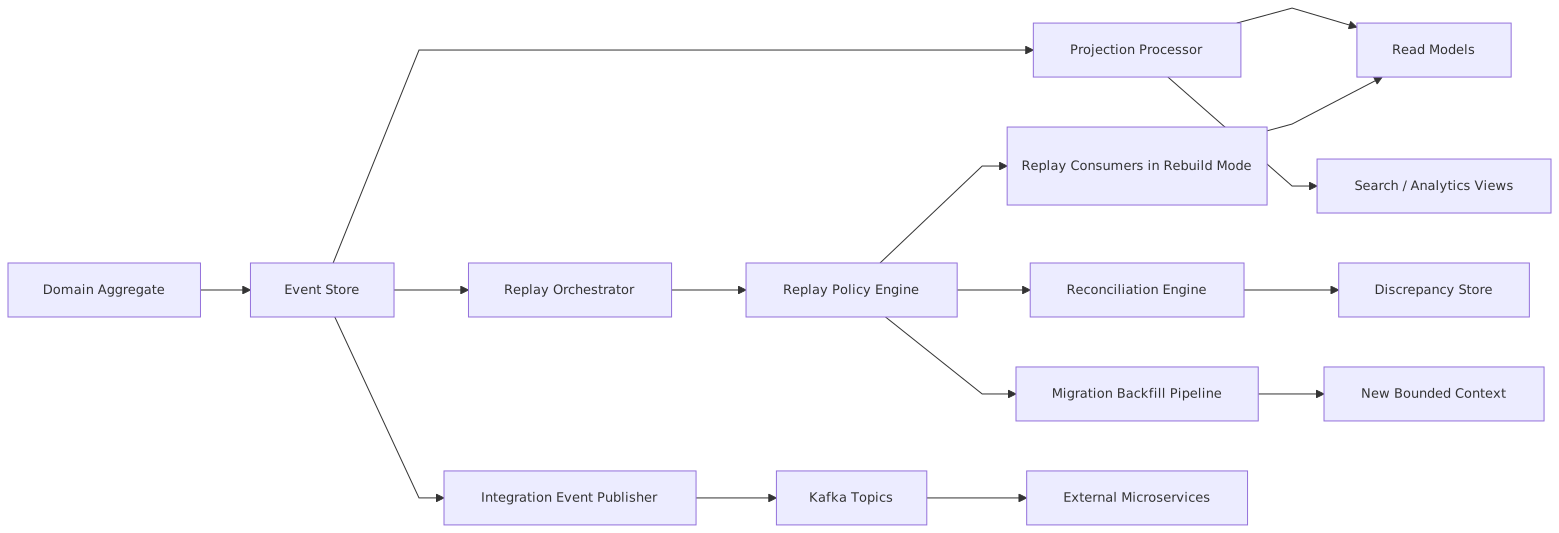
In this architecture:
- the event store remains the canonical history for the domain
- normal projections process live events continuously
- a replay orchestrator manages controlled historical processing
- a policy engine decides whether consumers run in live, rebuild, or reconciliation mode
- integration event publishing is separate from projection rebuild
- reconciliation captures drift rather than blindly mutating production state
This last point matters. Many teams use replay to “fix” state by overwriting downstream models. That can work for internal projections. It is dangerous for systems that have independent workflows, manual intervention, or external commitments. Reconciliation should expose differences before correction is applied.
Domain semantics and bounded contexts
Replay governance must be domain-aware. A finance bounded context and a customer-notification bounded context do not treat events the same way.
For example:
PaymentCapturedin finance is a ledger-relevant business fact- in customer communications it may simply trigger a receipt email
- in analytics it becomes one row among many
On replay:
- finance may rebuild balances
- communications must suppress actual email sending
- analytics may backfill a warehouse table
Same historical event. Different replay semantics.
This is classic domain-driven design. Bounded contexts are not just organizational convenience. They are semantic safety barriers. The replay model should honor those barriers by requiring each consumer to declare one of the following behaviors:
- rebuild-only: safe to process historical events and regenerate local state
- reconcile-only: produces comparison outputs, not direct side effects
- live-only: must never consume replayed events
- dual-mode: supports live and replay with explicit branch behavior
If your consumers do not have declared replay behavior, you do not have replay governance. You have hope.
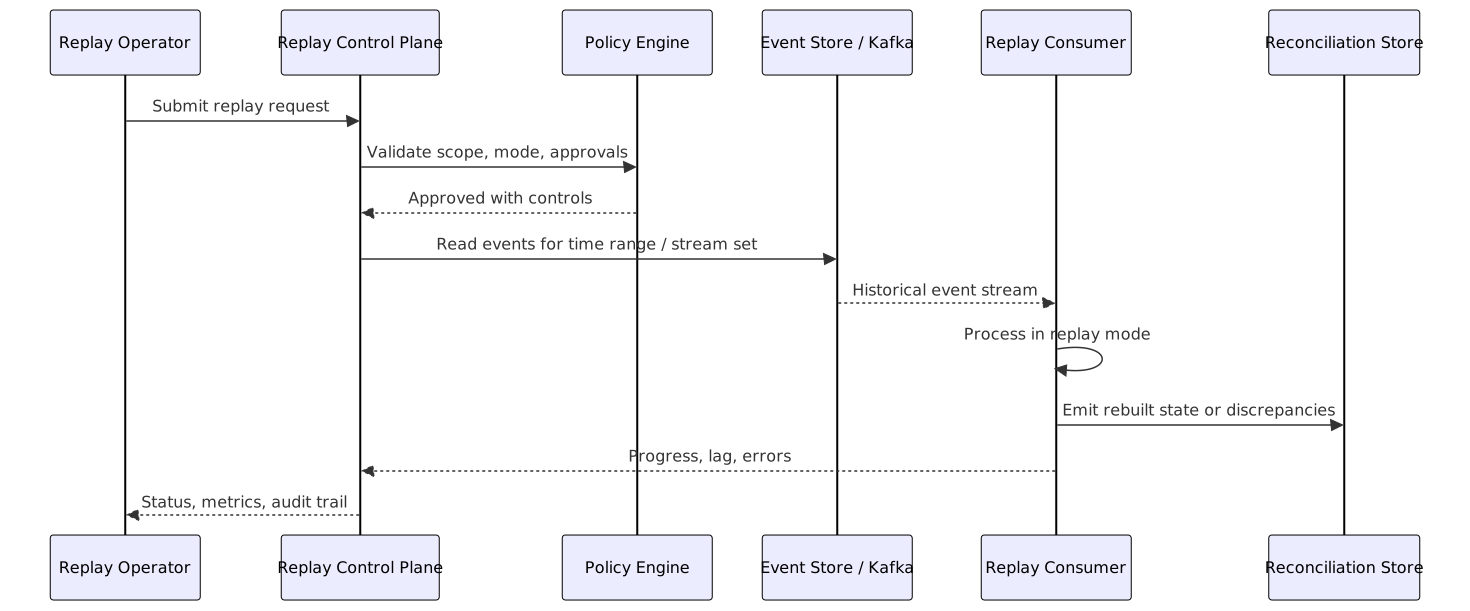
Replay control plane
A replay control plane is often worth introducing in larger estates. Not because architects love platforms, but because replay runbooks hidden in ten service repositories are not governance.
The control plane typically provides:
- replay job registration
- policy checks
- approval workflow
- throttling and scheduling
- Kafka offset isolation
- idempotency token injection
- audit logs
- metrics and tracing
- abort and resume capability
In Kafka-heavy estates, replay is often executed via dedicated replay topics or isolated consumer groups rather than rewinding live consumers. Rewinding production groups is a blunt instrument. It risks collisions with live offsets and surprises every dependent team.
Migration Strategy
Replay governance becomes especially important during migration. This is where the strangler pattern and event sourcing meet the real world.
The sensible migration strategy is progressive, not heroic.
Suppose an enterprise has a monolithic order management system with transaction tables, batch jobs, and decades of business rules. The target architecture is a set of bounded contexts around ordering, fulfillment, pricing, and customer service, with Kafka as the event backbone. Nobody should pretend that one weekend of “data migration” will solve this. The business semantics are too tangled.
Instead, use a strangler migration with replay and reconciliation in phases.
Phase 1: establish event extraction
Extract domain-significant changes from the monolith and publish them as events. At first these may be derived from database transaction logs, change data capture, or application hooks. But do not confuse CDC records with domain events forever. CDC is a bridge, not a destination.
Phase 2: build parallel projections
New services consume the event stream and build their own read models. They are not yet authoritative. They exist to prove semantic alignment and identify gaps.
Phase 3: reconcile aggressively
Compare outputs from the new service with the monolith. This is where replay shines. Historical events can be replayed into the new service repeatedly until discrepancies are understood.
Phase 4: shift responsibility by capability
Move one decision at a time. For example, let the new pricing service answer quote calculations for a subset of products, while the monolith still owns fulfillment. This preserves bounded context clarity.
Phase 5: retire old flows
Only after sustained reconciliation and operational confidence should old projections and pathways be removed.
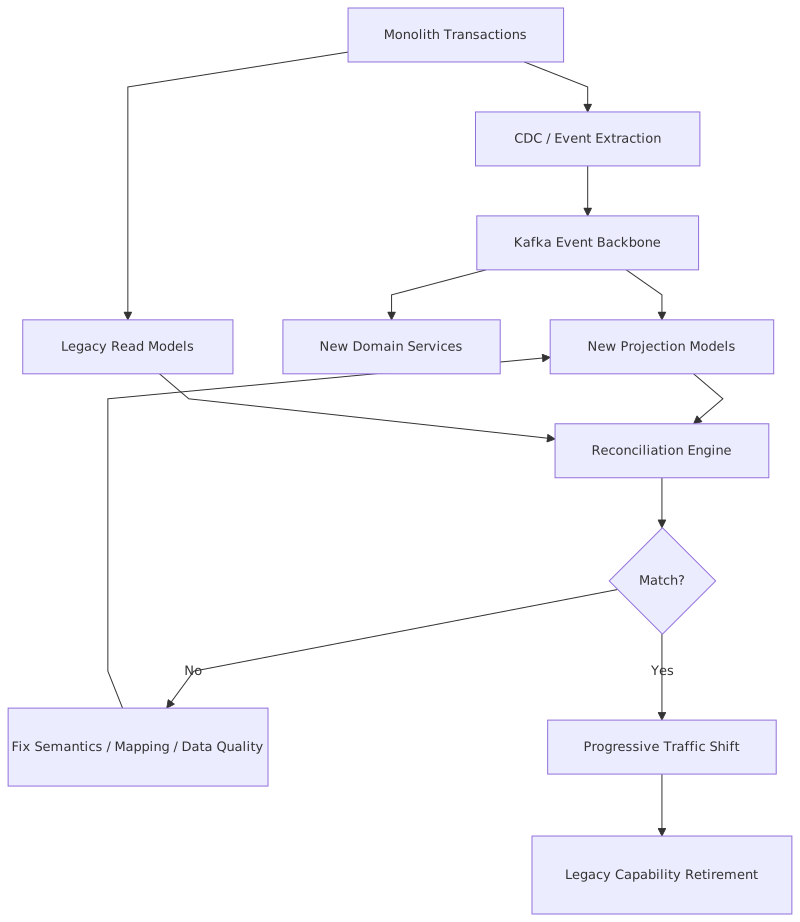
This is the right kind of boring. Boring migrations win.
Reconciliation as migration discipline
A strangler migration without reconciliation is just optimism in a blazer.
Reconciliation should operate at several levels:
- event count and sequence continuity
- aggregate state equivalence
- business invariant validation
- financial and operational totals
- exception queue analysis
For example, in a lending platform:
- the count of approved applications may match
- but risk categories may differ
- approved principal totals may drift by 0.7%
- historical exceptions may cluster around one legacy product type
That tells you something important: the new bounded context is not wrong in the abstract. It is semantically misaligned for specific domain cases.
Replay gives you the evidence. Governance gives you the discipline not to cut over early.
Enterprise Example
Consider a global insurer modernizing its claims platform.
The legacy claims system stored status changes in relational tables and drove dozens of downstream processes: adjuster assignment, reserve updates, fraud scoring, customer correspondence, payment processing, and regulatory reporting. The target architecture introduced event-sourced claims aggregates, Kafka topics for integration, and microservices around claims intake, adjudication, payments, and communications.
At first, the program assumed replay would be simple. Historical claim events would be backfilled into the new platform, and projections would be rebuilt as needed.
Reality was less polite.
The claims domain had changed semantics over ten years:
- reserve calculation rules changed after regulation updates
- fraud scoring models were versioned and externally hosted
- some historical correspondence events referenced templates no longer available
- GDPR-related erasure workflows had removed portions of customer-identifying data
- several downstream systems treated “status changed” as a signal to trigger actions
If the team had replayed everything blindly, they would have:
- regenerated obsolete letters
- recalculated reserves under the wrong policy basis
- repopulated erased personal data into search projections
- re-triggered partner settlement messages
So they introduced replay governance.
They classified consumers:
- claim search and operational dashboards as rebuild-only
- reserve reporting as reconcile-only unless approved for restatement
- correspondence and partner settlement as live-only
- fraud analytics as dual-mode with historical model version selection
They also separated the event types:
- domain events for claim lifecycle facts
- integration events for external notifications
- compliance redaction events to ensure replay respected erased data
A replay control plane ran backfills by claim cohort, business line, and jurisdiction. Reconciliation compared:
- current claim status
- reserve totals
- payment totals
- open-claim counts by region
- exception rates by product and date range
Cutover happened region by region. Not glamorous. Very successful.
The most important lesson was not technical. It was semantic. Historical events were valid, but not all were replayable in the same way. The architecture had to preserve the business meaning of the past without pretending the present had not changed.
That is enterprise architecture at its best: less about mechanism, more about boundaries and truth.
Operational Considerations
Replay governance fails in operations long before it fails in diagrams.
Throughput and throttling
Historical streams can be huge. Replaying at maximum speed may starve live Kafka consumers, overload databases, or create cache churn. Use separate consumer groups, bounded concurrency, and explicit throughput controls. In some cases, replay windows should be scheduled during low-traffic periods.
Idempotency and deduplication
Every replay-capable consumer needs a strategy for idempotency:
- event ID tracking
- sequence number checks
- aggregate version validation
- upsert semantics for projections
But remember: idempotency is necessary, not sufficient. A side-effecting action can be perfectly idempotent and still wrong in replay mode.
Schema evolution
Historical events often span many schema versions. Upcasting helps, but only if done carefully. Upcasters should preserve meaning, not merely shape. If you can’t explain how a legacy event maps to the current domain language, your replay results are already suspect.
Observability
Replay needs dedicated telemetry:
- lag by stream and partition
- processing rate
- divergence counts
- side-effect suppression metrics
- reconciliation outcome distribution
- per-consumer error classification
A replay with no observability is just a long-running mystery.
Security and compliance
Governance must account for:
- PII and redaction rules
- retention constraints
- encryption key rotation
- access approval for historical data
- legal holds
- jurisdiction-specific replay restrictions
History is an asset until it becomes evidence. Then everyone cares how you handled it.
Tradeoffs
There is no free lunch here.
Governance adds friction
Yes, it slows teams down. That is partly the point. The system should not make mass historical reprocessing as easy as refreshing a browser tab. Safe replay deserves ceremony.
Strong separation increases complexity
Separating domain events, integration events, replay modes, and side-effect policies adds moving parts. But the alternative is hidden coupling, which is complexity with better marketing.
Reconciliation delays cutover
Parallel runs and discrepancy analysis can feel expensive. They are expensive. They are still cheaper than moving financial or operational authority to a model you haven’t validated.
Storage and retention costs rise
If replay matters, event retention, archives, and schema compatibility become strategic concerns. That costs money. But “we cannot reconstruct what happened” is usually more expensive than S3.
Failure Modes
This is the section many architecture articles skip. It should not be skipped.
Blind replay into live consumers
The classic failure. A team rewinds Kafka offsets or republishes old events, and live consumers trigger emails, invoices, settlement messages, or inventory allocations.
Semantic corruption
Historical events are processed by new code that applies modern rules to old facts without explicit intent. The output looks consistent, but the meaning is wrong. These are the nastiest failures because they often pass technical validation.
Partial replay drift
One set of projections is rebuilt, another is not, and a third consumes both old and new derived state. The system becomes internally inconsistent. Support teams usually discover this first.
Replay storm
A large replay saturates brokers, databases, and caches. Live traffic suffers. Teams then pause consumers, creating backlogs elsewhere. An operational incident becomes a chain reaction.
Reconciliation theater
The organization claims to reconcile but only compares superficial metrics. Record counts match while financial totals drift. Cutover happens anyway. Six weeks later someone finds the gap.
Ownership ambiguity
No one knows who can approve replay that impacts compliance, finance, or partner integrations. The technical team makes a local decision with enterprise consequences.
When Not To Use
Replay governance is valuable, but event sourcing itself is not always the right choice.
Do not force event sourcing onto domains that:
- have low audit value and simple CRUD semantics
- do not benefit from temporal reconstruction
- cannot tolerate the complexity of schema evolution and replay controls
- lack stable domain language
- have no realistic plan for bounded context ownership
Likewise, do not rely on replay as the main recovery mechanism when:
- source events are incomplete or derived from lossy integration feeds
- downstream truth is authoritative and independent
- legal constraints prevent historical data reconstruction
- side effects cannot be cleanly isolated
There are cases where snapshots, transaction logs, batch rebuilds, or conventional data lineage tools are a better fit. Architecture is not improved by ideological purity. Sometimes the wisest event-sourcing decision is not to use it.
Related Patterns
Several related patterns sit naturally beside replay governance.
- Event sourcing: provides the historical fact stream
- CQRS: separates write-side truth from replayable read models
- Strangler fig pattern: enables progressive migration from legacy systems
- Outbox pattern: helps reliably publish integration events without conflating them with domain history
- Saga/process manager: coordinates long-running workflows, but must be replay-aware
- Snapshotting: reduces replay cost for aggregates, though not a substitute for governance
- Compensating transactions: correct outcomes when replay reveals drift or mistakes
- CDC: useful during migration, but should mature into proper domain event publication where possible
These patterns work best when applied with clear bounded contexts. That is the DDD through-line. If you ignore the model, your infrastructure will eventually punish you.
Summary
Event replay is where event-sourced architecture stops being elegant and starts being real.
In a toy system, replay is a convenience. In an enterprise, replay is a controlled intervention in business history. It affects domain semantics, operational safety, compliance posture, migration strategy, and trust in the platform itself.
The right approach is to govern replay explicitly:
- separate domain and integration events
- classify consumers by replay behavior
- use replay modes with clear semantic purpose
- reconcile before correcting
- migrate progressively through strangler patterns
- isolate side effects
- build a control plane for policy, execution, and audit
Most of all, understand this: immutable events do not remove responsibility. They increase it. Because once you can replay the past, you must decide which version of truth you are reconstructing, for whom, and under what authority.
That is the real governance diagram, even before you draw it. History is easy to store. The hard part is earning the right to run it again.
Frequently Asked Questions
What is enterprise architecture?
Enterprise architecture aligns strategy, business processes, applications, and technology in a coherent model. It enables impact analysis, portfolio rationalisation, governance, and transformation planning across the organisation.
How does ArchiMate support architecture practice?
ArchiMate provides a standard language connecting strategy, business operations, applications, and technology. It enables traceability from strategic goals through capabilities and services to infrastructure — making architecture decisions explicit and reviewable.
What tools support enterprise architecture modeling?
The main tools are Sparx Enterprise Architect (ArchiMate, UML, BPMN, SysML), Archi (free, ArchiMate-only), and BiZZdesign. Sparx EA is the most feature-rich, supporting concurrent repositories, automation, scripting, and Jira integration.