⏱ 18 min read
Introduction: Kafka as critical infrastructure in enterprise banking
When a Tier-1 bank processes millions of card transactions daily, the messaging infrastructure becomes as critical as the core banking system itself. Apache Kafka has emerged as the de facto standard for event streaming in banking — but deploying it in a regulated, mission-critical environment is fundamentally different from a typical startup use case. The gap between a proof of concept and a production-grade banking deployment is enormous, and most of that gap is architectural, not operational.
This article distills lessons from deploying Kafka across multiple banking environments. It covers the architectural decisions that must happen before a single broker is provisioned, partition strategies that prevent data loss, exactly-once delivery semantics, schema governance, security architecture, observability, disaster recovery, and the cultural transformation required to move from batch to real-time. Every pattern described here has been tested in production banking environments processing millions of events per day. EA governance checklist
Recommended Reading
From batch to real-time: the business case for event streaming
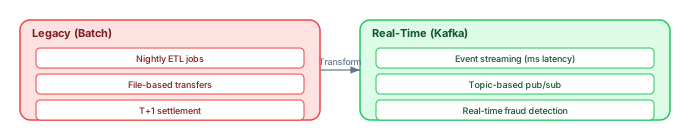
Banking IT has historically been batch-oriented: nightly ETL jobs extract data from operational systems, file-based transfers move it between departments, and settlement happens on a T+1 cycle. This model worked when banking was paper-based, but it creates dangerous blind spots in a digital economy. A fraudulent transaction made at 9 AM is not detected until the batch run at midnight — by which time the money is gone.
Kafka replaces this with event-driven architecture where every transaction, account change, and compliance event is streamed in real time. The business case is compelling across multiple dimensions: integration architecture diagram
Real-time fraud detection: Kafka Streams processes transaction events within milliseconds, applying ML models and rule engines to catch fraud before settlement. Banks report 60–80% improvement in fraud detection rates after migrating from batch to streaming.
Instant payment processing: With PSD2 and instant payment regulations, T+1 settlement is no longer acceptable. Kafka enables sub-second payment routing, confirmation, and reconciliation.
Live regulatory reporting: Rather than generating compliance reports from stale batch data, streaming architecture produces real-time feeds for AML monitoring, transaction reporting, and Basel III liquidity calculations.
Operational dashboards: Treasury, risk management, and operations teams see actual state rather than yesterday's snapshot. Position calculations, exposure monitoring, and liquidity views are always current.
Architecture before installation: the modeling-first imperative
The most expensive Kafka mistakes are architectural, not operational. Topic taxonomy, partition strategy, retention policies, consumer group design, and security boundaries must be decided before a single broker is provisioned. In banking, where data lineage and regulatory compliance are non-negotiable, these decisions should be modeled in an enterprise architecture tool (ArchiMate, Sparx EA) and reviewed by architecture governance before deployment. ArchiMate layers explained
We recommend creating a dedicated ArchiMate viewpoint for the Kafka architecture that shows: topics as Application Services, producers and consumers as Application Components, the Schema Registry as a Technology Service, and partition strategies as tagged values. This viewpoint becomes the single source of truth for Kafka governance and enables impact analysis when changes are proposed. ArchiMate layers explained
Topic taxonomy design

Topics are Kafka's fundamental organizing principle. A well-designed topic taxonomy follows a strict naming convention: {domain}.{entity}.{event} (e.g., payments.transaction.authorized, accounts.customer.updated). The taxonomy separates three categories:
Domain events: Business-meaningful state changes that represent the core event stream. These are the events that other systems subscribe to. Retention is typically 7–30 days, with compacted topics for entity state.
Integration topics: Legacy system synchronization, external partner feeds, and CDC (Change Data Capture) streams. These bridge the batch and streaming worlds during migration. Retention matches the source system's batch cycle.
Internal operational topics: Audit logs, dead-letter queues (DLQ), retry topics, and metrics streams. These are not consumed by business applications but are essential for operations and compliance.
This separation enables independent retention policies, access controls, and monitoring thresholds per topic category. It also simplifies compliance: auditors can be given read access to audit topics without exposing production event streams.
Cluster design and capacity planning
Banking Kafka clusters are sized differently from typical deployments because of two constraints: data retention requirements (regulatory mandates may require 5–7 years of transaction history) and availability requirements (zero tolerance for data loss, sub-second failover). A typical production banking cluster starts with 5–7 brokers across 3 availability zones, min.insync.replicas=2, replication factor of 3, and dedicated ZooKeeper/KRaft nodes.
Capacity planning follows a methodology: measure peak throughput (messages/second and MB/second), multiply by the replication factor, add 40% headroom for traffic spikes, and size disk for retention period × daily volume × replication factor. For a bank processing 50,000 transactions per second at peak, with 1KB average message size, 30-day retention, and replication factor 3: disk requirement = 50,000 × 1KB × 86,400 seconds × 30 days × 3 replicas ≈ 388 TB.
Partition strategy and event ordering

Partitions determine parallelism and ordering. In banking, ordering per account is critical: a debit must be processed before a subsequent credit for the same account to maintain correct balances. The partition key should be account_id, ensuring all events for a single account go to the same partition and are processed in order by a single consumer within a consumer group.
The hot partition problem
High-volume accounts (corporate treasuries, payment processors, correspondent banks) can create hot partitions — one partition receives disproportionate traffic while others sit idle. This creates consumer lag, processing delays, and potential SLA breaches. Mitigation strategies include: composite keys (account_id + transaction_type), increased partition count (128–256 for high-volume topics), custom partitioners that distribute high-volume accounts across multiple partitions with application-level reordering, and dedicated topics for ultra-high-volume entities.
Delivery semantics and exactly-once processing

In banking, message delivery semantics are regulatory requirements, not academic concerns. A payment processed twice is a financial loss. A payment dropped is a compliance violation and potential regulatory fine. Kafka supports three delivery guarantees:
At-most-once: Messages may be lost but never duplicated. Unacceptable for financial transactions.
At-least-once: Messages are never lost but may be duplicated. Requires idempotent consumers — acceptable with careful design.
Exactly-once (EOS): Transactional processing with no loss or duplication. Required for financial settlement and account balance calculations.
Exactly-once semantics in Kafka requires three components working together: idempotent producers (enable.idempotence=true) that assign sequence numbers to prevent duplicate writes, transactional producers that wrap multiple topic writes in atomic transactions, and Kafka Streams with processing.guarantee=exactly_once_v2 for stream processing applications.
The boundary problem
The critical insight is that EOS only applies within the Kafka boundary. A Kafka Streams application that reads from one topic, processes, and writes to another topic can be exactly-once. But a consumer that writes to an external database (PostgreSQL, Oracle) must implement idempotency at the database level — using unique transaction IDs, upsert operations, or idempotent write patterns. Every banking consumer that touches a database must address this boundary explicitly.
Schema governance and data contracts

Schema governance prevents the most common Kafka failure mode: a producer changes a message format and breaks every downstream consumer. In banking, where a single broken consumer can halt payment processing, this is unacceptable.
Deploy Confluent Schema Registry (or compatible alternatives like Apicurio) with BACKWARD compatibility mode. Every producer must register its schema before producing; every consumer validates against the registry. Use Apache Avro or Protobuf — not JSON — for type safety, compact serialization, and schema evolution support.
Schema governance rules for banking: all schema changes require architecture review, breaking changes are forbidden (fields can be added with defaults, never removed), every schema has an owner and a versioned changelog, and CI/CD pipelines validate schema compatibility before deployment.
Security architecture in banking context

Kafka security in banking requires defense in depth across four layers:
Network layer: Kafka brokers reside in a dedicated VLAN with firewall rules restricting access to approved producers and consumers only. No direct internet access. Inter-broker communication on a separate network segment.
Transport layer: TLS 1.3 for all broker-client and inter-broker communication. Mutual TLS (mTLS) with client certificates for authentication. Certificate rotation automated via HashiCorp Vault or similar PKI infrastructure.
Application layer: ACLs per topic, per consumer group, per client ID. SASL/SCRAM with credential rotation for service accounts. Separate ACL policies for produce, consume, describe, and admin operations.
Data layer: Disk-level encryption for broker storage (LUKS or cloud-native encryption). Schema validation prevents malformed messages. PII masking in logs and monitoring. Data classification tags on topics for regulatory compliance.
Observability and operations
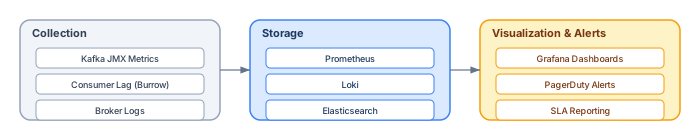
You cannot operate what you cannot observe. The Kafka observability stack for banking includes three layers:
Collection: JMX metrics from brokers and clients scraped by Prometheus. Consumer lag monitoring via Burrow (or Confluent Control Center). Centralized log aggregation via Loki or Elasticsearch. Network-level metrics from infrastructure monitoring.
Storage and correlation: Prometheus for time-series metrics with 90-day retention. Elasticsearch for log correlation and full-text search. Distributed tracing (Jaeger/Zipkin) for end-to-end event flow visibility.
Visualization and alerting: Grafana dashboards for real-time visualization. PagerDuty integration for alert escalation with on-call rotation. SLA reporting dashboards for management visibility.
Key metrics that require immediate alerting: under-replicated partitions (data loss risk), consumer lag exceeding SLA thresholds (processing delay), broker disk usage above 70% (capacity exhaustion), request latency p99 breaches (performance degradation), and ISR shrink events (replication failure).
Disaster recovery and business continuity
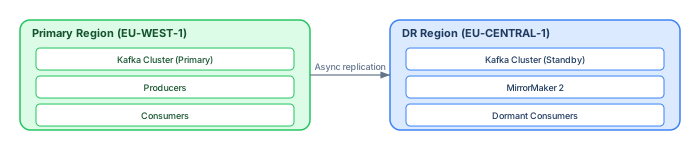
Banking regulators require tested disaster recovery plans with defined RPO (Recovery Point Objective) and RTO (Recovery Time Objective). For Kafka, this means cross-region replication using MirrorMaker 2, with a standby cluster that can assume production traffic within the defined RTO.
Key design decisions for Kafka DR in banking:
Replication mode: Asynchronous replication via MirrorMaker 2. RPO equals replication lag, typically 2–10 seconds under normal load. Synchronous cross-region replication is theoretically possible but introduces unacceptable latency for real-time processing.
Topic-level policies: Not all topics need DR. Domain event topics and settlement topics require cross-region replication. Internal operational topics (metrics, retry queues) can be recreated from scratch.
Consumer offset translation: MirrorMaker 2 handles offset translation automatically, enabling consumers to resume from approximately the correct position after failover.
Failover drills: Quarterly at minimum. The first drill always reveals configuration issues that documentation alone cannot catch. Automate the failover procedure and test it regularly.
Cultural transformation: from batch thinking to event-driven
The shift from batch to real-time is not just technical — it is cultural. Teams accustomed to batch processing have deeply ingrained mental models: data arrives in files, processing happens in windows, errors are caught in reconciliation. Event-driven architecture requires different thinking: data arrives continuously, processing is always-on, errors must be handled in real time. modeling integration architecture with ArchiMate
Common resistance patterns include: "We'll just write batch consumers" (defeats the purpose), "Can we buffer events into micro-batches?" (acceptable as a transition pattern), and "Real-time is too risky for financial data" (the opposite is true — batch processing hides errors longer).
Invest in training early. Run hands-on workshops where teams build simple producers and consumers. Create internal documentation with banking-specific examples. Assign Kafka champions in each team. And be patient — the cultural shift takes 6–12 months even with strong executive sponsorship.
Lessons learned from enterprise banking deployments
Model before you deploy. Topic taxonomy, partition strategy, retention policies, and consumer group design must be architecture decisions, not implementation afterthoughts. Use ArchiMate or Sparx EA to model the event architecture and get governance approval before provisioning.
Exactly-once is necessary but not sufficient. EOS protects within Kafka; external system idempotency requires additional design. Every consumer that writes to a database must implement idempotent writes with transaction IDs.
Schema governance is non-negotiable. The first time a schema change breaks production consumers, you will wish you had enforced compatibility from day one. Deploy Schema Registry before the first producer goes live.
Observability is not optional. Deploy monitoring before deploying producers. If you cannot see consumer lag, you cannot operate the platform. If you cannot trace an event end-to-end, you cannot debug production issues.
Start with one domain. Do not try to migrate all banking systems to Kafka simultaneously. Start with one domain (e.g., card transaction processing), prove the patterns, build operational maturity, and then expand.
Capacity planning methodology
Capacity planning for Kafka in banking must account for peak-hour volumes, not averages. Black Friday, month-end settlement, and regulatory reporting windows can produce 5–10x normal throughput. The methodology follows four steps.
Step 1: Estimate peak message rate. Measure the maximum sustained transactions per second during the busiest hour of the busiest day. Multiply by 1.5 for headroom. A typical Tier-1 bank processes 50,000–200,000 messages per second at peak.
Step 2: Calculate partition count. Each partition supports approximately 10 MB/s throughput (producer) and 30 MB/s (consumer) on modern hardware. For a topic handling 100,000 msgs/sec at 1 KB per message: 100 MB/s production throughput requires at minimum 10 partitions. In practice, use 3x this number for consumer parallelism and future growth — so 30 partitions for this topic.
Step 3: Size broker resources. Each broker in a well-configured cluster handles approximately 200 MB/s aggregate throughput. For a bank processing 500 MB/s total across all topics, plan for 5 brokers minimum, plus 2 for failover capacity — 7 brokers total. CPU requirements are modest (8–16 cores per broker); memory should be 32–64 GB (mostly for page cache); disk should be NVMe SSD with separate volumes for logs and data.
Step 4: Plan retention and storage. Banking regulations often require message retention for 7 years, but Kafka is not a long-term archive. Use tiered storage: 7 days hot retention on broker disks, then offload to S3/Azure Blob via Kafka Tiered Storage or a dedicated archival consumer that writes to a data lake. Calculate hot storage: peak_throughput_bytes × retention_seconds × replication_factor. For 500 MB/s with 7-day retention and RF=3: 500 × 604,800 × 3 = ~910 TB — plan accordingly.
Consumer group design patterns

Consumer groups are Kafka's mechanism for parallel processing with load distribution. Each partition is assigned to exactly one consumer within a group, but multiple consumer groups can independently read the same topic. In banking, this enables powerful patterns:
Pattern 1: Fan-out processing. A single payments.authorized topic is consumed by four independent consumer groups: the fraud detection engine, the settlement service, the regulatory reporting pipeline, and the customer notification service. Each group processes every message independently, at its own pace.
Pattern 2: Scaled consumers. Within a consumer group, add consumers to increase parallelism. If a topic has 12 partitions, deploying 12 consumers in a group gives maximum parallelism — each consumer handles one partition. Adding a 13th consumer provides no benefit (it sits idle). Removing a consumer triggers rebalancing — its partitions are redistributed to remaining consumers.
Pattern 3: Consumer lag monitoring. Consumer lag — the difference between the latest produced offset and the latest consumed offset — is the primary health metric. In banking, consumer lag must be monitored per consumer group with alerting thresholds tied to SLAs. For the fraud detection engine, any lag exceeding 30 seconds should trigger a P1 alert because delayed fraud detection means financial loss.
# Kafka consumer lag check (shell)
kafka-consumer-groups.sh --bootstrap-server broker:9092 \
  --group fraud-engine --describe

# Alert if lag exceeds threshold
TOTAL_LAG=$(kafka-consumer-groups.sh --bootstrap-server broker:9092 \
  --group fraud-engine --describe | awk '{sum+=$5} END {print sum}')
if [ "$TOTAL_LAG" -gt 10000 ]; then
  echo "ALERT: Fraud engine lag = $TOTAL_LAG"
fi
Security architecture: defense in depth
Banking regulators (ECB, PRA, OCC) require defense in depth for any system handling financial data. Kafka security must operate at four layers simultaneously.
Network layer: Kafka brokers sit in a dedicated VLAN with firewall rules that whitelist only approved producer and consumer IP ranges. Inter-broker communication uses a separate network interface from client-facing traffic. No broker port (9092, 9093) is exposed to the public internet under any circumstance.
Authentication layer: mTLS (mutual TLS) is the gold standard for banking Kafka deployments. Every producer and consumer presents a client certificate signed by the organization's internal CA. Certificate rotation is automated on a 90-day cycle. Service accounts are provisioned per application — no shared credentials.
Authorization layer: Kafka ACLs enforce least-privilege access. The fraud detection service has READ permission on payments.* topics and WRITE permission on fraud.alerts.* — nothing else. Admin operations (topic creation, partition changes, ACL modifications) require a separate admin principal with break-glass access procedures.
Encryption layer: TLS 1.3 encrypts all data in transit. At-rest encryption uses disk-level encryption (LUKS on Linux or cloud-native encryption on AWS/Azure). For highly sensitive topics (PII, card numbers), application-level encryption with envelope encryption and KMS-managed keys provides an additional layer. Encryption keys are rotated annually, with the rotation process automated and auditable.
# Kafka broker security configuration (server.properties)
listeners=SSL://0.0.0.0:9093
ssl.keystore.location=/etc/kafka/ssl/broker.keystore.jks
ssl.keystore.password=${VAULT_KEYSTORE_PASS}
ssl.key.password=${VAULT_KEY_PASS}
ssl.truststore.location=/etc/kafka/ssl/truststore.jks
ssl.client.auth=required
security.inter.broker.protocol=SSL
authorizer.class.name=kafka.security.authorizer.AclAuthorizer
super.users=User:admin-principal
Cultural transformation: from batch mindset to event-driven
The most underestimated aspect of Kafka adoption in banking is cultural. Teams that have operated batch systems for decades face a fundamentally different mental model. Batch processing is sequential, scheduled, and deterministic — you know exactly when it runs and can predict its behavior. Event streaming is continuous, asynchronous, and probabilistic — events arrive at unpredictable rates, consumers can fall behind, and failure modes are different.
Resistance patterns we observed: Operations teams feared losing control over "when things run." Developers struggled with idempotency requirements — in batch processing, reprocessing a file is straightforward; in streaming, it requires careful offset management. QA teams needed new testing strategies because you cannot test a streaming pipeline the same way you test a batch job. Compliance teams needed reassurance that event-driven architecture meets the same auditability requirements as batch processing — which it does, often better, because every event is immutable and timestamped.
What worked: Invest in training early — before the first producer is deployed. Run parallel systems (batch and streaming) for a transition period so teams can compare results. Assign "event-driven champions" in each team who have received Kafka training and can support their colleagues. Document the new operational runbooks (what to do when consumer lag spikes, how to replay events, how to handle schema evolution).
Conclusion
Apache Kafka in enterprise banking is not a messaging upgrade — it is an infrastructure transformation that touches every layer of the technology stack and every team in the organization. The patterns in this article — modeling-first architecture, key-based partitioning, exactly-once semantics, schema governance, defense-in-depth security, comprehensive observability, and tested disaster recovery — represent the minimum viable governance for a production Kafka deployment in a regulated financial environment.
Start with architecture. Model the event flows. Define the topic taxonomy. Establish schema governance. Deploy observability. Test disaster recovery. Train the teams. And then — and only then — start streaming.
If you’d like hands-on training tailored to your team — Sparx Enterprise Architect, BPMN, SysML or the Archi tool — or modelling coaching in ArchiMate and TOGAF-aligned governance, you can reach us via our contact page.
Frequently Asked Questions
What is architecture governance in enterprise architecture?
Architecture governance is the set of practices, processes, and standards that ensure architecture decisions are consistent, traceable, and aligned to organisational strategy. It typically includes an Architecture Review Board (ARB), architecture principles, modeling standards, and compliance checking.
How does ArchiMate support architecture governance?
ArchiMate supports governance by providing a standard language that makes architecture proposals comparable and reviewable. Governance decisions, architecture principles, and compliance requirements can be modeled as Motivation layer elements and traced to the architectural elements they constrain.
What are architecture principles and how are they modeled?
Architecture principles are fundamental rules that guide architecture decisions. In ArchiMate, they are modeled in the Motivation layer as Principle elements, often linked to Goals and Drivers that justify them, and connected via Influence relationships to the constraints they impose on design decisions.