⏱ 21 min read
Event partitioning is one of those topics teams underestimate right up until it ruins their week.
At first glance, Kafka partitioning looks like a scaling knob: add more partitions, get more throughput, move on. That is the kind of half-truth that causes expensive architecture. In real systems, partitioning is not merely a performance setting. It is a statement about business ordering, ownership, consistency boundaries, consumer parallelism, operational pain, and what kind of mistakes you are willing to make under load.
A partition is not just a shard of data. It is a promise about sequence.
And in enterprise systems, promises matter more than throughput charts.
If you get partitioning wrong, the failure is rarely dramatic on day one. Messages still flow. Dashboards stay green. Teams congratulate themselves for “decoupling.” Then a customer changes address while an order is being fulfilled, payment is retried, an inventory reservation arrives late, and suddenly different services hold different truths about the same business fact. The broker did exactly what you configured it to do. The architecture failed because the domain was ignored.
This is where event-driven architecture grows up. Kafka partitioning decisions have to be anchored in domain-driven design, not infrastructure enthusiasm. The right question is not “How many partitions do we need?” The right question is “What business things must remain in order, and what can safely diverge?” Once you answer that, partition strategy starts to become architecture rather than plumbing.
This article takes that view. We will look at event broker partitioning in Kafka architectures as an enterprise design problem: one that sits at the crossroads of microservices, domain semantics, migration strategy, reconciliation, and operational reality. event-driven architecture patterns
Context
Kafka has become the default event backbone for many enterprises modernizing from batch integration, point-to-point middleware, or tightly coupled service calls. It is used to connect microservices, capture change data from legacy systems, stream operational events, and fan out business facts to downstream consumers. That part is familiar. microservices architecture diagrams
What is less familiar is how quickly Kafka topics become the de facto nervous system of the enterprise. Teams start with a few event streams—orders, payments, customers, shipments—and before long they are using Kafka for state propagation, analytics ingestion, audit trails, near-real-time integration, fraud detection, and workflow orchestration.
At that scale, partitioning is no longer a broker detail. It is central to architecture because Kafka guarantees order only within a partition. That single constraint shapes everything downstream:
- which consumers can process independently
- how much parallelism is available
- which business entities remain consistent in sequence
- where hot spots appear
- what happens during replay
- how painful rebalancing becomes
- how easy it is to evolve the topology over time
Architects often inherit two bad instincts here.
The first is to partition by whatever key is conveniently available: customer ID, event type, source system, or no key at all. The second is to optimize for horizontal scalability before understanding ordering semantics. Both are understandable. Both are dangerous.
In domain terms, partitioning defines the lane in which a stream of facts travels. If events about the same aggregate or business transaction are allowed to scatter across lanes, consumers lose deterministic sequencing. They can still process events, but now they must reconstruct order, reconcile inconsistencies, or tolerate race conditions. Sometimes that is acceptable. Often it is not.
A serious Kafka architecture starts by treating partitioning as a domain modeling decision.
Problem
The core problem is simple to state and awkward to solve:
How do you partition Kafka topics to balance scalability and fault tolerance while preserving the business ordering guarantees that matter?
That sounds like an engineering tradeoff. It is, but only partly. The hard part is that ordering is not a technical absolute. It is domain-specific.
For some domains, order by customer is enough. For others, order must be preserved by account, order, claim, shipment, device, payment instrument, policy, or reservation. In some cases, ordering matters only within a bounded context, while other contexts can process the same events independently and eventually reconcile. In other cases, the “same event” means different things to different consumers, because the domain language itself differs.
This is where many Kafka implementations become brittle. Teams create a single shared topic, choose a partition key that feels generically useful, and assume downstream consumers will adapt. They do adapt, but by adding compensation logic, local caches, duplicate suppression, retry queues, and after-the-fact reconciliation jobs. Complexity migrates from the broker into every consuming service. The architecture saves nothing; it merely redistributes pain.
The partitioning problem becomes even harder in enterprise modernization. Legacy systems often emit records in ways that do not align with target domain aggregates. Mainframes batch updates by file. ERPs publish by table change. CRM platforms emit object events that mix unrelated concerns. When these are streamed into Kafka, architects must decide whether to preserve source semantics, reshape into domain events, or run both in parallel during migration.
There is no universal answer. There is only fit.
Forces
Several forces pull against each other in Kafka partition design. Good architecture is the art of making those tensions visible.
Ordering vs throughput
More partitions generally increase potential parallelism. But partitioning too finely can fragment ordering guarantees. If business correctness depends on strict sequence for a given entity, all relevant events must land in the same partition. That limits consumer concurrency for that entity stream.
This is the oldest distributed systems bargain: speed for certainty.
Domain integrity vs platform uniformity
Platform teams love standardization. A universal partition rule seems attractive—partition everything by tenant ID, or customer ID, or hash of key. It makes tooling simpler. But domains do not care about platform neatness. An insurance claim, a payment authorization, and a warehouse replenishment flow each have different units of consistency. A one-size-fits-all partition policy is often just centralized confusion.
Hot partition risk vs meaningful keys
The best domain key may create uneven distribution. A small number of high-volume accounts, devices, merchants, or stores can create “hot” partitions. The obvious technical response is to spread the load with a composite or randomized key. But that can destroy the ordering semantics that were valuable in the first place.
Replayability vs mutable interpretations
Kafka makes replay feasible, but replaying events into consumers only works cleanly if partitioning and key semantics remain stable. If teams frequently change the meaning of keys, split aggregates, or republish transformed events with different partition keys, replay becomes less like recovery and more like archaeology.
Autonomy vs reconciliation
Microservices encourage local ownership and independent processing. Yet distributed autonomy does not remove the need for coherence. When events affecting a shared business concept are partitioned in different ways across topics or bounded contexts, reconciliation becomes mandatory. The architecture must explicitly define how discrepancies are detected and repaired.
Migration speed vs model purity
During transformation from legacy integration to event-driven microservices, perfect partitioning is rarely available on day one. Sometimes you must begin with source-oriented events and progressively strangler them behind anti-corruption layers and domain translators. That means living for a while with imperfect partitioning and compensating controls.
That is not architectural weakness. That is enterprise realism.
Solution
The practical solution is to partition Kafka topics according to domain ordering boundaries, not merely technical distribution needs.
That sentence sounds tidy. Its implementation is not. But it gives a firm principle.
Start with aggregates and invariants
In domain-driven design, aggregates define consistency boundaries. They are not database tables dressed up in better language. They represent clusters of business rules that must change together and remain coherent.
If events for a single aggregate must be observed in order by consumers, then the aggregate identifier is a strong partition key candidate.
Examples:
OrderPlaced,OrderCancelled,OrderShipped-> partition byorderIdPaymentAuthorized,PaymentCaptured,PaymentRefunded-> partition bypaymentIdClaimOpened,ClaimAdjusted,ClaimSettled-> partition byclaimId
This preserves sequence where it matters.
Accept that not all topics should use the same key
An Order bounded context may partition by orderId. A customer profile stream may partition by customerId. A fraud scoring topic may partition by cardId or merchantId. Forcing one key across all contexts usually means you are modeling integration convenience, not domain truth.
Separate canonical business events from operational streams
Not every Kafka topic should carry domain significance. Some exist for telemetry, CDC replication, search indexing, or coarse data propagation. Use looser partitioning there if needed. Reserve strong semantic partitioning for event streams that represent business facts consumers rely on for correctness.
Use derived streams when consumers need different ordering semantics
Sometimes one event source cannot satisfy all consumers with a single partition strategy. In that case, create downstream derived topics tailored to different bounded contexts rather than compromising the source stream.
For example, an e-commerce platform may emit Order events partitioned by orderId. A loyalty service, however, may need customer-centric sequencing across purchases and returns. A stream processor can project order events into a customer activity topic partitioned by customerId.
That is duplication. It is also clarity.
Treat partition count as an evolution concern, not a guess
Partition count matters operationally, but choosing it once and pretending it is permanent is amateur thinking. Forecast likely throughput, concurrency needs, and consumer scaling windows. Then design migration paths for partition expansion, topic versioning, or stream re-projection.
Kafka lets you increase partitions, but doing so changes key-to-partition mapping for future records unless carefully managed. That can break assumptions about locality and replay. Plan for it early.
Architecture
A robust Kafka partitioning architecture usually includes several layers of intent:
- Domain event producers that emit stable business events with meaningful keys
- Kafka topics partitioned by aggregate or semantic key
- Consumer groups aligned with bounded contexts
- Derived streams and projections for alternate read or processing patterns
- Reconciliation capabilities for eventual consistency failures
- Operational controls for lag, skew, replay, and dead-letter handling
Here is a simplified view.
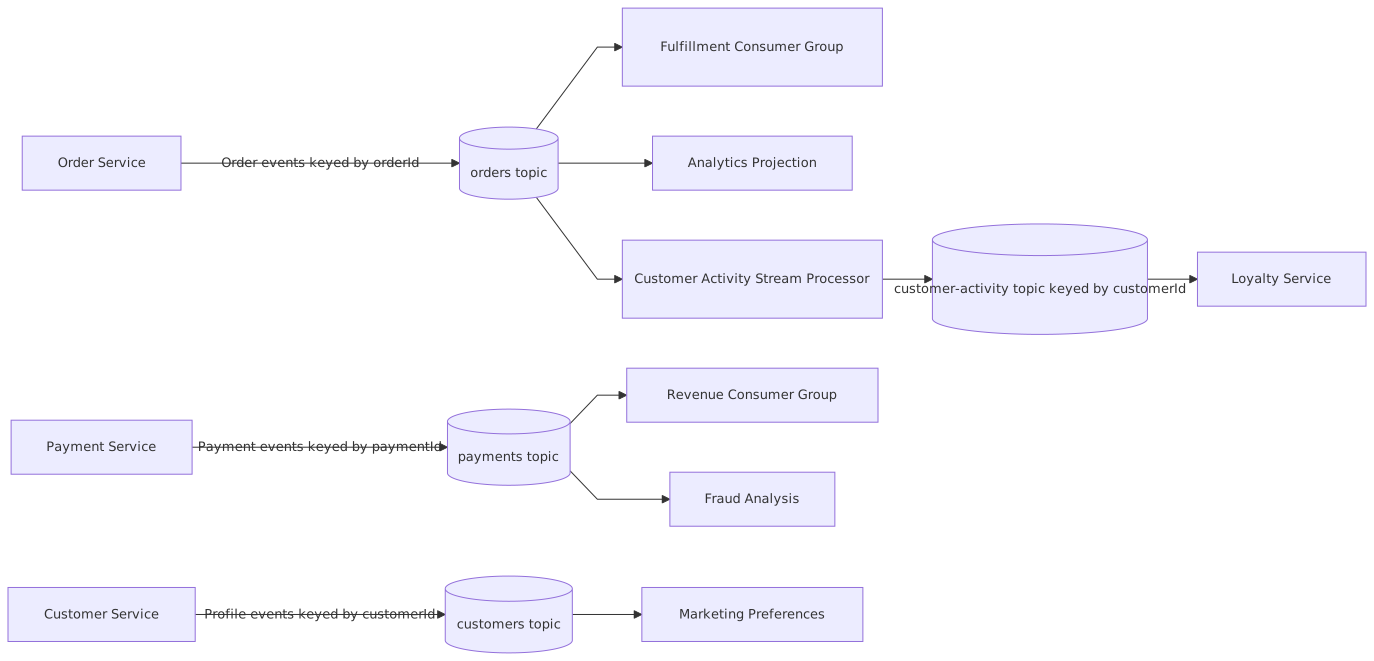
This architecture acknowledges an important truth: there is no single perfect event stream for all consumers. Kafka gives you durable transport and ordered partitions. It does not absolve you from designing multiple semantic views of the business.
Partition key selection patterns
A few patterns appear often in enterprise systems.
Aggregate key partitioning
Use the aggregate identifier as the key when event order matters within the aggregate lifecycle. This is usually the default for transactional domains.
Parent entity partitioning
Sometimes a child entity’s events must stay in order with its parent context. For instance, line item adjustments might be partitioned by orderId instead of lineItemId if downstream pricing and fulfillment need the whole order sequence.
Composite semantic key
In multi-tenant systems, partitioning by tenantId + aggregateId can preserve tenant isolation semantics while maintaining entity order. Be careful: this is helpful only if tenant separation has actual operational or legal significance.
Functional repartitioning
Use stream processing to create downstream topics with different keys for different purposes. This is often the cleanest way to support multiple ordering requirements across bounded contexts.
Domain semantics and language
Partitioning becomes stronger when event contracts use a clear ubiquitous language. If producers emit vague records like statusChanged, entityUpdated, or table-oriented payloads, consumers cannot infer meaningful ordering boundaries. They process technically valid events with semantically weak clues.
This is one reason domain-driven design matters here. A partition key has value only in relation to what the event means. orderId is useful because “order” is a real business concept with a lifecycle. rowId from a replicated source table may be stable, but it may not correspond to the consistency unit downstream services actually care about.
The broker can carry bytes. The architecture must carry meaning.
Migration Strategy
Most enterprises do not begin with well-designed event streams. They begin with legacy applications, batch feeds, ESBs, CRUD APIs, and database integrations that leak technical structure everywhere. So the partitioning question is often also a migration question.
The right migration pattern is usually a progressive strangler, not a big-bang repartitioning exercise.
Step 1: Capture source events without pretending they are domain events
CDC from an ERP or mainframe can be useful, but raw change streams should be labeled honestly. They are source events, not necessarily business events. Partition them in ways that support stable ingestion and replay, often by source primary key or source partitioning constraints.
Step 2: Introduce an anti-corruption translation layer
A stream processor or integration service reads source events and emits domain-aligned events into new topics with business-oriented partition keys. This is where bounded contexts begin to emerge.
Step 3: Build new consumers on the translated domain topics
New microservices should consume domain events, not legacy table mutations. This avoids hard-wiring new capabilities to old semantics.
Step 4: Reconcile during dual-running
For a time, old and new processing paths may both exist. Reconciliation is essential. Compare source-of-record states, detect divergence, and repair mismatches through compensating events or operational workflows.
Step 5: Strangle legacy consumers and retire transitional streams
Only once confidence is established should teams retire direct consumers of source-oriented topics.
Here is the migration shape.
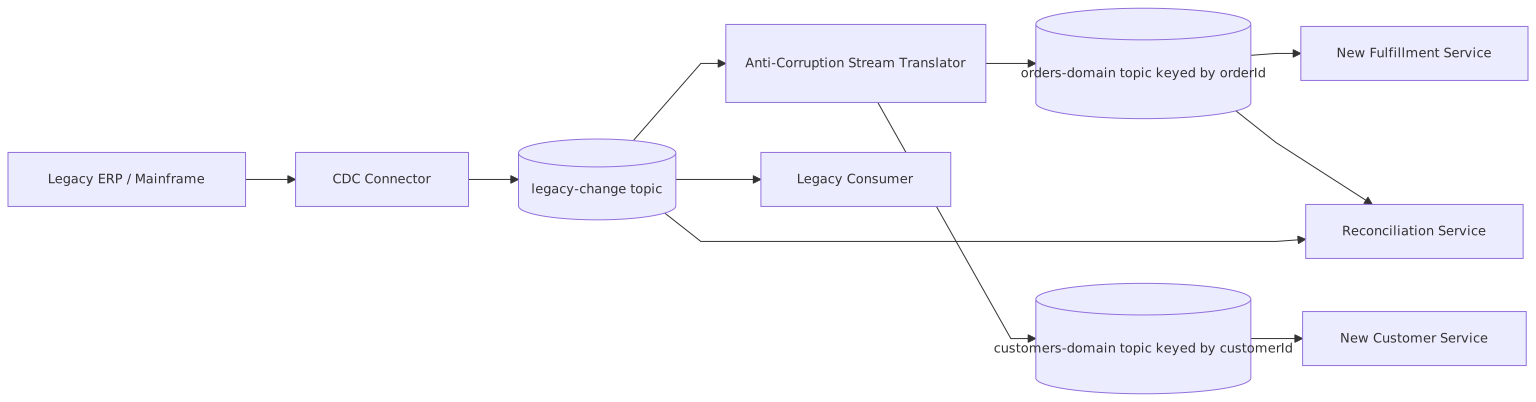
This approach is slower than simply wiring everyone to CDC topics. It is also far more survivable.
Reconciliation is not optional
Enterprises often talk about eventual consistency as if saying the phrase solves the problem. It does not. Eventual consistency without reconciliation is merely delayed inconsistency.
Partitioned event architectures need explicit reconciliation strategies:
- periodic state comparison between source and target
- missing-event detection by sequence or watermark
- duplicate event suppression with idempotency keys
- compensating events to reverse or correct outcomes
- operational dashboards for divergence counts and aging
Reconciliation matters especially during migration because source systems often emit late, corrected, or collapsed updates that do not map neatly onto target domain events.
Handling repartitioning during migration
If a legacy stream uses the wrong key, do not try to mutate the existing topic in place. Create a new versioned topic and re-publish with the new partition key. In-flight consumers can be moved gradually. Reprocessing old data into the new topology may require backfill jobs or historical replay.
This is one of the great unsentimental truths of Kafka architecture: sometimes the cleanest migration is to publish the stream you wish you had, not endlessly defend the stream you inherited.
Enterprise Example
Consider a global retailer modernizing its order management platform.
The legacy landscape is familiar: SAP for inventory and finance, a monolithic order application, regional warehouse systems, a CRM platform, and a batch-oriented customer loyalty engine. The enterprise introduces Kafka as an event backbone to support microservices for checkout, fulfillment, customer notifications, fraud, and returns.
At first, the platform team creates a single commerce-events topic partitioned by customerId, because customer seems like the most universal key. It feels sensible. After all, many business processes revolve around the customer.
Then reality arrives.
A single customer may place several orders simultaneously, including one with split shipments, one with backordered items, and one using a gift card plus card payment. Fulfillment services need strict order lifecycle sequencing. Payments need payment transaction sequencing. Returns processing needs order-item sequencing. Warehouse allocation depends on order events arriving in order. Partitioning by customerId forces unrelated orders into the same partition, reducing parallelism for active customers, while still failing to preserve consistent ordering across payment and warehouse entities that have their own lifecycles.
Worse, hot partitions emerge around major marketplace sellers and loyalty-heavy customers. Consumer lag grows unpredictably. Replay during incident recovery takes too long because high-volume customers dominate partition history. Teams begin adding local buffering and state machines to compensate.
This is how many enterprise architectures decay: not with one catastrophic error, but with many clever local repairs.
The retailer redesigns.
orderstopic partitioned byorderIdpaymentstopic partitioned bypaymentIdinventory-reservationstopic partitioned byreservationIdororderIddepending on consistency needcustomer-activityderived topic partitioned bycustomerIdshipment-eventstopic partitioned byshipmentId
The loyalty engine consumes customer-activity. Fulfillment consumes orders and shipment-events. Finance consumes payments. Stream processors correlate where needed, but each bounded context gets a stream aligned to its semantics.
A reconciliation service compares order state across order management, payment capture, and warehouse shipment systems. It emits OrderReconciliationRequired events for mismatches, which trigger either automated repair or human review.
The result is not a magically simple platform. It is a platform whose complexity is in the open, where it can be managed.
Operational Considerations
Partitioning strategy is only as good as its operation under stress.
Monitor partition skew
A healthy topic is not just one with low lag. Watch for uneven traffic distribution, consumer processing time by partition, and storage growth skew. A semantically correct key can still create operational hot spots. If one partition is perpetually hotter than others, investigate whether the domain truly requires that key or whether downstream projections could redistribute some read load.
Size partitions with replay in mind
Throughput is not the only reason to increase partitions. Recovery time matters. How long will it take to replay a topic after a consumer bug fix or state-store rebuild? Large partitions can turn recovery into a business outage.
Design idempotent consumers
Even with carefully chosen keys, retries and replays happen. Consumers should treat duplicate events as routine, not exceptional. Use event IDs, version checks, or deduplication stores where appropriate.
Watch rebalancing costs
High partition counts improve concurrency, but they also make consumer group rebalancing more expensive. Stateful stream processors suffer especially here. There is no glory in creating hundreds of partitions only to discover every deployment causes prolonged churn.
Retention and compaction strategy matter
For entity lifecycle topics, log compaction can support current-state recovery but may remove intermediate transitions some consumers need. For audit and reconciliation, full retention may be more important. Choose retention based on business recovery and compliance needs, not only storage economics.
Document key semantics
This sounds pedestrian because it is. Still, it is repeatedly neglected. Every topic should have explicit documentation for:
- partition key definition
- ordering guarantee scope
- expected event cardinality
- idempotency expectations
- replay guidance
- schema evolution constraints
Without that, teams infer semantics from code and tribal memory, which is how architectures become folklore.
Tradeoffs
There is no partitioning strategy without compromise.
Domain partitioning improves correctness but can reduce flexibility
When you strongly align partitions to aggregate boundaries, you make it easier to reason about business order. But you may constrain certain analytics or cross-entity processing patterns, requiring derived topics or additional stream processing layers.
More semantic topics increase clarity but add governance overhead
A topology with separate topics for orders, payments, shipments, returns, customer activity, and reconciliation is easier to understand than one giant shared stream. It is also more expensive to govern, secure, version, and monitor.
Repartitioning through stream processors adds power but increases latency and complexity
Derived topics are often the right answer, but they introduce more moving parts: state stores, processing guarantees, replay costs, and operational dependencies.
Stable keys simplify reasoning but may create hot spots
Business significance and even load distribution are often at odds. The key that preserves business order may not distribute traffic evenly. Sometimes that is acceptable. Sometimes it requires redesign of the business flow itself, not just the topology.
That last point is worth underlining. Architects sometimes treat hot partitions as a Kafka problem. Sometimes they are really a domain problem: one giant account, one dominant merchant, one central warehouse, one overloaded tenant. Technology reveals concentration that the business created.
Failure Modes
A mature architecture article should be honest about how these systems fail.
Wrong partition key
The classic failure. Consumers observe out-of-order events for an entity they assumed was ordered, leading to stale state, invalid compensations, or duplicate side effects.
Shared “enterprise topic” anti-pattern
Multiple domains publish dissimilar events into one broad topic with inconsistent keys and vague schemas. Every consumer becomes a historian and detective. Governance collapses. EA governance checklist
Partition expansion without semantic review
Teams increase partition counts to solve throughput issues, not realizing key hashing changes distribution for future events. Stateful consumers and locality assumptions break subtly.
CDC mistaken for domain eventing
Downstream services consume low-level change events directly and build business behavior atop table mutations. Over time, source system quirks become enterprise contracts. Migration becomes much harder.
No reconciliation path
Event loss, duplication, or consumer bugs leave systems divergent. Without reconciliation, teams rely on manual fixes and spreadsheet audits. This is common and avoidable.
Excessive repartitioning pipelines
Some organizations discover stream processing and begin deriving endless topic variants for every team. The result is a maze of dependencies, duplicated logic, and opaque lineage. Repartitioning is useful; indiscriminate proliferation is not.
When Not To Use
Kafka partition-centric architecture is powerful, but it is not the answer to every integration problem.
Do not use this approach when:
Strict global ordering is required across all events
Kafka gives partition order, not total order at enterprise scale. If the domain truly requires one global sequence, Kafka partitioning will force painful compromises.
Event volume is low and process simplicity matters more
For modest workloads, simple synchronous APIs or a lightweight queue may be easier to govern and operate. Kafka can be an expensive answer to a small question.
The domain model is still too immature
If the business cannot yet define meaningful aggregates, bounded contexts, or event semantics, heavy investment in partitioned event contracts may lock in confusion. Sometimes you need domain discovery before platform expansion.
Source systems cannot produce trustworthy keys
If identifiers are unstable, reused, or semantically ambiguous, partitioning by them bakes bad assumptions into the topology. Fix identity first or insert translation layers.
Teams are not ready for operational discipline
Kafka is not just a library with a cluster attached. It requires serious thinking about schemas, replay, lag, idempotency, retention, and incident response. If the organization will not do that work, a simpler integration style may be safer.
Related Patterns
Several related patterns often appear alongside Kafka partitioning.
- Outbox pattern for reliable event publication from transactional services
- CQRS projections for building consumer-specific read models from source events
- Saga orchestration or choreography where event order influences process progression
- Anti-corruption layers to shield new domain models from legacy event semantics
- Data mesh style domain ownership when topic stewardship aligns with bounded contexts
- Event sourcing in selected domains where aggregate event streams are first-class state records
Here is a broader architecture view showing partitioned domains plus reconciliation.
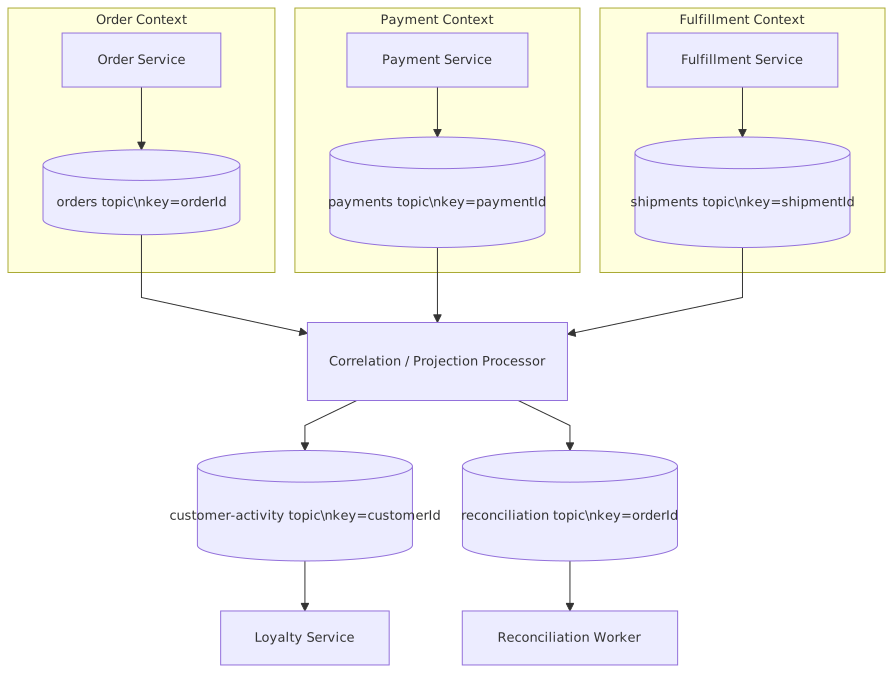
This kind of arrangement is often where enterprise event platforms end up: not one perfect stream, but a managed ecosystem of domain streams, projections, and correction mechanisms.
Summary
Kafka partitioning is not an infrastructure afterthought. It is architecture in disguise.
A partition key encodes what you believe must remain in order. In that sense, every partitioning decision is a business decision with technical consequences. Get it right, and you gain scalable parallelism without losing domain coherence. Get it wrong, and every downstream microservice inherits the burden of reconstructing truth from scattered events.
The practical guidance is straightforward, even if the implementation is not:
- partition by domain ordering boundaries
- use aggregates and invariants to choose keys
- avoid one-size-fits-all key policies
- create derived topics when different bounded contexts need different sequencing
- migrate progressively using strangler patterns and anti-corruption layers
- treat reconciliation as a first-class capability
- plan for operational realities like skew, replay, lag, and repartitioning
The deeper lesson is more important. Kafka is a powerful broker, but brokers do not design systems. Architects do. And good architects know that data in motion still belongs to a domain.
If your event streams preserve throughput but lose meaning, you have built a fast confusion machine.
If they preserve business sequence where it matters, expose tradeoffs honestly, and support correction when distributed reality drifts—as it always does—then partitioning stops being a tuning exercise and becomes what it should have been all along: a disciplined expression of enterprise design.
Frequently Asked Questions
What is event-driven architecture?
Event-driven architecture (EDA) decouples services by having producers publish events to a broker like Kafka, while consumers subscribe independently. This reduces direct coupling, improves resilience, and allows new consumers to be added without modifying producers.
When should you use Kafka vs a message queue?
Use Kafka when you need event replay, high throughput, long retention, or multiple independent consumers reading the same stream. Use a traditional message queue (RabbitMQ, SQS) when you need simple point-to-point delivery, low latency, or complex routing logic per message.
How do you model event-driven architecture in ArchiMate?
In ArchiMate, the Kafka broker is a Technology Service or Application Component. Topics are Data Objects or Application Services. Producer/consumer services are Application Components connected via Flow relationships. This makes the event topology explicit and queryable.