⏱ 6 min read
Recommended Reading
Executive summary
Event-driven enterprises need ARBs that review contracts and flows, not just application diagrams. AWS describes ARBs as multi-disciplinary teams ensuring compliance with enterprise guidelines and reducing recycle via stakeholder inclusion. enterprise cloud architecture patterns
In Kafka ecosystems, the review must include schema compatibility and evolution policy, retention/replay expectations, and lineage evidence standards (OpenLineage/PROV concepts).
- Fast-path vs exception-path event reviews
- Review checklist: schemas, ownership, retention, lineage
- Evidence: decisions and baselines/audits (if using EA)
- Pitfalls and metrics

- AWS ARB guidance.
- Schema evolution and compatibility.
What the ARB reviews in event-driven architecture

In event-driven enterprises, the Architecture Review Board must evolve beyond reviewing application designs to reviewing event schemas, topic designs, and consumer contracts. These are the architectural decisions that determine system coupling, data quality, and operational resilience. integration architecture diagram
Schema changes (high impact): Any breaking schema change (removing a field, changing a field type) affects every consumer of that topic. The ARB reviews: compatibility analysis (will existing consumers break?), consumer impact assessment (which teams are affected and what is their upgrade timeline?), rollback plan (how to revert if the change causes failures?). Non-breaking changes (adding optional fields) can be auto-approved if they pass Schema Registry compatibility checks.
New topic creation (medium impact): Each new topic is a new data contract in the enterprise. The ARB reviews: naming convention compliance, partition count justification, retention policy alignment with data classification, and ownership assignment. Standardize this with a topic request template that captures all required information.
New consumer registration (low impact): When a team wants to consume from an existing topic, the ARB confirms: the consuming team understands the event contract, has an anti-corruption layer if crossing bounded contexts, and has monitoring for consumer lag. This can be delegated to the topic owner for approval, escalating to the ARB only for cross-domain consumption.
Making EDA governance fast
Event-driven architectures move faster than traditional architectures. The ARB must match this pace. Implement tiered governance: non-breaking schema changes are auto-approved (Schema Registry enforces compatibility). New topics with standard templates get 48-hour approval. Breaking schema changes and cross-domain consumers get full board review. This ensures governance adds value without becoming a bottleneck. modeling integration architecture with ArchiMate
Tiered governance: matching review depth to change risk
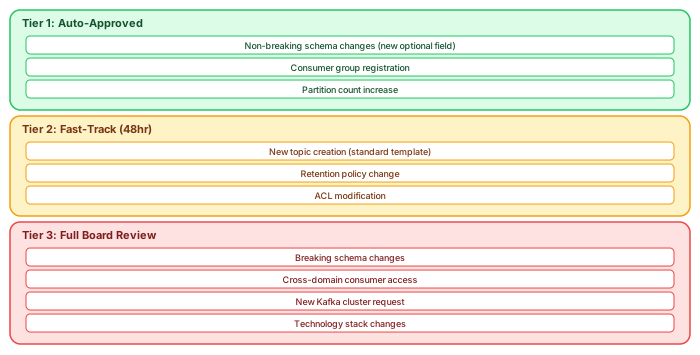
A one-size-fits-all architecture review process kills agility in event-driven enterprises. A schema change that adds an optional field has fundamentally different risk than a change that removes a field used by 15 consumers. Tiered governance matches review depth to actual risk. application cooperation diagram
Tier 1: Auto-approved. Changes that cannot break consumers are approved automatically by the Schema Registry's compatibility check. Adding an optional field to an Avro schema (backward compatible), registering a new consumer group for an existing topic, or increasing a topic's partition count — these changes are low risk and high frequency. Requiring board review for each one would create a bottleneck that drives teams to bypass governance entirely. Automation handles the volume; the board handles the judgment calls.
Tier 2: Fast-track (48-hour approval). Changes that require human judgment but not full board deliberation. Creating a new topic using the standard template (naming, partitioning, retention are pre-approved in the template — the review confirms the template was followed correctly). Changing a topic's retention policy (requires confirmation that the new retention meets regulatory requirements). Modifying ACLs (requires confirmation that access is appropriate for the requesting team). The assigned architect reviews and approves within 48 hours, escalating to the board only if the change is non-standard.
Tier 3: Full board review. Changes with enterprise-wide impact that require collective architectural judgment. Breaking schema changes (removing or renaming fields) that affect multiple consumer teams. Cross-domain consumer access requests (a team in the Risk domain wants to consume from the Payments domain — this creates coupling between domains). New Kafka cluster requests (infrastructure investment with long-term operational commitment). Technology stack changes (adopting a new serialization format, switching Schema Registry implementations). These decisions happen monthly at the board meeting, with impact analysis prepared by the EA team in advance.
Making the board meeting effective
The architecture review board for event-driven enterprises should follow a structured agenda. First, the EA team presents the impact analysis for each Tier 3 request using ArchiMate views from the repository — specifically the Consumer Dependency view showing which teams are affected. Second, the requesting team presents their rationale and proposed migration plan. Third, the board discusses and decides: approve, approve with conditions, defer for more analysis, or reject with rationale documented. Fourth, the decision is recorded in the architecture repository as an Architecture Decision Record, linked to the affected model elements. ArchiMate modeling guide
Target: 3-5 Tier 3 decisions per monthly meeting. If the board consistently sees more than 5 requests, either the tier boundaries are too conservative (push more decisions to Tier 2) or the organization is making too many breaking changes (investigate root cause). If the board sees fewer than 1 request per month, it may be over-governing at Tier 2 — review whether some Tier 2 decisions could be automated.
Measuring ARB effectiveness
The architecture review board must measure its own effectiveness to avoid becoming the bottleneck it was designed to prevent.
Review turnaround time: Time from request submission to decision. Target: Tier 2 within 48 hours, Tier 3 within one monthly board cycle. If turnaround consistently exceeds targets, either the board is understaffed, the tier boundaries are wrong, or requests lack sufficient information (causing back-and-forth).
Bypass rate: Percentage of changes that should have been reviewed but were not. Detect by comparing the Schema Registry change log and topic creation log against the governance request log. A high bypass rate indicates that the governance process is too slow, too heavy, or not well understood.
Decision reversal rate: Percentage of board decisions that are reversed within 6 months. Occasional reversals indicate healthy learning. Frequent reversals indicate poor analysis quality or insufficient expertise on the board.
If you’d like hands-on training tailored to your team — Sparx Enterprise Architect, BPMN, SysML, Apache Kafka or the Archi tool — or modelling coaching in ArchiMate and TOGAF-aligned governance, you can reach us via our contact page.
Frequently Asked Questions
What is enterprise architecture?
Enterprise architecture is a discipline that aligns an organisation's strategy, business operations, information systems, and technology infrastructure. It provides a structured framework for understanding how an enterprise works today, where it needs to go, and how to manage the transition.
How is ArchiMate used in enterprise architecture practice?
ArchiMate is used as the standard modeling language in enterprise architecture practice. It enables architects to create consistent, layered models covering business capabilities, application services, data flows, and technology infrastructure — all traceable from strategic goals to implementation.
What tools are used for enterprise architecture modeling?
Common enterprise architecture modeling tools include Sparx Enterprise Architect (Sparx EA), Archi, BiZZdesign Enterprise Studio, LeanIX, and Orbus iServer. Sparx EA is widely used for its ArchiMate, UML, BPMN and SysML support combined with powerful automation and scripting capabilities.