⏱ 5 min read
What enterprise teams must learn to be successful with Kafka
Kafka training should be designed around enterprise outcomes: reliable event streaming, scalable integration, governed data in motion, and operational excellence. integration architecture diagram
Recommended Reading
Kafka is described in official documentation as a distributed streaming platform with capabilities to publish/subscribe, store records durably, and process streams as they occur. turn16view0
For enterprise teams, training must cover more than APIs—it must include platform governance, security, and operational practices that prevent Kafka from becoming “just another integration mess.” turn17view0turn19view0 modeling integration architecture with ArchiMate
Core concepts: topics, partitions, offsets, and consumer groups
Kafka stores records in topics, implemented as partitioned logs; each partition is an ordered, append-only sequence of records with offsets that identify record positions. turn16view0
A key enterprise concept is that consumer position tracking is lightweight, enabling consumers to reprocess data by resetting offsets, which underpins replay-based recovery and audit-friendly pipelines. turn16view0
Consumer groups generalize queue and publish-subscribe semantics, enabling both scalable processing (work sharing across consumers) and multiple independent subscribers (multiple consumer groups). turn16view0
Architecture and reliability fundamentals
The Kafka documentation explains that partitions are distributed across servers and replicated across a configurable number of servers for fault tolerance, with leaders handling reads/writes and followers replicating. turn16view0

Training should ensure teams can reason about:
- Partitioning strategy (keys, ordering scope)
- Replication factor and failure tolerance
- Consumer group scaling constraints (consumers per group cannot exceed partitions for parallelism) turn16view0
Platform services: Connect, stream processing, and governance components
Kafka documentation describes core APIs and explicitly includes the Connector API concept for building reusable producers/consumers that connect Kafka topics to external systems (e.g., change capture from databases). turn16view0 application cooperation diagram
Where enterprises need reliability and scale, managed ecosystems often include governance components such as schema registries; documentation describes Schema Registry as a centralized repository for managing and validating schemas to support consistency and compatibility as schemas evolve. turn19view0 architecture decision records
Security and governance are part of “basic competence”
If teams can produce and consume but cannot secure and govern the platform, they are not production-ready.
Kafka provides an authorization framework and ACL semantics, including explicit default behavior when ACLs are missing. turn17view0
Governance practices often rely on schema management, compatibility rules, and versioning strategies described in schema registry documentation. turn19view0
A hands-on training blueprint for enterprise teams
A training program that matches enterprise maturity typically includes:
- Core producer/consumer labs focusing on partitions, ordering, and consumer groups turn16view0
- Operational labs showing failure scenarios (leader loss, consumer rebalance) grounded in replication and group mechanics turn16view0
- Governance labs implementing schema evolution and compatibility rules turn19view0
- Security labs using ACLs and role design patterns turn17view0
Frequently asked questions
Is Kafka training mainly for developers?
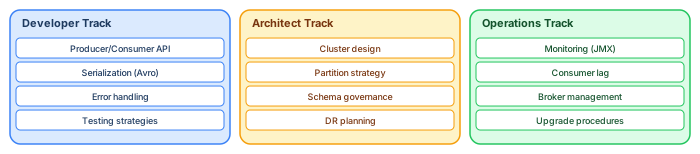
No. Enterprises need platform engineers, security teams, SRE/operations, and architects to understand the architecture, durability model, and governance mechanisms. The official documentation itself frames Kafka as combining messaging, storage, and stream processing—an architectural concern, not just a coding concern. turn16view0
Operational considerations
Kafka deployments require attention to operational fundamentals that are often underestimated during initial architecture decisions. Partition strategy determines consumer parallelism — too few partitions limits throughput, too many creates metadata overhead and increases leader election time during broker failures. A practical starting point: 3 partitions for low-volume topics, 6-12 for medium traffic, and 30+ only for topics exceeding 10,000 messages per second.
Retention configuration directly affects storage costs and replay capability. Set retention per topic based on the business requirement: 7 days for operational events (sufficient for most consumer catch-up scenarios), 30 days for analytics events (covers monthly reporting cycles), and multi-year for regulated data (financial transactions, audit trails). Use tiered storage to move older data to object storage (S3, Azure Blob) automatically, reducing broker disk costs without losing replay capability. enterprise cloud architecture patterns
Monitoring must cover three levels: cluster health (broker availability, partition balance, replication lag), application health (consumer group lag, producer error rates, throughput per topic), and business health (end-to-end event latency, data freshness at consumers, failed processing rates). Deploy Prometheus with JMX exporters for cluster metrics, integrate consumer lag monitoring into the platform team's alerting, and build business-level dashboards that domain teams can check independently.
If you’d like hands-on training tailored to your team — Sparx Enterprise Architect, BPMN, SysML, Apache Kafka or the Archi tool — or modelling coaching in ArchiMate and TOGAF-aligned governance, you can reach us via our contact page.
Frequently Asked Questions
What is enterprise architecture?
Enterprise architecture is a discipline that aligns an organisation's strategy, business operations, information systems, and technology infrastructure. It provides a structured framework for understanding how an enterprise works today, where it needs to go, and how to manage the transition.
How is ArchiMate used in enterprise architecture practice?
ArchiMate is used as the standard modeling language in enterprise architecture practice. It enables architects to create consistent, layered models covering business capabilities, application services, data flows, and technology infrastructure — all traceable from strategic goals to implementation.
What tools are used for enterprise architecture modeling?
Common enterprise architecture modeling tools include Sparx Enterprise Architect (Sparx EA), Archi, BiZZdesign Enterprise Studio, LeanIX, and Orbus iServer. Sparx EA is widely used for its ArchiMate, UML, BPMN and SysML support combined with powerful automation and scripting capabilities.