⏱ 21 min read
Event replay sounds innocent. Almost hygienic, even. “We’ll just reprocess the history.” A neat line in an architecture deck. A comforting promise told to executives after a projection bug, a pricing mistake, or a botched policy change. But in real enterprises, replay is rarely “just” anything. Replay is a loaded gun pointed at your production estate.
The problem is not replay itself. Event-sourced systems are built on the wonderful idea that history is durable, and current state is merely a consequence. That gives us auditability, temporal analysis, and the ability to rebuild read models or downstream state. It also gives us a dangerous illusion: if you can replay events, you can safely reconstruct the world. In practice, the world has moved on. Schemas changed. Services split. Side effects escaped. Meanings drifted. Yesterday’s event stream is not a harmless log file. It is fossilized business intent encoded in a system that no longer quite exists.
That is why replay isolation matters.
If your event-sourced platform has no isolated replay sandbox, then replay becomes coupled to current production behavior. That is how firms accidentally re-send customer emails, re-trigger settlements, duplicate shipments, distort analytics, poison caches, and rediscover old bugs with fresh enthusiasm. The technical failure is obvious. The architectural failure is deeper: the organization never decided whether replay is a domain reconstruction exercise, an operational recovery mechanism, or a migration tool. Those are different jobs, and they need different controls.
A mature architecture treats replay as a first-class capability with strong isolation boundaries, explicit domain semantics, and reconciliation paths back into trusted production state. Not a maintenance script. Not a heroic weekend activity. A capability.
This article argues for an opinionated pattern: Event Replay Isolation. It uses sandboxed consumers, side-effect suppression, semantic translation, and controlled reconciliation so that historical events can be re-evaluated without contaminating the live system. It fits especially well in Kafka-centric microservices estates, but the ideas apply equally to any event-sourced platform with durable append-only streams.
Context
Event sourcing gives us a seductive superpower: state can be rebuilt from facts. At its best, this aligns beautifully with domain-driven design. Aggregates emit domain events that capture meaningful business transitions: OrderPlaced, PolicyBound, ClaimApproved, PaymentCaptured. Those events are more than integration messages. They are the story of the domain.
And stories are useful. We replay them to:
- rebuild projections
- repair read models
- recalculate pricing or risk outcomes
- migrate to new bounded contexts
- backfill analytical stores
- validate new business rules against historical reality
- recover from software defects
- test a replacement service before cutover
In a simple system, replay is often implemented by pointing a consumer back to offset zero or reading from an event store from the beginning. Fine for a prototype. Catastrophic for an enterprise platform.
Why? Because enterprises are not one system. They are a landscape of bounded contexts, operational constraints, legal obligations, and deeply annoying external dependencies. One event may drive half a dozen reactions: customer notification, ERP posting, fraud scoring, tax reporting, partner settlement, and warehouse allocation. Replaying that event in the wrong place means waking all of those reactions again.
The core architectural mistake is conflating historical evaluation with business execution.
A domain event emitted in 2021 meant something in the context of 2021’s policies, product catalog, service boundaries, and compliance regime. In 2026, that same event may still be valid as a fact, but not as an instruction. Replay must respect that difference. Facts endure; interpretations change.
This is where domain-driven design earns its keep. If events are rich in domain semantics and tied to bounded contexts, we can reason about which histories may be replayed, translated, quarantined, or reconciled. If events are just low-level CRUD deltas with accidental fields from a database schema, replay becomes archaeology with explosives.
Problem
The problem is straightforward to state and surprisingly hard to solve:
How do we replay historical events to rebuild, validate, migrate, or repair state without causing unwanted side effects or corrupting live production behavior?
The difficulty comes from competing forces.
Replay needs fidelity
To be useful, replay should process real historical events with enough realism to expose defects and produce trustworthy derived state.
Production needs safety
Anything that can re-read years of history can also re-trigger years of downstream behavior. Safety demands isolation.
Domains evolve
Event versions, business meanings, aggregate boundaries, and bounded contexts all change over time. Replay has to cope with semantic drift.
Enterprises need continuity
You cannot usually stop the world, rebuild everything, and start again. Migration is incremental. New models must coexist with old ones. Reconciliation is unavoidable.
If you do nothing, replay ends up as one of three anti-patterns:
- The dangerous replay
Someone reconsumes from Kafka or the event store in the production topology and hopes idempotency saves them. event-driven architecture patterns
- The fake replay
Teams replay only sanitized subsets or synthetic data, then discover too late that production history behaves differently.
- The one-off replay script
A bespoke batch tool appears for every incident or migration. None are repeatable, observable, or governed.
All three are symptoms of the same thing: replay is treated as a technical utility rather than an architectural concern.
Forces
Good architecture emerges from tension, not purity. Replay isolation sits at the intersection of several stubborn forces.
1. Domain semantics versus transport mechanics
Kafka offsets are not business truth. Topics are not bounded contexts. Event stores are not the domain model. Replay architecture must preserve domain meaning, not merely re-read bytes.
For example, OrderSubmitted in Commerce may map to multiple concepts downstream: reservation intent in Inventory, credit exposure in Finance, fulfillment demand in Logistics. Replaying one event blindly through current integrations can create nonsense if those contexts have evolved independently.
2. Temporal correctness versus operational expediency
A replay can answer two very different questions:
- “What would the system have done then?”
- “What should the system look like now, given that history?”
Those are not the same. The first is historical simulation. The second is present-state reconstruction. Most enterprises need the second but accidentally build the first.
3. Isolation versus confidence
The more isolated the sandbox, the safer the replay. But if the sandbox omits too much of the real topology, confidence drops. You need enough realism to trust results, without enough coupling to cause harm.
4. Throughput versus control
Replaying ten billion events through a microservices estate is not just expensive. It can starve live consumers, thrash storage, distort metrics, and trigger autoscaling storms. Isolation needs resource control. microservices architecture diagrams
5. Event immutability versus evolving meaning
Events should be immutable. Meanings are not. Product rules change. Regulatory interpretations change. Reference data changes. If replay uses current reference data where original processing used historical data, outcomes drift. Sometimes that drift is the point. Sometimes it is a defect.
6. Local service autonomy versus enterprise reconciliation
Each service wants to own its state and logic. Enterprises want globally reconciled outcomes. Replay isolation must respect service boundaries while still enabling cross-context comparison and reconciliation.
Solution
The pattern is simple to describe:
Run replay in an isolated sandbox execution path that consumes historical events, suppresses or redirects side effects, optionally translates events into current domain semantics, and produces candidate state for controlled reconciliation into production.
There are four key ideas here.
1. Separate replay execution from live execution
Do not reuse the live consumer topology without guards. A replay should run in an explicit sandbox environment or execution mode:
- separate Kafka consumer groups
- separate output topics or namespaces
- separate databases/read models
- separate caches
- disabled or mocked external connectors
- throttled infrastructure quotas
This is not paranoia. This is professionalism.
2. Treat side effects as policy-controlled outputs
A replayed event may legitimately rebuild a projection, but it must not resend a payment instruction or customer email. So side effects need explicit classification:
- recomputable internal state: safe to rebuild
- replay-safe derived outputs: safe if routed to sandbox topics/stores
- irreversible external effects: must be suppressed or mocked
- conditionally replayable commands: only with explicit policy and idempotency guarantees
Architecturally, this usually means introducing an output abstraction. Domain processing produces intents; a replay policy decides what happens to them.
3. Insert semantic translation where domains evolved
Historical events often need upcasting, enrichment, or contextual remapping before they can be understood by a new model. This is not merely schema evolution. It is semantic evolution.
A replay isolation design should allow:
- schema upcasters
- event version translators
- bounded-context mapping
- historical reference data lookup
- temporal policy selection
This is where many replay efforts fail. The events are syntactically readable but semantically wrong.
4. Reconcile, don’t blindly promote
The result of replay is not automatically truth. It is candidate truth. The final step is reconciliation:
- compare sandbox state with production state
- identify expected and unexpected deltas
- classify differences by domain significance
- apply controlled promotion or cutover
- retain audit trail of the replay run
Replay without reconciliation is theater.
Architecture
At a high level, Event Replay Isolation introduces a dedicated replay path parallel to live processing.
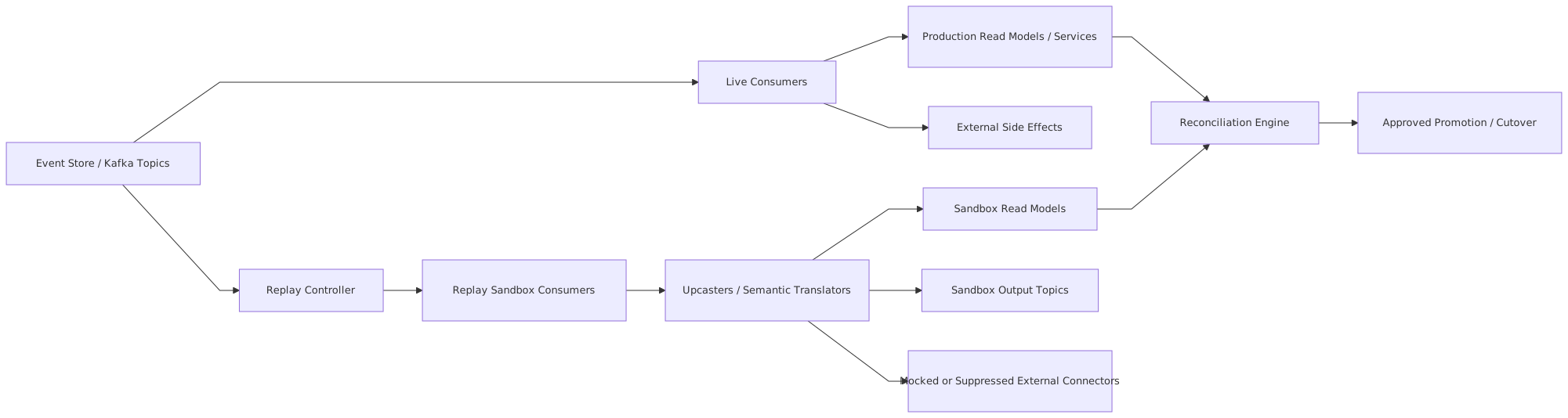
This architecture has several responsibilities.
Replay Controller
The replay controller is the conductor, not the orchestra. It manages:
- event range or stream selection
- bounded context scope
- replay mode: rebuild, validate, migrate, backfill
- execution rate and quotas
- policy package version
- checkpointing and restart behavior
- run metadata and audit trail
In large enterprises, this becomes a proper platform capability, not a shell script.
Sandbox Consumers
These consume from historical sources using isolated consumer groups or direct event store readers. They should support:
- deterministic reprocessing
- partition-aware ordering rules
- per-aggregate sequencing where required
- backpressure and throttling
- dead-letter capture for malformed or untranslatable events
Translators and Upcasters
These are often underrated. A replay that spans years will almost certainly require event version adaptation. More importantly, bounded contexts may have changed shape.
Imagine an insurance platform where PolicyEndorsed used to imply premium recalculation in one service, but now premium changes are explicit events in a Pricing context. Replay into the new world needs semantic mapping, not just field conversion.
Sandbox State Stores
All replay output lands in isolated stores:
- replay projection databases
- temporary document stores
- analytical tables
- sandbox caches
- side-output topics for inspection
Never write replay output directly into production stores unless the write path is itself policy-controlled and explicitly in promotion mode.
Reconciliation Engine
This compares sandbox outputs to production or target state. Reconciliation may be:
- entity-level comparison
- aggregate version comparison
- balance or ledger reconciliation
- statistical comparison for large estates
- business-rule invariant checks
- human-reviewed exception queues
This is where architecture meets domain operations. Differences should be intelligible to business stakeholders, not just developers.
Domain Semantics: The Part People Skip and Then Regret
Event replay is not fundamentally a data engineering problem. It is a domain semantics problem wearing a data engineering hat.
In domain-driven design, events should express meaningful business facts within bounded contexts. That matters because replay only makes sense if you know what the facts are supposed to mean now.
Take a retail banking example:
AccountOpenedInterestAccruedFeeWaivedStatementGenerated
These are not interchangeable technical records. FeeWaived may have compliance implications. InterestAccrued may depend on historical rate tables and holiday calendars. StatementGenerated may have legal notification requirements and retention concerns. Replaying them without understanding whether you are reconstructing balances, validating policy logic, or reproducing customer communications is a category error.
The architecture should therefore distinguish at least three semantic classes of replay:
- Projection replay
Rebuild read models from immutable facts. Lowest risk if side effects are isolated.
- Decision-model replay
Re-evaluate business rules against historical facts to test a new model or policy.
- Migration replay
Transform historical facts into a new bounded context or service boundary.
The processing pipeline may look similar, but the semantics are different. The controls should be different too.
Migration Strategy
Most enterprises do not adopt replay isolation on a greenfield platform. They inherit a mess: mixed event styles, accidental coupling, and services that treat every consumed event as a trigger for external behavior. So the migration has to be progressive.
This is where the strangler pattern earns another paycheck.
Step 1: Inventory event consumers and side effects
Start with a brutally practical catalog:
- which consumers rebuild internal state
- which call external systems
- which emit more events
- which rely on current reference data
- which are idempotent
- which can be safely re-run
- which definitely cannot
Do not trust team memory. Trace the actual runtime topology.
Step 2: Introduce replay modes and output policies
Before building a separate platform, add an execution mode to key consumers:
- live mode
- replay mode
- validation mode
In replay mode, consumers route outputs to sandbox topics/stores and suppress forbidden side effects. This can be ugly at first. That is acceptable. The goal is control.
Step 3: Externalize translation logic
Pull event upcasting and semantic translation out of ad hoc consumer code and into explicit pipeline components. That creates reusable migration machinery.
Step 4: Create isolated infrastructure slices
Move replay into dedicated namespaces, clusters, or accounts where practical. At minimum, separate:
- consumer groups
- databases
- object stores
- observability dimensions
- topic prefixes or clusters
Step 5: Add reconciliation before cutover
Do not cut over a new projection or service without proving equivalence or understanding divergence. Build reconciliation reports early.
Step 6: Strangle legacy direct replay
Once the isolated path is credible, ban “just reset the offsets in prod” as an operational practice. If this feels draconian, good. Some doors should be locked.
Here is a progressive migration view:
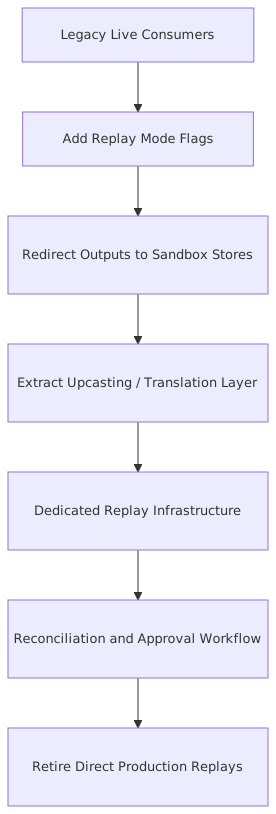
A strangler migration works because it does not demand instant purity. It builds safety around the existing system, then tightens the boundaries.
Enterprise Example
Consider a global insurer modernizing its policy administration platform.
The legacy estate used Kafka as an event backbone across Policy, Billing, Claims, and Customer Communications. Policy changes were event-sourced in the core platform, but downstream services were a mix of event-driven projections and side-effecting processors. When regulators required retrospective recalculation of certain premium components across five years of policies, the company initially considered replaying all policy events through the live topology.
That would have been a disaster.
Why? Because historical PolicyEndorsed, PremiumAdjusted, and PolicyReinstated events triggered not only internal projections but also:
- broker commission calculations
- billing schedule generation
- customer letters
- data warehouse feeds
- partner notifications
- claims eligibility cache updates
A replay through production consumers would have created duplicate invoices, unnecessary customer correspondence, and mismatched downstream reports. Worse, the policy domain had evolved: premium logic now lived in a separate Pricing bounded context that did not exist when many of the original events were emitted.
The insurer implemented replay isolation instead.
They created a replay sandbox with:
- separate Kafka consumer groups
- a topic namespace prefixed with
replay. - sandbox PostgreSQL projection stores
- mocked outbound connectors for document generation and broker APIs
- semantic translators mapping old premium-related events into the new Pricing context model
- a reconciliation engine comparing replayed premium outcomes against current policy records and billing balances
The process worked like this:
- Historical policy streams were selected by product line and date range.
- Events were upcast and semantically translated.
- Sandbox processors recalculated premium state and rebuilt related projections.
- No real invoices, letters, or broker transactions were emitted.
- Reconciliation identified policies where replayed premium differed materially from current booked amounts.
- Approved deltas were turned into explicit corrective business events, not hidden data patches.
That last point matters. They did not “fix the database.” They produced corrective domain actions with full auditability. Architecture with self-respect leaves a trail.
The result was not perfect. Some old events lacked reference data needed for accurate reinterpretation. Certain product lines had to fall back to manual review. But the replay did what it needed to do: it isolated historical recomputation from live operations, exposed semantic gaps, and enabled controlled correction.
That is what success looks like in the enterprise. Not elegance. Governed recoverability.
Operational Considerations
Architects love structure diagrams and then leave operations to discover the sharp edges. Replay isolation has plenty.
Capacity management
Replay can be monstrously expensive. Historical streams may dwarf normal live traffic. Throttle aggressively. Use quotas. Separate infrastructure where possible. A replay job should not trigger a production cost incident.
Ordering guarantees
Some domains require strict per-aggregate ordering. Others tolerate looser sequencing. Know which is which. “Kafka preserves order” is not an architecture. It preserves order per partition, under specific conditions, and your domain probably cares about something more precise.
Observability
Replay telemetry should be distinct from live telemetry:
- replay run ID
- source event range
- policy/version identifiers
- translated event counts
- suppressed side effects
- reconciliation mismatch categories
- throughput and lag
- failure buckets
If replay metrics are mixed into production dashboards, operations will spend a bad afternoon chasing ghosts.
Checkpointing
Long-running replays need resumability. Store checkpoints with enough metadata to guarantee deterministic restart. “Resume from the last offset” may be insufficient if translators or policies changed mid-run.
Data governance
Historical events may contain personal data subject to retention and access constraints. Replay sandboxes must honor the same security and compliance obligations as production, often more strictly because broad historical access is concentrated there.
Temporal reference data
Many replays fail because they use current reference data rather than historical snapshots:
- tax tables
- product catalogs
- FX rates
- holiday calendars
- commission schedules
Sometimes you want current rules applied to historical events. Sometimes you need historical rules. Make that choice explicit.
Reconciliation
Reconciliation is where replay stops being an engineering exercise and becomes enterprise architecture.
A replay produces computed state. The enterprise must decide whether that computed state should replace, amend, or simply inform production state. That requires domain-aware comparison.
A practical reconciliation pipeline looks like this:

Good reconciliation asks business questions, not just technical ones:
- Is the monetary delta above tolerance?
- Does the difference affect customer-facing obligations?
- Is the divergence due to known rule changes?
- Can the correction be represented as a valid domain event?
- Do we need human sign-off?
The best enterprise teams create reconciliation vocabularies shared by architecture, operations, and business control functions. A “difference” is too vague. A “balance variance over tolerance on active policy with customer impact” is actionable.
Tradeoffs
Replay isolation is not free. It buys safety by adding machinery.
Benefits
- protects production from accidental side effects
- enables repeatable historical recomputation
- supports migration and strangler modernization
- improves auditability and governance
- exposes semantic drift explicitly
- creates a testbed for new decision models
Costs
- more infrastructure
- more code paths
- extra policy and translation logic
- reconciliation complexity
- delayed feedback versus naïve direct replay
- organizational friction around approvals and governance
There is also a subtle tradeoff between purity and practicality. In theory, every side effect should be derived from explicit domain intents and controlled by policy. In reality, legacy estates are littered with direct API calls buried in consumers. Refactoring all of that before introducing replay isolation may stall the initiative. The better strategy is usually incremental containment: wrap the dangerous outputs first, then improve the model.
Failure Modes
It is worth being blunt here. Replay isolation fails in familiar ways.
1. Hidden side effects
A consumer writes to an “internal” cache that actually feeds a customer portal. Or emits an event that another live service treats as production truth. Side effects are often more indirect than teams realize.
2. Semantic mistranslation
Events are successfully upcast at the schema level but mapped incorrectly in domain meaning. The system runs cleanly and produces wrong answers. This is the most dangerous failure because it looks healthy.
3. Reference data drift
Replay uses current master data instead of historical context, producing plausible but invalid results.
4. Resource contention
Sandbox replay shares brokers, databases, or network limits with production and degrades live service.
5. Non-idempotent promotion
Reconciled changes are pushed into production via ad hoc scripts or direct writes, making rollback and audit impossible.
6. Human bypass
Under incident pressure, someone skips the sandbox and resets consumer offsets in prod “just this once.” Culture is part of architecture whether we like it or not.
7. Cross-context inconsistency
One bounded context is replayed and corrected, but dependent contexts are not reconciled accordingly. The enterprise now has locally correct and globally inconsistent state.
When Not To Use
Not every system needs a full replay isolation architecture.
Do not use this pattern when:
- your system is not meaningfully event-sourced and replay is only occasional ETL backfill
- event history is incomplete or too semantically poor to support trustworthy reconstruction
- the cost of reconciliation exceeds the business value of replay
- side effects are already minimal and projections are disposable
- a simpler snapshot rebuild or data migration script is sufficient
- the domain changes too rapidly and historical reinterpretation is not a business requirement
For a small internal tool with a couple of projections and no irreversible side effects, a full replay sandbox may be over-engineering. Architecture should have a sense of proportion.
Also, if your event model is really just database change capture masquerading as domain events, replay isolation will not rescue the underlying design. First fix the semantics, then industrialize replay.
Related Patterns
Event Replay Isolation sits near several adjacent patterns.
Event Sourcing
The foundation. Without durable event history, there is nothing meaningful to replay.
CQRS Projection Rebuild
A narrower case. Rebuilding read models is often the first use of replay isolation.
Strangler Fig Migration
Essential for introducing isolated replay into a live estate without a big-bang rewrite.
Outbox Pattern
Useful for making emitted integration events explicit and controllable, especially during replay promotion.
Anti-Corruption Layer
Critical when replaying historical events into a newly carved bounded context with different concepts.
Saga / Process Manager
Relevant when business flows span multiple services. Replay must take care not to resurrect in-flight orchestration behavior unless explicitly intended.
Digital Twin / Simulation Environments
A replay sandbox often resembles a simulation platform, but the difference is intent: replay isolation is tied to authoritative historical facts and controlled reconciliation.
Summary
Replay is one of those ideas that sounds cleaner on a whiteboard than it behaves in a real enterprise. The whiteboard says: we have history, therefore we can rebuild state. The enterprise replies: yes, but history carries old meanings, old boundaries, and dangerous triggers.
That is why event replay must be isolated.
A sound architecture separates historical evaluation from live execution. It reprocesses events in a sandbox, suppresses or redirects side effects, translates old semantics into current models where necessary, and reconciles candidate outcomes before promotion. It uses domain-driven design to keep replay grounded in business meaning, not just topic mechanics. It adopts strangler-style migration to introduce controls progressively rather than waiting for an impossible clean slate.
The central lesson is simple and worth remembering:
In event-sourced systems, history is an asset. Replay is a capability. Production is not the place to improvise.
Build the sandbox. Make side effects explicit. Reconcile with intent. And never confuse “we can replay events” with “we can safely replay the business.”
The key is not replacing everything at once, but progressively earning trust while moving meaning, ownership, and behavior into the new platform.
Frequently Asked Questions
What is enterprise architecture?
Enterprise architecture aligns strategy, business processes, applications, and technology in a coherent model. It enables impact analysis, portfolio rationalisation, governance, and transformation planning across the organisation.
How does ArchiMate support architecture practice?
ArchiMate provides a standard language connecting strategy, business operations, applications, and technology. It enables traceability from strategic goals through capabilities and services to infrastructure — making architecture decisions explicit and reviewable.
What tools support enterprise architecture modeling?
The main tools are Sparx Enterprise Architect (ArchiMate, UML, BPMN, SysML), Archi (free, ArchiMate-only), and BiZZdesign. Sparx EA is the most feature-rich, supporting concurrent repositories, automation, scripting, and Jira integration.