⏱ 21 min read
Event streaming promises a seductive thing: that if every service publishes facts about the world, the enterprise will somehow become composable. Then the hard part arrives. Facts that used to sit side by side in one database are now scattered across services, topics, retention policies, teams, and release trains. The business still wants an answer to a very old question—“what happened, to whom, and what should we do next?”—but now the answer depends on joining streams that were never born together.
This is where architecture stops being a slide deck and becomes a contact sport.
Streaming joins across services are one of those topics that look elegant in conference talks and turn unruly in real enterprises. A diagram with a couple of Kafka topics and a neat state store suggests inevitability. Production tells a different story: late events, changing keys, duplicate messages, upstream schema drift, privacy boundaries, legal retention constraints, and business concepts that don’t line up neatly across bounded contexts. The join is not just a technical operation. It is a statement about meaning. And if the meaning is wrong, the code will be beautifully incorrect at scale.
This article is about that edge. Not the toy case. The real one.
Context
In a monolith, joins are cheap to imagine. Data lives under one transactional roof, consistency semantics are usually clear enough, and the optimizer does the hard work. The cost is hidden in coupling. In a microservices landscape, we deliberately break that roof apart. We split data ownership by bounded context. Orders belong to Order Management. Payments belong to Billing. Shipments belong to Logistics. Customer preferences belong somewhere else entirely. That separation is healthy because it aligns software with the business. But every split introduces a tax: cross-context questions become harder.
Event streaming, especially with Kafka, is often used to pay that tax in a more controlled way. Rather than synchronously calling every service at request time, systems publish domain events and downstream consumers derive projections, trigger workflows, and build read models. When the business asks “orders paid but not shipped within two hours” or “claims approved where policy coverage was later rescinded,” the answer often requires joining data emitted by multiple services.
That is the moment people discover that “events everywhere” is not an architecture. It is a substrate.
Streaming joins sit in the middle of a broader enterprise move toward domain-driven design, data products, and asynchronous integration. They are useful because they let us correlate facts over time without centralizing every operational database. They are dangerous because they can quietly recreate a distributed monolith made of topics instead of tables.
Problem
The problem sounds simple:
- Service A emits one stream of business events.
- Service B emits another.
- We need to correlate them to derive a new business fact or support a decision.
For example:
- Join
OrderPlacedwithPaymentAuthorizedto produceOrderReadyForFulfillment. - Join
ClaimSubmittedwithPolicyValidatedto detect fraudulent or uncovered claims. - Join
CustomerUpdatedwithConsentChangedto decide whether a campaign can legally proceed. - Join shipment telemetry with warehouse release events to detect cold-chain risk.
If both events shared a stable identifier, arrived in order, used the same schema versioning discipline, and represented the same notion of time, this would be straightforward. They rarely do.
In enterprises, the deeper problem is semantic mismatch.
One service’s “customer” is another service’s “account holder.” One service emits intent (“payment requested”), another emits outcome (“funds captured”). One team keys by internal surrogate ID, another by business reference, another by composite key that mutates after enrichment. A join across these streams is only valid if the relationship reflects domain truth, not just accidental data overlap.
This is why streaming joins must be designed as domain collaborations, not merely data engineering pipelines.
Forces
Several forces shape the design.
1. Bounded contexts resist naive joins
Domain-driven design gives us bounded contexts to preserve conceptual integrity. That means events from different services are not interchangeable nouns with different JSON wrappers. They carry context-specific meaning. Joining across services can be entirely appropriate—but only if we are explicit about the translation between contexts.
A payment service saying “authorized” may mean “funds reserved.” An order service may treat “paid” as “financial risk cleared.” Those are related, not identical. A join topology that conflates them will leak bad assumptions into the business process.
2. Time is not one thing
There is event time, processing time, ingestion time, and business effective time. Enterprises routinely confuse them. A late payment authorization may arrive after shipping started. Was the order paid before it shipped? The answer depends on which clock matters to the business. Streaming platforms can window by event time, but the business needs a policy for what “late” means operationally.
3. Keys are political
Every architect wants a stable correlation key. Every enterprise eventually discovers that key ownership sits inside a team boundary and changes under pressure. Mergers, package upgrades, CRM replacements, and partner integrations all deform identifiers. Joins fail less because stream processors are weak and more because key design was wishful.
4. Operational correctness beats algorithmic elegance
A perfect low-latency join that no one can reconcile is inferior to a slightly delayed projection with auditability and repair paths. In regulated industries, “show me why these two records were joined” matters more than shaving 30 milliseconds.
5. Teams own services, but someone must own the derived fact
The output of a join is not free. If a new stream emits OrderReadyForFulfillment, who owns its definition? Which domain decides whether a payment reversal invalidates it? Derived facts need product ownership just like services do.
6. Reprocessing is inevitable
Backfills happen. Schema bugs happen. Upstream teams republish. Retention periods change. If your join topology cannot be replayed or reconciled, it will eventually rot.
Solution
The most robust approach is to treat cross-service streaming joins as a dedicated domain projection or policy engine, not as an incidental wiring detail between microservices. microservices architecture diagrams
In practice, that means:
- Identify the business fact you are trying to derive.
- Define the domain semantics explicitly.
- Create a join topology that subscribes to the required event streams.
- Materialize state needed for correlation.
- Emit a new derived event or projection owned by a clear downstream boundary.
- Add reconciliation paths for drift, lateness, and repair.
This sounds obvious. It usually isn’t done.
A good streaming join topology has a purpose. “Join order and payment events” is not a purpose. “Determine when an order is financially clear for fulfillment” is a purpose. That subtle shift matters because it forces discussion of business rules: authorization vs capture, timeout thresholds, reversals, fraud checks, split tenders, partial fulfillment, and manual hold states.
The output should be a domain event or read model that reflects that purpose, for example:
OrderFinanciallyClearedClaimCoverageDecisionProjectedCustomerContactabilityResolved
Those names are better than generic technical events because they encode meaning. They also create a stable contract for downstream consumers.
Core design idea
Use event streams as sources of truth for local facts, and a dedicated stream processor to derive cross-context facts through stateful joins.
This often means Kafka Streams, Flink, or another event processing engine, with materialized state stores and compacted topics for reference data. The key is not the tool. The key is ownership and semantics. event-driven architecture patterns
Here is the basic join topology.
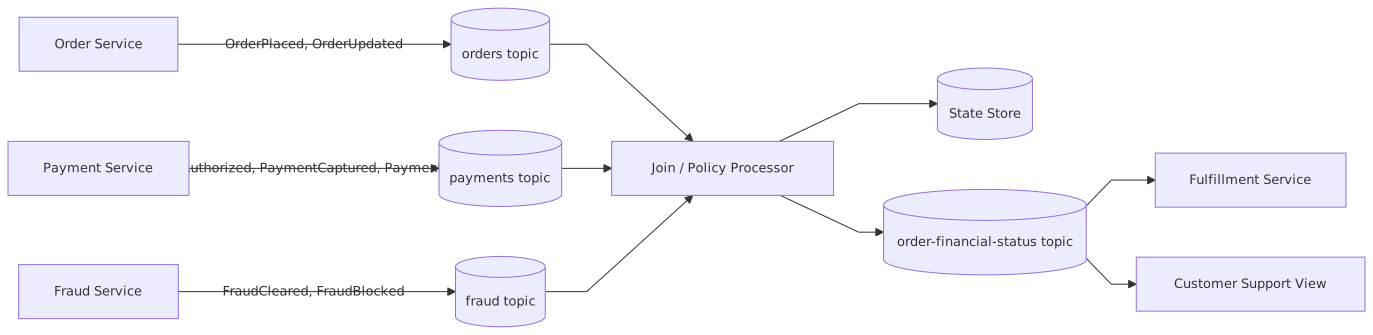
This processor is not “the place where all business logic goes.” That way lies madness. It is the place where a specific cross-context business decision is made. Keep it narrow. Keep it named. Keep it owned.
Architecture
There are several join patterns across services. Each has different consequences.
Stream-stream join
Use this when two event streams need temporal correlation. Example: OrderPlaced and PaymentAuthorized within a window. The processor keeps state for both sides and joins matching keys within time boundaries.
This is attractive for near real-time use cases. It is also brittle if events arrive very late, identifiers mutate, or there are many-to-many relationships.
Stream-table join
Use this when one side is really reference or latest-known state. For example, join OrderPlaced with the latest CustomerCreditProfile or ProductRegulatoryClassification. Typically the “table” is built from a compacted topic.
This is often a better fit for enterprise systems because many cross-service questions are really “event plus latest contextual state,” not “two simultaneous event streams.”
Table-table join over materialized views
Sometimes the right answer is not a pure stream topology but two independently materialized service-owned views joined downstream in an analytics or operational read model. This trades latency for clarity and recovery.
A mature architecture uses all three. Dogma here is expensive.
The semantic model
Before writing any topology, define:
- Correlation key
- Join cardinality
- Time semantics
- Business state transitions
- Repair policy
- Output ownership
Let’s take an order-payment example.
- Correlation key:
orderIdif stable across contexts; otherwise a mapping table from payment reference to order aggregate ID. - Cardinality: one order can have many payment events.
- Time semantics: order is “financially cleared” when at least one successful capture covers required amount and no active fraud block exists.
- Repair policy: if payment reversal occurs later, emit
OrderFinancialStatusChangedand trigger compensation. - Output ownership: fulfillment domain consumes but finance policy domain owns derivation.
That is architecture. Everything else is syntax.
Stateful processing and idempotency
A join processor needs durable state. It must remember enough about each side to correlate events and derive output deterministically. This state may include:
- latest order status
- cumulative captured amount
- fraud decision state
- timestamps for SLA calculations
- emitted output version to avoid duplicates
Because Kafka and other streaming systems typically provide at-least-once delivery unless carefully configured, idempotency matters. The processor should be able to consume duplicate events, survive rebalances, replay from offsets, and avoid emitting contradictory facts on retry.
A practical design is to store derived status and last applied event version per business key. If the same input event is replayed, the processor recognizes it as already applied.
Topology with reconciliation lane
The join path alone is not enough. Real enterprises need a second lane for repair and reconciliation.
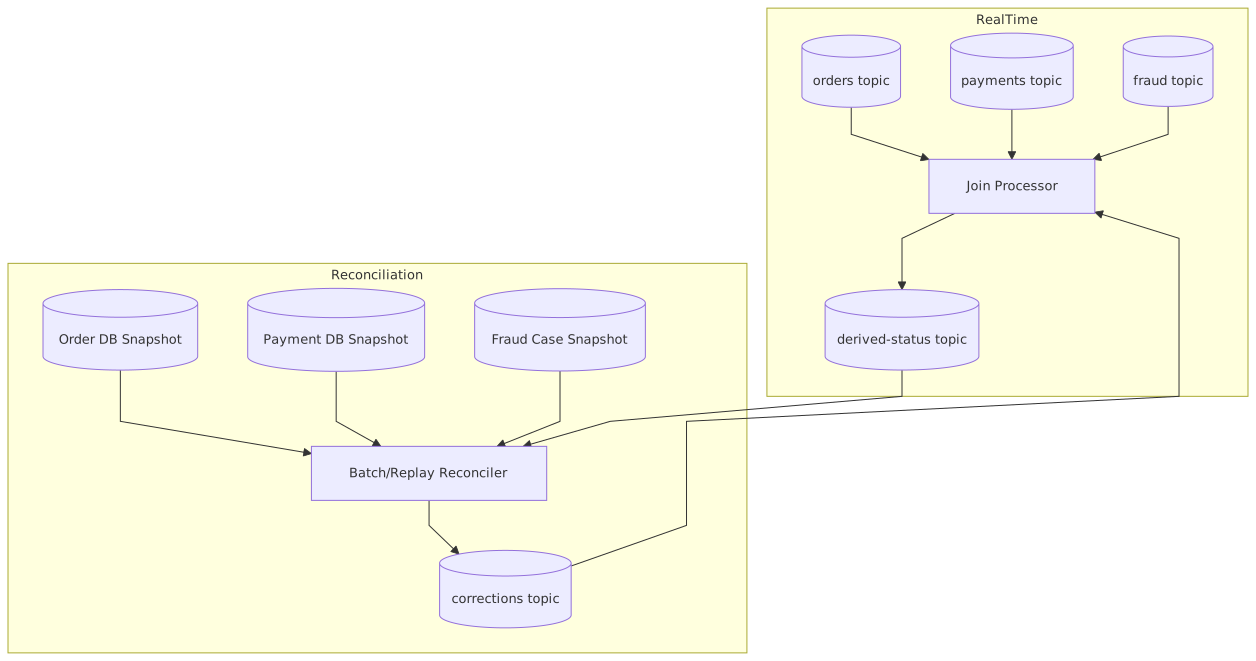
This second lane is the difference between architecture for demos and architecture for Tuesday morning after a botched release. Reconciliation allows you to compare derived truth with source-of-record snapshots, emit corrections, and heal drift.
If you skip this, you will eventually use ad hoc SQL and apology emails as your consistency model.
Migration Strategy
Most organizations do not begin with beautifully evented bounded contexts. They begin with a monolith, shared databases, or point-to-point APIs. So the question is not just how to design streaming joins. It is how to migrate toward them without betting the quarter on a rewrite.
The answer, almost always, is progressive strangler migration.
Start by identifying one high-value cross-service decision currently implemented in the monolith or an integration layer. Not ten. One. Then carve out the derivation as a separate projection or policy processor. Feed it from events produced by the existing systems, even if those events are initially emitted via change data capture, outbox pattern, or anti-corruption adapters.
A pragmatic migration sequence looks like this:
- Baseline the current decision logic
Understand where the join happens today. SQL? Stored procedures? Nightly batch? Synchronous orchestration? Document actual business behavior, not intended behavior.
- Publish source events with stable contracts
Use outbox if services own transactional data and need reliable event publication. If the source is still a legacy schema, CDC can be acceptable for transition, but treat raw CDC as a temporary integration shape, not a domain API.
- Build a side-by-side streaming projection
Compute the same derived fact in the new join topology while the old path remains authoritative.
- Reconcile continuously
Compare old and new outputs. Investigate mismatches. Most surprises will be semantic, not technical.
- Shift downstream consumers gradually
Let one consumer adopt the new derived event or read model. Expand once confidence grows.
- Retire old join logic
Only after reconciliation rates are acceptable and operational support is ready.
Here is the migration pattern.

The strangler part matters because joins are where hidden domain assumptions live. If you try to migrate all assumptions at once, you will import chaos faster than clarity.
CDC versus domain events
A blunt opinion: use domain events where you can, CDC where you must, and never confuse the two.
CDC tells you that rows changed. Domain events tell you what the business believes happened. For streaming joins, that distinction is huge. A payments table update from status=A to status=B is not the same thing as PaymentCaptured. The former is implementation leakage; the latter is business language.
CDC is useful during migration because it lowers extraction cost. But if the join topology becomes strategic, invest in proper domain events and anti-corruption mapping.
Enterprise Example
Consider a large retailer running e-commerce across multiple regions. The order domain, payment domain, fraud platform, and warehouse management system are all separate services. The business requirement sounds innocent: release an order to fulfillment only when payment is sufficiently secure and no fraud hold applies.
In the old world, this logic lived inside a monolithic order management platform backed by an Oracle database. It joined order lines, payment authorization records, fraud flags, and warehouse allocation status using a handful of tables and batch jobs. It worked, mostly, because everything was under one schema and everyone feared touching it.
Then the retailer modernized. Payments moved to a separate platform. Fraud was outsourced and integrated asynchronously. Warehouses began publishing stock allocation events over Kafka. The old SQL join no longer had direct access to all facts. Teams first compensated with synchronous API calls. That made checkout and release workflows slow, fragile, and expensive during peak season. A fraud API timeout could stall order release. A warehouse spike could amplify retry storms.
The replacement architecture created a dedicated Order Release Policy stream processor.
Inputs:
OrderSubmitted,OrderAmended,OrderCancelledPaymentAuthorized,PaymentCaptured,PaymentFailed,PaymentReversedFraudReviewStarted,FraudCleared,FraudDeclinedInventoryAllocated,InventoryAllocationExpired
The processor maintained per-order state:
- commercial amount required
- amount secured
- fraud disposition
- inventory readiness
- release decision status
- last emitted decision version
The output was not “joined order-payment-fraud message.” It was a domain fact: OrderReleaseEligibilityChanged.
That subtle naming decision changed the implementation. Warehouses did not need all upstream details. They needed a stable answer and enough reason codes to act. So the output included:
eligible: true|false- reason codes
- effective timestamp
- decision version
- correlation references
This let downstream fulfillment remain loosely coupled. They no longer reasoned directly about payment states and fraud transitions; they reasoned about release eligibility.
The retailer did not flip overnight. For three months, the old order management SQL logic remained authoritative while the new stream processor ran in shadow mode. A reconciliation job compared every release decision. The mismatch rate started embarrassingly high. Why? Because “payment authorized” in one region was enough for low-risk digital goods but not for high-value physical goods. The old logic had encoded this as a tangle of product-category exceptions and region flags. No one had documented it as domain policy.
This is why migration is discovery.
After those rules were made explicit, mismatch rates dropped below agreed thresholds. One warehouse cluster switched first, then another. By the holiday period, most release decisions ran off the new topology. The result was lower synchronous dependency, better release latency, and a clear audit trail for why an order was or was not released.
The architecture succeeded not because Kafka is magical, but because the team treated the join as a policy-owned domain projection with reconciliation and staged cutover.
Operational Considerations
Streaming joins are operational systems, not just integration code. Run them accordingly.
Partitioning and key alignment
If two streams are to be joined efficiently in Kafka, they typically need compatible partitioning by the correlation key. This is often underappreciated. If one topic is partitioned by orderId and another by customerId, your local stateful join becomes awkward or impossible without repartitioning. Repartitioning adds latency, cost, and operational complexity.
Design key strategy early. It is one of the few things that gets more expensive every quarter.
State store sizing and retention
Stateful joins require retained state for windows, aggregates, and latest-known facts. Underestimate store growth and you get crashes, long restarts, and compaction pain. Overestimate and you waste infrastructure. Model retention based on business lateness tolerances, replay needs, and compliance boundaries.
Schema evolution
Cross-service joins are sensitive to schema drift. Use schema registries, compatibility rules, and event versioning discipline. More importantly, treat semantic changes as contract changes even when the JSON still validates.
Observability
You need more than CPU and consumer lag. Useful join metrics include:
- unmatched event counts by source
- late arrival distribution
- state store hit/miss patterns
- duplicate event rates
- reconciliation mismatch counts
- output decision churn
- replay duration and backlog
A join topology that is “up” but silently producing degraded matches is not healthy.
Data governance and privacy
Joining across services often creates a richer, more sensitive derived dataset than any source alone. That can cross regulatory boundaries. A marketing consent stream joined with customer profile and activity data can become legally toxic if misgoverned. Minimize payloads. Use purpose-specific derived events. Do not casually centralize personally identifiable information because the topology made it easy.
Backfills and replay
Replays are where good intentions die. If you reprocess six months of events, will the topology emit six months of downstream actions again? Can it distinguish rebuild from live execution? Can consumers tolerate duplicate historical decisions? Mature designs support replay modes, side outputs, or versioned topics for backfills.
Tradeoffs
Streaming joins across services buy decoupling at read and decision time, but they introduce complexity at design and operations time. That trade is often worth it, but not always.
What you gain
- lower synchronous coupling between microservices
- near real-time cross-domain decisions
- explicit derived business facts
- scalable projections and read models
- better auditability than opaque API choreography
- natural support for event-driven workflows
What you pay
- stateful processing complexity
- eventual consistency
- replay and reconciliation burden
- key management pain
- semantic governance overhead
- more moving parts for support teams
The deepest tradeoff is this: you are shifting complexity from transactional joins in a single database to explicit, distributed policy derivation. That is healthier if the business domains are genuinely separate and the enterprise needs scalable asynchronous collaboration. It is wasteful if the split is artificial.
Failure Modes
This is where architecture earns its keep.
Semantic misjoin
Two events share a key but not a meaning. For example, a reused external reference accidentally correlates unrelated records after a partner migration. The topology joins correctly by code and incorrectly by domain. This is the most dangerous failure because dashboards look normal.
Mitigation: explicit canonical correlation policies, anti-corruption mapping, and reconciliation against source systems.
Late and out-of-order events
A payment reversal arrives after release eligibility was already emitted. Without compensating logic, downstream systems act on stale truth.
Mitigation: model reversibility, emit status changes not one-off commands, and ensure downstream consumers can handle revocation or compensation.
Identifier drift
A service changes key generation or introduces region-scoped IDs. The join match rate collapses.
Mitigation: governed key strategy, mapping tables, and contract review for identifier changes.
State corruption or loss
A processor state store becomes inconsistent after an unclean failover or bad deployment. The topology resumes but emits wrong outputs.
Mitigation: checkpointing, deterministic rebuild paths, state validation, replay testing, and operational drills.
Duplicate amplification
An upstream retry bug republishes thousands of events. The join processor emits repeated derived status changes, triggering duplicate downstream actions.
Mitigation: input deduplication where possible, idempotent state transitions, output versioning, and consumer idempotency.
Reconciliation blindness
The system slowly diverges from source-of-record reality because no one compares them anymore.
Mitigation: continuous reconciliation with business-owned thresholds and exception workflows.
When Not To Use
Not every cross-service data need deserves a streaming join.
Do not use this pattern when:
1. The domains are not truly separate
If two services are split for organizational fashion but still require tight transactional consistency and constant joining, you may have cut the system at the wrong seam. Reconsider the bounded context design.
2. The use case is simple request-time composition
If a UI needs occasional aggregated data with no need for derived state or event-time semantics, an API composition layer may be simpler and cheaper.
3. The latency requirement is loose and data volume is modest
For nightly reporting or low-frequency operational views, batch ETL or warehouse-based joins may be easier to govern and reconcile.
4. Correlation keys are unstable or unavailable
If you cannot reliably match records across contexts, a streaming join will only industrialize ambiguity.
5. The organization lacks operational maturity
Stateful stream processing demands disciplined observability, schema management, replay strategy, and support ownership. Without that, you are building an outage generator.
6. Regulatory boundaries prohibit the combined dataset
Some joins should not exist operationally, even if they are technically feasible.
A useful test is this: if the business cannot clearly name the derived fact and who owns it, you probably should not build the topology yet.
Related Patterns
Streaming joins do not live alone. They work best alongside a set of complementary patterns.
Outbox pattern
Use it to reliably publish domain events from transactional services without dual-write hazards. Essential when source systems own authoritative business changes.
Change Data Capture
Useful as a migration bridge from legacy systems. Good servant, poor master.
CQRS and materialized views
A join topology often produces a read model or projection tailored to a business process. This is classic CQRS territory.
Saga / process manager
If the joined result drives a long-running business process with compensations, a saga may consume the derived event and coordinate next steps.
Anti-corruption layer
Critical when integrating legacy payloads or partner events into a clean domain semantic model.
Reconciliation pattern
Batch or periodic comparison of source-of-record and derived state. In enterprises, this is not optional decoration. It is part of the architecture.
Data mesh / data products
There is a relationship here, but be careful. A derived cross-domain stream can be a data product if it has clear ownership, semantics, quality measures, and consumers. Without those, it is just another accidental topic.
Summary
Streaming joins across services are one of the most useful and most misunderstood techniques in event-driven architecture. They let enterprises derive meaningful business facts without dragging every decision back through a tangle of synchronous APIs or rebuilding the monolith in secret. Done well, they create explicit policy boundaries, scalable read models, and resilient downstream workflows.
Done badly, they produce distributed confusion at impressive speed.
The central lesson is simple: a join is not merely where two streams meet. It is where two bounded contexts negotiate meaning. That negotiation must be designed. Correlation keys, time semantics, output ownership, reversibility, and reconciliation are first-class concerns. Domain-driven design is not an optional philosophical garnish here; it is what stops your topology from becoming a machine for manufacturing plausible nonsense.
Use Kafka and stream processors when they fit. Build stateful join topologies for specific business decisions. Name the derived facts in domain language. Migrate with a strangler approach. Reconcile relentlessly. Expect failure modes before production kindly introduces them to you.
And know when not to do it. Sometimes the right architecture is a simpler API composition, a batch projection, or a redesign of service boundaries. There is no virtue in forcing a streaming join where the business meaning is weak.
But where the meaning is strong—where orders, payments, fraud, inventory, claims, coverage, consent, or telemetry truly need to converge into a decision—streaming joins across services can be one of the sharpest tools in the enterprise architect’s kit.
Sharp tools deserve respect.
Frequently Asked Questions
What is event-driven architecture?
Event-driven architecture (EDA) decouples services by having producers publish events to a broker like Kafka, while consumers subscribe independently. This reduces direct coupling, improves resilience, and allows new consumers to be added without modifying producers.
When should you use Kafka vs a message queue?
Use Kafka when you need event replay, high throughput, long retention, or multiple independent consumers reading the same stream. Use a traditional message queue (RabbitMQ, SQS) when you need simple point-to-point delivery, low latency, or complex routing logic per message.
How do you model event-driven architecture in ArchiMate?
In ArchiMate, the Kafka broker is a Technology Service or Application Component. Topics are Data Objects or Application Services. Producer/consumer services are Application Components connected via Flow relationships. This makes the event topology explicit and queryable.