⏱ 5 min read
Recommended Reading
Executive summary
Combining ArchiMate with EDA modeling provides a governance communication layer that connects business outcomes to event streams. ArchiMate provides the unambiguous relationship language; Kafka provides the platform semantics; schema evolution defines contract evolution; and ADRs preserve decision rationale.
- Modeling patterns: events as services/contracts, flows as relationships
- Governance: compatibility and ownership
- Decision traceability: ADR + model links

- ArchiMate standard framing.
- Schema evolution (compatibility).
- ADR practice.
Mapping EDA concepts to ArchiMate elements
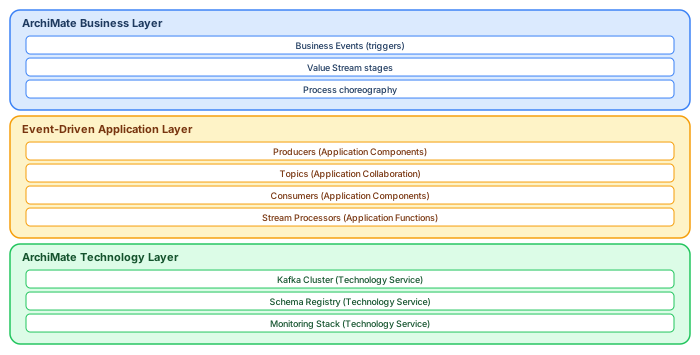
ArchiMate was designed before event-driven architecture became mainstream, but its element vocabulary maps surprisingly well to EDA concepts with a few modeling conventions. ArchiMate tutorial for enterprise architects
Events → Application Event or Business Event. ArchiMate 3.2 includes Event elements at both business and application layers. A Business Event represents something business-meaningful that happened ("Customer placed order"). An Application Event represents the technical manifestation ("OrderPlaced message on orders.events topic"). Connect them with a Realization relationship — the Application Event realizes the Business Event.
Topics → Application Collaboration or Data Object. A Kafka topic can be modeled as an Application Collaboration (it is where producers and consumers interact) or as a Data Object (it stores structured data). The Collaboration approach emphasizes the interaction; the Data Object approach emphasizes the content. Choose based on the viewpoint: cooperation views use Collaboration, data flow views use Data Object.
Producers and Consumers → Application Components. Standard Application Components with a stereotype tag (Role: Producer or Role: Consumer) to distinguish their function in the event flow. Use Serving relationships from producers to topics and from topics to consumers.
Stream Processors → Application Functions. Kafka Streams or Flink processors are behavioral elements that transform events. Model as Application Functions with Access relationships to input and output topics (Data Objects).
Building EDA-specific viewpoints
Define a custom "Event Flow" viewpoint that shows: producers (left), topics (center), and consumers (right), with data flow arrows showing event movement. This viewpoint does not exist in standard ArchiMate but is trivially defined as a custom viewpoint in Sparx EA or Archi. It becomes the primary view for event-driven architecture governance — the architecture review board uses it to understand who produces what, who consumes what, and where the dependencies are. ArchiMate layers explained
Architecture governance for event-driven systems
Event-driven architectures introduce governance challenges that traditional request-reply systems do not face. Events are asynchronous, loosely coupled, and often cross domain boundaries — meaning a single event schema change can affect consumers across multiple teams without immediate visibility. Architecture governance must adapt: schema registries enforce compatibility, topic naming conventions enable discoverability, and consumer dependency tracking reveals hidden coupling.
Model event-driven architectures in Sparx EA using ArchiMate Application Events, Application Components (producers and consumers), and Flow relationships. Tag each topic with ownership, schema version, and consumer count. Build an Event Flow viewpoint that shows producers on the left, topics in the center, and consumers on the right — this view becomes the governance instrument for the architecture review board. ArchiMate relationship types
Applying these patterns in practice
The value of ArchiMate modeling is realized not through comprehensive coverage of every element type, but through disciplined application of a few core patterns that answer recurring stakeholder questions. Three patterns account for the majority of architecture communication needs. ArchiMate modeling best practices
The Layered View pattern shows how business processes depend on applications, and how applications depend on infrastructure. Build this view by placing Business Processes at the top, Application Components in the middle, and Technology Nodes at the bottom. Connect them with Serving and Realization relationships. This single view demonstrates cross-layer traceability — when a server is decommissioned, trace upward to see which applications and business processes are affected.
The Cooperation View pattern shows how application components interact through interfaces and data flows. Place the core application in the center and its integration partners around it, connected by Flow relationships labeled with the data exchanged. This view reveals integration dependencies that are otherwise buried in technical documentation.
The Motivation View pattern connects strategic goals to architecture decisions. Stakeholder concerns drive Goals, Goals are realized by Outcomes, Outcomes are enabled by Capabilities, and Capabilities are realized by Application Components. This chain answers the question executives always ask: "Why are we building this?"
If you’d like hands-on training tailored to your team — Sparx Enterprise Architect, BPMN, SysML, Apache Kafka or the Archi tool — or modelling coaching in ArchiMate and TOGAF-aligned governance, you can reach us via our contact page.
Frequently Asked Questions
What is enterprise architecture?
Enterprise architecture is a discipline that aligns an organisation's strategy, business operations, information systems, and technology infrastructure. It provides a structured framework for understanding how an enterprise works today, where it needs to go, and how to manage the transition.
How is ArchiMate used in enterprise architecture practice?
ArchiMate is used as the standard modeling language in enterprise architecture practice. It enables architects to create consistent, layered models covering business capabilities, application services, data flows, and technology infrastructure — all traceable from strategic goals to implementation.
What tools are used for enterprise architecture modeling?
Common enterprise architecture modeling tools include Sparx Enterprise Architect (Sparx EA), Archi, BiZZdesign Enterprise Studio, LeanIX, and Orbus iServer. Sparx EA is widely used for its ArchiMate, UML, BPMN and SysML support combined with powerful automation and scripting capabilities.