⏱ 21 min read
Microservices fail in boring ways.
Not with some dramatic fireball of distributed systems theory, but with a tiny field rename on a Tuesday afternoon. A producer changes customerType to segment. Tests stay green. The build passes. Kafka keeps moving bytes. Then, two days later, a billing workflow quietly starts classifying enterprise customers as retail, and everyone stares at dashboards wondering why margin dropped in one region and not another.
That is the real shape of the problem. In event-driven systems, we do not merely integrate software. We integrate interpretations. One team publishes an event believing it means one thing, another team consumes it believing it means something adjacent, and the platform faithfully transports the misunderstanding at scale.
This is why event contract testing deserves architectural attention. Not as a tooling footnote. Not as “we should probably add schema validation.” But as topology: who depends on whose events, at what semantic depth, under what compatibility guarantees, with what migration path, and how failures are contained when assumptions drift.
A good event contract topology is less like a wiring diagram and more like city planning. Roads are easy. Neighborhoods are hard. You can connect everything to everything, but then congestion, ambiguity, and accidental dependencies become your operating model. A healthy event-driven architecture shapes flows around bounded contexts, protects domain semantics, and makes contracts explicit enough that independent change remains possible.
This article walks through that architecture in practical terms: domain-driven design thinking, Kafka-oriented event contracts, progressive strangler migration, reconciliation patterns, tradeoffs, failure modes, and when not to use this style at all. event-driven architecture patterns
Context
Most enterprises did not start with event contract topology as a conscious design choice. They started with projects.
One team introduced Kafka to decouple channels from core systems. Another added microservices around order fulfillment. A third team adopted Avro and a schema registry because JSON events had become an archaeological site. Over time, the estate accumulated event streams, handlers, projections, retries, dead-letter topics, and a comforting but misleading belief that “we are loosely coupled because it is asynchronous.”
Asynchronous transport does not guarantee loose coupling. Quite often it hides tight coupling behind time.
In synchronous APIs, coupling is visible: a client calls an endpoint and expects a response shape. In event-driven systems, coupling is diffused across topics, consumer groups, replay behavior, temporal assumptions, and data interpretation. Consumers can become deeply dependent on event structure, ordering, keys, optional fields, and semantic meaning while never talking directly to the producer team.
This gets sharper in large enterprises where domains evolve at different speeds. Pricing changes every quarter. Customer identity changes every year. Regulatory data definitions change whenever the regulator feels poetic. If the event estate does not reflect bounded contexts and domain language, teams end up using shared event streams as a universal data distribution mechanism. That is not event-driven architecture. That is a distributed shared database with extra latency.
Contract testing enters here as the discipline of verifying that event publishers and event consumers continue to agree. But agreement has layers:
- Structural agreement: fields, types, schemas, required attributes.
- Behavioral agreement: what event sequences imply, what versioning guarantees exist, what ordering assumptions hold.
- Semantic agreement: what the event means in the domain, what business invariants it represents, and what it explicitly does not promise.
The architecture question is not merely “should we test contracts?” It is “what topology of contracts allows independent evolution without semantic chaos?”
Problem
The naive pattern is common and seductive.
A service publishes domain events to Kafka. Many consumers subscribe. Each consumer writes its own parsing logic and assumptions. A schema registry enforces backward compatibility, so everyone feels safe. But backward compatibility at schema level is not enough. A producer can preserve the schema and still break the business.
Imagine an OrderAccepted event. Structurally stable for years. Then the business changes acceptance rules: some accepted orders now require deferred fraud clearance before fulfillment. The producer team adds a flag, defaulting to false, and preserves compatibility. A warehouse consumer ignores the new flag and ships goods. The schema did not break. The contract did.
This is the central problem: event contracts are not only data shapes; they are domain promises.
The second problem is topological sprawl. In many microservice estates, a single core event topic attracts a dozen consumers across unrelated contexts: billing, CRM, analytics, notification, compliance, and machine learning. Every new consumer increases the blast radius of producer change. The producer becomes a hidden platform team without governance, funding, or authority. EA governance checklist
The third problem appears during migration. Enterprises rarely redesign from scratch. They strangle a monolith, carve out domains, bridge old events to new streams, and run dual models for months or years. During that time, contract testing must span old and new representations. Otherwise migration introduces a particularly nasty class of defects: both systems individually work, but they do not describe the same business reality.
And then there is replay. Kafka gives you replay almost for free, which is wonderful right up until old consumers replay old events into new semantics. Event contract topology has to account not just for messages in flight, but for messages reinterpreted months later.
Forces
Architecture is the art of balancing stubborn forces. Event contract topology sits in the middle of several.
1. Team autonomy versus semantic control
You want teams to evolve independently. That is one of the reasons microservices exist. But if every team can consume every event and infer its own meaning, the enterprise creates semantic anarchy. Domain-driven design matters here: events should emerge from bounded contexts, and consumption should respect those boundaries. microservices architecture diagrams
Autonomy without language discipline becomes accidental integration.
2. Reuse versus responsibility
A rich event stream invites reuse. Why create a new integration when the data is already on Kafka? Because not every available event is an appropriate contract. Reusing an internal domain event as a cross-context integration event often leaks implementation details. The short-term gain is speed; the long-term cost is frozen models and brittle coordination.
3. Schema evolution versus business evolution
Schema registries, Avro, Protobuf, and compatibility rules are valuable. They prevent crude breakage. But business meaning evolves in ways schema tools cannot detect. A field can remain optional and still become mandatory in practice. An enum value can be added and remain formally compatible while breaking downstream decision logic. Structural checks are necessary and insufficient.
4. Eventual consistency versus operational confidence
Microservices and Kafka invite eventual consistency. Fine. But eventual consistency without reconciliation is just wishful thinking with a queue. If consumers miss events, process out of order, or apply stale logic, the system needs explicit mechanisms to detect and correct divergence.
5. Migration speed versus architectural cleanliness
A strangler migration often requires temporary bridges, anti-corruption layers, duplicated events, and translation topics. Purists dislike this. Enterprises need it. The trick is to make temporary topologies visibly temporary and contract-tested so they do not become permanent folklore.
Solution
The solution is to treat event contract testing as a topology of bounded contracts, not a flat matrix of producer-consumer checks.
That means several opinionated choices.
Use domain events inside a bounded context, integration events across contexts
This sounds obvious until you inspect a real enterprise event catalog. Most event estates are littered with implementation-shaped events pretending to be enterprise facts.
Within a bounded context, a service can publish detailed domain events optimized for local consumers. Across bounded contexts, publish integration events that represent deliberate business contracts. Smaller. Clearer. More stable. Less tempting as a data lake substitute.
For example:
- Inside Order Management:
OrderAccepted,InventoryReserved,FraudHoldApplied - Across to Billing:
BillableOrderCreated - Across to Customer Communications:
OrderConfirmationRequested
Not every internal event deserves an audience.
Contract-test at multiple levels
A mature topology uses three complementary forms of contract testing:
- Schema compatibility tests
Validate serialization, mandatory fields, evolution rules, and registry compatibility.
- Consumer-driven event contract tests
Consumers publish expectations about events they depend on. Producers verify against them in CI.
- Semantic scenario tests
Cross-service examples verify business meaning over event flows, especially for critical paths such as order-to-cash, claims processing, or payments.
If you stop at schema compatibility, you will eventually ship a semantically broken but structurally valid event. And the hardest production incidents are exactly those.
Introduce an event contract catalog mapped to bounded contexts
Do not govern event contracts only topic by topic. Govern them context by context.
For each event contract, define:
- owning bounded context
- publisher authority
- intended consumers or consumer categories
- domain meaning
- invariants
- versioning policy
- retention and replay expectations
- idempotency guidance
- deprecation path
This is architecture, not bureaucracy. If you cannot answer who owns the meaning of an event, you do not have a contract. You have a rumor.
Prefer hub-and-spoke semantics over mesh dependency
Not every topology should become a central event gateway, but most enterprises benefit from reducing arbitrary consumer connections to core domain streams.
A common pattern is:
- core domain publishes authoritative event
- downstream context-specific adapter or stream processor translates to consumer-facing integration event
- consumers depend on translated contract, not raw source event
This limits blast radius and lets the source domain evolve internally while preserving stable outward contracts.
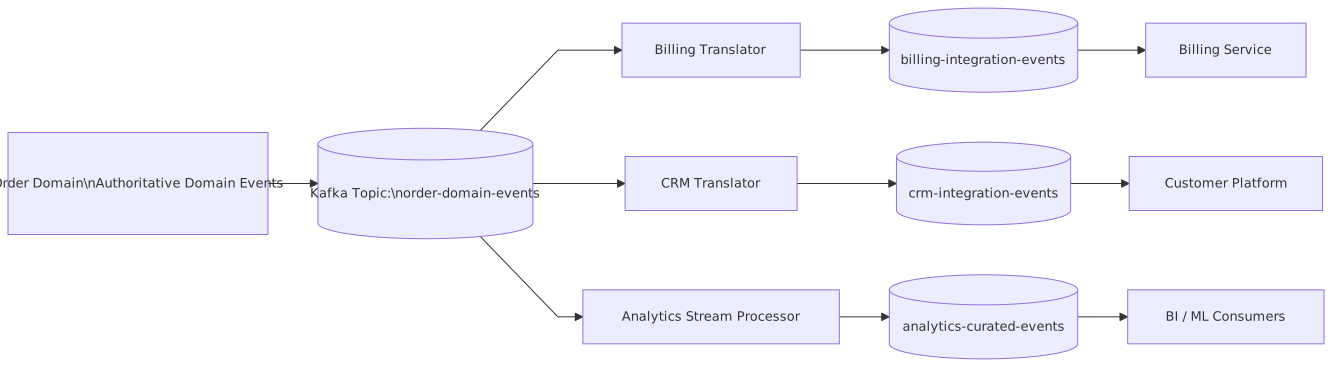
This is not duplication for its own sake. It is semantic insulation.
Reconciliation is part of the contract strategy
Every serious event-driven architecture needs reconciliation. Not as an afterthought, but as one of the ways the architecture tells the truth.
Consumers will miss messages. Deployments will race. Handlers will contain bugs. Event order will be imperfect across partitions or upstream systems. Reconciliation closes the gap between “events probably propagated” and “business state actually matches.”
Typical reconciliation mechanisms include:
- periodic rebuild from authoritative source
- compare-and-correct projections
- compensating commands triggered by mismatch detection
- golden-source queries for high-value workflows
- business-level balancing reports, such as order shipped but invoice absent
Without reconciliation, contract testing catches what you predicted. Reconciliation catches what reality invented.
Architecture
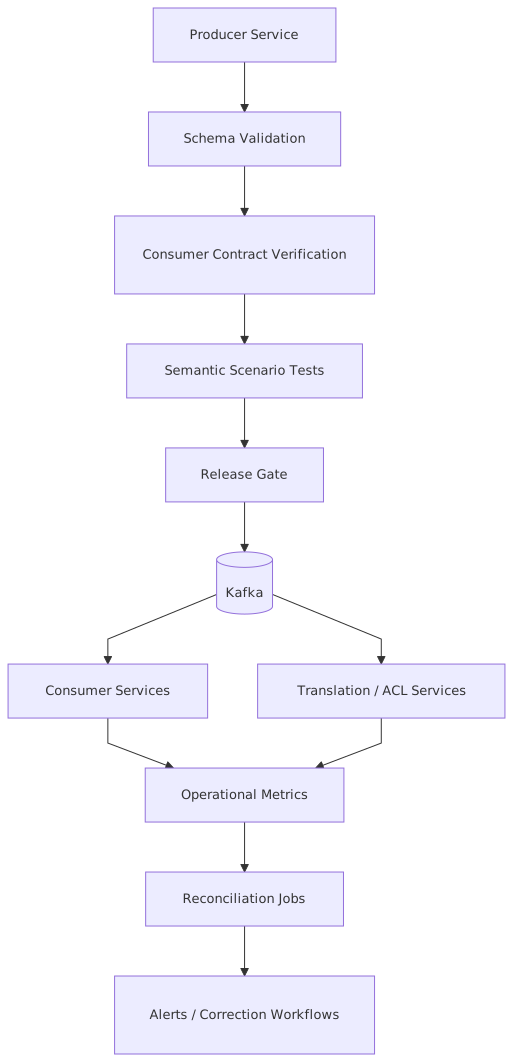
A practical event contract testing architecture has distinct layers.
1. Authoritative event ownership
Each event family belongs to a bounded context. That context owns the semantic model and lifecycle. Ownership should not be split because shared ownership is another phrase for neglected ownership.
2. Contract repository
Store event contracts as executable artifacts: schemas, example payloads, consumer expectations, semantic notes, and compatibility rules. This can sit in source control with CI hooks, or in a dedicated contract platform. The important thing is that contracts are versioned and reviewable like code.
3. Producer verification pipeline
On producer build:
- validate schema against registry rules
- run consumer contract packs
- run semantic examples
- verify deprecation and compatibility policy
- fail fast if critical consumers are broken
4. Consumer verification pipeline
On consumer build:
- validate parser/deserializer compatibility
- run against provider-generated examples
- test unknown-field tolerance
- test missing optional field behavior
- test replay/idempotency assumptions
A consumer that only works against today’s exact payload is a future outage waiting politely.
5. Translation and anti-corruption layer
When crossing bounded contexts, use translators, stream processors, or dedicated integration services to convert domain events into context-appropriate contracts. This is classic domain-driven design. Anti-corruption layers are not only for synchronous APIs. They are often more important in event-driven systems because semantic leakage spreads farther.
6. Observability and reconciliation loop
Track not just event throughput and lag, but contract health:
- consumer deserialization failures
- unknown enum/value incidence
- translation drops
- semantic validation rejects
- reconciliation mismatch rates
- replay anomaly counts
A topology that cannot reveal contract drift is flying at night.
Domain semantics matter more than field lists
A mature contract describes what happened in business language.
Take PaymentCaptured. Good semantic contract notes would include things like:
- this means funds capture was accepted by the payment provider, not necessarily settled in the bank
- duplicate events may occur; consumers must use
paymentIdandcaptureSequence - amount is in minor currency units
- refunds are represented separately and do not negate prior captures
- event time represents provider acknowledgment time, not original authorization time
That level of precision prevents whole categories of integration mistakes.
Field lists do not explain the business. Events need both.
Topology patterns
There are a few recurring topologies worth naming.
Direct producer-consumer contracts
Useful when:
- few consumers
- stable domain
- low semantic variance
- small team count
Risk:
- producer accumulates hidden obligations
- every new consumer increases change friction
Translator topology
Useful when:
- source event is authoritative but too detailed or unstable for broad use
- consumers belong to different bounded contexts
- migration is in progress
- semantics differ by audience
Risk:
- more components
- translation logic must itself be governed and tested
Contract hub topology
A central platform team provides contract management, compatibility checks, examples, and policy enforcement, while domain teams still own event meaning.
Useful in large enterprises.
Risk:
- if the hub starts owning domain semantics, you get central bureaucracy and local resentment
Migration Strategy
Migration is where architecture leaves PowerPoint and meets payroll.
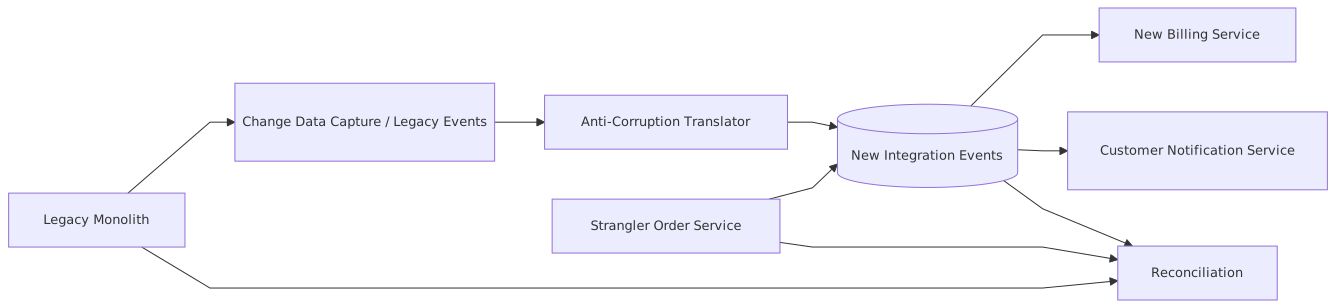
Most enterprises moving from monoliths or tightly coupled ESB-style integrations cannot flip overnight to clean event contracts. They need a progressive strangler migration. The right move is usually not to replace everything at once, but to establish a contract topology that can coexist with the old world while gradually reducing dependency on it.
Step 1: Identify authoritative business facts
Do not start by streaming every table change from the monolith. Start by identifying business facts that matter across contexts: order submitted, policy issued, claim approved, payment captured, shipment dispatched.
This is where domain-driven design earns its keep. Event boundaries should follow domain semantics, not database tables.
Step 2: Introduce anti-corruption translation around the legacy model
Legacy systems often emit records or state changes that are too technical, too overloaded, or too ambiguous. Introduce a translation layer that converts them into explicit integration events. This protects new microservices from inheriting old vocabulary and old mistakes.
Step 3: Contract-test old-to-new equivalence
During strangler migration, both the legacy process and the new service path may represent the same business event. Use semantic contract tests and reconciliation to verify equivalence.
For example:
- legacy order accepted record
- new order service
OrderAccepted - translated billing event
BillableOrderCreated
The contract question becomes: do these paths produce the same billable reality?
Step 4: Move consumers off raw legacy events
This is one of the most important and most ignored steps. If you let new consumers bind directly to legacy event feeds “just for now,” you create a new generation of legacy dependencies.
Always migrate consumers toward stable integration contracts, not toward the nearest available topic.
Step 5: Run dual publishing carefully
Dual publish is often necessary. It is also a trap.
If a service publishes both old and new events, define:
- authoritative source of truth
- sequencing expectations
- cutover criteria
- reconciliation approach
- retirement date
Without that, dual publish becomes dual ambiguity.
Step 6: Retire by consumer cohort, not by technical component
A topic is not retired when the producer stops caring. It is retired when the last meaningful consumer dependency is gone, replays are no longer needed, and audit/regulatory obligations are covered elsewhere.
Migration succeeds when dependency topology simplifies. Not merely when code moved repositories.
Enterprise Example
Consider a global retailer modernizing its order-to-cash landscape.
The starting point was familiar: a large commerce platform, SAP for finance, a warehouse management system, a CRM cloud product, and Kafka introduced as the “enterprise event backbone.” Within eighteen months, nearly every team consumed raw order-events. It looked efficient. It was not.
The order-events topic had become the town square, data dump, and integration API all at once. Billing inferred tax treatment from fields intended for fulfillment. CRM used warehouse-specific statuses as customer journey signals. Analytics replayed low-level corrections and inflated sales funnel metrics. Every producer change triggered nervous Slack messages and emergency regression testing.
The turning point came after a promotion event. The order domain introduced split shipment logic. No schema break. Same event family. But partial fulfillment semantics changed. Finance interpreted first shipment as complete revenue recognition in some markets. The issue was discovered by reconciliation reports, not by pre-release testing.
The remediation was architectural, not just procedural.
What they changed
- Declared bounded context ownership
- Order domain owned operational order events
- Finance owned billable lifecycle
- CRM owned customer communication triggers
- Created translation services
- order-domain-events remained internal-authoritative
- billing-integration-events were derived for finance
- customer-engagement-events were derived for CRM and notification
- Adopted consumer-driven event contract testing
- Finance expressed required scenarios around split shipments, cancellations, and tax handling
- CRM expressed scenarios around customer-visible milestones
- Producer builds verified these packs
- Added semantic examples and replay tests
- historical event sequences were replayed in test environments
- expected downstream states were compared
- Implemented reconciliation
- shipped orders versus recognized revenue
- invoice presence versus billable event count
- customer notification milestone versus order state
The result
Change velocity improved, but not because they added more automation in the abstract. It improved because they reduced semantic overexposure.
The order team could change internal workflow events more freely. Finance got a stable contract shaped around finance language. CRM stopped consuming warehouse semantics by accident. Incidents shifted from “mysterious downstream breakage” to explicit contract failures during build or visible reconciliation mismatches after release.
This is what good architecture does. It moves failure left when possible and makes it legible when not.
Operational Considerations
Event contract topology is not only a design-time concern. It has runtime consequences.
Versioning policy
Be explicit. Support in-place additive evolution where possible. Use new event types or translated streams when semantics materially change. Do not hide a major business meaning shift behind a compatible schema tweak.
Replay discipline
Replays are powerful, but they are not innocent. Consumers must define:
- whether events are replay-safe
- how idempotency is achieved
- whether old semantics remain valid on replay
- whether translation logic is versioned with event time awareness
A replay through today’s translator over yesterday’s meaning can corrupt downstream state very efficiently.
Partitioning and ordering
Kafka only guarantees ordering within a partition. If a consumer implicitly relies on cross-key or cross-topic ordering, the architecture is already in debt. Contract tests should include out-of-order scenarios where business logic is sensitive to sequence.
Dead-letter handling
A DLQ is not an architecture. It is a symptom bucket. Distinguish:
- transient processing failure
- deserialization incompatibility
- semantic rejection
- poisoned historical replay
Each demands a different response.
Data governance and privacy
Integration events often outlive the use case that justified them. Avoid turning broad topics into uncontrolled propagation of personal or regulated data. Event contracts should include data classification and minimization guidance.
Observability by business outcome
Track not just lag and throughput, but business completeness:
- accepted orders lacking billing events
- captured payments lacking ledger postings
- shipped orders lacking customer notifications
Technical health without business reconciliation is a half-truth.
Tradeoffs
Let’s be honest. This architecture is not free.
More artifacts, more discipline
You will have schemas, consumer packs, semantic examples, translators, and contract catalogs. Some teams will complain that this slows them down. On week one, they may be right. By month six, they are usually wrong.
Translation layers add complexity
Every translation service is another deployable unit, another set of tests, another operational concern. But complexity already exists in the estate. The question is whether it lives explicitly in an owned adapter or implicitly across twenty consumers.
I prefer complexity where it can be named.
Consumer-driven contracts can overfit
A badly run contract testing practice lets consumers dictate producer internals or preserve accidental fields forever. The producer must retain authority over domain meaning. Consumer expectations should constrain the contract, not colonize the model.
Reconciliation can become expensive
Periodic compare-and-correct jobs, snapshots, and golden-source checks consume infrastructure and attention. For low-value workflows, this may be overkill. For revenue, compliance, or customer-critical flows, it is cheap insurance.
Failure Modes
A few failure modes recur so often they are worth calling out plainly.
1. Schema compliance theater
Teams celebrate backward compatibility while semantics drift underneath. Everything passes until the quarter-end report fails.
2. Shared event as enterprise data feed
A rich source topic becomes the universal integration mechanism. Downstream consumers take dependencies on fields never intended for them. The producer loses change freedom.
3. Translator logic without ownership
An integration team creates translation services but does not own domain semantics, while domain teams do not own downstream contracts. The result is a semantic no-man’s land.
4. Contract tests based only on happy-path payloads
Critical event sequences include duplicates, reversals, partials, late arrivals, and unknown enum values. If your contract examples are all neat and linear, production will educate you.
5. No reconciliation for eventual consistency
When drift happens, the organization discovers it through customers, auditors, or finance. That is the expensive way to learn.
6. Migration “temporary” topics that become permanent
Bridging streams and dual-publish contracts linger for years because retirement was never planned. Temporary architecture is the most permanent kind.
When Not To Use
This approach is powerful, but it is not universal.
Do not build a heavy event contract topology when:
- you have a small system with two or three services and low domain volatility
- integration is mostly synchronous and eventing is only for side effects
- consumers are owned by the same team and evolve in lockstep
- the business does not need replay, broad fan-out, or long-lived asynchronous workflows
- a simple API contract with a few end-to-end tests will do
Likewise, do not force cross-context integration through events if the real requirement is a synchronous decision with immediate consistency. Not every interaction should be Kafka-shaped. Some domain operations are better modeled as commands and queries, not emitted facts.
Architecture is choosing restraint as much as pattern adoption.
Related Patterns
Several patterns connect naturally with this topology.
Consumer-Driven Contracts
Useful for capturing consumer expectations explicitly. Essential, but must be balanced with producer-owned semantics.
Schema Registry and Compatibility Enforcement
Important foundation for serialized event evolution. Necessary, never sufficient.
Anti-Corruption Layer
Critical when translating across bounded contexts or from legacy models during strangler migration.
Outbox Pattern
Valuable for reliable event publication from transactional services. Prevents publication gaps, though it does not solve semantic contract quality by itself.
Event Sourcing
Sometimes adjacent, often confused. Event sourcing stores domain state as events. Event contract topology governs integration contracts between services. They overlap but are not the same thing.
CQRS and Projections
Relevant where consumers build read models from events. Contract and replay behavior become especially important here.
Saga / Process Manager
Useful for long-running orchestration across services. Event contracts must support compensations, retries, and partial failure handling.
Reconciliation / Compare-and-Correct
Not glamorous. Absolutely essential in real enterprise estates.
Summary
Event-driven microservices do not fail because teams forgot to serialize JSON correctly. They fail because business meaning leaks, shifts, and fragments across an uncontrolled dependency graph.
That is why event contract testing should be treated as topology.
A strong topology starts with bounded contexts and domain language. It distinguishes domain events from integration events. It combines schema checks, consumer-driven verification, and semantic scenario tests. It uses translators and anti-corruption layers to prevent semantic leakage. It embraces progressive strangler migration instead of fantasy rewrites. And it includes reconciliation, because eventual consistency without correction is just deferred disappointment.
Kafka is a fine backbone. But a backbone is not a nervous system. Architecture must still decide what signals mean, who is allowed to depend on them, and how the estate detects drift before the quarter closes or the regulator calls.
The memorable line here is simple: in event-driven architecture, the hardest contract is not syntax. It is meaning.
Design for that, test for that, migrate toward that, and your microservices have a chance to remain independently evolvable instead of becoming a distributed misunderstanding.
Frequently Asked Questions
What is a service mesh?
A service mesh is an infrastructure layer managing service-to-service communication. It provides mutual TLS, load balancing, circuit breaking, retries, and observability without each service implementing these capabilities. Istio and Linkerd are common implementations.
How do you document microservices architecture for governance?
Use ArchiMate Application Cooperation diagrams for the service landscape, UML Component diagrams for internal structure, UML Sequence diagrams for key flows, and UML Deployment diagrams for Kubernetes topology. All views can coexist in Sparx EA with full traceability.
What is the difference between choreography and orchestration in microservices?
Choreography has services react to events independently — no central coordinator. Orchestration uses a central workflow engine that calls services in sequence. Choreography scales better but is harder to debug; orchestration is easier to reason about but creates a central coupling point.