⏱ 19 min read
Most Kafka architectures fail long before the first broker is installed.
That sounds harsh, but it’s true. The failure usually starts in architecture workshops where people say things like, “We’ll do event-driven,” “Kafka will decouple everything,” or my personal favorite, “We’ll just publish business events.” Then they draw three boxes, six arrows, maybe a cloud icon, and call it architecture.
It isn’t.
If you are designing Kafka event architectures in an enterprise, especially in banking or other regulated environments, you need more than topics and consumer groups. You need models that force clarity. And yes, UML still matters here. Not because UML is fashionable—it definitely is not—but because it gives architects a disciplined way to describe event flows, ownership, trust boundaries, identity propagation, failure handling, and operational responsibilities. UML modeling best practices
Here’s the simple version up front: using UML to design Kafka event architecture means modeling producers, consumers, topics, schemas, trust zones, IAM controls, and operational dependencies before implementation starts. If you do that well, you reduce ambiguity, integration friction, and security surprises. If you skip it, Kafka becomes a very fast way to spread confusion across the enterprise.
That’s the SEO-friendly explanation. Now let’s get into the real thing.
Kafka architecture is not just messaging architecture
A lot of teams still treat Kafka like a better MQ. Bigger throughput, more retention, nicer ecosystem, done. That mindset is one of the reasons event platforms become messy so quickly.
Kafka is not just transport. In enterprise architecture, Kafka is usually all of these at once:
- an integration backbone
- an event distribution platform
- a near-real-time data movement layer
- a replay mechanism
- a compliance problem
- a platform ownership problem
- an identity and authorization problem
- a cloud networking problem
- a semantics problem pretending to be a technical one
And that last one matters. Most Kafka issues are not technical first. They are semantic. Teams don’t agree on what an event means, who owns it, what guarantees exist, whether it is a fact or a command disguised as a fact, whether PII is allowed, whether replay is legal, or whether consumers are allowed to depend on internal fields.
That’s why UML helps. Not because UML magically solves distributed systems, but because it slows people down enough to think. UML for microservices
Why use UML for Kafka event architecture?
Because architecture diagrams in slide decks are usually too vague to be useful.
A real architect needs to answer questions like:
- Who owns the event contract?
- Is this event derived from a transaction commit or emitted before persistence?
- What IAM principal is used by the producer?
- Can a consumer in another cloud account subscribe?
- What happens when schema version 3 is published and one downstream service only handles version 2?
- Is the event carrying customer identity data, token references, or both?
- Is the topic domain-owned or platform-owned?
- What is the blast radius of a bad event?
If your diagram can’t help answer those questions, it’s decoration.
UML gives you a common modeling language to show structure and behavior. Not every UML diagram is useful for Kafka, and some architects overdo it. You do not need 14 diagram types and a repository full of unread artifacts. But a small set of UML models can be incredibly effective:
- Component diagrams for producers, consumers, schema registry, IAM services, gateways, and platform services
- Sequence diagrams for event publication, enrichment, authentication, failure handling, and replay
- Deployment diagrams for cloud clusters, VPC/VNet boundaries, Kubernetes, IAM trust domains, and managed Kafka services
- State machine diagrams for event lifecycle and consumer processing states
- Class or information models for event payload structure and schema evolution rules
- Use case diagrams, sparingly, for stakeholder communication
The contrarian view here: many architects think event-driven design should be “lightweight” and “emergent.” Fine in a startup. In a bank with IAM controls, audit requirements, and three cloud landing zones? That’s fantasy. You need modeling discipline.
The practical architecture goal
The goal is not “draw UML.” The goal is to make event architecture decisions explicit.
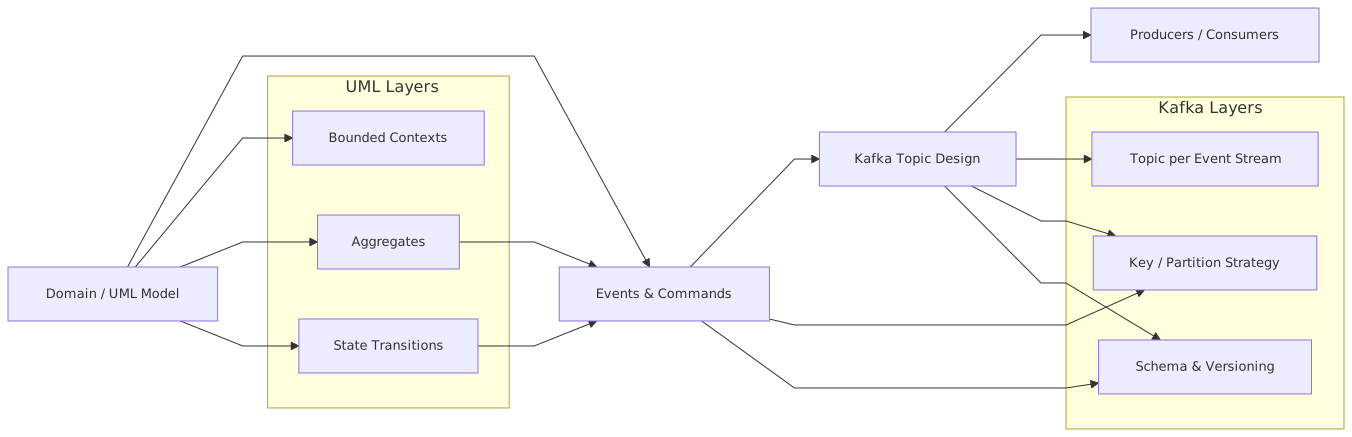
In real architecture work, UML models help with five things:
If you use UML this way, it becomes a thinking tool, not a bureaucracy tool.
Start simple: model the minimum architecture
When I design a Kafka event architecture, I usually start with a very simple model. Not because the problem is simple, but because complexity reveals itself in layers.
The minimum UML-based architecture view should show:
- Business domain services
Example: Payments Service, Customer IAM Service, Fraud Detection Service.
- Kafka platform services
Brokers, schema registry, topic governance, observability stack. ArchiMate for governance
- Security services
IAM provider, service identities, certificate authority, secrets management.
- Consumers and downstream channels
Analytics, notifications, ledger, risk engines, cloud data lake.
- Trust boundaries
Internal zone, regulated data zone, partner zone, cloud account boundary.
- Event contracts
The actual business events and who governs them.
That first diagram is usually a component diagram. It should answer, in plain terms:
- what talks to Kafka
- what Kafka talks to
- who is allowed to do what
- where the boundaries are
- which things are enterprise-shared versus domain-owned
Already, this weeds out weak architecture. Teams suddenly realize they have no clear owner for the customer-profile-updated topic, or that five services publish to the same business topic, or that a cloud-native analytics consumer is about to ingest regulated banking data with no policy model.
That’s not a Kafka problem. That’s an architecture problem exposed by modeling.
UML component diagrams: where architects should begin
The component diagram is the most useful starting point for Kafka design because it forces clarity around responsibilities.
Imagine a banking platform with these capabilities:
- Core Banking System
- Customer Identity and Access Management platform
- Payments API
- Fraud Analytics
- Notification Service
- Enterprise Kafka platform in cloud
- Data Lake in another cloud account
In a useful component diagram, I would model:
- Core Banking Adapter as a producer of account and transaction events
- IAM Service as a producer of identity lifecycle events
- Payments Service as both producer and consumer
- Fraud Engine as consumer of transaction and login anomaly events
- Notification Service as consumer of business-approved outbound events
- Schema Registry as a shared platform dependency
- Kafka Cluster as event backbone, not business owner
- Access Control Service / IAM governing producer and consumer credentials
- Audit Service receiving access and policy events
And I’d annotate responsibilities directly on the model:
- Topic ownership: domain team
- ACL ownership: platform team with domain approval
- Schema compatibility enforcement: platform control
- Data classification: information security and domain owner
- Retention standard: platform baseline, domain exception process
This is where a lot of enterprise architects go wrong. They draw Kafka as a giant central box and every team points arrows at it. That gives the illusion of standardization while hiding the actual architecture. In reality, the platform owns the rails, but domains must own the events. If the platform team owns business semantics, you are building a bottleneck.
Strong opinion: centralized Kafka platform, decentralized event ownership is usually the right balance. The opposite model—centralized event design by a platform committee—kills delivery speed and often produces generic, lifeless event contracts no one likes.
Sequence diagrams: the missing piece in most Kafka designs
Component diagrams show structure. They do not show timing, causality, or failure. That’s where sequence diagrams matter.
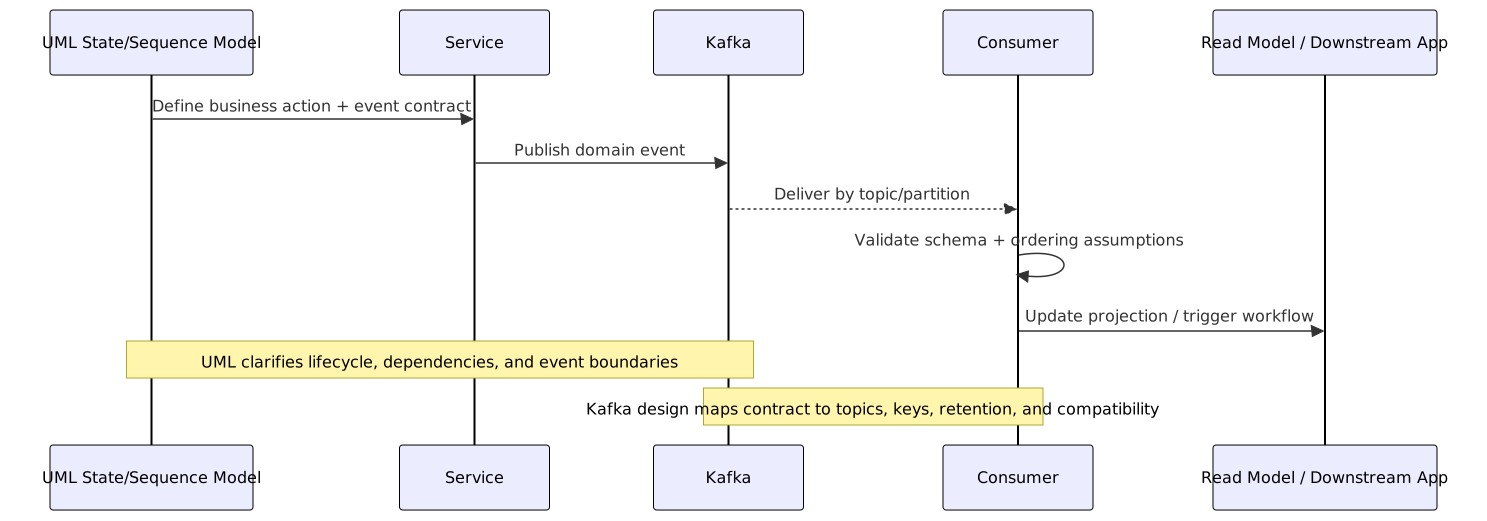
And honestly, architects underuse them in event-driven systems.
A Kafka sequence diagram should show things like:
- user or system action triggers domain transaction
- service persists business state
- outbox or event publisher emits event
- schema validation occurs
- producer authenticates via IAM credential
- Kafka acknowledges write
- consumers poll and process
- retries or dead-letter handling occur
- audit or observability events are emitted
This matters because many event architecture arguments are actually arguments about sequence.
For example:
Question 1: When is the event published?
Before commit? After commit? Via CDC? Via outbox? Via transactional producer?
That choice radically changes reliability and semantics.
Question 2: What identity is attached?
Does the event carry user identity claims? A service identity? A token reference? A customer ID only?
In IAM-heavy environments, this is not optional detail.
Question 3: What happens on consumer failure?
Retry forever? Park and alert? Skip malformed payloads? Trigger compensating flow?
Again, these are architecture decisions, not implementation trivia.
A sequence diagram forces the team to walk through the runtime truth. It exposes the hand-waving.
Real enterprise example: banking payments and IAM events in the cloud
Let’s use a realistic example.
A retail bank is modernizing customer and payment services. It has:
- legacy core banking on-prem
- IAM platform in a private cloud
- digital banking apps in AWS
- Kafka as a managed cloud service
- fraud and analytics consumers in Azure
- strict controls around customer identity data and payment events
The bank wants to support these event flows:
CustomerAuthenticatedCustomerProfileUpdatedPaymentInitiatedPaymentAuthorizedPaymentSettledSuspiciousLoginDetected
At first, the team says: “We’ll put these on Kafka topics and let consumers subscribe.”
That’s the moment an architect should say: stop. Not enough.
What the real architecture work looks like
You model at least four views.
1. Component view
Shows:
- IAM service publishes authentication and profile events
- Payments service publishes payment lifecycle events
- Fraud engine consumes both payment and IAM anomaly events
- Notification service consumes only approved customer communication events
- Data lake receives curated streams, not raw unrestricted topics
2. Sequence view
For PaymentAuthorized:
- customer initiates payment in mobile app
- Payments API authenticates via IAM
- payment request persisted in transaction store
- outbox record created
- publisher service reads outbox
- producer authenticates using workload identity
- event validated against schema registry
- event published to
payments.authorized.v1 - fraud engine consumes
- ledger consumer consumes
- notification service consumes derived
customer-notification-requestedevent, not raw payment event
That last point is important. Too many teams let everything consume raw business events directly. Better architecture often introduces bounded downstream events for specific use cases.
3. Deployment view
Shows:
- managed Kafka cluster in shared cloud account
- producers in domain-specific Kubernetes namespaces
- private connectivity from on-prem core banking
- Azure fraud consumers over controlled private network path
- IAM trust federation across cloud accounts
- secrets and certificates managed centrally
- topic-level ACLs and network segmentation
4. Information model
Shows:
- payload structure
- mandatory fields
- classification tags
- schema versioning rules
- prohibited fields, such as raw authentication token or full PAN data
Now the architecture is real. You can have a meaningful review with security, operations, application teams, and risk.
Without those views, people are just improvising with expensive middleware.
Kafka and IAM: where many designs become dangerously naive
A lot of Kafka event designs are oddly innocent about identity and access management. That’s a serious mistake in enterprise architecture.
Here’s the uncomfortable truth: if your event architecture ignores IAM, it is not enterprise architecture.
In Kafka environments, IAM shows up in several layers:
- producer authentication
- consumer authentication
- topic-level authorization
- schema registry authorization
- service-to-service trust
- secret rotation or certificate rotation
- user identity propagation inside event payloads
- auditability of access and event production
Architects often focus on ACLs and stop there. But ACLs are just one control point.
You need to model:
- which workload identity publishes each topic
- whether identities are local to Kafka, federated from cloud IAM, or mTLS-based
- whether consumers run in the same trust boundary
- what customer identity data is permitted in payloads
- how access reviews happen
- what happens when a service account is compromised
This is where deployment diagrams become useful. They’re not sexy, but they show trust boundaries better than almost anything else.
For example, in a bank:
- IAM events may be classified as sensitive due to behavioral signals
- payment events may be confidential but broadly useful
- fraud consumers may require selective access to both
- analytics consumers may receive masked or derived streams only
If you don’t model those distinctions, teams default to broad access. Broad access is easy. It is also how regulated environments end up with avoidable audit findings.
Contrarian thought: people love saying “events are immutable facts.” Fine. But not all immutable facts should be broadly replayable forever. In banking, retention and replay are legal and governance decisions, not just platform features. EA governance checklist
Common mistakes architects make
Let’s be blunt. These are the mistakes I see repeatedly.
1. Treating topic design as the architecture
Topics matter, but they are not the architecture. If your design review is mostly a topic naming discussion, the team is avoiding harder questions.
2. Modeling only happy-path flows
Kafka makes failure normal. Your architecture must show retries, poison messages, replay behavior, duplicate handling, and consumer lag response.
3. Ignoring business ownership
A platform team can run Kafka, but it should not invent business event semantics for domains. That creates dependency and resentment.
4. Mixing commands and events
Architects often call everything an event. “SendPaymentForApproval” is usually not an event. It’s a command pretending to be one.
5. Over-sharing raw events
Not every consumer should subscribe to every core event. Curated, derived, or policy-filtered streams are often better.
6. No schema governance
Without compatibility rules and ownership, event contracts decay fast. Consumers become hostages to producer changes.
7. Weak IAM modeling
Service accounts, ACLs, secret rotation, and identity propagation are often left to engineering later. Bad idea.
8. No data classification in event models
Architects document APIs with security labels, then publish Kafka payloads with almost no classification discipline. Strange and common.
9. Confusing decoupling with lack of accountability
Kafka decouples runtime dependencies. It does not remove the need for producer-consumer governance. architecture decision record template
10. Drawing generic cloud diagrams
A cloud icon and a Kafka icon is not a deployment architecture. Show accounts, clusters, network paths, trust zones, and operational boundaries.
Here’s a practical summary.
How UML actually helps in day-to-day architecture work
This is where some articles get abstract. Let’s keep it grounded.
In real enterprise architecture work, UML models are useful in workshops, reviews, and governance—not just in design tools.
During discovery
You use component diagrams to identify:
- producers and consumers
- hidden dependencies
- shared services
- ownership gaps
During security review
You use deployment and sequence diagrams to show:
- trust boundaries
- service identities
- token or certificate usage
- cross-cloud access
- regulated data movement
During solution design
You use information models and sequence diagrams to define:
- event contracts
- schema evolution
- publication timing
- failure handling
During architecture board review
You use the models to answer:
- why Kafka is appropriate here
- what alternatives were rejected
- who owns what
- what operational model exists
- what risks remain
During implementation oversight
You compare the code and pipelines against the model:
- are producers using the right identity?
- are topics created according to standards?
- is the outbox pattern really implemented?
- are consumers reading approved topics only?
That last point matters. UML is not just for drawing pretty pictures before delivery. It becomes a reference model for conformance.
And yes, models go stale. Of course they do. So keep them lean. The answer to stale documentation is not no documentation. It’s better documentation discipline.
Strong recommendation: model event lifecycle, not just event transport
This is one of my stronger views.
Architects spend too much time modeling where events go, and not enough time modeling what stage of truth the event represents.
In banking, that distinction is critical.
For example:
PaymentInitiatedmeans customer intent capturedPaymentAuthorizedmeans internal controls passedPaymentSettledmeans external financial completion confirmed
Those are not interchangeable. Consumers should not infer one from another.
A state machine diagram can be surprisingly useful here. You model the entity lifecycle and map which state transitions emit events. That helps prevent lazy event design where one vague event like PaymentUpdated carries too much ambiguity.
I’ll say it plainly: generic update events are usually bad architecture. They feel flexible. They are actually evasive. Good events say what happened.
The same applies in IAM:
CustomerAuthenticatedAuthenticationFailedMfaChallengeCompletedPrivilegeGrantedPrivilegeRevoked
Clear names, clear semantics, clear lifecycle.
Choosing modeling depth without becoming bureaucratic
There is a fair criticism of UML: people can overdo it. Absolutely true.
You do not need a giant modeling repository with every notation perfectly formalized. In fact, that often kills usefulness.
My rule is simple:
- Component diagram for context and ownership
- Sequence diagram for critical runtime flows
- Deployment diagram for trust and operational boundaries
- Information model for event contract and schema rules
- State diagram only where lifecycle ambiguity is high
That’s enough for most Kafka architecture work.
And annotate the models with plain language. Architects sometimes hide behind notation. Don’t. If a senior engineer or security reviewer cannot understand the diagram in a few minutes, the model is too clever.
A practical design pattern set for enterprise Kafka
When using UML for Kafka architectures, these patterns come up constantly.
Outbox pattern
Use when business transaction consistency matters. Sequence diagrams are perfect for showing the relation between database commit and event publication.
CDC pattern
Useful for legacy core banking integration, but dangerous if teams assume database change equals business event. Often it doesn’t.
Domain event plus derived event
A strong pattern for reducing raw event overexposure. Fraud may consume raw payment events; notifications may consume a derived customer communication event.
Federated IAM for Kafka access
In cloud environments, model workload identity federation instead of static secrets where possible.
Multi-cluster or cross-region replication
Deployment diagrams help here. Architects should show failover and data residency boundaries, not just say “it replicates.”
Schema version governance
Model compatibility expectations explicitly. Backward-compatible by default is often the right enterprise baseline, but not always.
Contrarian note: not every integration needs Kafka. Sometimes a synchronous API is cleaner, safer, and easier to govern. Architects should stop pretending event-driven is always more mature. It’s often more complex. Use it when the business and operational characteristics justify it.
What good looks like
A good Kafka architecture model in an enterprise setting usually has these characteristics:
- business events are clearly named and owned
- producer and consumer identities are explicit
- trust boundaries are visible
- schema governance is not an afterthought
- failure and replay are modeled
- derived streams are used where broad raw access is risky
- cloud deployment realities are shown honestly
- operational ownership is split clearly between platform and domain teams
And maybe most importantly: the models help people make decisions. They are not there to satisfy a method.
Final thought
Kafka can be an excellent backbone for enterprise events. In banking, especially, it can connect digital channels, IAM signals, payment processing, fraud analytics, and cloud data platforms in a way that is fast and scalable.
But speed is not architecture.
If you want a Kafka event platform that survives contact with security teams, audit teams, cloud networking, domain ownership disputes, and real production incidents, model it properly. UML is not glamorous, but it is useful. And usefulness is what matters.
So yes, design your Kafka architecture with UML. Not because UML is elegant. Because ambiguity is expensive.
That’s the real point.
FAQ
1. Which UML diagrams are most useful for Kafka event architecture?
The most useful are component diagrams, sequence diagrams, deployment diagrams, and event information models. State diagrams help when business lifecycle matters, like payments or IAM status changes.
2. Should architects model Kafka topics directly in UML?
Yes, but not as the main focus. Topics should appear as part of a broader model showing ownership, schemas, security, and runtime behavior. Topic lists alone are not architecture.
3. How does IAM fit into Kafka architecture design?
IAM is central. You need to model producer and consumer identities, topic authorization, schema registry access, trust federation across cloud environments, and rules for identity data inside event payloads.
4. What is the biggest mistake in enterprise Kafka design?
Usually it’s treating Kafka as just a transport layer and skipping semantic modeling. Teams end up with unclear event ownership, poor security controls, and brittle consumer dependencies.
5. Is UML too heavyweight for event-driven architecture?
Only if you use too much of it. A few focused models are enough. The goal is not formal perfection. The goal is architectural clarity before implementation complexity takes over.
Frequently Asked Questions
How is Kafka modeled in enterprise architecture?
Kafka is modeled in ArchiMate as a Technology Service (the broker) or Application Component in the Application layer. Topics are modeled as Application Services or Data Objects. Producer and consumer applications connect to the Kafka component via Serving relationships, enabling dependency analysis and impact assessment.
What is event-driven architecture?
Event-driven architecture (EDA) is an integration pattern where components communicate by publishing and subscribing to events rather than calling each other directly. Producers emit events (e.g. OrderPlaced) to a broker like Kafka; consumers subscribe independently. This decoupling improves resilience, scalability, and the ability to add new consumers without changing producers.
How do you document event-driven architecture?
Document EDA using UML sequence diagrams for event flow scenarios, ArchiMate application cooperation diagrams for producer-consumer topology, and data object models for event schemas. In Sparx EA, Kafka topics can be modeled as named data objects with tagged values for retention, partitioning, schema version, and owning team.