⏱ 21 min read
Most event buses begin life as a highway and end up as a city during rush hour.
At the start, the picture looks clean. A few services publish a handful of events. One Kafka cluster, one shared event namespace, one place to look. Architects like it because it feels tidy. Platform teams like it because there is only one thing to operate. Delivery teams like it because they can wire a consumer in an afternoon and call it “loosely coupled.” event-driven architecture patterns
Then reality arrives. More domains appear. Teams multiply. Compliance officers ask uncomfortable questions. One product line emits millions of low-value telemetry events while another carries payment state changes that matter to auditors, customers, and regulators. A single event bus that once promised simplicity starts behaving like a shared basement: everything gets thrown into it, and nobody really wants to own the mess.
This is where event bus segmentation becomes serious architecture rather than messaging hygiene.
Segmenting the event bus is not about drawing boxes around Kafka topics to make diagrams look sophisticated. It is about recognizing that not all events are equal, not all consumers should coexist, and not all forms of coupling are visible in code. Some of the worst coupling in an enterprise hides in shared infrastructure, shared schemas, and shared assumptions about what an “enterprise event” means.
A segmented bus architecture treats the event backbone as a set of bounded communication spaces aligned to domain semantics, operational needs, and risk boundaries. Done well, it reduces blast radius, clarifies ownership, and makes event-driven systems more governable without turning them into a centrally planned bureaucracy. Done badly, it creates a maze of bridges, duplicated data, and accidental distributed monoliths.
So the question is not whether segmentation is elegant. The question is whether your enterprise has reached the point where a single event fabric is causing more trouble than it saves.
It usually has.
Context
In many enterprises, event-driven architecture grows out of one of three pressures.
First, integration pressure. Legacy systems need to communicate, often without synchronous coupling. Events become a practical way to move state changes around the estate.
Second, scaling pressure. As microservices proliferate, teams want asynchronous collaboration rather than a web of REST calls. Kafka, Pulsar, or cloud event backbones become the nervous system. microservices architecture diagrams
Third, data pressure. Analytics, machine learning, observability, and operational automation all want a feed of “what happened” in the business.
These pressures are legitimate. They are also different. That matters.
A payment authorization event is not the same creature as a clickstream event. A product catalog update is not the same as a risk alert. Yet many organizations push all of them onto one shared bus, administered by one platform model, governed by one set of rules, and consumed by anyone who can get network access and a service account.
This is where domain-driven design provides a much-needed correction. In DDD terms, events belong to bounded contexts before they belong to the enterprise. They carry domain meaning, not just payloads. “OrderPlaced” in sales may not mean the same thing as “OrderRegistered” in fulfillment or “RevenueRecognized” in finance. If you flatten those distinctions into one giant enterprise bus, you are not creating reuse. You are creating semantic debt.
Event bus segmentation is one way to make those domain boundaries operationally real.
Problem
The classic unsegmented bus fails in a very enterprise way: not all at once, and not in one place.
At first, teams celebrate decoupling. They publish events and consumers appear. Soon, the number of topics grows faster than anyone can curate. Event names drift. Schemas fork. Ownership becomes fuzzy. Consumers rely on events they were never intended to use. Security boundaries blur. Critical workloads share broker capacity with noisy, low-priority traffic. One retention policy fits none.
The bus becomes a commons. And, like many commons in large organizations, it becomes overgrazed.
There are several recurring symptoms:
- Semantic pollution: events are named from technical perspectives rather than domain language.
- Hidden coupling: consumers depend on another domain’s internal events because they are available.
- Operational contention: high-volume streams impact latency and throughput for critical business events.
- Governance paralysis: every schema change becomes a negotiation with unknown downstream consumers.
- Compliance exposure: sensitive domains share infrastructure and access models with low-risk workloads.
- Evolution drag: teams cannot refactor their event models safely because the bus has become a public utility.
The most dangerous part is that the bus still “works.” Messages still flow. Dashboards look busy. But the architecture has become brittle in the way big enterprises dislike most: failure is distributed, debugging is political, and ownership is negotiable.
A single event bus does not create these issues by itself. But at scale it amplifies them.
Forces
Architectural decisions get interesting when good things compete with each other. Event bus segmentation sits right in that tension.
1. Domain autonomy versus enterprise interoperability
Bounded contexts want freedom to evolve their event models in line with their own language and workflows. The enterprise wants discoverability and reuse across domains. If you optimize only for autonomy, you get fragmentation. If you optimize only for interoperability, you get a shared semantic swamp.
2. Simplicity of platform versus clarity of boundaries
One Kafka cluster is easy to explain. Fewer moving parts, fewer teams, fewer support headaches. But simplicity in platform can hide complexity in usage. Segmentation adds visible structure so that the invisible coupling does not metastasize.
3. Throughput versus isolation
Some event streams are huge and forgiving. Others are small and mission critical. Shared infrastructure can improve utilization. It can also let low-value traffic degrade high-value workflows. Isolation costs money. Lack of isolation costs incidents.
4. Reuse versus accidental dependency
A broad enterprise bus encourages consumers to find and use existing events. Sometimes that is healthy integration. Often it becomes dependency on internal domain facts that were never meant to be stable contracts.
5. Central governance versus local ownership
Architects love standards. Teams love delivery. Segmentation works only when there is enough central policy to keep the estate coherent, and enough local control that teams can actually change things. Too much of either and the design collapses.
6. Data consistency versus asynchronous reality
Segmented buses often require relays, bridges, projections, and published-language events. That introduces lag and occasional mismatch. The organization must accept reconciliation as a first-class capability rather than pretending eventual consistency is somebody else’s problem.
That last point is usually where the grown-up architecture begins. In event-driven systems, truth is often plural, delayed, and contextual.
Solution
The core idea is simple: do not treat the event bus as one universal communication surface. Segment it according to business meaning, operational characteristics, and trust boundaries.
A segment is not merely a folder of topics. It is a deliberate communication zone with its own ownership, contract rules, access model, and quality-of-service expectations.
In practice, segmentation often happens along three dimensions:
- Domain segmentation: events are grouped by bounded context or domain area, such as Orders, Payments, Customer, Inventory, Risk.
- Sensitivity segmentation: highly regulated or confidential domains use separate infrastructure, credentials, retention, and audit controls.
- Operational segmentation: high-volume telemetry, transactional events, and integration feeds may run on distinct clusters or buses because their performance profiles are incompatible.
The mistake is thinking these dimensions must line up perfectly. They rarely do. A payments segment may be both a domain and a sensitivity boundary. Observability events may be operationally separate but cut across all domains. That is fine. Architecture is not taxidermy. The boundaries should serve behavior.
A well-segmented event-driven system typically includes:
- Internal domain event streams
Events used inside a bounded context or close collaboration space. These are allowed to evolve more quickly and reflect rich domain semantics.
- Published language or integration event streams
Curated events exposed outside the domain for cross-context consumption. These are more stable, more governed, and intentionally designed.
- Bridges or relays between segments
Components that transform, filter, redact, enrich, or route domain events into integration events or other segments.
- Explicit consumer registration and ownership metadata
Not every possible consumer should subscribe freely to every stream.
- Reconciliation mechanisms
Since segments decouple timing and representation, systems need ways to detect and repair divergence.
Here is the mental model: inside the domain, speak your native language. Outside the domain, use a published language. Between them, be deliberate.
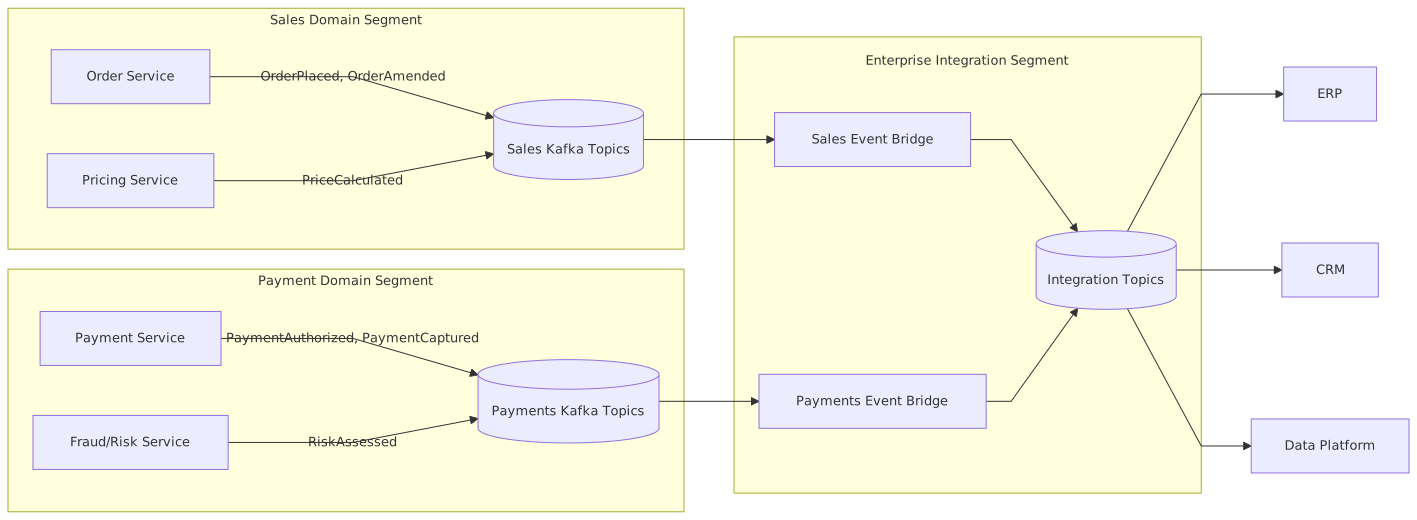
That bridge is not bureaucracy. It is a safety valve. It protects the domain from the enterprise, and the enterprise from the domain.
Architecture
Let us get concrete.
Segments as bounded communication spaces
A segment should have:
- a clear business scope
- named owners
- topic naming conventions aligned to domain language
- schema policies
- access rules
- retention and replay policies
- service-level expectations
For example, an Order Management segment might allow rich internal events such as OrderPriced, OrderReserved, OrderBackordered, OrderReleasedForFulfillment. These events are meaningful inside that context. External consumers, however, may only receive curated integration events like CustomerOrderConfirmed or OrderDeliveryCommitted.
That distinction matters. Internal events capture workflow detail. Integration events capture commitments.
Kafka and segmentation
Kafka is often where this conversation becomes practical. Segmentation can be implemented in several ways:
- Single cluster, logical segmentation using namespaces, ACLs, quotas, and topic conventions.
- Multiple clusters by domain or sensitivity, with replication or bridge services between them.
- Hybrid model, where most domains share a cluster logically, but critical or regulated domains run separate infrastructure.
There is no doctrine here. Kafka gives you the primitives. Architecture decides how hard the walls need to be.
A reasonable progression for many enterprises is:
- start with logical segmentation on a shared cluster
- add quotas, ownership metadata, and contract rules
- isolate critical or regulated domains physically when needed
- create bridge services rather than allowing unrestricted cross-segment consumption
That keeps the design proportional.
Domain semantics and published language
This is where many teams stumble. They think segmentation is an infrastructure problem. It is not. It is a language problem with infrastructure consequences.
DDD teaches that each bounded context has its own model. Therefore, its events should reflect that model. But when another context consumes those events, the sender is effectively publishing part of its language into someone else’s world.
If that language is unstable, overly technical, or too granular, the receiver builds coupling around assumptions that will break later.
Published language is the remedy. A domain should expose events intended for others, with semantics designed for external understanding. These events are usually:
- coarser grained
- more stable
- less workflow-specific
- stripped of private implementation details
- versioned carefully
For example, InventoryReservationAttempted may be useful internally. StockCommittedForOrder may be the integration event that downstream fulfillment systems actually need.
This is segmentation as semantic design.
Bridges, anti-corruption layers, and translation
Cross-segment communication should usually pass through a bridge or anti-corruption layer. The bridge can:
- transform internal events into integration events
- aggregate multiple internal events into one published fact
- redact sensitive fields
- enforce schema validation
- route events to another cluster or bus
- maintain idempotency and ordering where needed
Bridges do add moving parts. They also add a place where architecture can be intentional rather than accidental.
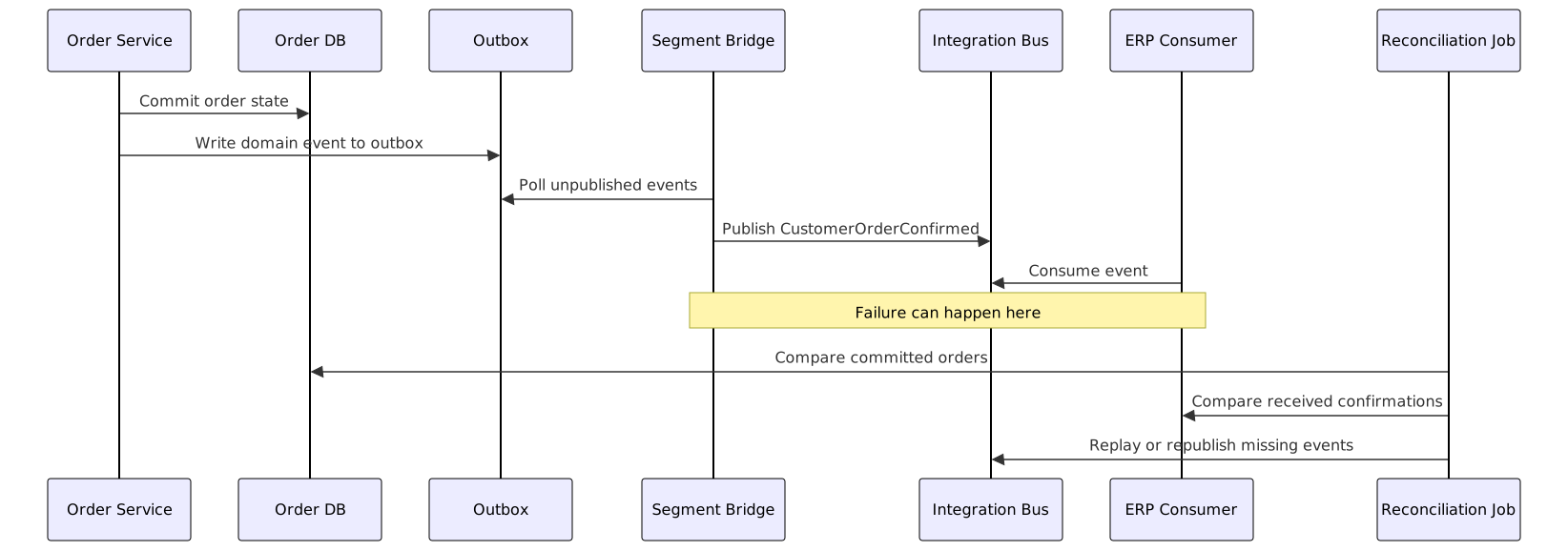
Reconciliation is not optional
Once you segment, you accept asynchronous divergence. Maybe the Orders domain confirms an order, but the integration event to Finance is delayed. Maybe a bridge drops a message after writing an offset but before publishing downstream. Maybe a consumer missed a retention window.
If your architecture has no reconciliation strategy, your segmentation is decorative.
Reconciliation can include:
- periodic comparison of source-of-truth state and downstream projections
- replayable event logs
- outbox patterns for reliable publication
- business repair workflows
- compensating events
- lineage metadata and audit trails
A mature enterprise event architecture always has a story for “what if two systems disagree on what happened?”
Because eventually they will.
Migration Strategy
Few enterprises get to redesign their event backbone from scratch. Most have to migrate from a shared bus that already powers dozens or hundreds of integrations. That means segmentation must be introduced without breaking the estate.
This is a textbook case for a progressive strangler approach.
Step 1: Map the current event landscape
Before you segment anything, identify:
- major producers and consumers
- event volumes and criticality
- schema volatility
- sensitive data flows
- unknown consumers
- domains with the most semantic confusion
This exercise is often humbling. Many organizations discover that they do not have an event architecture. They have an event rumor network.
Step 2: Define candidate segments from domain boundaries
Use bounded contexts, not org charts, as the starting point. Sales, Payments, Fulfillment, Customer, Risk, and Billing are typical business segments. Also identify cross-cutting streams that should remain separate for operational reasons, such as telemetry or CDC replication.
Step 3: Introduce published language topics
Do not immediately move every consumer. Instead, let domains start publishing curated integration events alongside their internal topics. This is often the first visible sign of segmentation: not new infrastructure, but better contracts.
Step 4: Insert bridges
Use bridge services or stream processors to move from internal streams to integration streams. At this stage, the original shared bus may still exist, but new consumers are directed toward segmented contracts.
Step 5: Migrate consumers gradually
Move consumers one by one, starting with those that can tolerate some change. Keep old and new feeds running in parallel where necessary. Measure differences. Reconcile outputs.
Step 6: Restrict direct access to internal events
As confidence grows, tighten ACLs and governance so that cross-domain consumers cannot attach directly to internal event streams. This is the policy line that turns convention into architecture. EA governance checklist
Step 7: Physically isolate where justified
Only after semantic and logical segmentation is working should you consider additional clusters or buses for high-risk domains. Infrastructure separation without semantic discipline merely relocates the mess.
Here is how the migration often looks.
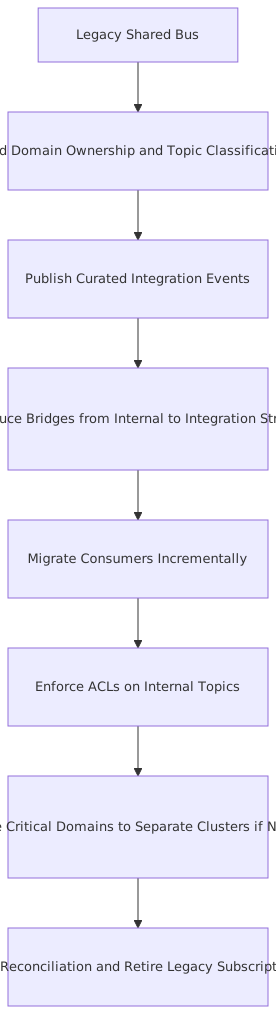
The strangler principle applied to eventing
The important thing is not to “cut over” the bus in one dramatic weekend. Enterprises love planning those weekends and regretting them on Monday.
Strangler migration works because it changes the center of gravity. New integrations use segmented contracts. Old integrations are left in place, then retired as consumers move. Over time, the old shared bus becomes a compatibility surface rather than the architecture’s heart.
That is a much safer path.
Enterprise Example
Consider a global retail bank modernizing its customer and payments platforms.
Initially, the bank had one central Kafka platform used by digital channels, card processing, customer servicing, fraud analytics, and downstream finance. It looked modern from a distance. Up close, it had all the usual scars.
The customer domain published events like CustomerUpdated, AddressChanged, ProfileMerged, and PreferenceSet. These were consumed not only by servicing applications but also by risk, CRM, marketing, and branch systems. Over time, each consumer interpreted “customer updated” differently. Some treated it as a full snapshot. Others assumed it meant KYC changes. A marketing team built logic based on an internal servicing event. Fraud systems subscribed directly to low-level profile changes because they were available.
Meanwhile, payments traffic spiked massively during peak periods. Card authorization streams competed for broker capacity with customer preference events and mobile app telemetry. During one incident, replication lag on the shared cluster delayed finance posting and customer notification workflows while the platform team chased partition hotspots created by unrelated high-volume publishers.
The bank did not need more eventing. It needed less chaos.
What changed
They introduced segmentation in three layers:
- Customer domain segment for internal customer lifecycle events
- Payments domain segment isolated physically due to security and performance requirements
- Enterprise integration segment for curated cross-domain and downstream system events
The Customer domain kept rich internal events for servicing and profile workflows. But external consumers no longer subscribed to those directly. Instead, a bridge produced integration events such as:
CustomerContactDetailsChangedCustomerComplianceStatusChangedCustomerMergedCustomerCommunicationPreferenceChanged
These events had stable schemas, explicit owners, and downstream usage registration.
Payments went further. Due to PCI obligations and operational criticality, the bank moved payment eventing to a separate Kafka cluster with stricter ACLs, retention controls, encryption, and operational support. A bridge emitted sanitized business integration events to the enterprise segment, such as PaymentSettled and RefundCompleted, without exposing sensitive internal processing detail.
Reconciliation and repair
This was not flawless. In early migration, several downstream systems saw mismatches because the integration events were intentionally coarser than the old internal streams. The bank had to implement reconciliation jobs comparing payment ledger records with finance posting confirmations, and customer profile state with CRM projections.
That turned out to be healthy. Before segmentation, inconsistency had existed but remained hidden. Segmentation forced the enterprise to name it, measure it, and handle it.
Business result
The result was not architectural purity. It was improved control:
- reduced unauthorized downstream dependency on internal events
- fewer broker contention incidents between high-volume and critical domains
- clearer schema ownership
- simpler audit conversations with regulators
- better ability for customer and payments teams to evolve independently
The bank still had plenty of complexity. But now the complexity lived in explicit bridges and contracts instead of leaking through the entire estate.
That is progress in enterprise architecture: not removing complexity, but moving it to places where adults can manage it.
Operational Considerations
Segmentation changes operations as much as design.
Observability
You need traceability across segments. Correlation IDs, causation metadata, event lineage, and bridge metrics become essential. If an order event is transformed twice before reaching ERP, support teams must be able to trace that journey quickly.
Capacity and quotas
Shared clusters with logical segmentation need quotas, partition planning, and producer limits. Otherwise one domain’s traffic surge can still starve another. Physical segmentation reduces this risk but increases platform overhead.
Schema governance
Internal domain events can evolve faster than integration events. That implies different governance tracks. Heavyweight review for every internal event is overkill. No review for externally consumed contracts is reckless. ArchiMate for governance
Security and access control
ACLs should reflect segment intent. Cross-domain reads from internal topics should be rare and scrutinized. Sensitive segments may require separate credentials, networks, audit logging, or full physical isolation.
Replay and retention
Different segments need different policies. Analytics may want long retention and replay. Transactional domains may prioritize compacted topics or shorter windows with external archival. One policy across the enterprise is usually a sign nobody asked the right questions.
Disaster recovery
Bridges, outbox processors, and reconciliation jobs become part of the recovery model. If you fail over one segment but not another, how will you replay and restore consistency? Event segmentation demands recovery design, not just cluster backup.
Tradeoffs
Let us be blunt: segmentation is not free.
What you gain
- smaller blast radius
- stronger domain ownership
- better semantic clarity
- reduced accidental coupling
- improved compliance posture
- more targeted operational tuning
What you pay
- more moving parts
- bridge and translation logic
- duplicated events across segments
- more complex end-to-end tracing
- eventual consistency issues made explicit
- governance effort to define and maintain boundaries
That trade is usually worth it in medium-to-large enterprises with multiple domains and teams. It is not worth it if your architecture has only a handful of services and one business capability. Segmentation solves scaling problems of meaning and governance. If you do not have those problems yet, it may just create ceremony.
The real tradeoff is this: do you want complexity hidden inside a giant shared bus, or visible in your architectural boundaries? I prefer visible complexity. At least then you can argue about it honestly.
Failure Modes
Segmentation can fail in predictable ways.
1. Segmenting by org chart
If the boundaries mirror temporary reporting lines rather than stable domain concepts, the design will churn every reorganization. That is architecture written in pencil.
2. Too many segments too early
Over-segmentation creates a patchwork of tiny buses and endless translation layers. Teams spend more time crossing boundaries than delivering behavior. If everything is a segment, nothing is.
3. No published language discipline
If domains simply mirror their internal events into enterprise streams, segmentation changes plumbing but not coupling. You still have semantic leakage, just in more places.
4. Bridge sprawl
When every team builds ad hoc relays, the estate fills with opaque processors nobody owns. Bridges need first-class ownership, observability, and design standards.
5. Ignoring reconciliation
This is the most common operational failure. Teams assume reliable messaging removes the need for state comparison and repair. It does not. Reliability reduces some errors; it does not eliminate divergence.
6. Treating Kafka clusters as the architecture
Physical isolation alone does not solve semantic confusion. You can have five beautifully isolated clusters and still publish nonsense.
When Not To Use
There are cases where event bus segmentation is the wrong move.
Do not use it when:
- you have a small system with a few services and one cohesive domain
- event volumes and sensitivity levels are broadly similar
- teams are not yet mature enough to own contracts and bridges
- the real problem is poor event design rather than shared infrastructure
- you cannot support the operational overhead of multiple segments or clusters
Also, do not segment just because “enterprise architects prefer domain boundaries.” A weak domain model segmented aggressively becomes a distributed argument. If the business capabilities are still unsettled, start with logical controls and better event contracts before hardening boundaries.
The point is not segmentation for its own sake. The point is purposeful decoupling.
Related Patterns
Event bus segmentation sits alongside several established patterns.
Bounded Context
The conceptual source of truth for where event boundaries should be drawn.
Published Language
Essential for exposing cross-context events without leaking internal semantics.
Anti-Corruption Layer
Useful for bridges that translate between domain models across segments.
Outbox Pattern
Improves reliability when publishing events from transactional systems into a segment.
Strangler Fig Pattern
Ideal for incremental migration from a shared bus to segmented communication spaces.
CQRS and Projections
Common in consumers building read models from segmented event streams.
Data Mesh
Related in spirit, especially around domain ownership of data products, though event segmentation is not the same as a data mesh strategy.
Event-Carried State Transfer
Often used in integration segments, but should be applied carefully to avoid oversharing internal domain state.
These patterns work best together when the architecture is explicit about semantics, not merely transport.
Summary
A single enterprise event bus is seductive because it looks like simplification. For a while, it is. Then scale, regulation, throughput, and semantics turn that simplicity into shared confusion.
Event bus segmentation is the architectural response to that maturity point.
It says that events belong to domains before they belong to the enterprise. It says that internal domain signals are not the same thing as external integration contracts. It says that operational isolation, security boundaries, and semantic boundaries should be designed consciously rather than discovered during incidents. And it accepts a hard truth of event-driven systems: once you decouple aggressively, reconciliation becomes part of the business architecture.
The best segmented bus designs are not maximalist. They do not carve the world into tiny message fiefdoms. They establish a few strong boundaries where those boundaries matter: around business domains, around sensitive flows, around incompatible operational profiles. They use bridges and published language to connect those spaces deliberately. They migrate progressively, strangling the old shared bus without betting the company on a cutover.
In short: segment the bus when the bus has become a crowd.
Not because the diagram looks cleaner, though it often does. Because the enterprise needs clearer meaning, safer evolution, and smaller failure. In the end, that is what good architecture is for.
Frequently Asked Questions
What is enterprise architecture?
Enterprise architecture aligns strategy, business processes, applications, and technology in a coherent model. It enables impact analysis, portfolio rationalisation, governance, and transformation planning across the organisation.
How does ArchiMate support architecture practice?
ArchiMate provides a standard language connecting strategy, business operations, applications, and technology. It enables traceability from strategic goals through capabilities and services to infrastructure — making architecture decisions explicit and reviewable.
What tools support enterprise architecture modeling?
The main tools are Sparx Enterprise Architect (ArchiMate, UML, BPMN, SysML), Archi (free, ArchiMate-only), and BiZZdesign. Sparx EA is the most feature-rich, supporting concurrent repositories, automation, scripting, and Jira integration.