⏱ 22 min read
Most production bugs die in the dark.
Not because they are especially clever, but because our systems are. We overwrite state, patch rows, retry jobs, and move on. By the time an incident finally matters enough to investigate properly, the crime scene has been cleaned, the fingerprints wiped, and the one thing we actually need—the sequence of decisions the system made—is gone.
This is the quiet promise of event sourcing: not merely that we can rebuild state, but that we can replay history. And replay is where architecture stops being bookkeeping and starts becoming forensic science.
That distinction matters in enterprises. Large organizations rarely suffer from a lack of data. They suffer from a lack of trustworthy narrative. The database says an order is cancelled. The payment system says it settled. The warehouse says it shipped. Support says the customer was promised a refund. Each system is correct in isolation and wrong in aggregate. Traditional CRUD architectures preserve the latest answer. Event-sourced systems preserve the story.
Time travel debugging sits right in that gap. It lets teams reconstruct what the business believed at a given point in time, how that belief changed, and where the model diverged from reality. If you are running Kafka-backed microservices, dealing with cross-service workflows, or trying to untangle a monolith while preserving auditability, this is not a theoretical nicety. It is operational leverage. event-driven architecture patterns
But let’s be clear from the start: event sourcing is not a free lunch, and time travel debugging is not an excuse to overengineer. You are choosing to model facts as a stream of domain events, with all the power and burden that implies. Done well, this gives you replay, traceability, deterministic investigation, richer audit, and a better grip on domain semantics. Done badly, it gives you an expensive log of poorly named technical noise and a team that now needs three conversations to answer a simple question.
So the right discussion is not “is event sourcing modern?” That is the wrong question. The right one is: when does preserving history as a first-class architectural concept create enough business and operational value to justify the complexity?
That is what this article is about.
Context
Most enterprise systems were built around mutable state. A customer record is updated. An invoice changes status. An order row gets new columns populated over time. This is natural because relational databases made it easy, and because most line-of-business applications were optimized for current-state queries.
For ordinary CRUD workflows, that works. In fact, it works very well.
The trouble starts when the business asks questions that are inherently temporal:
- What did the system know at 10:03, before the compensation job ran?
- Why did a loan move from approved to declined two minutes later?
- Which exact sequence of events caused the inventory reservation to disappear?
- Can we reconstruct the customer journey that led to the disputed charge?
- If we deploy a corrected pricing rule, can we replay historical decisions to see impact?
These are not database questions. They are domain-history questions.
In a distributed architecture, especially one shaped around Kafka and microservices, these questions become sharper. Each service owns its own data. State is fragmented. Events propagate asynchronously. Retries introduce duplicates. Consumers lag. Clock times drift. A workflow that looked linear in a whiteboard sketch turns into a messy, real-world braid of commands, events, policies, and compensations.
That is exactly where event sourcing earns its keep.
In domain-driven design terms, event sourcing works best when the business cares about the meaningful transitions in an aggregate’s lifecycle, not just the final shape of a row. A PaymentCaptured event says something very different from payment_status = 'CAPTURED'. One is a domain fact with narrative weight. The other is a state snapshot. You can derive the second from the first. You cannot reliably derive the first from the second.
And that is the crux of time travel debugging: you debug not by staring at current state, but by replaying domain facts in order and asking, “Given what the system knew then, was this decision valid?”
Problem
Traditional debugging in enterprise systems breaks down for temporal and distributed failure.
A row in a table only tells you what is true now. Logs tell you what code paths ran, but often in implementation language rather than domain language. Tracing tools help with request flow, but they rarely preserve the durable business narrative across retries, asynchronous hops, and state transitions over days or weeks.
When incidents involve a chain of state changes, three things go wrong.
First, history is lossy. Updates overwrite prior values. Audit fields are partial. You might know that something changed, but not the exact sequence of business events that caused it.
Second, distributed causality is fragmented. One service emits an event, another consumes it later, a third enriches it, and a fourth compensates when something fails. The truth is scattered across systems that each see only a slice.
Third, reproduction is unreliable. By the time engineers investigate, external dependencies have moved on, data has been corrected manually, and support teams have applied fixes. You are no longer debugging the original incident. You are debugging a mutated aftermath.
This is why so many enterprise postmortems contain phrases like “could not reliably reproduce” or “manual intervention obscured original state.” Those phrases are really architectural confessions.
Event sourcing attacks this directly. If the event stream is the source of truth, then the sequence of domain changes is durable. If aggregates are rebuilt by replaying events, then you can reconstruct historical states. If downstream read models are projections, then they can be regenerated. If service interactions are evented through Kafka or similar logs, then the architectural center of gravity shifts from mutable records to durable facts.
That gives you a debugging superpower: rewind to a point in time, replay deterministically, inspect decisions, and compare actual outcomes with expected outcomes under new rules.
Not magic. Just discipline.
Forces
Several forces push architects toward this style, and several push back.
Forces in favor
Audit and compliance. In banking, insurance, healthcare, and regulated retail, it matters not just what happened but why and in what order. Event logs align naturally with evidentiary requirements.
Complex domain semantics. If the business revolves around workflows, decisions, approvals, reservations, and reversals, then state transitions are first-class concepts. Event sourcing captures those semantics directly.
Distributed systems reality. Kafka-based microservices already operate in streams of facts. Treating events as architecture instead of integration exhaust can simplify reasoning.
Replay and reprocessing. A corrected pricing algorithm, fraud model, or eligibility policy can be tested against historical streams. That is hugely valuable.
Debugging and reconciliation. If projections drift or consumers fail, rebuilding from events is often cleaner than trying to patch read models manually.
Forces against
Cognitive overhead. Teams must think in aggregates, commands, events, snapshots, projections, idempotency, and event schema evolution. This is a different mental model.
Query complexity. Current-state reporting becomes a projection problem. Ad hoc SQL over a normalized current-state schema is usually simpler.
Storage and retention. Keeping full event histories costs money and governance effort.
Schema evolution pain. Events are forever, or near enough. Poor event design becomes permanent debt.
Operational complexity. Replays can overload downstream systems, create duplicate side effects, or expose hidden assumptions in consumers.
This is the event-sourcing trade: you spend architectural complexity to buy temporal truth.
That trade is justified only when the business actually needs temporal truth.
Solution
The solution is straightforward to describe and hard to do well.
Model domain changes as immutable events. Persist those events in order per aggregate. Rebuild aggregate state by replaying its event stream. Derive query-optimized read models via projections. Use replay, either full or bounded to a point in time, to reconstruct past state and debug behavior.
The key word here is domain.
A common failure is to event-source technical mutations rather than business facts. Events like CustomerTableUpdated or StatusFieldChanged are not domain language; they are database exhaust wearing a costume. Time travel debugging with such events is miserable because replay tells you that storage changed, not what the business decided.
Good event names carry business semantics:
OrderPlacedInventoryReservedPaymentAuthorizationRequestedPaymentAuthorizedShipmentDispatchedRefundIssued
These events let you reason about intent, causality, and policy. They make replay meaningful.
Here is the broad shape:

The debugger is not necessarily a fancy UI. Often it is a disciplined capability:
- fetch event stream for aggregate
X - replay to timestamp
T - inspect aggregate decision state
- compare projections before and after replay
- run a corrected policy against the same event history
- reconcile differences
That last point is critical. Replay is not just for diagnosis; it is often the first step in reconciliation.
Point-in-time reconstruction
To reconstruct historical state, you replay only events up to a chosen sequence number or timestamp. This gives the state as the system understood it then. In well-designed systems, this replay is deterministic for aggregate logic because the aggregate is driven solely by prior events plus incoming commands.
Projection rebuilds
Read models should be disposable. If a projection corrupts state or a consumer bug slips through, you rebuild from the event log. This is one of the most practical benefits of event sourcing in enterprise estates.
Differential replay
A particularly powerful pattern is replaying historical events through both old and new logic, then comparing outcomes. This is invaluable for pricing, fraud, recommendation, or eligibility systems.
Architecture
A serious enterprise architecture for time travel debugging with event sourcing usually contains five moving parts.
1. Event-sourced aggregates
Each aggregate is the consistency boundary. In DDD terms, that means invariants are enforced within the aggregate, and events express meaningful completed state transitions.
For example, an Order aggregate may emit:
OrderPlacedOrderLineAddedOrderConfirmedOrderCancelled
A Payment aggregate may emit:
PaymentInitiatedPaymentAuthorizedPaymentCapturedPaymentVoided
Do not cram a whole business process into one aggregate. That way lies lock contention, huge streams, and broken boundaries. Time travel debugging works better when aggregates reflect real transactional consistency boundaries.
2. Event store
The event store preserves ordered streams per aggregate. It may be a purpose-built event database, or a relational implementation with optimistic concurrency and append-only semantics.
Kafka is often involved, but Kafka is not automatically your event store. That distinction matters. Kafka is superb as a distributed log and integration backbone. It is not always the best canonical source for aggregate event streams unless you are deliberate about partitioning, retention, ordering guarantees, compaction, and replay semantics.
In many enterprises, the pattern is:
- event store as source of truth for aggregate streams
- Kafka as propagation channel for integration events and projections
That separation keeps domain consistency concerns from being swallowed by messaging infrastructure concerns.
3. Projections and read models
Read models exist because the business needs queries, dashboards, APIs, and reports. These are built by subscribing to domain events and updating denormalized views.
The important architectural rule is this: projections are downstream conveniences, not the source of truth.
That rule makes debugging sane. If a read model is wrong, you do not argue with it. You rebuild it.
4. Replay engine
Replay is not an afterthought. It should be designed explicitly with controls:
- replay by aggregate, tenant, or bounded context
- replay to timestamp or sequence
- dry-run mode
- side-effect suppression
- throughput throttling
- differential comparison outputs
Without these controls, replay becomes either dangerous or useless.
5. Observability tied to domain events
Logs and traces should correlate with event IDs, aggregate IDs, causation IDs, and correlation IDs. This lets teams stitch together technical execution and domain history.
Here is a practical enterprise flow:
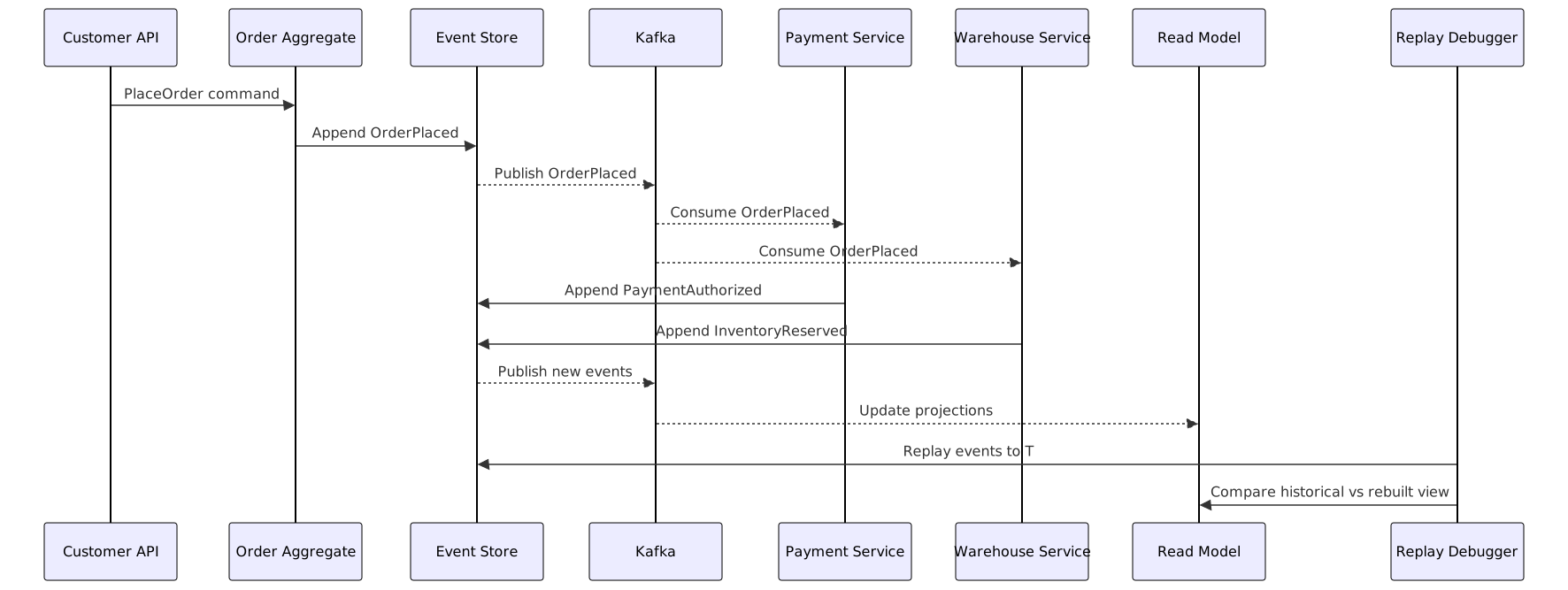
Domain semantics and event design
This is where architects earn their pay.
Events must represent business facts that have happened, not commands, intentions, or implementation details. A command asks. An event states.
- Command:
AuthorizePayment - Event:
PaymentAuthorized
Commands can be rejected. Events cannot be “unhappened”; they can only be followed by compensating events like PaymentAuthorizationReversed.
That distinction matters enormously for replay. Time travel debugging depends on event streams being an accurate ledger of facts, including reversals. If teams start emitting speculative events or muddying commands and events together, replay becomes interpretive fiction.
Snapshotting
Long streams can make aggregate rehydration expensive. Snapshots reduce replay cost by storing periodic materialized aggregate state plus event version markers.
Useful, yes. But keep the order of truth straight:
- event stream is source of truth
- snapshot is a cache
If snapshots become treated as primary, you have quietly rebuilt mutable-state architecture with extra steps.
Migration Strategy
Most enterprises will not greenfield their way into event sourcing. They have monoliths, relational schemas, brittle integrations, batch jobs, and reporting dependencies. So the sane approach is a progressive strangler migration.
Do not try to event-source the world. Start where temporal truth matters.
Step 1: Identify high-value bounded contexts
Choose domains where history, auditability, and complex transitions matter:
- payments
- order lifecycle
- claims processing
- inventory reservations
- entitlements
- policy underwriting
Avoid low-value administrative CRUD domains at first. Nobody needs event sourcing for office location maintenance.
Step 2: Introduce domain events before full event sourcing
A useful intermediate step is to emit domain events from the monolith or CRUD service when key state transitions occur. This builds event vocabulary, Kafka pipelines, and downstream consumers before changing the source-of-truth model.
Be honest, though: this is not yet event sourcing. It is event notification over mutable state. Still useful, but not the same.
Step 3: Carve out one aggregate
Pick a bounded context and implement one aggregate with append-only events and projections. Keep the blast radius small. Measure replay, projection rebuild time, support workflows, and operational burden.
Step 4: Run dual models during migration
During strangler migration, you often maintain:
- legacy current-state store
- new event store
- reconciliation process between them
This feels untidy because it is untidy. Migration is lived in the overlap.
Step 5: Reconcile relentlessly
Reconciliation is not optional. During progressive migration, compare:
- aggregate state rebuilt from events
- legacy system state
- read model outputs
- downstream consumer interpretations
Differences should be surfaced as first-class operational signals, not discovered by angry customers.
Step 6: Cut over bounded context by bounded context
Once confidence is high, make the event-sourced aggregate the source of truth for that context. Continue publishing integration events for surrounding systems.
A strangler path might look like this:
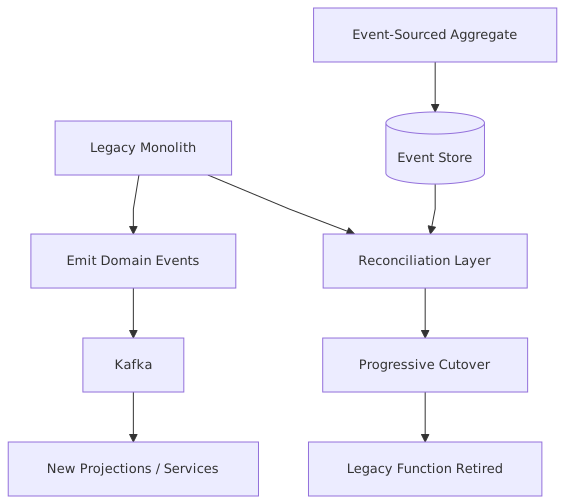
Data backfill and historical import
One of the hardest questions is whether to backfill historical events from existing relational state.
My advice: only backfill what the business actually needs.
If you create synthetic events from table snapshots without true historical semantics, label them clearly as migration events such as OrderImportedFromLegacyState. Do not pretend you know a narrative you never recorded. Architects get into trouble when they manufacture false history.
A mixed strategy often works:
- import current state as a baseline event
- capture true domain events going forward
- preserve legacy audit tables for older forensic needs
That is not pure, but enterprises do not get paid for purity. They get paid for controlled risk.
Enterprise Example
Consider a large retailer running e-commerce, store pickup, and warehouse fulfillment across multiple regions.
Their order platform had grown into a typical enterprise mess: an order service, payment gateway integration, warehouse management, customer notifications, returns, and a support tool that allowed manual adjustments. Kafka connected many of these services, but the source of truth for the order itself remained a mutable relational schema in a central service.
A recurring incident haunted them: orders occasionally appeared as cancelled in customer channels while warehouse systems still shipped them, leading to refund disputes, reshipments, and painful reconciliation with finance.
The old investigation pattern was grim. Teams pulled database snapshots, log files, Kafka offsets, and support records. By then, support agents had already applied corrections. Every incident turned into an archaeology dig.
They moved the Order and Payment domains toward event sourcing.
Domain model
The Order bounded context captured facts such as:
OrderPlacedOrderConfirmedOrderCancelledFulfillmentRequestedShipmentDispatchedDeliveryConfirmed
The Payment bounded context captured:
PaymentAuthorizationRequestedPaymentAuthorizedPaymentCapturedPaymentRefundInitiatedPaymentRefundCompleted
Warehouse and notification systems remained conventional microservices consuming Kafka integration events. microservices architecture diagrams
What changed
When a disputed case occurred, the support and engineering teams could replay the specific order stream to the point just before cancellation. They discovered a subtle failure mode: a compensation workflow consumed a duplicate InventoryReservationFailed message after a consumer rebalance, triggering OrderCancelled even though a later InventoryReserved event had already been applied in the order timeline. The consumer logic had been idempotent on message ID, but not on business causation across retries and out-of-order arrival.
This is exactly the sort of bug mutable state hides.
Replay exposed the domain narrative clearly:
- order placed
- payment authorized
- inventory reservation retried
- reservation succeeded
- stale failure message reprocessed
- compensation cancelled order incorrectly
- warehouse, already acting on success path, shipped item
With event history preserved, the team fixed the compensating policy and then ran differential replay on 90 days of order events. They identified a small but meaningful set of orders affected by the same sequence and reconciled them proactively before customers escalated.
That is enterprise value. Not elegance. Not theory. Fewer financial disputes, lower support cost, better customer outcomes, and a story auditors could actually follow.
Operational Considerations
The glamorous part of event sourcing is replay. The expensive part is operating replay safely.
Idempotency
Replays must not accidentally trigger external side effects such as charging cards, sending emails, or printing labels. Projection handlers and consumers need explicit replay mode or side-effect suppression. If your architecture cannot distinguish “historical rebuild” from “live processing,” you are carrying a loaded weapon.
Ordering
Aggregate-local ordering is essential. Cross-aggregate global ordering is often impossible or unnecessary. Architects must be disciplined about what invariants require within one consistency boundary versus what is eventually consistent across boundaries.
Kafka partitioning strategy matters here. If you depend on order for a given aggregate, key by aggregate identifier. If you spray related events across partitions, do not later complain that replay is confusing.
Retention and archival
Time travel debugging needs history, but not all history must remain hot. Design a retention model:
- hot storage for recent operational replay
- warm archive for extended forensic use
- cold regulatory archive as needed
The trick is preserving replayability without paying premium storage forever.
Event versioning
Events evolve. Fields are added, semantics clarified, old shapes deprecated. This requires version-tolerant consumers and careful upcasting or translation during replay.
The failure mode here is subtle: old events are technically readable but semantically misinterpreted by newer code. That produces false confidence, which is worse than visible breakage.
Projection rebuild performance
Rebuilding read models from millions or billions of events can be slow. Use snapshots, partitioned rebuilds, parallelized projection runners, and bounded replay windows where possible.
But be careful. Optimization that breaks determinism defeats the point.
Security and privacy
Event streams often contain sensitive business facts. Immutable logs create governance pressure around deletion rights, masking, and tenant isolation. If you operate in regulated domains, design for encryption, tokenization, and privacy-aware event payloads from day one. EA governance checklist
Tradeoffs
Event sourcing gives you exceptional temporal visibility. It also taxes every team that touches it.
The upside is real:
- precise audit trail
- historical reconstruction
- replay for debugging and reprocessing
- disposable read models
- clearer domain transitions
- better reconciliation
The downside is equally real:
- harder mental model
- more moving parts
- projection lag and inconsistency windows
- event evolution complexity
- larger operational surface
- more difficult ad hoc analytics unless projected carefully
A common executive misunderstanding is to see event sourcing as simply “better audit.” It is much more than that, and more expensive than that. You are changing the primary representation of the business from current state to historical facts.
That is a profound design choice.
My blunt view: if your domain is simple CRUD with modest audit requirements, event sourcing is probably the wrong answer. You will pay Ferrari maintenance costs to drive to the corner shop.
Failure Modes
The architecture is powerful, but it has sharp edges.
Poor event semantics
If events are thin wrappers around table updates, replay will not explain the business. It will merely restate storage churn.
Oversized aggregates
If streams become giant and contested, replay and concurrency both suffer. This usually indicates weak aggregate boundaries.
Treating Kafka as magical truth
Kafka is excellent, but retention settings, compaction policies, partitioning, and operational resets can all undermine assumptions. Be explicit about what is canonical.
Replay causing side effects
The classic nightmare is reprocessing old events and sending duplicate customer emails, duplicate invoices, or worse, duplicate financial transactions.
Hidden nondeterminism
If aggregate logic depends on current wall-clock time, mutable reference data, or external calls during replay, reconstructed state may differ from original outcomes. Time travel debugging requires deterministic rules or explicit recorded inputs.
Projection drift ignored too long
Teams often tolerate read model inconsistencies until they become political. Build reconciliation early. Drift is not a social problem; it is an architectural signal.
Manufactured history during migration
Backfilling fake event narratives from current-state tables creates misleading forensic records. A false ledger is worse than an incomplete one.
When Not To Use
Do not use event sourcing just because you use Kafka. Those are separate choices.
Do not use it because a conference speaker made replay sound romantic.
Do not use it for low-change reference data, simple content management, or administrative CRUD systems where current state is sufficient and historical reconstruction has little business value.
Avoid it when:
- the team lacks DDD maturity
- domain language is unclear
- query flexibility matters more than historical fidelity
- operational maturity is weak
- regulatory deletion constraints conflict badly with immutable history and you have no mitigation design
- the business does not care about sequence-of-fact reconstruction
This last one is the most important. Architecture should serve business need, not taste.
If nobody will ever replay the stream, no auditor needs it, no policy engine will be re-run, and no significant debugging value comes from historical state reconstruction, then event sourcing is probably ceremony masquerading as engineering.
Related Patterns
Time travel debugging with event sourcing lives in a family of patterns.
CQRS
Almost always adjacent. Commands produce events; projections serve queries. CQRS helps manage the split between write-side invariants and read-side optimization.
Outbox pattern
Useful when integrating mutable-state systems with Kafka reliably during migration. It gives transactional publication of events without full event sourcing.
Saga / process manager
Long-running cross-service workflows often use sagas. Event sourcing can make saga debugging easier because transitions are explicit, but sagas also introduce more replay complexity.
Snapshotting
Important for performance on long streams. Helpful, but secondary to the event log.
Audit log
Not the same thing. Audit logs record activity. Event sourcing models domain facts as primary truth. They overlap, but they are not interchangeable.
Strangler fig pattern
Essential for enterprise migration. Replace capability slice by slice rather than attempting wholesale rewrite.
Reconciliation pattern
Vital during migration and in ongoing operations. Compare independently derived truths and surface drift intentionally.
Summary
Time travel debugging is the most compelling practical argument for event sourcing in complex enterprise systems.
Not because replay is fashionable. Because mutable-state architectures forget too much. They keep the answer and lose the reasoning. In distributed systems, that is not just inconvenient; it is dangerous. You cannot debug what you did not preserve.
Event sourcing flips the model. Domain facts become the durable core. State becomes something you can rebuild. Read models become consumable views rather than sacred truth. Incidents become replayable. Reconciliation becomes structured. Migration becomes possible through progressive strangler steps rather than reckless rewrites.
But this power comes with terms and conditions. You need strong domain semantics, disciplined aggregate boundaries, careful migration design, explicit replay controls, and a tolerance for operational complexity. You also need the courage to say no when the domain does not justify it.
That is the architect’s job: not to admire a pattern, but to know where it pays rent.
If your enterprise needs to answer “what exactly happened, in what order, and what did the system believe at the time?” then event sourcing is one of the few architectures that answers honestly.
And honest history is a rare thing in software.
Frequently Asked Questions
What is CQRS?
Command Query Responsibility Segregation separates read and write models. Commands mutate state; queries read from a separate optimised read model. This enables independent scaling of reads and writes and allows different consistency models for each side.
What is the Saga pattern?
A Saga manages long-running transactions across multiple services without distributed ACID transactions. Each step publishes an event; if a step fails, compensating transactions roll back previous steps. Choreography-based sagas use events; orchestration-based sagas use a central coordinator.
What is the outbox pattern?
The transactional outbox pattern solves dual-write problems — ensuring a database update and a message publication happen atomically. The service writes both to its database and an outbox table in one transaction; a relay process reads the outbox and publishes to the message broker.