⏱ 20 min read
Distributed systems don’t fail like a light bulb. They fail like a city in bad weather: one bridge closes, traffic shifts, side streets jam, emergency routes appear, and suddenly the route that looked redundant on the whiteboard becomes the only thing standing between “minor incident” and a quarterly postmortem. That is the real subject of streaming failover. Not just uptime. Not merely replication. It is the craft of deciding what the business is willing to lose, delay, duplicate, or reinterpret when the stream bends under pressure.
Too many teams treat failover in event streaming as a transport concern. Put another cluster in another region, mirror topics, and declare victory. Then an actual failure arrives and they discover something unpleasant: brokers fail over faster than semantics. The infrastructure may recover while the business meaning does not. Orders are replayed out of sequence. Payments are processed twice. Inventory diverges quietly. Consumers reconnect to a healthy cluster and proceed to spread damaged state with remarkable efficiency.
That is why failover patterns in event streaming have to be discussed in the language of domain-driven design as much as in the language of Kafka clusters and replication factors. A stream is not just bytes in motion. It is a running story of the business. If failover changes the story, then architecture has failed even if the platform dashboard is green. event-driven architecture patterns
This article takes a hard look at streaming failover patterns with that assumption in mind. We will cover what problem failover is really solving, what forces shape the design, how common patterns work, how to migrate toward them without detonating an existing platform, and where they break. We will also spend time on the part many architecture articles skip: reconciliation. Because in most enterprises, failover is not a clean handoff. It is a period of ambiguity followed by repair.
Context
Event streaming became popular because enterprises got tired of moving data in little bespoke pipes. A stream promised continuity, replayability, decoupling, and a shared operational fabric for microservices. Kafka became the default choice for many organizations because it gave them durable logs, partitioned scale, consumer groups, and a practical path from integration spaghetti to platform thinking. microservices architecture diagrams
But as platforms mature, expectations harden. A stream that handles customer notifications can tolerate delay. A stream that carries card authorizations, claims adjudication, or order state transitions cannot. The conversation moves from “Can we publish events?” to “What happens when a region is gone, a cluster is split, a consumer reads stale offsets, or replication lags behind the business clock?”
This is where failover patterns matter.
In enterprise architecture, streaming failover is usually driven by one of four contexts:
- Regional resilience for customer-facing products
- Disaster recovery for regulated operations
- Operational continuity during platform maintenance or partial outages
- Migration from a legacy event backbone to a new one
These are not the same problem. A bank that needs active payment processing in two regions has a very different failover requirement from a retailer that can queue orders for twenty minutes during a broker outage. The architecture should reflect that. One of the biggest mistakes I see is choosing a failover topology before clarifying business semantics. If a domain cannot tolerate dual writers, don’t build active-active because it looks sophisticated in a diagram.
The domain should lead. Technology follows.
Problem
At first glance, failover in event streaming sounds simple: when the primary path is unavailable, switch to the secondary. That works for routers. It does not work cleanly for streams.
A stream has state hidden everywhere:
- producer acknowledgements
- partition leadership
- in-flight batches
- consumer offsets
- local materialized views
- downstream side effects
- business invariants encoded in event order
When a primary Kafka cluster or region becomes impaired, the system faces several hard questions:
- What exactly failed?
Broker quorum, network path, DNS resolution, schema registry, consumer processing, or downstream dependency?
- What is the unit of failover?
Cluster, topic, consumer group, service, domain capability, or an entire region?
- What does continuity mean?
Continue publishing, continue consuming, preserve ordering, preserve exactly-once semantics, preserve low latency, or preserve correctness after reconciliation?
- Who decides to fail over?
Humans, automation, clients, service mesh, platform controllers?
- How do we come back?
Failing over is one thing. Returning to steady state without data corruption is the harder half.
The dangerous simplification is to frame this as an availability problem. It is really a continuity under semantic uncertainty problem. During failover, you are often forced to choose between guarantees that are normally presented as compatible.
You may preserve write availability at the cost of ordering. You may preserve consistency at the cost of latency. You may preserve durability but lose a clean notion of “latest truth” across regions.
And if you haven’t named those tradeoffs beforehand, the business will discover them during an incident.
Forces
Architecture lives in the tension between competing truths. Streaming failover patterns are shaped by a familiar but still brutal set of forces.
Availability vs correctness
If the business insists that event publication must never stop, you will likely accept duplicate events, delayed replication, or post-failure reconciliation. If the business insists correctness must be strict, then some writes must pause when authority is unclear.
There is no clever topology that abolishes this tradeoff.
Ordering vs partitioned scale
Kafka gives ordering within a partition, not across a topic, and certainly not across mirrored clusters during failover. If your domain depends on total order across entities, you are already in dangerous territory. Most domains should instead model order where it matters: per aggregate, per account, per order, per claim.
This is where domain-driven design earns its keep. Event partitioning should align with domain identity and invariants. If “payment applied after invoice closed” is illegal, the keying strategy must keep those transitions coherent for the same invoice or account.
Recovery time vs reconciliation effort
Fast failover usually means accepting temporary divergence. Slow controlled failover usually means less repair later. Enterprises often over-optimize for dramatic failover speed and under-invest in reconciliation. Then they discover that “five-minute RTO” translated into “three-day finance correction.”
Platform standardization vs domain-specific semantics
A central platform team wants one failover pattern for everyone. Domains do not cooperate. Customer analytics, fraud detection, and securities settlement do not need the same semantics. The right enterprise move is usually a small number of approved failover patterns with clear fit criteria, not one universal answer.
Human control vs automation
Automated failover sounds attractive until split-brain, replication lag, or stale health signals trigger an unnecessary switch. Human-controlled failover sounds safe until the on-call team is making semantic decisions at 3 a.m. under pressure. The best systems automate the mechanical parts and leave the semantic threshold explicit.
Solution
There is no single failover pattern for event streaming. There is a family of patterns, each suited to particular domain semantics and operational constraints. The architect’s job is not to memorize them, but to choose one that matches business truth.
The most useful patterns are these:
- Passive standby cluster
- Active-passive with mirrored topics
- Active-active by domain partitioning
- Producer dual-write with consumer preference
- Store-and-forward failover at the service boundary
- Local continuity with later reconciliation
Let’s unpack them.
1) Passive standby cluster
This is the old-fashioned and often sensible choice. The primary Kafka cluster handles production traffic. Data is replicated or snapshotted to a standby environment. During failure, producers and consumers are redirected to the secondary.
This is appropriate when:
- failover is rare
- strict operational simplicity matters
- some downtime is acceptable during switchover
- reconciliation can be bounded
It is not glamorous. It is often the right answer.
2) Active-passive with mirrored topics
The primary cluster is writable. The secondary cluster continuously receives replicated topics using tooling such as MirrorMaker 2, Cluster Linking, or vendor-specific replication. Consumers may be prepared to move, but only one side is authoritative for writes at a time.
This is a common enterprise pattern because it balances resilience and control. The key design question is not replication itself. It is offset and semantic continuity. A mirrored topic is not automatically a seamless continuation for every consumer group or materialized state.
3) Active-active by domain partitioning
Both regions or clusters are active, but not for the same business authority. One domain slice is mastered in one region, another slice in another. For example, customer accounts may be region-homed; events for account A are always authored in region 1, while account B lives in region 2.
This is real active-active, not the marketing version where both sides write everything and everyone prays. It works when the domain can be partitioned cleanly by ownership.
If your domain cannot identify a clear authority boundary, active-active becomes an expensive machine for generating duplicates and disputes.
4) Producer dual-write with consumer preference
A producer writes events to both primary and secondary streams, often with an idempotency key and a canonical event identity. Consumers read from their preferred source and can switch if needed.
This sounds robust. It is also one of the easiest ways to create hidden inconsistency. Producer retries, partial acknowledgements, and non-atomic dual writes create complex edge cases. Use it only when you are willing to invest in strong idempotency and downstream deduplication.
5) Store-and-forward failover at the service boundary
Instead of failing over the central stream directly, the producer service persists domain events in a local outbox and forwards them to Kafka when available. If the stream is impaired, the service continues to record business intent locally, then publishes later.
This is often the most business-friendly pattern. It preserves domain truth first, transport second. It accepts delayed propagation but avoids losing business facts.
6) Local continuity with later reconciliation
Sometimes the honest answer is this: during failover, each region continues to operate within local constraints, records events, and reconciles after recovery. This is common in retail, logistics, field operations, and some healthcare workflows where local continuity outranks global immediacy.
This pattern requires mature reconciliation capabilities. Without them, it is not architecture; it is debt with a timer.
Architecture
A practical enterprise architecture usually combines patterns. One common design is active-passive cluster failover paired with outbox-based local continuity in the services and explicit reconciliation services for domain repair.
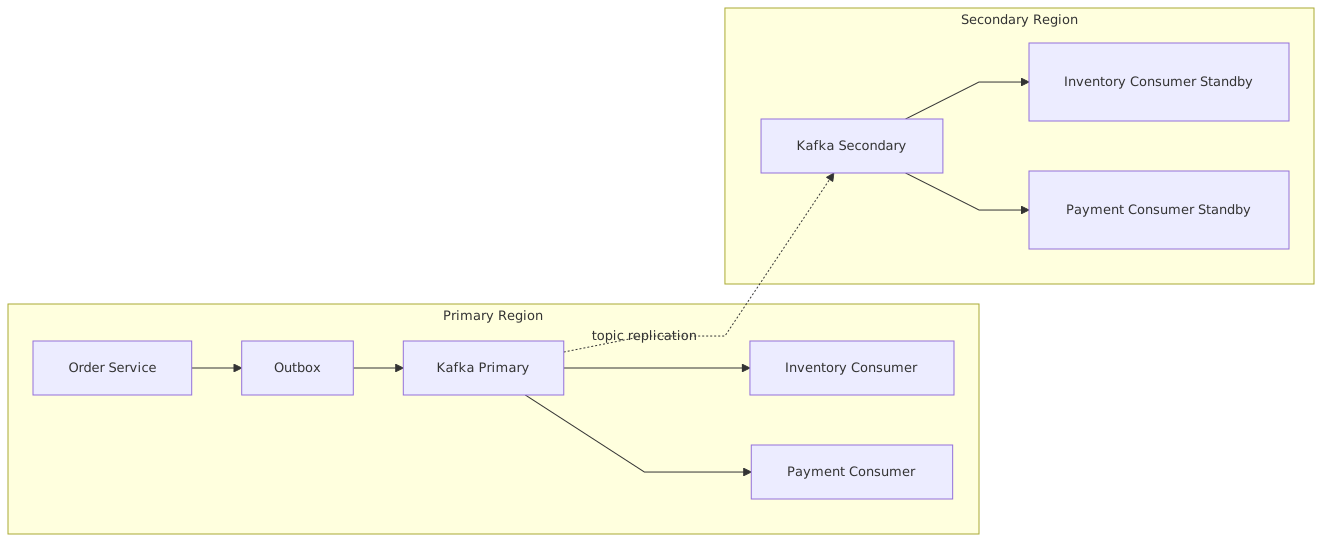
That architecture works because it separates concerns:
- Outbox preserves business intent at the producer boundary.
- Primary Kafka cluster acts as the main event backbone.
- Replicated secondary cluster provides failover continuity.
- Standby consumers reduce restart friction.
- Reconciliation capability repairs semantic drift afterward.
Notice what this architecture does not promise: perfect continuity with no duplicates and no ordering anomalies. Mature architecture is honest about what it can and cannot do.
Domain semantics first
The stream should reflect bounded contexts, not enterprise fantasy. An “OrderPlaced” event in commerce and a “SettlementInstructionCreated” event in treasury should not be treated as interchangeable just because they both travel over Kafka.
Failover boundaries should align with domain boundaries too. A claims domain may support delayed downstream propagation if claims are durably recorded in its system of record. A fraud scoring domain may tolerate replays and duplicates because scoring is derived and repeatable. A payment ledger domain will likely require strict authority, immutable event identity, and tightly controlled failover gates.
In other words, not every topic deserves the same failover treatment.
Consumer state matters more than teams think
The ugly secret of streaming failover is that consumers carry semantic weight. A stateless consumer can often be restarted against a failover cluster with modest pain. A stateful consumer with local stores, windows, or materialized views is another story.
If you are using Kafka Streams, Flink, or custom stateful processors, you need a deliberate strategy for:
- state checkpoint replication
- offset translation
- replay boundaries
- duplicate handling
- watermark or event-time anomalies
A replicated topic does not automatically mean a coherent replicated projection.
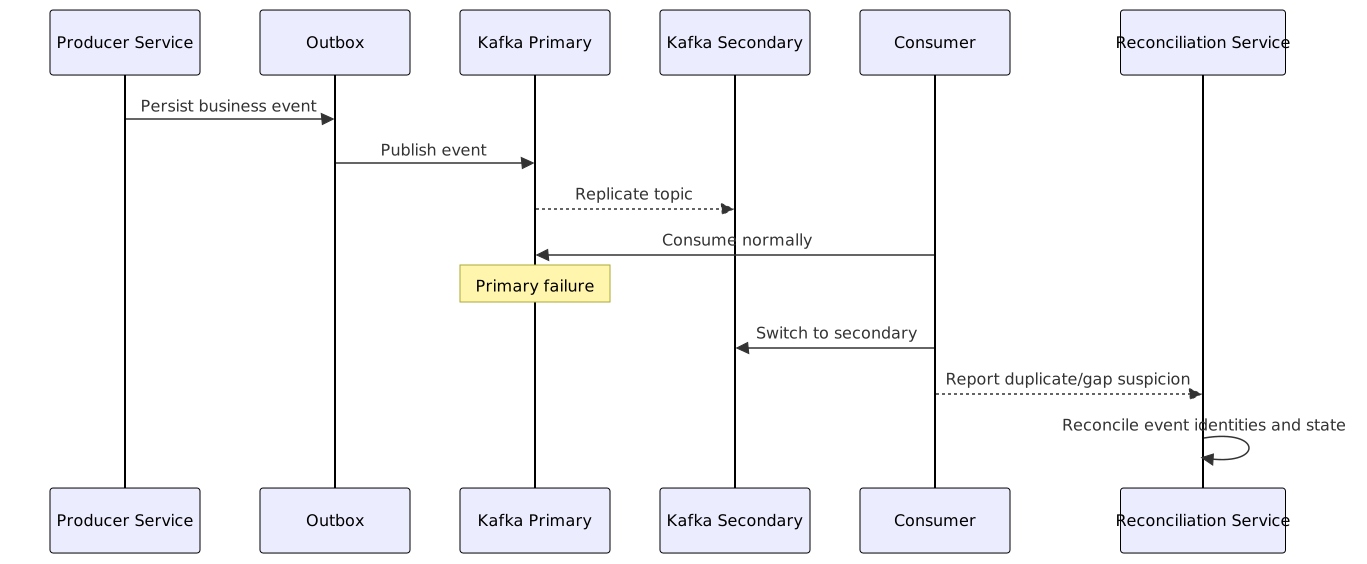
The important point is the final step. Failover is not complete when traffic resumes. It is complete when the business state is trustworthy again.
Migration Strategy
Most enterprises do not get to design streaming failover from a blank sheet. They inherit a Kafka estate with topic sprawl, consumer groups with folklore semantics, and a collection of microservices that were “temporarily” coded to assume one cluster forever.
That means migration matters as much as target state.
The right migration approach is usually progressive strangler migration. Build failover capability around the current platform, route selected domains through the new path, observe semantic behavior, and only then widen the blast radius.
Step 1: Classify event streams by business criticality
Not all streams deserve the same architecture. Group them into classes such as:
- mission-critical transactional
- operationally important but recoverable
- analytical or derived
- ephemeral notifications
This avoids over-engineering low-value streams and under-protecting critical ones.
Step 2: Introduce canonical event identity
Before failover sophistication, establish a durable event identity model:
- event ID
- aggregate or entity ID
- causation ID
- correlation ID
- event version
- producer timestamp and business timestamp
Without canonical identity, reconciliation becomes guesswork.
Step 3: Add producer outbox where domain truth matters
For critical services, start by introducing the transactional outbox pattern so business state and event intent are captured atomically. This is often the foundation for resilient failover because it decouples business commit from stream availability.
Step 4: Mirror selected topics to a secondary cluster
Start with read-mostly or derived topics first. Then move to domain events with known semantics. Validate:
- replication lag
- schema compatibility
- consumer startup behavior
- offset mapping
- replay duration
- duplicate rates
Step 5: Create failover runbooks and controlled drills
A failover pattern you have not exercised is a rumor. Run game days. Pull network paths. Simulate broker unavailability. Force consumer relocation. Measure not just uptime but semantic outcomes.
Step 6: Strangle consumer dependence on cluster-specific assumptions
Many consumers bake in assumptions about broker addresses, topic naming, partition count, retention, or offset monotonicity. Abstract these behind platform conventions or service libraries. Migration dies in the details.
Step 7: Introduce reconciliation services
This is the step teams avoid because it feels like admitting imperfection. In reality, it is the mark of serious design. Build services or workflows that can:
- detect missing events
- identify duplicates
- compare materialized projections with source-of-truth systems
- issue corrective events
- escalate irreconcilable differences
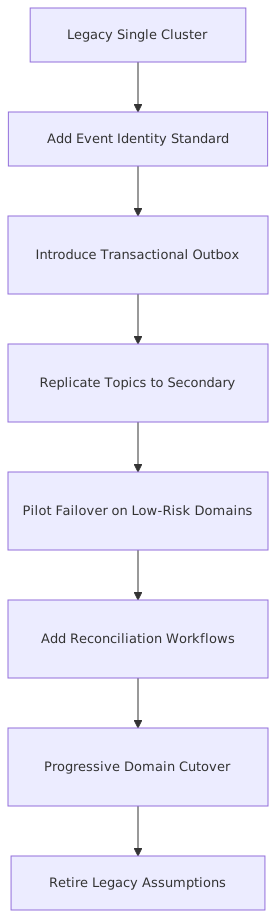
That is what strangler migration looks like in streaming. Not a grand rewrite. A controlled change in where authority and resilience are anchored.
Enterprise Example
Consider a global retailer with e-commerce, store operations, and fulfillment systems spread across North America and Europe. They use Kafka as the event backbone for order lifecycle, inventory updates, pricing changes, shipment events, and customer notifications.
At first, the architecture was simple: one primary Kafka cluster per major region, asynchronous replication to a disaster recovery cluster, and microservices publishing directly to Kafka. It looked modern. It was also fragile.
Then a regional network incident hit the North America cluster. The order service could not publish OrderPlaced events. The checkout database committed orders, but downstream inventory reservation and payment authorization consumers saw nothing. Operations improvised by replaying database rows into Kafka after recovery. Some payments were re-attempted. Some reservations happened late. Customer support had a terrible week.
The retailer changed the architecture in three important ways.
First, they introduced a transactional outbox in the order and payment bounded contexts. If checkout committed an order, the outbox guaranteed the domain event existed even if Kafka was unavailable.
Second, they moved to active-passive failover with mirrored topics for critical transactional streams, while leaving less critical marketing and analytics streams on simpler disaster recovery arrangements.
Third, they built a reconciliation service for order state. It compared:
- order database records
- published event identities
- payment processor references
- inventory reservation outcomes
If failover or replay caused divergence, the service emitted corrective commands or compensating events such as ReservationReleaseRequested or PaymentReviewRequired.
This was not free. They accepted several tradeoffs:
- occasional delayed event publication during stream impairment
- more operational complexity in outbox processing
- explicit duplicate handling in consumers
- a new reconciliation backlog process for edge cases
But the result was far better aligned with business truth. During the next incident, checkout continued. Some downstream workflows were delayed by minutes, not lost. The platform resumed and reconciliation closed gaps automatically for the majority of affected orders.
That is what good failover architecture looks like in the wild. Not magic. Damage containment.
Operational Considerations
If failover is only in the architecture deck, it will fail in production. Operations is where patterns become real.
Health signals must be semantic, not merely technical
A Kafka cluster may be reachable while the business is effectively down because lag has exploded, schema registry is unavailable, or a critical consumer cannot materialize state. Triggering failover based only on broker health is naive.
Good failover decisions consider:
- replication lag thresholds
- producer error rates
- consumer group lag by criticality
- schema compatibility failures
- state store restoration status
- downstream dependency health
Observability needs event lineage
Tracing HTTP calls is not enough. You need lineage across event publication, replication, consumption, and side effects. Architects should insist on observability that can answer:
- Did this business event get published?
- Was it replicated?
- Which consumer processed it?
- Were side effects executed once or more than once?
- Did reconciliation touch it later?
Runbooks should distinguish failover from disaster declaration
A temporary cluster impairment may justify pausing consumers or buffering writes, not full failover. If every wobble triggers region switch, the platform will thrash itself into outage.
Offset management needs discipline
Offset translation between primary and secondary environments is where many failover dreams go to die. Standardize your approach early:
- replicate offsets if supported
- checkpoint by event identity where possible
- favor idempotent consumption over brittle offset purity
Security and governance still apply in the bad day
Secondary clusters must not be neglected cousins. Access controls, encryption, schema governance, and data retention policies need parity, or failover will open compliance holes exactly when the organization is least able to manage them. EA governance checklist
Tradeoffs
There is no failover pattern without a bill attached.
Active-passive gives clarity of authority and simpler semantics, but may involve slower switchover and underutilized standby capacity.
Active-active reduces regional dependence and can improve latency, but only if the domain can be partitioned cleanly. Otherwise, it multiplies reconciliation cost.
Outbox-based continuity preserves business intent, but it introduces another moving part and can create publication backlogs that stress recovery.
Dual-write strategies can improve continuity on paper, but they often shift complexity into every consumer and reconciliation process.
Reconciliation-heavy designs accept the world as it is, but they require mature operational support and domain-specific repair logic.
The point is not to avoid tradeoffs. It is to make them deliberately. Enterprise architecture is often the art of choosing where pain belongs.
Failure Modes
Streaming failover designs fail in surprisingly repeatable ways.
Split-brain authority
Two regions both believe they are primary and accept writes for the same domain entities. This is catastrophic for ledgers, reservations, and any workflow with scarce resources.
Mitigation: clear authority rules, domain partitioning, and conservative failover automation.
Silent replication lag
Secondary looks healthy, but mirrored topics trail far enough behind that failover loses recent business events.
Mitigation: lag-based readiness thresholds and domain-specific acceptance criteria.
Consumer state corruption after switch
Stateful consumers replay from a failover cluster and rebuild projections inconsistently due to duplicates, reordered events, or missing checkpoints.
Mitigation: deterministic rebuild procedures, state snapshot strategy, and idempotent event application.
Duplicate side effects
The same business event is processed in both environments or replayed after uncertain acknowledgement, causing duplicate payment capture, notification spam, or inventory holds.
Mitigation: idempotency keys, side-effect deduplication, and explicit event identity.
Reconciliation backlog becomes the outage
Traffic resumes, but reconciliation cannot keep up, so operations shifts from visible outage to prolonged semantic uncertainty.
Mitigation: automate common repairs, classify exceptions, and cap failover scope by domain.
The memorable rule here is simple: if you cannot reconcile, you have not really failed over. You have only postponed the outage into the business layer.
When Not To Use
Some failover patterns should be avoided entirely in certain conditions.
Do not use active-active multi-region writing when:
- the domain has no clean ownership partition
- cross-region ordering is critical
- side effects are not idempotent
- the organization lacks reconciliation capability
Do not build sophisticated mirrored-cluster failover for:
- low-value analytical streams
- ephemeral telemetry
- domains where replay from source systems is cheaper than resilience engineering
Do not push failover complexity into every microservice if:
- you can solve it once in a platform pattern
- teams lack the operational maturity to implement it safely
- domain semantics are not yet understood
And do not use event streaming failover as a substitute for a proper system of record. A stream is a log of facts and intents. In many domains it is not, by itself, the final legal authority. Architects get in trouble when they confuse transport durability with business truth.
Related Patterns
Streaming failover sits alongside several adjacent patterns.
- Transactional Outbox: captures business intent atomically with state change.
- Saga orchestration/choreography: coordinates long-running business workflows, often requiring idempotency during replay.
- CQRS projections: materialized views that must survive or rebuild after failover.
- Bulkhead isolation: limits blast radius by separating critical streams from less important traffic.
- Circuit breakers and backpressure: prevent overloaded consumers or dependencies from turning failover into a cascade.
- Compensating transactions: repair business outcomes after duplicates or out-of-order processing.
- Strangler Fig migration: incrementally replaces fragile platform assumptions with resilient patterns.
These patterns are not optional accessories. In a serious enterprise system, failover usually depends on them.
Summary
Streaming failover is not about making Kafka immortal. It is about preserving business meaning when the streaming fabric is damaged.
That shifts the design conversation. Start with domain semantics, not cluster topology. Decide where authority lives. Partition by business identity when you can. Use active-passive more often than fashion suggests. Introduce transactional outbox where domain truth matters. Treat reconciliation as a first-class architectural capability, not a sheepish operational afterthought. Migrate progressively with a strangler approach. Drill failure. Measure semantics, not just uptime.
The cleanest line I can offer is this: in event streaming, failover is easy until the business notices.
And that is exactly why it deserves better architecture than a secondary cluster and a hopeful runbook.
Frequently Asked Questions
What is event-driven architecture?
Event-driven architecture (EDA) decouples services by having producers publish events to a broker like Kafka, while consumers subscribe independently. This reduces direct coupling, improves resilience, and allows new consumers to be added without modifying producers.
When should you use Kafka vs a message queue?
Use Kafka when you need event replay, high throughput, long retention, or multiple independent consumers reading the same stream. Use a traditional message queue (RabbitMQ, SQS) when you need simple point-to-point delivery, low latency, or complex routing logic per message.
How do you model event-driven architecture in ArchiMate?
In ArchiMate, the Kafka broker is a Technology Service or Application Component. Topics are Data Objects or Application Services. Producer/consumer services are Application Components connected via Flow relationships. This makes the event topology explicit and queryable.