⏱ 21 min read
Most distributed systems don’t collapse in a dramatic fireball. They sag. First the dashboards get slower on Monday mornings. Then a support team complains that customer timelines take eight seconds to load. Then product asks for “just one more filter” on a reporting screen that already behaves like a warehouse query pretending to be an API. Eventually everyone says the same thing with different accents: the reads are hurting us.
That is the real entry point to read model sharding in a CQRS architecture. Not fashion. Not because someone read about planet-scale systems and wanted to sprinkle “shards” over a perfectly healthy application. Sharding is what you do when the read side becomes a city that has outgrown its roads. CQRS gives you permission to build roads for the traffic you actually have. Read model sharding is what happens when even those roads need districts, boundaries, and deliberate traffic rules.
And let’s be blunt: this is not just a database scaling trick. If you approach it that way, you’ll create a distributed mess with faster hardware bills. Read model sharding is a domain decision disguised as an infrastructure decision. It forces you to ask what the read side means, who consumes it, where consistency matters, which queries belong together, and what business boundaries are worth preserving even under load. The technology matters, yes. Kafka topics, consumer groups, projection services, search indexes, caches, and partition keys all matter. But none of them rescue a model that ignores the language of the business.
This article walks through the architecture with that bias in mind. We’ll look at the problem, the forces pushing a team toward sharding, the solution shape, migration strategy, enterprise example, operational concerns, tradeoffs, failure modes, and when to leave the whole thing alone.
Context
CQRS exists because reads and writes are usually not the same problem. Writing is about enforcing invariants, preserving intent, and protecting the integrity of business transactions. Reading is about answering questions cheaply, quickly, and often in forms that would make a write model blush.
A good write model speaks in aggregates, commands, and business rules. A good read model speaks in use cases: customer order history, agent case dashboard, fraud review queue, regional sales summary, inventory by fulfillment zone. One protects truth. The other packages truth for consumption.
That separation becomes particularly valuable in microservices environments where each service owns its operational data and emits events for others to consume. Kafka often becomes the bloodstream here: domain events emitted from write-side services are consumed by projection services that maintain read-optimized stores. Some teams use relational read stores, some use document databases, some use Elasticsearch or OpenSearch, some use Redis for hot paths, and many use all of them because enterprise systems are rarely monogamous.
At small scale, a single read model store per bounded context can be enough. Queries remain fast. Projection lag stays manageable. Team cognition is still cheap. But scale changes the geometry. A customer service portal may need to retrieve timelines for tens of millions of customers. A trade surveillance system may need region-specific slices with low latency and strict tenant isolation. A marketplace may need product search and seller analytics with completely different cardinality and access patterns. The read side stops being “a database behind the API” and becomes its own architecture.
That is where sharding enters.
Problem
A single read store eventually becomes a success tax.
The symptoms are familiar:
- Query latency spikes as datasets grow.
- Indexes become contradictory because one query pattern wants one shape and another wants the opposite.
- Projection rebuilds take too long.
- Hot tenants or hot business entities dominate shared resources.
- Global reports and operational dashboards interfere with transactional read APIs.
- Teams struggle to deploy read-side changes without stepping on each other.
- Reconciliation windows widen because replaying all events into one giant projection becomes expensive.
In a CQRS architecture, the pain is often more visible because the read side is explicitly optimized for queries. That means stakeholders depend on it. If the dashboard is slow, the architecture is slow. If the support screen is inconsistent, the architecture is inconsistent.
The naive reaction is to scale up: bigger instances, more replicas, more cache. That often buys time. But it doesn’t resolve the structural issue when the read model is serving fundamentally different access patterns or carrying too much unrelated load in one place. Replication helps concurrency, not all forms of contention. Caching helps repetition, not arbitrary filtering on fresh data. Bigger hardware helps until the monthly cloud bill starts asking governance questions. EA governance checklist
The deeper problem is this: the read model no longer has a natural unit of ownership or distribution.
If every query, every tenant, every region, every product line, and every report lands in one logical read store, then the system has no boundaries. And systems without boundaries do not scale gracefully. They merely postpone the invoice.
Forces
Read model sharding is driven by several forces, and they pull against each other.
1. Latency versus consistency
Consumers want low-latency reads. The business also wants confidence that what users see is close enough to the latest truth. Sharding can reduce latency by distributing load, but it can increase the complexity of event propagation and make eventual consistency more visible.
2. Domain alignment versus technical convenience
It is tempting to shard by whatever key the database likes: hash of record ID, modulo partition count, random even distribution. That works for throughput, but it often undermines business semantics. If customer service agents always need a full customer timeline, and timeline events for one customer are spread arbitrarily across shards, you’ve traded one problem for another.
In domain-driven design terms, shard boundaries should respect bounded contexts, aggregates, tenancy, geography, or operational slices that mean something in the business. A shard key is not just a partitioning trick. It is a statement about what belongs together.
3. Throughput versus rebuildability
More shards can mean more parallelism. It can also mean more moving parts during projection rebuilds, more replay coordination, and more opportunities for drift between shards.
4. Isolation versus flexibility
A hot tenant can be isolated onto dedicated infrastructure. That is good. But as soon as you special-case tenants, product expectations change. “Can we move this tenant live?” “Can we split one region?” “Can we merge low-volume shards?” Operational flexibility becomes part of the design.
5. Team autonomy versus platform complexity
Independent teams often benefit when read models are separated by domain or use case. But too many bespoke shard schemes create a platform nobody can reason about. Enterprises love local optimization until they have to run it at 3 a.m.
6. Cost versus resilience
Sharding usually increases total infrastructure surface area: more databases, more consumer groups, more monitoring, more failover plans. It can make the system more resilient to localized hotspots, but also more expensive and more failure-prone in aggregate.
Solution
The central idea is simple: split the read side into multiple independently scalable projections, each responsible for a defined slice of query traffic, and route events and queries according to a shard strategy grounded in domain semantics.
That sentence sounds neat. Real systems are not.
There are several legitimate sharding approaches for CQRS read models:
- Tenant-based sharding
Useful in SaaS systems where tenant isolation, noisy-neighbor protection, and compliance boundaries matter. Large tenants can be placed on dedicated shards.
- Geographic or region-based sharding
Appropriate when reads are mostly local to a geography and data sovereignty matters. Common in banking, retail, and telecom.
- Aggregate affinity sharding
For read models centered around one aggregate root or business entity, such as customer, account, or order. All events relevant to that entity’s projection land on the same shard.
- Use-case or view-based sharding
Separate read models for operational dashboards, search, analytics, and customer self-service, even when sourced from similar event streams.
- Hybrid sharding
Often the real answer. For example: shard a customer timeline by tenant and customer ID, while maintaining a separate regional reporting projection optimized for aggregates and snapshots.
The architecture usually has these ingredients:
- Write-side services emit domain events.
- Events land in Kafka topics or another durable event backbone.
- Projection services consume events and update shard-specific read stores.
- A query routing layer resolves the appropriate shard for incoming requests.
- Reconciliation and replay mechanisms rebuild or verify shards.
- Observability tracks lag, divergence, skew, and hot partitions.
Here is a canonical shape:
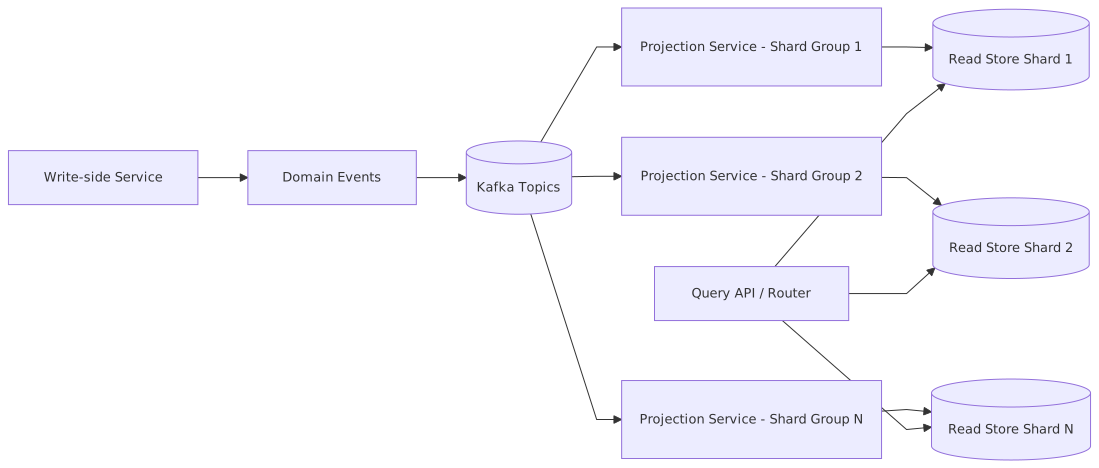
The trick is not drawing this diagram. Anyone can do that. The trick is choosing shard keys and projection boundaries that preserve useful business meaning.
If you are building a customer support timeline, shard by tenant + customer_id is often sound because customer-centric queries dominate. If you are building regional inventory visibility, shard by region + fulfillment_zone may be more natural. If you are building anti-money-laundering alerts, perhaps the right approach is not one shard scheme at all, but separate projections for customer reviews, transaction monitoring, and regulatory reporting.
Read model sharding is not a universal partitioning of all truth. It is a selective partitioning of representations.
That distinction matters.
Architecture
Let’s get concrete.
Domain semantics first
In domain-driven design, a bounded context defines the meaning of a model. Read models should not casually cut across those meanings. A customer profile in the CRM context is not the same thing as a customer risk profile in the compliance context, even if both use the word “customer.” If you shard a read model that conflates multiple bounded contexts, you are scaling ambiguity.
A better approach is:
- identify bounded contexts,
- identify the primary query views within each context,
- identify dominant access patterns,
- choose shard keys that preserve locality for those patterns.
This usually results in multiple sharded read models, not one grand unified shard map.
Event partitioning and projection affinity
Kafka is relevant because partitioning strategy on topics often shapes projection scalability. If a projection shard is built around customer affinity, then events concerning a customer should either:
- be emitted with a consistent partition key, or
- be rekeyed into downstream topics suitable for projection.
That does not mean every source topic in every microservice must use the same partition key. That would be architecture by hostage situation. It means the read-side pipeline may need an explicit normalization or enrichment stage to create projection-friendly streams. microservices architecture diagrams
For example:
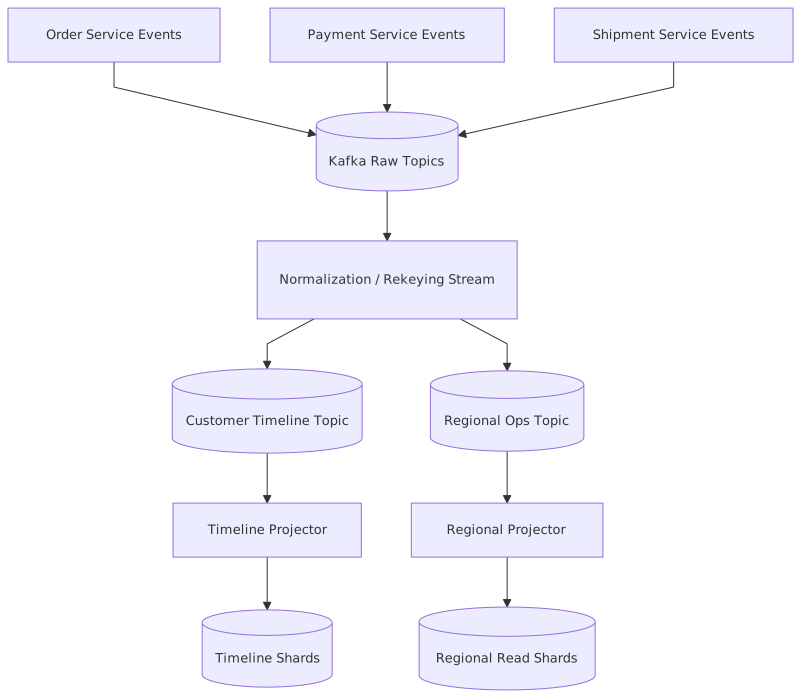
This is a healthy pattern in enterprise systems. The raw event streams reflect service ownership. The normalized projection streams reflect read-model needs. Mixing those concerns usually ends badly.
Query routing
A sharded read model needs a routing mechanism. This can live in:
- an API gateway for simple tenant or region routing,
- a dedicated query service,
- a shard map service backed by metadata,
- client-side routing in tightly controlled internal systems.
A static shard map is fine until it isn’t. Once you start relocating tenants, splitting large shards, or creating dedicated premium-customer shards, the map becomes dynamic operational metadata. Treat it like configuration with change history, versioning, and rollback.
Reconciliation and replay
Eventually consistent read models drift. Not because your team is careless, but because production is a machine for discovering edge cases.
A projection may fail halfway through a batch. A consumer may be paused. A schema change may skip a field in one shard. A rebalancing event may cause duplicate consumption. If your architecture has no reconciliation story, it is not production-ready.
You need at least two mechanisms:
- Replay/rebuild
Reconstruct a shard from a retained event stream or snapshot + tail events.
- Reconciliation
Compare read-side state against source-of-truth references or invariant checks. This might be count comparisons, hash totals, sequence tracking, or business-level validation.
A mature system separates “projection correctness” from “projection freshness.” They are different. A shard can be fresh and wrong.
Multi-model read side
Many enterprises use more than one read storage technology:
- relational DB for structured operational queries,
- search engine for free-text and faceted search,
- cache for low-latency session or dashboard snippets,
- columnar or warehouse store for reporting.
This is still CQRS. It is not cheating. But each model may need a different shard strategy. Search shards may follow index-level distribution, while operational read stores may follow tenant or region. Keep the language clear: one domain event stream can feed multiple sharded read models for different purposes.
Migration Strategy
The worst time to redesign the read side is after you’ve already coupled every consumer to one giant database. Which is, unfortunately, when most enterprises start.
So migration matters. And the right migration is almost always progressive, not heroic.
Use the strangler fig pattern. Wrap the old read path, grow new sharded projections beside it, and cut traffic over in slices.
A practical progression looks like this:
Stage 1: Introduce explicit read APIs
If consumers query the read database directly, stop there first. Put a query service or API layer in front. This creates a seam. Without a seam, there is no migration, only surgery.
Stage 2: Build one new sharded projection for one painful use case
Do not “shard the whole read side.” Pick the most constrained, highest-value use case: customer timeline, case dashboard, regional order board, partner reporting. Build a new projection from the event stream. Route only that API to the new model.
Stage 3: Run dual reads and compare
For a period, execute queries against both the legacy and new read models. Compare shape, counts, and critical fields. This is where reconciliation becomes practical, not theoretical.
Stage 4: Shift traffic gradually
Start with internal users or one tenant or one geography. Measure latency, correctness, lag, and operational burden.
Stage 5: Split hot shards
Only after observing production traffic should you introduce shard splits or premium isolation. Premature shard topology design is architecture cosplay.
Stage 6: Decommission legacy read paths
Do this later than you want. Enterprises forget hidden consumers. They always exist.
Here is the migration pattern in one view:
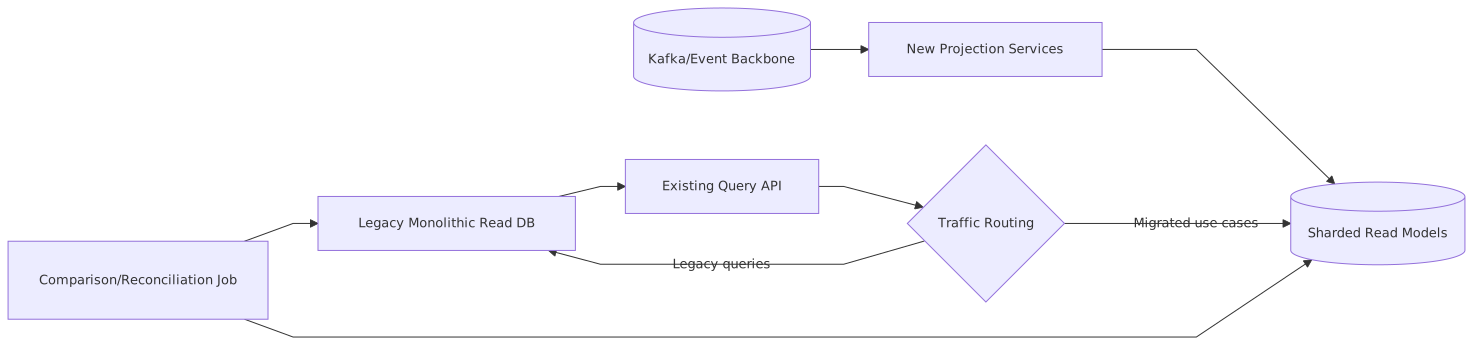
A key migration decision is whether to backfill from source tables, replay historical events, or use snapshots plus recent events. Replay is conceptually cleaner but may be impractical with poor event retention or bad historical event quality. Backfill from operational tables is faster but risks baking old coupling into the new world. Snapshots plus event catch-up are often the compromise.
There is no pure answer here. There is only what your system can survive.
Enterprise Example
Consider a global insurance company. Not a toy startup. A company with multiple lines of business, regional regulations, acquired systems, and a customer service operation that lives on screens.
They implemented CQRS around policy administration, claims, billing, and customer communications. Domain events flowed through Kafka. Over time they built a large customer service read model used by agents to answer “what is happening with this customer?” It combined policy status, recent claims, payment issues, correspondence history, and open tasks. event-driven architecture patterns
At first this was brilliant. Agents got a unified timeline. Average handle time dropped. Product loved it.
Then scale arrived in the ugly enterprise way:
- one region acquired another book of business,
- some tenants became enormous,
- claim events surged after severe weather incidents,
- billing generated a high volume of updates,
- regional data residency rules tightened.
The single read store became a traffic jam. Worse, projection rebuilds after schema changes took days. During catastrophe events, agent timelines for unaffected regions slowed because everything shared one path.
The company moved to sharded read models with these principles:
- bounded context views remained distinct under the hood,
- the agent timeline projection was sharded by
region + customer_id, - large partner-distribution tenants got isolated shard groups,
- search moved to a dedicated index pipeline,
- reporting left the operational read path and went to a separate analytical projection.
Why region + customer_id? Because agent workflows were region-local, compliance rules were region-specific, and most queries centered on a customer. It wasn’t mathematically perfect. It was operationally honest.
They used Kafka Streams to normalize events from policy, claims, billing, and communications into a customer-timeline topic keyed on the shard strategy. Projection services updated region-local document stores. A query router resolved the region and customer to the correct shard.
The migration took nine months. Not because the technology was hard, although some of it was, but because semantics had to be repaired. “Customer contact preference” meant different things in two acquired systems. Claims used one identifier, billing another. Reconciliation surfaced these domain fractures quickly. Good. Better in migration than in front of agents.
The result:
- p95 timeline latency dropped from 4.8 seconds to under 600 ms,
- catastrophe-event hotspots remained local to affected shard groups,
- regional rebuilds took hours instead of days,
- premium partner tenants no longer starved smaller customers,
- support teams could monitor lag and correctness per shard.
But the system also became more operationally demanding. They added shard metadata management, replay tooling, and explicit reconciliation services. That is the part conference talks skip. Scale is not free. It just changes where you pay.
Operational Considerations
This is where many elegant whiteboard designs become expensive reality.
Shard skew
Even with a sensible shard key, load distribution may be uneven. A few customers, regions, or tenants can dominate traffic. You need metrics for:
- events per shard,
- storage growth per shard,
- query rate per shard,
- p95 and p99 latency per shard,
- consumer lag per shard.
If you cannot see skew, you cannot manage it.
Hot partition handling
Kafka partition hotspots often mirror shard hotspots. Sometimes the only fix is changing keys or introducing higher-cardinality partitioning in downstream normalized topics. Sometimes it is isolating outlier tenants. Sometimes it is admitting one giant customer deserves dedicated infrastructure.
Replay tooling
Rebuilds should be routine, not heroic. Provide:
- replay from offset/time range,
- replay into a shadow shard,
- compare-and-swap cutover,
- throttling to avoid collateral damage.
Schema evolution
Read models are downstream consumers of events. When event schemas evolve, read-side teams discover whether “backward compatible” really means anything. Version events carefully. Prefer additive changes. Maintain explicit translation layers in projection pipelines when semantics shift.
Idempotency and duplication
At-least-once delivery is normal. Projection updates must be idempotent or sequence-aware. A duplicate event that increments counters twice will quietly poison a shard. Those are the worst bugs: plausible and wrong.
Observability
At minimum track:
- consumer lag,
- projection failure counts,
- dead-letter rates,
- reconciliation mismatches,
- stale shard age,
- routing errors,
- cache hit/miss if caching is involved.
Disaster recovery
Sharded read models can improve blast-radius isolation, but recovery planning gets more involved. Decide:
- do all shards need equal recovery priority?
- can some be rebuilt while others fail over?
- where are snapshots stored?
- can regional shards recover independently under data sovereignty constraints?
Tradeoffs
Read model sharding is a trade, not a victory parade.
What you gain
- better horizontal read scalability,
- lower latency for localized query patterns,
- noisy-neighbor isolation,
- bounded blast radius,
- faster targeted rebuilds,
- cleaner alignment between read models and use cases.
What you pay
- more infrastructure,
- more routing logic,
- more operational metadata,
- harder debugging,
- more nuanced reconciliation,
- more complex migrations,
- more sophisticated platform engineering.
And there is a subtle cost: once you shard the read side, people may assume the write side can be bent the same way. Sometimes yes. Often no. CQRS lets the read side optimize aggressively because it is not the write side. Don’t let read-model success tempt the organization into careless transactional partitioning.
Failure Modes
These systems rarely fail in exotic ways. They fail in predictable ways that teams failed to respect.
1. Wrong shard key
The classic error. Chosen for even distribution, disastrous for common queries. The system scales and still feels slow because every meaningful request fans out across shards.
2. Cross-shard query explosion
A product manager adds “global search across all customers with live freshness” to a model designed for customer-local reads. Suddenly every request is a distributed scatter-gather operation. Congratulations, you rebuilt the original bottleneck with more network hops.
3. Silent divergence
One shard misses or misprocesses a subset of events after a deploy. Everything looks healthy except one tenant’s totals are subtly wrong. Without reconciliation, this can persist for weeks.
4. Rebuild paralysis
Historical replay works in theory but not at production event volumes. The architecture depends on a rebuild path that nobody has proven under pressure.
5. Routing drift
Shard maps change, but caches or services hold stale routing metadata. Reads go to the wrong place or old shard. These are nasty because they look like data corruption.
6. Overloaded normalization pipeline
Teams focus on shard stores and forget the stream processing layer that rekeys and enriches events. The supposed “scalable read side” now bottlenecks in one central transformer.
7. Semantic corruption during migration
Legacy data fields are interpreted differently in the new projection. The system is technically correct according to the new schema and operationally wrong according to users.
When Not To Use
This is the part too many architecture articles whisper. I prefer to say it plainly.
Do not use read model sharding when:
- your dataset is modest and query latency is already acceptable,
- your actual problem is poor indexing or badly designed queries,
- your team lacks event quality or reliable domain events,
- consumers still directly depend on database internals,
- the dominant read patterns require broad cross-entity joins that won’t shard cleanly,
- your organization cannot support reconciliation and replay operations,
- your bounded contexts are still unresolved and the domain language is unstable.
Sharding amplifies both strengths and confusion. If your event model is muddy, your shard topology will fossilize that mud. If your domain semantics are unsettled after a merger or major product rewrite, wait. Build cleaner projections first. You can scale a good model later. Scaling a bad one just makes the mistakes expensive.
Sometimes a read replica, a search index, a cache, or one purpose-built projection is enough. Architecture should solve today’s asymmetry, not tomorrow’s conference talk.
Related Patterns
Read model sharding sits near several patterns that are often confused with it.
CQRS
The umbrella separation of read and write concerns. Sharding is one scaling tactic within the read side.
Event sourcing
Often paired with CQRS, but not required. Read model sharding works with event-sourced systems and with systems that simply publish domain events from state-based writes.
Strangler fig migration
The practical way to adopt sharded read models progressively alongside legacy read stores.
Materialized views / projections
The actual read-side artifacts. Sharding applies to these views, not to some abstract “read database.”
Sagas and process managers
Relevant when workflows emit events across services, but they are not substitutes for projection design.
Search indexing
A specialized read model, often independently sharded by the search platform.
Data mesh
Sometimes invoked in large organizations, but this is not the same thing. A federated data product model may coexist with CQRS read sharding, yet operational read models remain application-facing concerns, not just analytics concerns.
Summary
Read model sharding in CQRS architecture is what happens when the read side graduates from convenience to responsibility. It is a way to scale not just throughput, but meaning. Done well, it keeps customer timelines local, regional dashboards responsive, premium tenants isolated, and rebuilds survivable. Done badly, it turns one slow database into a distributed guessing game.
The essential lesson is this: shard by domain truth as experienced in reads, not by infrastructure convenience alone. Let bounded contexts, aggregate affinity, tenancy, and geography shape the partitioning strategy. Use Kafka and stream processing to normalize event flows where necessary. Migrate progressively with a strangler approach. Build reconciliation before you congratulate yourself. Expect replay, skew, routing changes, and semantic surprises. They are not edge cases. They are the job.
And know when not to do it. A simple system with a well-indexed read model is a beautiful thing. Don’t shatter it just because the word “shard” sounds like scale.
But when the read side really has become a city with too much traffic, sharding is not an exotic trick. It is urban planning for software. And like all urban planning, it works best when you respect the neighborhoods.
Frequently Asked Questions
What is CQRS?
Command Query Responsibility Segregation separates read and write models. Commands mutate state; queries read from a separate optimised read model. This enables independent scaling of reads and writes and allows different consistency models for each side.
What is the Saga pattern?
A Saga manages long-running transactions across multiple services without distributed ACID transactions. Each step publishes an event; if a step fails, compensating transactions roll back previous steps. Choreography-based sagas use events; orchestration-based sagas use a central coordinator.
What is the outbox pattern?
The transactional outbox pattern solves dual-write problems — ensuring a database update and a message publication happen atomically. The service writes both to its database and an outbox table in one transaction; a relay process reads the outbox and publishes to the message broker.