⏱ 21 min read
Most enterprise systems don’t fail because they can’t store data. They fail because they can’t tell the truth fast enough.
That is the real pressure behind reactive read models in CQRS. Not fashion. Not architecture astronautics. Not some vendor deck with arrows in six shades of blue. The problem is more grounded than that. Businesses need answers now, but their transactional systems were built to preserve correctness first, history second, and speed of insight somewhere far behind. So teams pile reports on top of OLTP databases, bolt caching onto fragile services, and wonder why a dashboard showing “current account exposure” disagrees with the customer portal by twelve minutes and three retries.
Reactive read models are one of the few patterns that address this honestly. They accept a blunt truth: the shape of data used to change the business is often not the same shape of data used to understand the business. CQRS makes that split explicit. Reactive read models make it operational. They continuously project domain changes into query-optimized views, usually through streams, events, and asynchronous processing. Done well, this gives you systems that are responsive under load, explicit about eventual consistency, and capable of evolving around business language rather than database convenience.
Done badly, it gives you distributed confusion at scale.
That distinction matters. Because this pattern is powerful, but it is not free. It creates new models, new timing assumptions, new failure modes, and new responsibilities around replay, reconciliation, and semantics. The engineering challenge is not just “how do I build a projection?” It is “what truths does this projection represent, at what lag, under which business invariants, and how do I know when it is wrong?”
That is architecture territory.
Context
CQRS emerged because enterprise systems are pulled in two directions at once. On the write side, you want rich domain behavior, transactional safety, and business invariants protected close to the model. On the read side, users want denormalized views, flexible filtering, low-latency APIs, and analytics-friendly structures. Trying to satisfy both with one model is a bit like asking a forklift to win a Formula 1 race. It can move, certainly. But not in the way you need.
Reactive read models fit naturally when domain events or change streams are already flowing through the estate. In modern enterprises this often means Kafka, Pulsar, or cloud event infrastructure feeding a set of projection services. A customer profile view may be assembled from customer onboarding, address change, credit risk updates, and product holding events. A supply chain cockpit may pull together shipment milestones, warehouse scans, order amendments, and customs statuses. Nobody wants to join all that on demand from live transactional services. The query path would become a hostage to every upstream dependency.
This is where domain-driven design sharpens the conversation. Read models are not just technical caches. They are bounded-context-specific interpretations of domain facts. The “Order Summary” projection in Sales is not the same thing as the “Fulfillment Work Queue” in Logistics, even if both mention the same order ID. They exist to serve distinct user questions, with different semantics, latency tolerance, and completeness rules.
That semantic precision is the difference between a useful architecture and an elegant lie.
Problem
Traditional CRUD systems tend to centralize data around persistence concerns. Tables are normalized to support updates. APIs mirror entities. Queries become ever more complex because the user does not care about your schema. They care about a business question.
- “Show me all premium customers likely to churn.”
- “What inventory can I promise by region in under 50 milliseconds?”
- “Why was this payment held and what changed since yesterday?”
- “Which claims are blocked due to missing documents but still inside SLA?”
These are not transactional write concerns. They are read concerns, and they almost always need data shaped across aggregates, services, or bounded contexts.
In a microservices landscape the problem gets worse. Data is intentionally decentralized. The Order service owns orders. The Payment service owns payments. The Shipment service owns shipments. This is right from a domain ownership perspective, but miserable if your customer service portal needs a coherent “where is my order?” view. Synchronous fan-out across services creates latency, fragility, and cascading failure. Shared databases break autonomy and eventually break teams.
Reactive read models solve this by materializing the answer ahead of time.
Not eventually in the abstract. Specifically. Deliberately. As a product of domain changes.
Forces
Several forces push teams toward reactive read models, and these forces often conflict.
1. Business responsiveness versus transactional integrity
Write models must enforce invariants. If a trade breaches limit, the trade should not book. If a claim is invalid, it should not progress. But read consumers often accept slightly stale data if they get fast and scalable access. The architecture must separate “must be correct now” from “must be visible soon.”
2. Domain semantics versus generic integration
Event streams are seductive. Teams publish technical events like row_updated or customer_table_changed and call it integration. That is not domain-driven design; that is database exhaust. Reactive read models depend on meaningful signals. OrderPlaced, PaymentAuthorized, ShipmentDelayed carry business semantics. Generic change notifications force downstream consumers to reverse-engineer intent, which is brittle and expensive.
3. Independence of services versus consistency of user experience
Microservices want autonomy. Product teams want clean boundaries. Users want one screen with one answer. Reactive projections let you preserve ownership of writes while composing a coherent read experience elsewhere.
4. Throughput versus replayability
Streams let you scale. But at enterprise scale, replay and rebuild become operationally decisive. A projection corrupted by a bug must be reconstructable. That means immutable event histories or durable logs, versioned schemas, and projection logic you can rerun safely. Throughput without replay is bravado.
5. Simplicity versus specialization
A single relational database is simpler. But it pushes every use case through the same shape. Reactive read models allow specialized storage: Elasticsearch for search, Redis for ultra-fast key lookups, Cassandra or DynamoDB for high-volume denormalized views, columnar stores for analytics. Useful, yes. Simple, no.
Solution
The solution is to treat reads as first-class products of domain change.
Commands hit the write model inside a bounded context. The write model validates intent and applies state transitions. Those transitions produce domain events or are captured through a transaction log / outbox. Reactive processors then subscribe to these events and build one or more read models optimized for specific queries. APIs and UIs query the read models, not the write model.
The word reactive matters. We are not talking about nightly ETL. We are talking about continuously updated projections with explicit lag behavior. When a payment is authorized, the customer account view should reflect that quickly, often within seconds or less. When an address changes, shipping eligibility views should be updated automatically. The system reacts to business facts as they happen.
At its best, this architecture gives you three things:
- Query performance because data is already shaped for the question.
- Operational resilience because the read path is decoupled from synchronous upstream dependencies.
- Evolutionary design because new read use cases can be built by projecting existing streams without tearing open write models.
But there is a price. You now own consistency windows, projection correctness, idempotency, schema evolution, replay strategy, and reconciliation workflows. These are not implementation details. They are the architecture.
Architecture
A typical enterprise architecture for reactive read models in CQRS looks something like this:
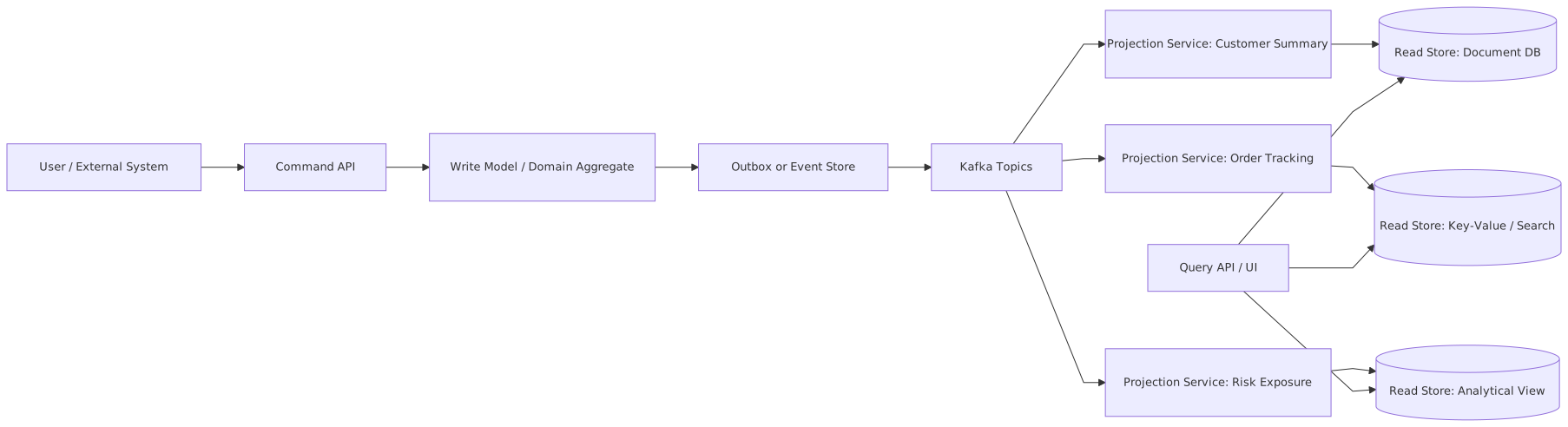
This diagram hides the hard parts, of course. Architecture diagrams always do. The truth lives in the semantics between the boxes.
Write side
The write side should be organized around aggregates and invariants, not around reporting convenience. This is where domain-driven design earns its keep. If your Order aggregate has to coordinate too many business rules, maybe the aggregate boundary is wrong. If your service emits events that expose persistence mechanics instead of business transitions, your model is undercooked.
A healthy write side emits domain events because something meaningful happened, not because a row was touched. That distinction matters enormously for projections. A ShipmentDelayed event can update customer notifications, SLA views, operational dashboards, and compensation processes. A shipment.status = 7 change just spreads confusion.
Event transport
Kafka is often the practical choice in large enterprises. It provides durable logs, partitioned scalability, consumer groups, replay, and decent operational maturity. More importantly, it gives you a backbone for distributing domain changes without forcing consumers into lockstep.
Still, Kafka is not magic. Ordering is generally guaranteed only within a partition. That means your partitioning key must line up with the semantics your projections need. If all events for an order must be processed in sequence, partition by order ID. If a projection needs causally ordered customer events, use customer ID. Get this wrong and you will spend months writing compensating code for race conditions your topology created.
Projection services
Projection services listen to topics, transform events, and update read stores. Each projection should have a clear purpose and ownership. This is not a dumping ground for every possible query. A “Customer 360” read model for a service center has a different purpose than a “Collections Prioritization” view. Separate them when the consumers, semantics, or nonfunctional requirements differ.
These services must be idempotent. They must handle duplicates, delayed events, reordering within practical limits, and versioned payloads. They should persist checkpoints or offsets carefully, ideally tied to successful storage updates. If you acknowledge the stream before the write commits, you will lose updates. If you write without deduplication, retries will corrupt counters and summaries.
Read stores
The storage choice should serve the query. This sounds obvious and is rarely practiced with enough discipline.
- Document stores for aggregated customer or case views.
- Search indexes for free text and faceted queries.
- Key-value stores for ultra-low-latency lookups.
- Relational read databases for familiar tabular queries and reporting joins.
- Time-series or analytical stores for trend and event analysis.
Do not pick one read store “for consistency.” Pick the right one for the read model’s job. Consistency in architecture is overrated; coherence is what matters.
Query side
The query API should make the consistency model visible where needed. If data may lag, say so. Return projection timestamps, event positions, or freshness indicators for sensitive domains. In many enterprises the worst failure is not stale data. It is stale data pretending to be current.
Domain semantics and read model design
This is where many implementations drift into mediocrity. Teams build projections as if they were technical denormalizations. In reality, the read model should speak the language of the user and the bounded context consuming it.
Take a banking example. “Available balance,” “ledger balance,” and “exposure” are not interchangeable. They may derive from related events, but each term carries domain semantics, business rules, and timing assumptions. A reactive read model must preserve that meaning. If you flatten them into one field because the UI “just needs a number,” you have not simplified the domain; you have hidden a future incident.
A good read model answers a named business question.
- Customer Service: “What does the customer believe is happening?”
- Operations: “What work needs attention now?”
- Compliance: “What evidence trail supports this decision?”
- Finance: “What has been recognized versus merely signaled?”
Those are different models, fed by overlapping facts, each with their own projection logic.
Reconciliation: the part architects should talk about more
Reactive read models are eventually consistent. Fine. But eventually according to whom? And what if they never converge because of missed messages, corrupted state, bad projection code, schema mismatches, or upstream event defects?
This is why mature architectures include reconciliation as a first-class concern.
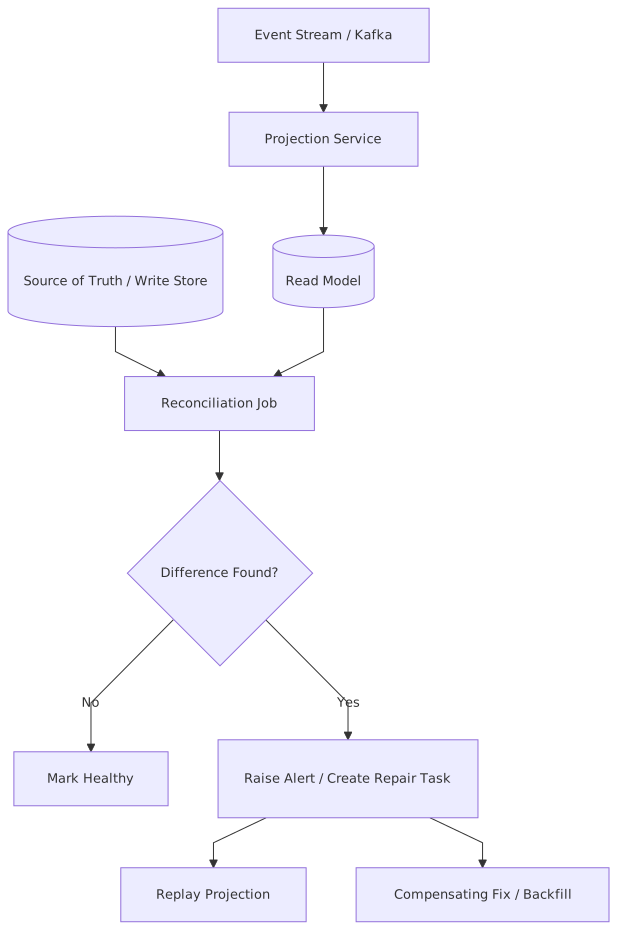
Reconciliation can be periodic or continuous. It can compare aggregate counts, hashes, business keys, balances, or sampled entity snapshots. In financial and regulated domains, reconciliation is non-negotiable. In retail, maybe less strict, but still valuable for trust.
The point is simple: a projection is not correct because your code compiles. It is correct because you can prove, continuously, that it matches the business facts it claims to represent.
Some teams resist this because they think replay is enough. Replay is necessary, not sufficient. If the source events themselves were wrong, replay reproduces the wrongness faithfully. Reconciliation catches divergence. Governance and event quality prevent it from recurring. EA governance checklist
Migration Strategy
The clean-sheet version of CQRS is intoxicating. It is also how many transformation programs burn money. Most enterprises do not get to start over. They have monoliths, shared schemas, brittle reporting queries, and ten years of accidental coupling. So the only sensible migration strategy is progressive strangler migration.
Do not replace the whole read path in one dramatic move. Strangle one read use case at a time.
Step 1: Identify high-pain read scenarios
Look for the places where current reads are too slow, too expensive, too coupled, or too fragile. Customer dashboards that fan out to six services. Operational worklists timing out at peak load. Reporting queries that lock transactional tables. Start where pain is obvious and measurable.
Step 2: Establish a trustworthy event source
If the legacy system does not emit domain events, use an outbox pattern or change data capture as a bridge. Outbox is better when you can modify the application; CDC is useful when you cannot. But remember the semantic warning: CDC tells you what changed, not necessarily what it meant. Often a translation layer is needed to lift technical changes into domain events fit for downstream projection.
Step 3: Build one projection with one consumer
Do not create an enterprise-wide read platform before proving a real use case. Build a projection for a named screen or API. Measure latency, freshness, and correctness. Add reconciliation early. Make the consistency contract explicit to users.
Step 4: Run in parallel
For a time, serve the old and new read paths side by side. Compare outputs. Use shadow traffic if possible. This is where many hidden semantic differences emerge. Not because the new architecture is wrong, but because the old one encoded undocumented business logic in SQL views, ETL scripts, or front-end transformations. Parallel run surfaces those ghosts.
Step 5: Cut over gradually
Shift one channel, one region, or one business segment first. Keep rollback possible. The strangler pattern is not timid; it is disciplined.
Step 6: Expand by bounded context
Once one projection is stable, extend the event backbone and projection patterns to adjacent use cases. But keep ownership local. Do not centralize all read model logic into one “data team service.” That simply recreates the reporting bottleneck in modern clothing.
Here is a practical migration shape:

The gateway can route selected queries to the new read model while the rest still hit legacy views. That buys you migration without a big-bang rewrite.
Enterprise Example
Consider a global insurer handling claims across policy, billing, fraud, and document management systems. The old architecture centered on a large relational core. Claims agents opened a case screen that triggered synchronous calls to five systems plus a handful of SQL joins against replicated tables. It worked on quiet days. On storm events, claim volumes spiked, latency climbed above ten seconds, and agents began opening duplicate sessions because they assumed the portal had frozen. That increased load further. The classic death spiral.
The insurer introduced a CQRS-style read architecture for the claims workspace.
On the write side, claims processing remained in domain services responsible for policy validation, claim intake, reserve updates, and fraud signals. Each meaningful state transition emitted domain events through an outbox into Kafka: ClaimRegistered, DocumentReceived, ReserveAdjusted, FraudFlagRaised, PaymentIssued, CoverageConfirmed.
Projection services built several read models:
- Claims Workspace View for agents, denormalized by claim ID, including policy summary, claimant details, outstanding tasks, recent events, and payment status.
- Supervisor Queue View highlighting aged claims, SLA breaches, and high-risk indicators.
- Fraud Triage View combining claims events with external scoring and suspicious pattern markers.
- Customer Self-Service View with a deliberately simplified and legally safe version of claim status.
Notice the domain thinking here. There was no single “Claim Read Model.” There were several, because the business asks several different questions.
The migration started with just the Claims Workspace View for one country operation. The team used CDC initially because the core claims platform could not be modified quickly. They then introduced an anti-corruption translation service to map low-level database changes into domain events the projections could trust. Over time, strategic services moved to proper outbox-based publication.
The results were not miraculous, just solid. Workspace load times dropped from 8-12 seconds at peak to under 500 milliseconds for the majority of reads. Upstream outages no longer blanked the entire screen because the reactive view remained available, albeit occasionally a few seconds behind. Agent productivity improved because the UI no longer stitched data together in the browser. Most importantly, the insurer gained a replayable and observable read architecture they could extend to fraud and customer channels.
But there were scars. One projection bug doubled reserve adjustments during replay because the service was not idempotent. A later schema evolution broke one country’s fraud view because an optional field became mandatory in practice but not in contract. Both incidents reinforced the same lesson: reactive read models are production systems, not convenience layers.
Operational Considerations
Reactive architectures live or die in operations.
Freshness and lag monitoring
You need to know how far behind each projection is, in both technical and business terms. Kafka consumer lag is useful but incomplete. Business lag is better: “latest claim event projected 17 seconds ago” or “95th percentile order visibility delay is 3.2 seconds.” Users care about business freshness, not partition offsets. event-driven architecture patterns
Replay strategy
Every projection should be rebuildable. That means immutable source streams, versioned projection code, and a practical way to reprocess without taking down production reads. Sometimes this means rebuilding into a side store and swapping over. Sometimes it means replaying only from a known checkpoint after a code fix. Decide this before your first incident, not during it.
Schema evolution
Event contracts evolve. They always do. Use explicit versioning, tolerant readers where sensible, and governance around breaking changes. The worst enterprise events are neither stable enough to trust nor versioned enough to evolve. ArchiMate for governance
Idempotency and deduplication
At-least-once delivery is common. Duplicates happen. Retries happen. If your projection increments counters or aggregates amounts, you must deduplicate by event ID or maintain processed positions carefully. “Probably once” is not a delivery guarantee.
Backfills and historical corrections
Business corrections happen outside the happy path. Late-arriving data, policy amendments, canceled shipments, merged customer identities, account reversals. Your projection model must absorb correction events and sometimes backfill large historical ranges. If your read model only works for forward-only happy flows, it is not enterprise grade.
Security and data minimization
Read models often denormalize sensitive data aggressively. That can violate least privilege if unmanaged. Build projections intentionally for specific consumers and avoid dumping full source payloads into broad-access stores. A fast data leak is still a data leak.
Tradeoffs
Reactive read models are a trade.
You get speed, decoupling, and flexibility on the query side.
You pay with complexity, asynchronous reasoning, and operational discipline.
That trade is usually worth it when read performance and composition matter deeply. It is usually not worth it for small systems with simple queries and modest scale. There is no prize for introducing Kafka so that two screens can load slightly faster against one well-designed relational schema.
Other tradeoffs deserve candor:
- Consistency vs availability: read models remain available even if some upstream services are impaired, but they may be stale.
- Autonomy vs duplication: multiple projections repeat some transformation logic, but this duplication is often healthy because it preserves context-specific meaning.
- Flexibility vs governance: streams allow many downstream consumers, but unmanaged event proliferation becomes a semantic junkyard.
- Performance vs storage cost: denormalized read stores duplicate data. Storage is cheap until governance, security, and retention make it expensive again.
Failure Modes
This pattern fails in predictable ways. We should stop pretending otherwise.
Semantic drift
Events start meaningful and gradually become vague or overburdened. Downstream consumers infer behavior from optional fields and undocumented conventions. Eventually every projection interprets the same event differently. This is a governance failure masquerading as agility.
Projection corruption
A bug, replay defect, or bad deduplication rule corrupts the read model. Users trust the screen anyway. This is why reconciliation and freshness indicators matter.
Hidden synchronous dependency
Teams build a “reactive” read model but still call upstream services synchronously to fill in missing fields. Now the read path has all the complexity of asynchronous projection and all the fragility of runtime coupling. Pick a side.
Partitioning mismatch
Events requiring ordered handling are partitioned poorly. Projections see updates out of sequence and produce impossible states. This is an architectural topology error, not an implementation nit.
Unbounded read model growth
A popular projection becomes the answer to everything. More fields, more consumers, more semantics, more ownership confusion. Soon it is a distributed monolith in JSON form.
Replay paralysis
Events exist, but replay takes days, saturates infrastructure, or cannot be done safely in production. The team discovers too late that “rebuildable” was only true in small test environments.
When Not To Use
Reactive read models are not a default.
Do not use them when a straightforward relational model solves the problem cleanly. If the system is modest, the query patterns are simple, and consistency must be immediate across read and write, a single model is often better. Mature SQL is still one of the best tools in enterprise software.
Do not use them if your domain events are not yet trustworthy. Without good domain semantics, you are just moving data around asynchronously and calling it architecture.
Do not use them where operational maturity is low. Running Kafka, projection fleets, replay pipelines, and reconciliation jobs takes discipline. A small team already struggling with basic deployment hygiene will not be helped by adding distributed state propagation.
Do not use them for highly volatile exploratory reporting where BI tools over a warehouse or lakehouse are more appropriate. Not every read need belongs in an application-grade projection.
And do not use them when your primary need is transactional workflow, not query optimization. CQRS is often sold as a universal good. It isn’t. Sometimes it is simply more moving parts than the problem deserves.
Related Patterns
Reactive read models sit among a family of useful patterns.
- Event Sourcing: Often paired with CQRS, but not required. Event sourcing stores domain events as the source of truth. Reactive projections then become a natural consequence. But you can build reactive read models from outbox events without event sourcing the write model.
- Outbox Pattern: Essential for reliable event publication when using transactional databases. It prevents the classic “database commit succeeded but event publish failed” split-brain.
- Change Data Capture: Useful during migration, especially for legacy systems you cannot easily modify. Best treated as a bridge, not a long-term substitute for domain events where semantics matter.
- Strangler Fig Pattern: The sensible migration strategy for introducing new query paths incrementally.
- Materialized Views: A broader category that includes reactive projections. The difference is the stronger architectural role in CQRS and domain-oriented event propagation.
- Saga / Process Manager: Coordinates long-running business processes on the write side; projections often give visibility into saga state, but should not be confused with process orchestration itself.
- Anti-Corruption Layer: Crucial when lifting technical events or legacy changes into a cleaner domain language for downstream consumers.
Summary
Reactive read models in CQRS are not really about reads. They are about making business truth consumable at the speed the enterprise requires.
They work because they accept a design truth many systems avoid: commands and queries want different things. The write side wants integrity, invariants, and transactional safety. The read side wants shape, speed, and composition. By projecting domain changes into dedicated query models, we get systems that are faster to read, more resilient under load, and easier to evolve around real business questions.
But the pattern only pays off if you treat semantics seriously. Domain events must mean something. Read models must be designed around bounded contexts and user questions. Migration must be progressive, usually through a strangler approach. Reconciliation must exist because eventual consistency without verification is just wishful thinking. And operations must be engineered for lag, replay, schema evolution, and failure.
The enterprise lesson is simple and hard at the same time: build read models as products, not byproducts.
Because in the end, the business does not care that your events are elegant or that your Kafka cluster is beautifully partitioned. It cares whether the screen in front of an employee, customer, or regulator reflects the right business story, quickly enough to act.
That is the standard.
And reactive read models, used with discipline, are one of the few architectural tools that can meet it.
Frequently Asked Questions
What is CQRS?
Command Query Responsibility Segregation separates read and write models. Commands mutate state; queries read from a separate optimised read model. This enables independent scaling of reads and writes and allows different consistency models for each side.
What is the Saga pattern?
A Saga manages long-running transactions across multiple services without distributed ACID transactions. Each step publishes an event; if a step fails, compensating transactions roll back previous steps. Choreography-based sagas use events; orchestration-based sagas use a central coordinator.
What is the outbox pattern?
The transactional outbox pattern solves dual-write problems — ensuring a database update and a message publication happen atomically. The service writes both to its database and an outbox table in one transaction; a relay process reads the outbox and publishes to the message broker.