⏱ 20 min read
Most event-sourced systems begin with a noble idea and end with a stopwatch.
At first, replaying a few dozen events to rebuild an aggregate feels elegant, almost virtuous. We tell ourselves this is the cleanest expression of the domain: facts recorded over time, decisions emerging from history, no mutable lies smuggled into the data model. Then the business grows up. The order aggregate now has twenty thousand state transitions. The pricing engine emits corrections. Compliance wants immutable retention. Fraud rules introduce compensating events. Suddenly every command is dragging a caravan of old decisions behind it.
That is the moment snapshots stop being a clever optimization and become architecture.
A snapshot is not a shortcut around event sourcing. It is a treaty between historical truth and operational reality. If you get that treaty right, your system remains faithful to the domain while still meeting latency, throughput, and recovery expectations. If you get it wrong, you create a second truth source, poison replay semantics, and spend your nights reconciling ghosts.
This article is about that treaty: how to think about snapshot strategies in event stores, how to design them so they respect domain-driven design, how to migrate toward them without blowing up production, and where they fit in Kafka-heavy, microservice-laden enterprise estates. More importantly, it is about when not to use them. Because many teams do not have a snapshot problem. They have a badly bounded domain, a bloated aggregate, or a read-model abuse problem wearing a snapshot hat. event-driven architecture patterns
Let’s start there.
Context
Event sourcing is compelling because it records what happened, not merely what is. In a rich domain, that distinction matters. A loan application that moved from submitted to under review to conditionally approved to withdrawn tells a very different story than a row that simply says status = withdrawn. The sequence carries intent, timing, policy interactions, and causality. It is the business narrative.
In domain-driven design terms, the event stream is often the most faithful representation of an aggregate’s lifecycle. The aggregate enforces invariants. Commands express intention. Events record facts. Projections shape those facts for reporting, search, operational dashboards, and integration. This is the good part.
The difficult part arrives when aggregate reconstruction becomes expensive. Every command that touches an aggregate usually needs current state. In a pure event-sourced model, current state is rebuilt by replaying the aggregate’s event stream in order. If a customer account has 50 events, this is trivial. If a warehouse inventory aggregate has 80,000 stock movements, reservations, adjustments, quarantines, and reconciliation events, this is not trivial. It becomes a tax on every write path.
Enterprise systems amplify the issue. Long-lived aggregates are common in financial services, insurance, supply chain, telecom, and regulated healthcare. Data retention rules stretch event streams over years. Versioned event schemas accumulate. Service boundaries drift. Replays become slower, more failure-prone, and more operationally expensive.
That is where snapshots enter. A snapshot captures the derived state of an aggregate at a specific event version. Instead of replaying from event zero, the event store or repository loads the latest valid snapshot and replays only subsequent events.
Simple idea. Dangerous in practice.
Because the moment you persist derived state, you are introducing an optimization that can quietly harden into a dependency. The architecture must ensure snapshots are disposable, reproducible, versioned, and semantically subordinate to the event stream. The events remain the source of truth. The snapshot is a cache with legal paperwork.
Problem
Without snapshots, aggregate load time grows with stream length. That growth is not linear in business pain; it is exponential in operational annoyance.
A single stream replay may still be acceptable, but multiply it across command handlers, retries, idempotency checks, API bursts, failovers, blue-green deploys, dead-letter reprocessing, and historical rehydration jobs, and the cost becomes visible. P99 latency rises. CPU burns. Backlogs creep in. Autoscaling masks the issue until finance notices the cloud bill.
Teams often respond with the wrong medicine.
Some split aggregates prematurely. Some bypass aggregate logic and write current state into side tables “for speed.” Some start caching deserialized aggregates without version discipline. Some offload command validation into read models. These are all ways of borrowing money from the future at ugly interest rates.
The real problem is narrower: how do we preserve event-sourced semantics while reducing replay cost and keeping recovery deterministic?
That question has several hidden sub-problems:
- How often should snapshots be taken?
- What exactly belongs in a snapshot?
- Who creates them: the command path, a background process, or the store itself?
- How do we version snapshots across schema and code changes?
- How do we validate snapshot correctness against the underlying event stream?
- How do we migrate existing systems toward snapshots safely?
- How do Kafka consumers, projections, and downstream services behave when snapshots are introduced?
- What happens when snapshots are stale, corrupted, missing, or semantically incompatible?
These are architecture questions, not library questions.
Forces
Snapshot strategy is governed by a set of forces that pull in opposite directions.
Fidelity vs performance
The closer you stay to pure replay, the more obviously correct the system feels. But purity burns CPU. Snapshots improve load time, especially for long-lived aggregates, but they add another persistence concern and another class of defects.
Write latency vs operational decoupling
Creating a snapshot synchronously on the write path keeps things simple but adds latency to command handling. Doing it asynchronously reduces command latency but introduces lag and edge cases around snapshot freshness.
Aggregate semantics vs generic infrastructure
A generic “snapshot every 100 events” rule is easy to implement. It is also often wrong. In DDD, some aggregates become expensive after 20 events because each event triggers complex invariant reconstruction. Others can happily replay 2,000 simple state changes. Snapshot cadence should reflect domain semantics, not infrastructure laziness.
Storage cost vs replay cost
Snapshots consume storage. In high-volume domains, especially if snapshots are frequent and large, the storage footprint can become serious. But the alternative is repeatedly paying replay cost in compute and latency.
Migration safety vs architectural cleanliness
Retrofitting snapshots into an established event store requires pragmatic compromises. You may carry dual-loading paths, reconciliation jobs, and compatibility code for longer than anyone likes. Architecture in enterprises is often less about elegance and more about changing the engine while flying over compliance territory.
Determinism vs evolving code
A snapshot is serialized state produced by a particular code version interpreting a particular event history. If your aggregate behavior changes, old snapshots may still deserialize while being semantically wrong. That is one of the nastiest failure modes because nothing obviously crashes.
Solution
The best snapshot strategy is usually boring, explicit, and domain-aware.
At a high level:
- Treat the event stream as the only source of truth.
- Persist snapshots as disposable acceleration artifacts.
- Bind each snapshot to an aggregate identifier, event stream version, snapshot schema version, and creation metadata.
- Load aggregate state from the latest compatible snapshot, then replay subsequent events.
- Rebuild or ignore incompatible snapshots rather than stretching semantics to fit.
- Reconcile periodically by comparing snapshot-derived state with full replay.
That is the core. The nuance lies in when to create snapshots and what shape they should take.
Snapshot timing strategies
There are four common strategies.
1. Fixed interval snapshots
Create a snapshot every N events.
This is the classic choice because it is easy to reason about. Every 100 or 500 events, persist a snapshot. It works well when event processing cost is roughly uniform and aggregates are structurally similar.
But fixed intervals can be crude. A payments aggregate with 50 complex events may benefit sooner than a customer profile aggregate with 500 simple events.
2. Time-based snapshots
Create a snapshot if the latest one is older than some duration.
This can make sense for aggregates that are loaded frequently but updated irregularly. It is less useful when event volume is the real driver of replay cost.
3. Cost-based snapshots
Create a snapshot when estimated replay cost exceeds a threshold.
This is the most architecturally mature approach. Measure replay time, event count, event weight, deserialization cost, or aggregate complexity, and snapshot when the cost justifies it. It is more work. It is also more honest.
4. Domain milestone snapshots
Create snapshots at meaningful business boundaries: month-end close, policy issuance, claim settlement, shipment dispatch, invoice finalization.
This is often the most underrated strategy. In DDD terms, these milestones carry semantic gravity. They also align beautifully with reconciliation, audit, and business support processes.
A good enterprise system often uses a blend: domain milestone snapshots plus a safety net based on replay cost.
Architecture
Let’s make this concrete.
At runtime, the aggregate repository should load like this:
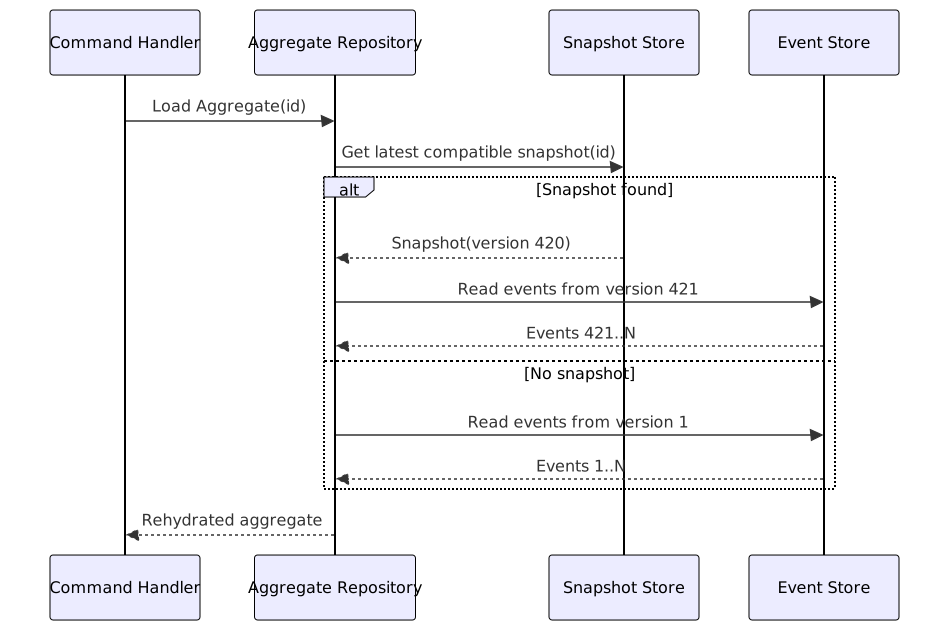
This looks simple because it is. The sophistication belongs in the compatibility rules and operational discipline, not in making the loading path clever.
What belongs in a snapshot
A snapshot should contain only the state required to restore aggregate behavior safely and efficiently. That usually means:
- aggregate identifier
- aggregate type
- event stream version at snapshot creation
- snapshot schema version
- serialized aggregate state
- creation timestamp
- optional code/build metadata
- optional checksum or hash
What should not be in the snapshot?
- unrelated projection data
- external service lookups
- denormalized read-model fluff
- transient caches
- state that can only be interpreted by side effects outside the aggregate boundary
This matters. A snapshot is not a read model. It is not a mini reporting database. It is a restart point for aggregate behavior.
That distinction is pure domain-driven design. The aggregate snapshot serves command-side consistency. Projections serve query-side convenience. Mix them and the model starts lying.
Snapshot compatibility
Snapshots are always vulnerable to model evolution. An old snapshot may reflect fields, invariants, or decision logic that no longer exist. So every snapshot must be evaluated for compatibility before use.
A robust policy usually includes:
- snapshot schema versioning
- aggregate code version compatibility checks
- safe fallback to full replay
- optional background re-snapshot after fallback replay
That gives us this lifecycle:
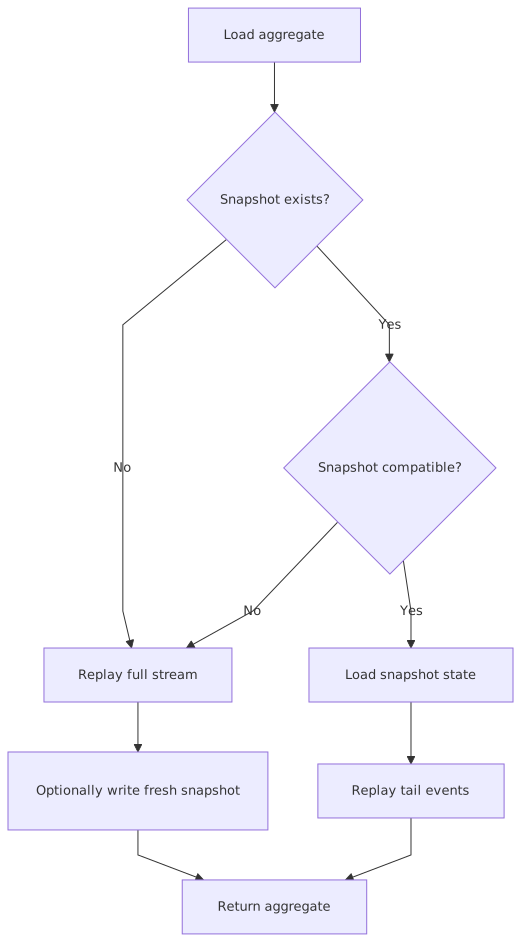
The key principle is ruthless: if compatibility is uncertain, throw the snapshot away and replay. CPU is cheaper than semantic corruption.
Snapshot creation path
There are three broad options.
Synchronous creation in the command path
After appending events, if snapshot threshold is met, persist a snapshot in the same unit of work or immediately after.
Pros:
- simple mental model
- snapshot immediately available
- fewer moving parts
Cons:
- increases write latency
- can extend transactional boundaries
- snapshot failures may complicate command handling
Use this when command throughput is moderate and consistency requirements are tight.
Asynchronous snapshot worker
The command path only appends events. A background processor detects streams crossing a threshold and generates snapshots.
Pros:
- lower write latency
- isolates snapshot work
- scales independently
Cons:
- snapshots lag behind events
- extra orchestration
- requires idempotent processing and monitoring
This is often the right enterprise default, especially with Kafka or internal event buses.
Native store-managed snapshots
Some event store products or frameworks support snapshots directly.
Pros:
- less custom code
- integrated retrieval
Cons:
- infrastructure strategy may dominate domain strategy
- portability can suffer
- snapshot semantics may be too generic
Use with caution. A store feature is not an architecture. The domain still owns the policy.
Snapshot timeline
Here’s the basic shape over time:
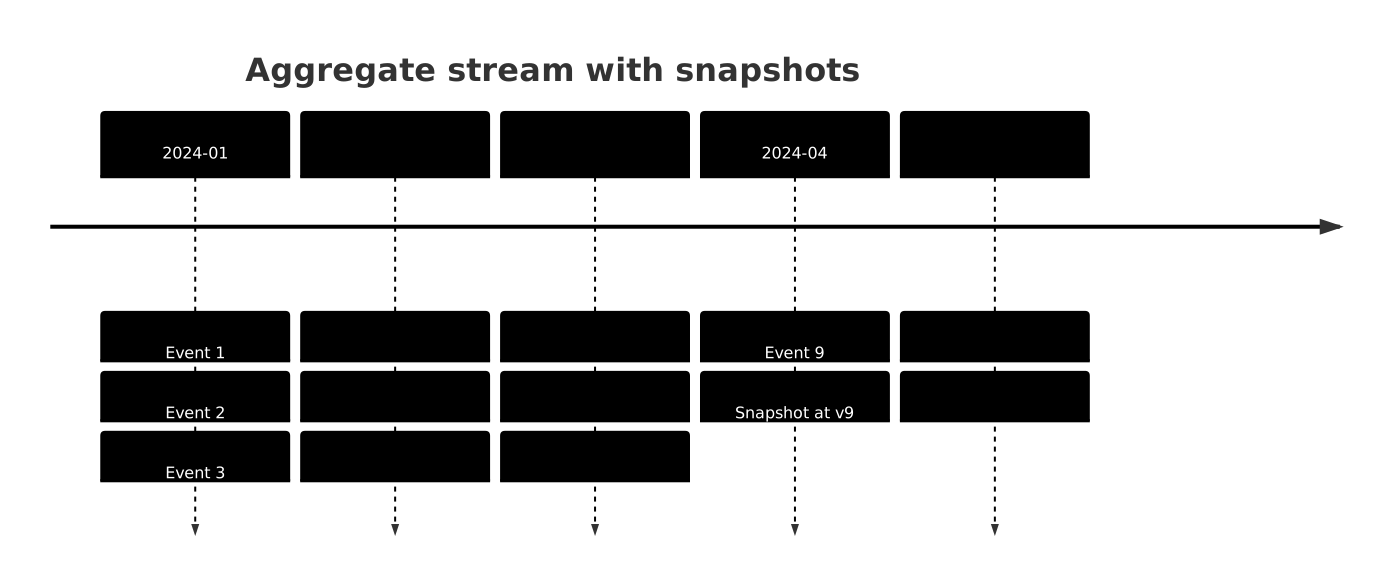
On load, state starts at snapshot v9, then replays events 10 and 11. That is the happy path. The unhappy path is where architecture earns its salary.
Migration Strategy
Most enterprises do not get to design snapshotting greenfield. They inherit an event-sourced estate where replay times have become noticeable, support teams have normalized slowness, and no one wants to risk a “performance optimization” that changes domain behavior.
So migrate with a strangler mindset.
Do not replace aggregate loading wholesale. Introduce snapshots as a compatible acceleration layer around the existing event store. The old path remains available until confidence is established.
A sensible progressive migration looks like this:
1. Observe before changing
Measure replay cost by aggregate type:
- event count distribution
- average and P95/P99 load times
- deserialization failures
- streams larger than threshold
- command latency attributable to hydration
This will quickly reveal whether the issue is really snapshots or bad aggregate design. If one aggregate type dominates replay cost, target it first.
2. Introduce snapshot persistence without using it
Generate snapshots for selected aggregates, but keep production reads on full replay. This gives you real data and lets you validate serialization, storage volume, and generation cost.
3. Run reconciliation
For each candidate aggregate:
- rebuild state from full replay
- rebuild state from snapshot + tail replay
- compare semantic state
- log any divergence
Reconciliation is not optional in mature systems. It is the bridge between confidence and wishful thinking. It also surfaces hidden nondeterminism in aggregate code, which is far more common than teams admit.
4. Enable read-through use for a small cohort
Turn on snapshot-assisted loading for one aggregate type, one bounded context, or one environment ring. Use feature flags. Keep fallback to full replay automatic.
5. Expand gradually
Broaden aggregate coverage based on measured gains and defect rate. Some aggregates will benefit enormously. Some barely move the needle. Architecture should notice the difference.
6. Retire migration scaffolding
After sufficient confidence, remove duplicated paths, but keep replay-based verification jobs. A snapshot strategy without periodic full replay validation is a system relying on memory of correctness rather than evidence.
This is the enterprise version of the strangler fig pattern: wrap, observe, redirect, retire. Boring and effective.
Enterprise Example
Consider a global insurer handling policy administration across multiple countries.
Each policy aggregate records events such as:
- PolicyCreated
- CoverageAdded
- CoverageRemoved
- PremiumAdjusted
- EndorsementIssued
- PaymentReceived
- RenewalQuoted
- RenewalBound
- PolicyCancelled
- ReinstatementProcessed
Policies can live for years. A commercial policy may accumulate thousands of events, especially where endorsements, retroactive adjustments, and regulatory annotations are involved. The core policy service uses event sourcing to preserve the full policy narrative and support auditability.
Initially, replay is acceptable. Then several things happen at once:
- New rating logic makes aggregate rehydration more expensive.
- Claims and billing microservices subscribe to Kafka topics emitted from policy events.
- A customer portal increases command volume for endorsements and renewals.
- Historical replay jobs for compliance consume too much infrastructure.
- During incident recovery, warm-up of command nodes becomes painfully slow.
The team decides to add snapshots.
A bad implementation would snapshot “whatever is in memory” every 100 events and call it done. That would fail within months because policy state evolves differently across countries and product lines.
A better implementation is domain-aware:
- Snapshot only command-relevant policy state, not portal view data.
- Use domain milestones: create a snapshot at policy issuance, each endorsement completion, and renewal bind.
- Add a replay-cost trigger for unusually active policies.
- Persist snapshot metadata including product version and schema version.
- Generate snapshots asynchronously using a worker fed from event-append notifications.
- Reconcile nightly by sampling policies and comparing full replay against snapshot+tail reconstruction.
- Publish no snapshots to Kafka. Kafka remains the integration and projection spine; snapshots stay internal to command-side persistence.
That last point is important. Teams sometimes ask whether snapshots should be emitted as events on Kafka for downstream consumers. Usually no. Downstream services care about business facts, not your optimization strategy. If another service needs a compacted current-state topic, build that as an explicit projection, not by leaking aggregate snapshots into the integration fabric.
The result in this insurer case is typical:
- command-side latency drops sharply for long-lived policies
- recovery time for service restarts improves
- storage grows moderately but predictably
- one class of hidden bugs emerges around old snapshots after aggregate code changes
- reconciliation catches them before business impact
That is a real enterprise pattern: performance gains are easy; preserving semantics through evolution is the hard part.
Operational Considerations
Snapshot architecture lives or dies in operations.
Monitoring
Track:
- snapshot hit rate
- average tail replay length after snapshot load
- snapshot generation lag
- snapshot generation failure rate
- incompatible snapshot rate
- fallback-to-full-replay rate
- reconciliation mismatch rate
- storage growth by aggregate type
If you are not measuring fallback rates, you are missing the canary. Rising fallback often signals schema drift, deployment mismatch, or broken compatibility assumptions.
Retention and cleanup
You rarely need every historical snapshot. In most systems, keeping only the latest snapshot per aggregate is enough. Sometimes keeping the latest few helps rollback scenarios. More than that usually smells like indecision.
Be careful with regulated domains. Snapshot retention is different from event retention. Events may be subject to immutable audit requirements. Snapshots usually are not, because they are derived artifacts.
Deployment discipline
Aggregate code changes can invalidate snapshots. This means deployment pipelines must treat snapshot compatibility as a first-class concern.
Good practice includes:
- explicit snapshot schema migration rules
- compatibility tests in CI
- replay suites with historical event samples
- feature-flagged rollout when aggregate behavior changes materially
Recovery and rebuild
You need a standard playbook for snapshot corruption or accidental deletion:
- disable snapshot reads if needed
- fall back to full replay
- regenerate snapshots in background
- compare rebuilt snapshots against expected metrics
If falling back to full replay is impossible operationally, your snapshots are not an optimization anymore. They are a dependency. That is a design smell.
Tradeoffs
Snapshotting is one of those techniques where the tradeoffs are obvious in theory and murky in lived systems.
The upside is clear:
- faster aggregate hydration
- lower command latency for long streams
- less compute spent reprocessing old events
- better recovery and startup characteristics
The costs are equally real:
- more persistence complexity
- versioning overhead
- reconciliation burden
- risk of semantic divergence
- operational tooling and monitoring requirements
A snapshot strategy also changes team behavior. Once snapshots exist, developers become less sensitive to oversized aggregates and event stream bloat. That can be dangerous. Snapshots should relieve pressure, not excuse poor aggregate boundaries.
There is also a subtle tradeoff between snapshot frequency and confidence. More frequent snapshots reduce replay cost further, but they create more derived artifacts to validate, migrate, and manage. There is a point where shaving another 10 milliseconds off hydration is simply not worth the semantic exposure.
My rule of thumb is blunt: optimize the streams that hurt, not the ones that merely exist.
Failure Modes
This is where most articles go soft. They should not. Snapshot strategies fail in recognizable ways.
Semantically stale snapshots
The snapshot deserializes perfectly, but aggregate rules have changed and the restored state no longer means what the current code expects. This is the most dangerous defect because it looks healthy.
Mitigation:
- snapshot compatibility metadata
- replay-based regression tests
- periodic reconciliation
Partial snapshot writes
Events are appended, but snapshot persistence fails or commits inconsistently.
Mitigation:
- treat snapshot creation as retryable and idempotent
- never make event append success depend on snapshot success unless you truly mean it
Corrupted serialization
A serializer change, field evolution bug, or storage corruption breaks snapshot reads.
Mitigation:
- checksums
- explicit schema versioning
- fallback replay path
Race conditions
An asynchronous snapshot worker creates a snapshot from version 100 while events 101-105 are arriving, and metadata handling is sloppy.
Mitigation:
- snapshot must record exact stream version
- repository must always replay from snapshot version + 1
- writes must use optimistic concurrency on event streams
Reconciliation drift
Your system never checks whether snapshots still match replay semantics, so divergence accumulates silently.
Mitigation:
- scheduled full replay verification
- domain-level comparison, not just byte-level equality
Snapshot abuse as integration data
Another team starts consuming snapshots as if they were canonical current state.
Mitigation:
- keep snapshots internal
- publish explicit integration events or projections instead
When Not To Use
Not every event-sourced system needs snapshots.
Do not use them when:
- aggregates have short streams and replay is cheap
- write volume is low and latency is acceptable
- your actual bottleneck is projection building or external I/O
- aggregate boundaries are wrong and need redesign
- you cannot support fallback replay operationally
- your team lacks discipline around schema evolution and reconciliation
This last one matters. Snapshotting is not hard code. It is hard governance. If the organization cannot maintain compatibility rules, replay tests, and operational checks, snapshots may create more risk than benefit. EA governance checklist
Also, if you are using event sourcing mainly for integration choreography and not for rich domain behavior, snapshots may be unnecessary. A compacted Kafka topic or current-state store might solve the practical problem more directly. Do not add command-side complexity because the pattern sounds sophisticated.
Related Patterns
Snapshotting sits among several neighboring patterns, and architects should know the boundaries.
CQRS
Snapshots help the command side rehydrate aggregates. CQRS read models solve query efficiency. They are complementary, not interchangeable.
Materialized views and projections
If your problem is query latency, build better projections. Do not use snapshots as a poor man’s read model.
Kafka log compaction
A compacted topic preserves the latest value per key for streaming consumers. That is useful for integration and operational state distribution. It is not the same as an aggregate snapshot in an event store, though the conceptual family resemblance is obvious.
Memento pattern
At a software design level, snapshots resemble mementos: captured state that can restore an object later. In event-sourced systems, the extra challenge is ensuring the memento remains subordinate to historical facts.
Strangler Fig Pattern
Useful for migration. Introduce snapshot-assisted loading around the old replay mechanism, then progressively route more traffic through it once reconciliation proves safety.
Upcasting
If event schemas evolve, you may upcast old events during replay. Snapshot compatibility must account for this. Sometimes replay with upcasting is safer than attempting to migrate snapshots forward indefinitely.
Summary
Snapshot strategies in event stores are not about shaving replay time for its own sake. They are about balancing historical truth against operational gravity.
The event stream remains the source of truth. Always. The snapshot is a disposable acceleration artifact tied to a precise stream version and a compatibility contract. That sounds like a small distinction. In practice it is the difference between architecture and folklore.
The right strategy is domain-aware. Some aggregates deserve milestone snapshots because the business itself has natural state boundaries. Some need cost-based thresholds because computational effort, not event count, is the real issue. Some need no snapshots at all. The architecture should follow the domain and the evidence, not the fashion.
In enterprise systems, the safe path is progressive migration: observe replay pain, generate snapshots without using them, reconcile relentlessly, enable gradually, and keep full replay as the ultimate backstop. This is especially important in Kafka-centric microservice estates, where it is tempting to let infrastructure concerns flatten domain semantics. Resist that temptation. Snapshots are for aggregate restoration, not for broadcasting shortcuts to the rest of the estate. microservices architecture diagrams
And remember the memorable line that tends to save teams from themselves: if your snapshot becomes indispensable, it has probably stopped being a snapshot.
That is the whole game. Preserve the history. Accelerate the present. Never confuse the two.
Frequently Asked Questions
What is CQRS?
Command Query Responsibility Segregation separates read and write models. Commands mutate state; queries read from a separate optimised read model. This enables independent scaling of reads and writes and allows different consistency models for each side.
What is the Saga pattern?
A Saga manages long-running transactions across multiple services without distributed ACID transactions. Each step publishes an event; if a step fails, compensating transactions roll back previous steps. Choreography-based sagas use events; orchestration-based sagas use a central coordinator.
What is the outbox pattern?
The transactional outbox pattern solves dual-write problems — ensuring a database update and a message publication happen atomically. The service writes both to its database and an outbox table in one transaction; a relay process reads the outbox and publishes to the message broker.